| Bytes | Lang | Time | Link |
|---|---|---|---|
| 074 | Setanta | 250806T212308Z | bb94 |
| 025 | AWK | 250806T181851Z | xrs |
| 084 | Swift | 231203T152218Z | Annett S |
| 063 | Google Sheets | 231130T110903Z | doubleun |
| 148 | GNU sed E | 231129T072751Z | Philippo |
| 009 | Vyxal 3 | 231128T143024Z | pacman25 |
| 100 | Go | 230630T132300Z | bigyihsu |
| 048 | Python 3 | 230629T231248Z | spooky_s |
| 012 | Japt | 190308T023228Z | Oliver |
| 011 | Thunno 2 + | 230629T155711Z | The Thon |
| 010 | Vyxal | 220426T023556Z | naffetS |
| 035 | TIBASIC | 190411T182905Z | absolute |
| 034 | Julia 1.0 | 220504T144803Z | MarcMush |
| 066 | Excel | 220426T160902Z | Engineer |
| 039 | Ruby | 220426T153446Z | CG One H |
| 051 | APOL | 211222T173328Z | Ginger |
| 023 | K oK | 190414T182152Z | mkst |
| 024 | Perl 6 | 190308T034919Z | Jo King |
| 059 | C | 190413T214829Z | luigig44 |
| 081 | Forth gforth | 190411T165836Z | reffu |
| 390 | Turing Machine Code | 190318T173220Z | SuperJed |
| 108 | APLNARS | 190319T111239Z | user5898 |
| 080 | BinaryEncoded Golfical | 190320T001425Z | SuperJed |
| nan | BotEngine | 190318T185656Z | SuperJed |
| 019 | APL Dyalog Unicode | 190319T084908Z | Ven |
| 009 | Stax | 190318T180912Z | recursiv |
| 039 | Perl 6 | 190318T160036Z | bb94 |
| 009 | MathGolf | 190308T081459Z | maxb |
| 029 | Ruby | 190308T083419Z | G B |
| 035 | JavaScript | 161103T202325Z | Oliver |
| 049 | C# | 180302T062226Z | lee |
| 051 | Mathematica | 170517T222606Z | ZaMoC |
| 041 | PHP | 161206T165439Z | Titus |
| 011 | Jelly | 161212T000604Z | Dennis |
| 046 | PHP | 161103T161734Z | Xanderha |
| 102 | Labyrinth | 161107T161723Z | Robert H |
| 011 | Pyth | 161108T190136Z | Jakube |
| 073 | Clojure | 161105T164644Z | Carcigen |
| 048 | Haskell | 161103T133329Z | Laikoni |
| 042 | Python 2 | 161103T211938Z | 0WJYxW9F |
| 019 | Pyth | 161104T143209Z | Erik the |
| 019 | CJam | 161104T134126Z | Erik the |
| 019 | Perl | 161104T123211Z | Dom Hast |
| 093 | Batch | 161104T004221Z | Neil |
| 043 | Python 2 | 161103T024121Z | Daniel |
| 030 | reticular | 161103T191540Z | Conor O& |
| 014 | MATL | 161103T175100Z | Luis Men |
| 081 | C | 161103T183436Z | Steadybo |
| 051 | C# | 161103T164954Z | Morgan T |
| 047 | Ruby | 161103T163812Z | Elenian |
| 046 | PowerShell v2+ | 161103T142132Z | AdmBorkB |
| 043 | GolfSharp | 161103T134733Z | downrep_ |
| 011 | 05AB1E | 161103T133512Z | Emigna |
| 046 | R | 161103T133247Z | plannapu |
| 010 | Brachylog | 161103T133121Z | Fatalize |
| 013 | Pyke | 161103T131753Z | Blue |
| 050 | Java 8 | 161103T023308Z | Socratic |
| 058 | Lua | 161103T034349Z | Cyv |
| 024 | J | 161103T030950Z | miles |
| 018 | Japt | 161103T030005Z | ETHprodu |
| 030 | JavaScript ES6 | 161103T022159Z | ETHprodu |
Setanta, 74 bytes
gniomh(n){n+=1nuair-a n%3<1|fad@(roinn@(go_teacs(n))("3"))>1 n+=1toradh n}
Swift, 84 bytes
func f(_ n:Int)->Int{var n=n+1;while String(n).contains("3")||n%3==0{n+=1};return n}
Google Sheets, 63 bytes
=+let(n,sequence(254),filter(n,n>A1,mod(n,3),iserr(find(3,n))))
Put the input in cell A1 and the formula in B1.
The filter() gets all matching values above the value in A1 and the unary plus + gets the first value from that list.
GNU sed -E, 148 bytes
Could be easier with a language with a modulo operator. Or division. Or counting. Or some idea about what numbers are. sed has neither, but it can solve the challenge much like a elementary school kid would:
s/^/0123456789-0/
:1
s/((.)(.).*)\2$/\1\3/
:2
s/((.)(.).*)\2-/\1\30/
t2
/-.*3/b1
h
:3
s/((.)(.).*-.*)\3/\1x\2/
s/x0*x0*x//
t3
/x/!{g;b1}
g
s/.*-0*//
Go, 100 bytes
import(."strings";."fmt")
func f(n int)int{i:=n+1
for;i%3<1&&Contains(Sprint(i),"3");i++{}
return i}
Python 3, 49 48 bytes
-3 bytes thx to The Thonnu, I missed some spaces and swapping else x+1 and else-~x allowed another space to be taken out, not
+2 bytes bc I didn't know I need to count f= on a recursive function, thx xnor :)
seems clunky but i cant see more golfs, please lmk if you see something!
f=lambda x:f(x+1)if x%3>1or'3'in str(x+1)else-~x
Thunno 2 +, 11 bytes
(D3Ḋsd3Ƈ|;⁺
Explanation
(D3Ḋsd3Ƈ|;⁺  # Implicit input
             # Increment
(            # While loop
 D           # (condition)  Duplicate
  3Ḋ         #              Divisible by 3?
    s        #              Swap
     d       #              Digits
      3Ƈ     #              Contains 3?
        |    #              Logical OR
         ;⁺  # (body)  Increment
             # Implicit input
Vyxal, 10 bytes
λ›D₃$3c∨[x
It would be 9 bytes with ₌ (parallel apply), but that seems to clear the stack, so that didn't work.
How?
λ›D₃$3c∨[x
λ           # Open a lambda (for recursion)
 ›          # Increment
  D         # Triplicate, push three copies of a to the stack
   ₃        # Is it divisible by three?
    $       # Swap
     3c     # Does the number contain a three?
       ∨    # Is either of the top two things on the stack true?
        [x  # Then recurse
TI-BASIC, 36 35 bytes
Repeat fPart(Ans/3)max(3≠int(10fPart(Ans₁₀^(seq(-X-1,X,0,log(Ans:Ans+1:End:Ans
Input is in Ans.
Output is in Ans and is implicitly printed when the program completes.
Examples:
17
              17
prgmCDGFF
              19
299
             299
prgmCDGFF
             400
Explantion:
(Newlines added for readability. They do not appear in the source code.)
Repeat                                              ;loop until...
  fPart(Ans/3)                                      ; the current number is not
                                                    ;  a multiple of 3
  max(3≠int(10fPart(Ans₁₀^(seq(-X-1,X,0,log(Ans     ; and until it does not
                                                    ;  contain any 3s
Ans+1                                               ;add 1 to the current number
End
Ans                                                 ;leave the current number
                                                    ; in "Ans" and implicitly
                                                    ; print it
Note: TI-BASIC is a tokenized language. Character count does not equal byte count.
Excel, 79 66 bytes
It Taylor Rained 13 bytes
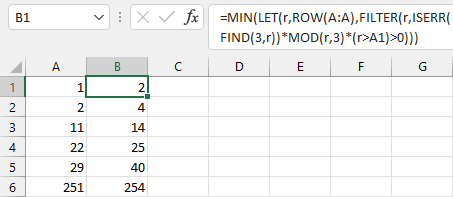
=MIN(LET(r,ROW(A:A),FILTER(r,ISERR(FIND(3,r))*MOD(r,3)*(r>A1)>0)))
Input is in the cell A1. Output is wherever the formula is.
The LET() function allows you to define variables for later reference so ti works in pairs of variable,value. The last argument is unpaired as it is the output.
r,ROW(A:A)creates an array of 1 to whatever the last row is. In the latest version of Excel, that's 1,048,576.g,FILTER(r,~*~*~>0)takes that array and filters just for the values that aren't multiples of 3 and don't have a 3 in them. This done is by multiplying:ISERR(FIND(3,r))which returns TRUE if if a 3 is not in the number and FALSE if it isMOD(r,3)which returns 0 if it's a multiple of 3 and some positive integer if it isn't(r>A1)creates an array of TRUE / FALSE where the first TRUE value will be the first term that's larger than the input.- When you do math on booleans, Excel uses TRUE=1 and FALSE=0 so the formula
~*~*~>0only returns TRUE when the three pieces are TRUE (no 3 in number), some positive integer (not a multiple of 3), and TRUE (larger than the input).
MIN(LET(~))finds the smallest value in the filtered array which only includes the "without 3" numbers larger than the input so the first value in the array is the next value in the sequence.
APOL, 51 bytes
v(0 +(⧣ 1));w(|(!(%(⁰ 3)) c(t(⁰) '3')) ∆(0));-(⁰ 1)
K (oK), 24 23 bytes
Solution:
(1+)/[{(~3!x)|51in$x};]
Explanation:
Iterate from input+1 until valid number is found. Bit of a cheat dropping whitespace between 51 and in.
(1+)/[{(~3!x)|51in$x};] / the solution
    /[{             };] / iterate (/) while {} is true
                  $x    / string x, e.g. 12 => "12"
              51in      / is "3" (51 in ASCII) in the string?
             |          / or
       (    )           / do this together
         3!x            / x modulo 3
        ~               / not
 1+                     / add 1 to x (e.g. x++)
Perl 6, 27 25 24 bytes
{max $_+1...{!/3/&$_%3}}
Finds the first number larger than the input that doesn't have a three and has a remainder when moduloed by 3. I was hoping to do something fancy with the condition, like !/3/&*%3 but it doesn't work with the !. :(
Explanation:
{                      }   # Anonymous code block
     $_+1                  # From the input+1
         ...               # Get the series
            {         }    # That ends when
             !/3/            # The number does not contain a 3
                 &           # and
                  $_%3       # The number is not divisible by 3
 max                       # And get the last element of the series
C, 59 bytes
n,m;f(){if(++n%3)for(m=n;m;m/=10)(m%10==3)?f():0;else f();}
Forth (gforth), 81 bytes
: f begin 1+ >r i i 3 mod 1 r> begin 10 /mod >r 3 <> * r> ?dup 0= until * until ;
Explanation
- Add 1
- check if multiple of 3
- check if contains a 3
- if the result of step 3 or step 4 is true, repeat from step 1
Code Explanation
: f               \ start a new word definition
  begin           \ start an indefinite loop
    1+            \ add 1 to current number
    >r i i        \ put current number on return stack, then place on normal stack twice
    3 mod         \ check if number is multiple of 3
    1 r>          \ place a 1 on the stack, then move the current number to the normal stack
    begin         \ start another indefinite loop
      10 /mod     \ get quotient and remainder of dividing by 10
      >r          \ put quotient on return stack
      3 <>        \ check if remainder does not equal 3
      *           \ multiply by accumulator (cheaper version of "and")
      r>          \ remove quotient from return stack
      ?dup 0=     \ if quotient does not equal 0, duplicate, else put -1 on stack
     until        \ end loop if top of stack does not equal 0
     *            \ multiply result of both checks (cheaper "and")
   until          \ end outer loop
 ;                \ end word definition
Turing Machine Code, 390 bytes
0 * * r 0
0 _ _ l 1
1 1 2 l 2
1 2 3 r 0
1 3 4 l 2
1 4 5 l 2
1 5 6 l 2
1 6 7 l 2
1 7 8 l 2
1 8 9 l 2
1 9 0 l 1
1 * 1 l 2
2 * * l 2
2 _ _ r 3
3 1 1 r 4
3 4 4 r 4
3 7 7 r 4
3 2 2 r 5
3 5 5 r 5
3 8 8 r 5
3 _ _ l 1
4 1 1 r 5
4 4 4 r 5
4 7 7 r 5
4 2 2 r 3
4 5 5 r 3
4 8 8 r 3
5 1 1 r 3
5 4 4 r 3
5 7 7 r 3
5 2 2 r 4
5 5 5 r 4
5 8 8 r 4
* 0 0 r *
* 6 6 r *
* 9 9 r *
* 3 3 r 0
* _ _ * halt
APL(NARS), 54 chars, 108 bytes
r←h w;c
r←c←0
→3×⍳(0=3∣r)∨'3'∊⍕r⋄c+←1⋄→0×⍳r>w
r+←1⋄→2
I prefer this, the loop, to all recursive functions; test:
  h¨1 2 11 22 29 251
2 4 14 25 40 254
  h¨3 6 10
4 7 11
Binary-Encoded Golfical, 80 bytes
This binary-encoded format can be converted to the standard graphical version using the encoder utility included in the github repo, or run directly using the interpreter by adding the -x flag.
Hexdump of binary encoding:
01 70 03 15 14 14 1b 1a 14 04 01 14 14 2c 14 14
00 03 14 14 0a 01 14 14 2f 14 14 53 2d 14 23 1d
14 32 14 14 1b 14 1a 00 0a 14 14 0a 01 14 14 2f
14 14 53 31 14 06 03 14 14 23 1d 14 00 0a 14 14
0a 01 1c 14 2d 17 14 3d 2d 14 23 1d 14 1c 2c 1d
Original image (23x3):

Magnified 20x:

BotEngine, 770 107x7 = 749 (740 bytes)
This can almost certainly be made rather more compact than it currently is, but I finally managed to get it working at least.
v  0 1 2 3 4 5 6 7 8 9 $ $   0 1 2 3 4 5 6 7 8 9 $  0 1 2 3 4 5 6 7 8 9 $> 0 1 2 3 4 5 6 7 8 9 $v$ $3
I>>S S S S S S S S S S S>S$v>S S S S S S S S S S S >S S S S S S S S S S S >S S S S S S S S S S S>e>SS~v
R  e1e2e3e4e5e6e7e8e9e0e1>e ^e0e1e2e3e4e5e6e7e8e9e$ e0e1e2e3e4e5e6e7e8e9>^ e0e1e2e3e4e5e6e7e8e9>^  Re3  $
$e^                  < e$   ^<     <     <     <        <     <     <        <     <     <         P>  >S~v
>^ >>>>>>>>>>>>>>>>>>>>>^ ~<   >     >     >       ^<     <     <     <        <     <     <      ^   <^  <
                                 >     >     >        >     >     >       ^<     <     <     <          e$
  ^                                              <                                                      <
Input and output is in standard big-endian decimal, although most of the program uses little-endian internally to make the increment cycle more straightforwards.
APL (Dyalog Unicode), 33 28 27 19 bytesSBCS
1∘+⍣{('3'∊⍕⍺)<×3|⍺}
-6 thanks to Adám. -8 thanks to ngn.
Old Explanation:
1-⍨g⍣((×3|⊢)>'3'∊⍕)∘(g←+∘1)
                       +∘1  ⍝ curry + with 1, gives the increment function
                            ⍝ increments the left argument so we do not return the number itself
                    (g←   ) ⍝ assign to "g"
                   ∘        ⍝ compose g with the repeat
                 ⍕          ⍝ does parsing the argument to a string...
             '3'∊           ⍝ ...contain '3'?
        3|⊢                 ⍝ residue of a division by 3
      (×   )                ⍝ direction (0 if 0, 1 if greater, ¯1 is lower)
     (      >     )         ⍝ and not (we want the left side to be 1, the right side 0)
   g⍣                       ⍝ repeat "g" (increment) until this function is true ^
1-⍨                         ⍝ afterwards, decrement: inversed -
APL (Dyalog Extended), 23 17 bytesSBCS
1∘+⍣(3(×⍤|>∊⍥⍕)⊣)
Thanks to Adám. -6 thanks to ngn.
Old Explanation:
0+⍣(3(×⍤|>∊⍥⍕)⊢)⍢(1+⊢)⊢
0                       ⍝ the left argument (⍺)
 +⍣(3(×⍤|>∊⍥⍕)⊢)        ⍝ the left function (⍺⍺)
                 (1+⊢)  ⍝ the right function (⍵⍵)
                        ⍝     (increments its argument)
                      ⊢ ⍝ the right argument (⍵)
                        ⍝     (just returns the input)
                ⍢       ⍝ under:
                        ⍝     calls (⍵⍵ ⍵) first, which increments the input
                        ⍝     also (⍵⍵ ⍺) which gives 1
                        ⍝     then calls (⍺incremented ⍺⍺ ⍵incremented)
                        ⍝     afterwards, does the opposite of ⍵⍵, and decrements the result
  ⍣                     ⍝ ⍣ fixpoint: repeats the left operation until the right side is truthy
 +                      ⍝ calls + with ⍺incremented and the input (so, 1+input)
   (3(×⍤|>∊⍥⍕)⊢)        ⍝ right operation
    3                   ⍝ on its left, "3"
              ⊢         ⍝ on its right, the current iteration
      ×⍤|               ⍝ divisibility check: × atop |
        |               ⍝     starts with 3|⊢ (residue of ⊢/3)
      ×                 ⍝     then returns the direction (0 if 0, 1 if greater, ¯1 is lower)
          ∊⍥⍕           ⍝ contains 3:
            ⍕           ⍝    stringifies both its arguments (3 and ⊢)
          ∊⍥            ⍝    checks for membership
         >              ⍝ divisibility "and not" contains 3
Stax, 9 bytes
ú╜H▌»NWì╤
Unpacked, ungolfed, and commented it looks like this.
w       repeat rest of the program while the produced value is true
  ^c    increment and copy value
  E3#   (a) count number of digits that are 3
  n     copy incremented value
  3%!   (b) is multiple of 3?
  +     sum of (a) + (b) values
Perl 6, 39 bytes
{my$a=$_+1;$a++while $a%%3||$a~~/3/;$a}
MathGolf, 10 9 bytes
ö)_3‼╧÷+▲
Explanation
The program loops until it finds a number that is neither divisible by 3 or contains the number 3. ‼ is a new addition to MathGolf, and is newer than this challenge (and this answer). It has been an idea I had in mind for a while, but I finally got everything together to implement it.
ö           start block of length 7
 )          increment
  _         duplicate TOS
   3        push 3
    ‼       apply next two operators separately to the stack
     ╧      pop a, b, a.contains(b)
      ÷     is divisible
       +    pop a, b : push(a+b) (works as a logical OR)
        ▲   do while true with pop
C#, 49 bytes
int A(int n)=>(++n+"").IndexOf('3')*n%3<0?n:A(n);
Slightly different and shorter than the above c#, using recursion and another trick I came up with to condense the two conditions into one
PHP, 47 41 bytes
inspired by Xanderhall, but the latest idea finally justifies an own answer.
while(strstr($n+=$n=&$argn%3,51));echo$n;
or
while(strpbrk($n+=$n=&$argn%3,3));echo$n;
This takes advantage from the fact that the input is also from the sequence: For $n%3==1, the new modulo is 2. For $n%3==2, the new modulo is 4-3=1. $n%3==0 never happens.
Run as pipe with -R or try them online.
Jelly, 11 bytes
D;Æf3ḟµ‘#2ị
How it works
D;Æf3ḟµ‘#2ị  Main link. Argument: n

      µ      Combine the links to the left into a chain.
       ‘#    Execute the chain for k = n, n + 1, n + 2, ... until n + 1 matches
             were found. Yield the array of all n + 1 matches.
D            Decimal; yield the array of k's decimal digits.
  Æf         Yield the array of k's prime factors.
 ;           Concatenate both.
    3ḟ       Filter false; remove digits and factors from [3].
             This yields [3] (truthy) if neither digits nor factors contain 3,
             [] (falsy) if they do.
         2ị  Extract the second match. (The first match is n.)
PHP, 60 55 54 46 bytes
Thanks to @user59178 for shaving off a few bytes, @AlexHowansky for a byte, @Titus for another few bytes
for(;strstr($i=++$argv[1],51)|$i%3<1;);echo$i;
Called from command line with -r. Naive method that loops while the number is a multiple of 3, or has 3 in its digits.
Labyrinth, 117 102 bytes
?       """""""""""_
):_3    (         0/{!@
;  %;:}_';:_3-_10 1
"  1            %;_
""""_""""""""{;;'
Labyrinth is a two-dimensional, stack-based programming language and at junctions, direction is determined by the top of the stack (positive goes right, negative goes left, zero goes straight). There are two main loops in this programs. The first mods the integer input by 3 and increments if 0. The second repeatedly checks if the last digit is 3 (by subtracting 3 and modding by 10) and then dividing by 10 to get a new last digit.
Pyth, 11 bytes
f&-I`T3%T3h
Try it online: Demonstration or Test Suite
Explanation:
f&-I`T3%T3hQ   implicit Q at the end
f         hQ   find the smallest integer T >= input + 1 which fulfills:
  -I`T3           T is invariant under removing the digit 3
 &                and
       %T3        T mod 3 leaves a positive remainder
Clojure, 73 bytes
(fn c[n](let[m(inc n)](if(or(=(rem m 3)0)(some #(=\3 %)(str m)))(c m)m)))
Recursively loops while n is divisible by 3, or contains a 3 in its string representation. Although I'm using unoptimized recursion, it was able to handle 2999999 as an input, so it should be ok.
Ungolfed
(defn count-without-3 [n]
  (let [m (inc n)]
    (if (or (= (rem m 3) 0)
            (some #(= \3 %) (str m)))
      (count-without-3 m)
      m)))
Haskell, 50 48 bytes
f n=[x|x<-[n..],mod x 3>0,notElem '3'$show x]!!1
Try it on Ideone. Saved 2 bytes thanks to @Charlie Harding.
Alternative: (50 bytes)
g=f.(+1)
f n|mod n 3<1||(elem '3'.show)n=g n|1<3=n
Python 2, 49 44 42 bytes
f=lambda x:'3'[:~x%3]in`~x`and f(x+1)or-~x
The other Python entry beats this (edit: not any more :-D), but I posted it because I rather like its recursive approach. Thanks to Mitch Schwarz and Erik the Golfer for helping me make this shorter.
Pyth, 19 bytes
JhQW|!%J3/`J\3=hJ;J
I am sure I can golf this... it's the same as my CJam answer.
Explanation:
JhQW|!%J3/`J\3=hJ;J
  Q                 Evaluated input
 h                  Increment
J                   Assign J to value
       J            Variable J
        3           Value 3
      %             Modulo
     !              Logical NOT
           J        Variable J
          `         String representation
            \3      Value "3"
         /          Count occurrences
    |               Logical OR
               h    Increment
                J   Variable J
              =     Apply function then assign
                 ;  End statement block
                  J Variable J
CJam, 19 bytes
ri{)__3%!\`'3e=e|}g
Explanation:
ri{)__3%!\`'3e=e|}g
r                   Get token
 i                  Convert to integer
  {              }  Block
   )                 Increment
    _                Duplicate
     _               Duplicate
      3              Push 3
       %             Modulo
        !            NOT gate
         \           Swap
          `          String representation
           '3        Push '3'
             e=      Count occurrences
               e|    OR gate
                  g While popped ToS is true
If a less verbose explanation was asked, I would have done this:
ri{)__3%!\`'3e=e|}g
ri                  Get integer
  {              }  Block
   )                 Increment
    __               Triplicate
      3%!            Test non-divisibility with 3
         \           Swap
          `'3e=      Count occurrences of '3' in string repr
               e|    OR gate
                  g While popped ToS is true
Perl, 19 bytes
18 bytes code + 1 for -p.
++$_%3&&!/3/||redo
Usage
perl -pe '++$_%3&&!/3/||redo' <<< 8
10

perl -pe '++$_%3&&!/3/||redo' <<< 11
14
Batch, 93 bytes
@set/pn=
:l
@set/an+=1,r=n%%3
@if %r%==0 goto l
@if not "%n:3=%"=="%n%" goto l
@echo %n%
Takes input on STDIN.
Python 2, 73 66 43 bytes
Thanks to xnor for telling me I was being silly by using 2 variables, and thanks to Mitch Schwartz too.
x=~input()
while'3'[:x%3]in`x`:x-=1
print-x
reticular, 30 bytes
in v
?v$>1+d3,qds:3@cQm*
;\$o
Explanation
1: initialization
in v
This converts the input to a number, then goes down (v)
2: loop
?v$>1+d3,qds:3@cQm*
   >                 go right!              [n]
    1+               add 1                  [n+1]
      d3,            duplicate and mod 3    [n+1, (n+1)%3]
         qd          reverse and duplicate  [(n+1)%3, n+1, n+1]
           s         cast to string         [(n+1)%3, n+1, `n+1`]
            :3@c     count numbers of "3"   [(n+1)%3, n+1, `n+1`.count(3)]
                Qm*  negate and rotate      [n+1, continue?]
?v                   terminate if continue
  $                  drop continue
3: final
;\$o
 \$o  drop and output
;     terminate
MATL, 14 bytes
`Qtt3\wV51-hA~
Explanation
`       % Do...while
  Q     %   Add 1. Takes input implicitly in the first iteration
  tt    %   Duplicate twice
  3\    %   Modulo 3
  wV    %   Swap, string representation
  51-   %   Subtract 51, which is ASCII for '3'
  h     %   Concatenate
  A~    %   True if any result was 0. That indicates that the number
        %   was a multiple of 3 or had some '3' digit; and thus a
        %   new iteration is needed
C, 81 bytes
f(int n){int m;l:if(++n%3){for(m=n;m>0;m/=10)if(m%10==3)goto l;return n;}goto l;}
C#, 56, 51 bytes.
This is surprisingly short for a C# answer!
x=>{while(++x%3<1|(x+"").Contains("3"));return x;};
Ruby, 47 bytes
i=gets.to_i;i while(i+=1)%3==0||"#{i}"=~/3/;p i
I really feel like this can be golfed further.
PowerShell v2+, 46 bytes
for($a=$args[0]+1;$a-match3-or!($a%3)){$a++}$a
Takes input $args[0], adds 1, saves into $a, starts a for loop. The conditional keeps the loop going while either $a-match3 (regex match) -or $a%3 is zero (the ! of which is 1). The loop simply increments $a++. At the end of the loop, we simply place $a on the pipeline, and output via implicit Write-Output happens at program completion.
Examples
PS C:\Tools\Scripts\golfing> 1,2,11,22,29,33,102,251,254|%{"$_ --> "+(.\count-without-three.ps1 $_)}
1 --> 2
2 --> 4
11 --> 14
22 --> 25
29 --> 40
33 --> 40
102 --> 104
251 --> 254
254 --> 256
GolfSharp, 43 bytes
m=>r(m,m).w(n=>n%3>0&!n.t().I("3")).a()[1];
05AB1E, 11 bytes
[>Ð3ås3Ö~_#
Explanation
               # implicit input
[              # start loop
 >             # increase current number
  Ð            # triplicate
          #    # break loop IF
         _     # logical negation of
   3å          # number has one or more 3's in it
        ~      # OR
     s3Ö       # number % 3 == 0
R, 46 bytes
n=scan()+1;while(!n%%3|grepl(3,n))n=n+1;cat(n)
Brachylog, 10 bytes
<.='e3:I'*
Explanation
(?)<.                Output > Input
    .=               Assign a value to the Output
    . 'e3            3 cannot be an element of the Output (i.e. one of its digits)
        3:I'*(.)     There is no I such that 3*I = Output
Pyke, 13 bytes
Whii3%!3`i`{|
              - i = input
W             - do:
 hi           -  i += 1
   i3%!       -    not (i % 3)
            | -   ^ or V
       3`i`{  -    "3" in str(i)
              - while ^
Java 8, 57 56 55 50 bytes
Thanks to @Numberknot for 1 byte Thanks to @Kevin Cruijssen for 5 bytes
i->{for(;++i%3<1|(i+"").contains("3"););return i;}
This is a Function<Integer, Integer>
Explanation
Naive implementation that simply increments until it reaches an acceptable number.
Test Class
public class CodeGolf {

    public static void main(String[] args) {
        Function<Integer, Integer> countingGame = i->{for(;++i%3<1|(i+"").contains("3"););return i;};
        int val = 1;
        for (int i = 0; i < 10; i++) {
            System.out.print(val + " ");
            val = countingGame.apply(val);
        }
    }

}
Output of Test Class:
1 2 4 5 7 8 10 11 14 16
Lua, 58 Bytes
i=...+1while(i%3==0or(i..""):find"3")do i=i+1 end print(i)
J, 24 bytes
3(]0&({$:)~e.&":+.0=|)>:
Straight-forward approach that just iterates forward from input n until it finds the next number that is valid by the rules.
Forms five smileys, $:, :), 0=, =|, and >:.
Usage
   f =: 3(]0&({$:)~e.&":+.0=|)>:
   (,.f"0) 1 2 11 22 29 251
  1   2
  2   4
 11  14
 22  25
 29  40
251 254
Explanation
3(]0&({$:)~e.&":+.0=|)>:  Input: integer n
                      >:  Increment n
3                         The constant 3
 (                   )    Operate dyadically with 3 (LHS) and n+1 (RHS)
                    |       Take (n+1) mod 3
                  0=        Test if equal to 0
             &":            Format both 3 and n+1 as a string
           e.               Test if it contains '3' in str(n+1)
                +.          Logical OR the results from those two tests
  ]                         Right identity, gets n+1
   0&(   )~                 If the result from logical OR is true
       $:                     Call recursively on n+1
      {                       Return that as the result
                            Else act as identity function and return n+1
Japt, 18 bytes
°U%3*!Us f'3 ?U:ßU
I finally have a chance to use ß :-)
How it works
                    // Implicit: U = input integer
°U%3                // Increment U, and take its modulo by 3.
     !Us f'3        // Take all matches of /3/ in the number, then take logical NOT.
                    // This returns true if the number does not contain a 3.
    *               // Multiply. Returns 0 if U%3 === 0  or the number contains a 3.
             ?U     // If this is truthy (non-zero), return U.
               :ßU  // Otherwise, return the result of running the program again on U.
                    // Implicit: output last expression
JavaScript (ES6), 30 bytes
f=n=>++n%3*!/3/.test(n)?n:f(n)