| Bytes | Lang | Time | Link |
|---|---|---|---|
| 076 | Tcl | 180414T001621Z | sergiol |
| 041 | TeXg | 250427T114014Z | Skillmon |
| 036 | Juby | 250430T130034Z | Jordan |
| 082 | LaTeX | 250428T092155Z | Skillmon |
| 094 | LaTeX in TeX Live 2025 | 250426T235235Z | John |
| 065 | Swift 6 | 250301T192035Z | macOSist |
| 038 | Bash | 250227T092309Z | roblogic |
| 008 | Uiua | 250228T014155Z | janMakos |
| 054 | AWK | 250227T195802Z | xrs |
| 052 | Zsh | 190810T234207Z | GammaFun |
| 827 | ☾ | 250227T055627Z | Ganer |
| 009 | Pip | 240318T002304Z | DLosc |
| 005 | Nekomata | 230607T081413Z | alephalp |
| 005 | Thunno 2 | 230607T073145Z | The Thon |
| 049 | Lua | 230426T113957Z | bluswimm |
| 039 | Arturo | 230425T185056Z | chunes |
| 061 | Python 3 | 230217T195843Z | steenber |
| nan | 230129T145303Z | The Thon | |
| 108 | Java 8 | 230216T111220Z | Fhuvi |
| 051 | Lua | 230131T132132Z | Ginger |
| 014 | K ngn/k | 230130T173442Z | coltim |
| 052 | JavaScript | 230129T151422Z | EzioMerc |
| 162 | Go | 230130T142819Z | bigyihsu |
| 004 | Japt | 180419T083327Z | Shaggy |
| 006 | Pyt | 230129T144000Z | Kip the |
| 038 | Julia | 210617T124242Z | MarcMush |
| 023 | Ly | 210617T063000Z | cnamejj |
| 004 | Vyxal | 210616T114349Z | lyxal |
| 068 | Java JDK | 160915T121047Z | Olivier |
| 112 | C++ gcc | 200204T205349Z | S.S. Ann |
| 015 | Burlesque | 200204T091438Z | DeathInc |
| 008 | Keg | 200204T073118Z | lyxal |
| nan | Java 8 bytecode | 191204T160923Z | Citty |
| 034 | Ruby | 191204T142143Z | IMP1 |
| 039 | Wren | 191204T133028Z | user8505 |
| 018 | K oK | 190810T225934Z | mkst |
| 044 | PowerShell | 190812T084800Z | mazzy |
| nan | Python2 | 190812T020352Z | WarmTaun |
| 035 | Julia 1.0 | 190810T221409Z | TimD |
| 067 | Kotlin | 190810T191605Z | Brojowsk |
| 006 | Keg | 190810T180432Z | Edgex42 |
| 017 | Pip | 190801T151604Z | Kenzie |
| 043 | C# Visual C# Interactive Compiler | 190802T021221Z | dana |
| 062 | Lua | 190801T115202Z | val - di |
| 070 | Swift 5 | 190801T101406Z | Tiziano |
| 043 | brainfuck | 190730T145828Z | Dorian |
| 005 | Ohm v2 | 190731T092505Z | Cinaski |
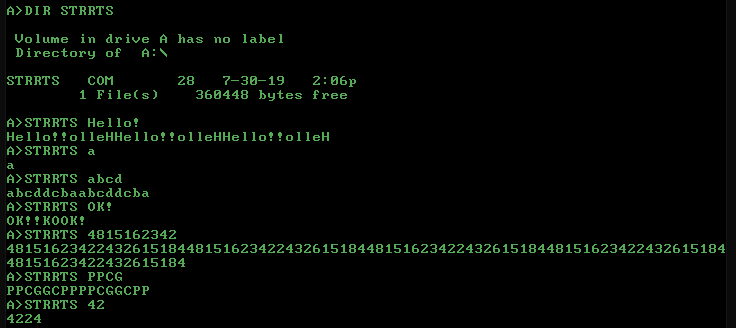
| 2928 | 8088 Assembly | 190730T175202Z | 640KB |
| 010 | Gaia | 190327T144245Z | Giuseppe |
| 025 | Perl 6 | 180331T070318Z | Phil H |
| 070 | PicoLisp | 190323T103453Z | Galen Iv |
| 091 | SNOBOL4 CSNOBOL4 | 180413T141109Z | Giuseppe |
| 062 | Factor | 190323T190104Z | Galen Iv |
| 043 | Red | 190323T123638Z | Galen Iv |
| 024 | Cubix | 190323T093423Z | MickyT |
| 078 | C gcc | 171126T153401Z | gastropn |
| 046 | APLNARS | 190322T062112Z | user5898 |
| 060 | ES7 | 190321T194029Z | elipszil |
| 007 | 05AB1E | 180413T183640Z | Multi |
| 011 | Japt | 180413T161202Z | Etheryte |
| 034 | ><> | 160916T130121Z | SE - sto |
| 016 | Gol><> | 180331T084229Z | Bubbler |
| 023 | Add++ | 180330T171018Z | caird co |
| 1510 | CJam | 180325T071910Z | lolad |
| 005 | Pushy | 171126T201801Z | FlipTack |
| 052 | Cubix | 170725T213643Z | Giuseppe |
| 010 | Implicit | 171125T205035Z | MD XF |
| 059 | Excel VBA | 170725T011827Z | Taylor R |
| 109 | Vimscript | 160920T194158Z | Christia |
| 053 | bash + utillinux | 160917T223206Z | frame |
| 040 | ><> | 160919T154957Z | Sok |
| 228 | BrainFlak | 160915T062525Z | Wheat Wi |
| nan | Python 3 | 160918T005137Z | vpzomtrr |
| 117 | Haxe | 160918T152739Z | Yytsi |
| 088 | VBScript | 160918T095016Z | jveazey |
| 071 | Scala | 160916T212208Z | Himself1 |
| 035 | Octave | 160915T100519Z | Stewie G |
| 008 | MATL | 160916T104911Z | Sanchise |
| 010 | CJam | 160915T082827Z | Luis Men |
| 010 | Vitsy | 160916T131429Z | Addison |
| 042 | Julia | 160916T111713Z | ojdo |
| 066 | Lua | 160916T103832Z | Scepheo |
| 070 | Lua 5.1 | 160915T072047Z | ATaco |
| 054 | PHP | 160915T220023Z | Christal |
| 032 | Vim + coreutils | 160915T210939Z | Jordan |
| 034 | Vim | 160915T034251Z | DJMcMayh |
| 094 | C# | 160915T195524Z | milk |
| 127 | Swift 2.2 | 160915T192918Z | Danwakee |
| 030 | Perl 6 | 160915T190126Z | Brad Gil |
| 151 | Java | 160915T042003Z | Herb |
| 007 | Pyke | 160915T170102Z | Blue |
| 008 | Dyalog APL | 160915T125737Z | Adá |
| 057 | PowerShell v2+ | 160915T130030Z | AdmBorkB |
| 006 | Pyth | 160915T122232Z | insert_n |
| 032 | Haskell | 160915T065549Z | michi7x7 |
| 008 | J | 160915T031349Z | Conor O& |
| 010 | Straw | 160915T102853Z | TuxCraft |
| 024 | Perl | 160915T072219Z | Ton Hosp |
| 053 | R | 160915T094930Z | rturnbul |
| 088 | Java | 160915T081352Z | Shaun Wi |
| 137 | C# | 160915T075937Z | Jakub Ja |
| 027 | Retina | 160915T072728Z | Martin E |
| 050 | JavaScript ES 6 | 160915T060336Z | Titus |
| 051 | Groovy | 160915T065836Z | norganos |
| 003 | 2sable | 160915T045724Z | Adnan |
| 016 | Brachylog | 160915T064422Z | Fatalize |
| 052 | PHP | 160915T061917Z | Crypto |
| 054 | PHP | 160915T061126Z | Titus |
| 012 | Actually | 160915T051333Z | user4594 |
| 039 | Ruby | 160915T031423Z | Downgoat |
| 010 | Pip | 160915T030941Z | DLosc |
| 003 | Jelly | 160915T032251Z | miles |
| 043 | Ruby | 160915T032817Z | Jordan |
| 017 | Minkolang | 160915T031953Z | El'e |
| 040 | Python | 160915T031357Z | xnor |
Tcl, 76 bytes
proc S {s i\ 0} {if $i<[string le $s] {list $s[S [string rev $s] [incr i]]}}
proc S {s i\ 0} {if $i<[string le $s] {set s $s[S [string rev $s] [incr i]]}}
proc S s {time {append r [expr {[incr i]%2?$s:[string rev $s]}]} [string le $s]
set r}
proc S s {append r $s
time {set r $r[set s [string rev $s]]} [expr [string le $s]-1]
set r}
TeX-g, 73 71 64 43 41 bytes
TeX-g is a (La)TeX based code golf dialect draft written in TeX, that I work on every now and then. The following works with the code of commit 0fa354f (the latest commit as of writing this).
The byte count includes loading TeX-g and the definition of the function. The newline is part of the syntax and therefore counted.
The edit (64 -> 43 bytes) was possible because TeX-g got a function that defines macros taking NUL-terminated strings as input (was added in commit 0fa354f).
\input-g $2{~!{#1}\;_#1:!\tl_reverse:N!
}
Complete test file (just compile this with pdfTeX or LuaTeX), since this contains NUL-bytes in the string termination the following is a hexdump of the file:
00000000  5c 69 6e 70 75 74 2d 67  20 24 32 7b 7e 21 7b 23  |\input-g $2{~!{#|
00000010  31 7d 5c 3b 5f 23 31 3a  21 5c 74 6c 5f 72 65 76  |1}\;_#1:!\tl_rev|
00000020  65 72 73 65 3a 4e 21 0a  7d 0a 0a 32 48 65 6c 6c  |erse:N!.}..2Hell|
00000030  6f 21 00 0a 0a 32 61 00  0a 0a 32 61 62 63 64 00  |o!...2a...2abcd.|
00000040  0a 0a 32 4f 4b 21 00 0a  0a 32 34 32 00 0a        |..2OK!...242..|
0000004e
Human readable version with the NUL-bytes replaced by ^@:
\input-g $2{~!{#1}\;_#1:!\tl_reverse:N!
}

2Hello!^@

2a^@

2abcd^@

2OK!^@

242^@
LaTeX, 82 bytes
{\ExplSyntaxOn\gdef\a#1{\str_set:Nn\1{#1}\str_map_inline:Nn\1{\1\tl_reverse:N\1}}}
Complete test file:
\documentclass{article}

{\ExplSyntaxOn\gdef\a#1{\str_set:Nn\1{#1}\str_map_inline:Nn\1{\1\tl_reverse:N\1}}}

\begin{document}
\a{Hello!}

\a{a}

\a{abcd}

\a{OK!}

\a{42}
\end{document}
LaTeX in TeX Live 2025, 94 Bytes
An error is corrected, since the old code doesn't answer the question.
\ExplSyntaxOn\def\a#1{\int_step_inline:nn{\tl_count:n{#1}}{#1\tl_reverse:n{#1}}}\ExplSyntaxOff
Minimum Working Example (Using This Function):
\documentclass{minimal}

\ExplSyntaxOn\def\a#1{\int_step_inline:nn{\tl_count:n{#1}}{#1\tl_reverse:n{#1}}}\ExplSyntaxOff


\begin{document}
\a{hello!}
\end{document}
Swift 6, 66 65 bytes
let b={s in(0..<s.count).map{$0%2<1 ?s:""+s.reversed()}.joined()}
Bash, 42 47 38 bytes
yes "$1
`rev<<<$1`"|head -${#1}|rs -g0
Corrected and added test cases. Version 1.0 handled odd-length strings incorrectly.
Uiua, 8 bytes
♭⍥⇌°⊏↯⊸⧻
Expanation
♭⍥⇌°⊏↯⊸⧻
      ⊸⧻ # Get the length, preserving the string
     ↯   # Copy the string N times
   °⊏    # Enumerate the list of strings
 ⍥⇌      # Reverse each string as many times as its index
♭        # Flatten the list of strings into one string
AWK, 54 bytes
{for(;i++<NF;)for(j=NF;j--;)printf i%2?$(NF-j):$(j+1)}
{for(;i++<NF;)       # number of iterations from string length
for(j=NF;j--;)       # to traverse the string
printf               #
i%2?$(NF-j):$(j+1)}  # print forwards or backwards
Zsh, 52 bytes
set ${(s..)1}
for c;s+=${(j..)@}&&set ${(Oa)@}
<<<$s
(46 bytes, wrong)
(41 bytes, wrong)
set ${(s..)1}        # split into characters
for c;
    s+=${(j..)@} &&  # join and append
    set ${(Oa)@}     # reverse (O)rder by (a)rray position
<<<$s
☾, 8 chars (27 bytes)
⋄⟞ᴙᓕ⨝
Note: ☾ uses a custom font, but you can run this code in the Web UI
Note: If you have a subscript without something indexable behind it, it just turns into a list. Thus
ᓕ's modifier is [[0,1,…,len(arg)]], which means "on the outermost axis, get values at these indicies"; this works because it automatically mod's overflow indicies by the list length (2 in this case).
Pip, 9 bytes
R{R:\a}Ma
Explanation
This solution is really weird...
R{R:\a}Ma
          ; a is first cmdline arg as a local variable; \a is the same, but global
       Ma ; Map this function over each character of a:
 {  \a}   ;   Take the global variable \a
  R:      ;   Reverse it in place
R         ;   Then reverse that (without modifying \a)
          ; Join the results together and autoprint (implicit)
Nekomata, 5 bytes
xᵐᵑ↔j
xᵐᵑ↔j
x       Range from 0 to length of input - 1
 ᵐ      Map
  ᵑ       Apply the next function n times
   ↔        Reverse
    j   Concatenate
Thunno 2, 5 bytes
l{D¢r
Explanation
l{D¢r  # Implicit input
l{     # Repeat length of input times:
  D¢   #  Print TOS without a newline, without popping
    r  #  Reverse for next iteration
Thunno J, \$ 7 \log_{256}(96) \approx \$ 6 bytes
(actually 5.76 bytes but that doesn't show up on the leaderboard)
rDeKDrD
Explanation
rDeKDrD  # Implicit input
r        # Reverse the input
 D       # Duplicate and get the length
  eK     # Loop through, popping the loop variable:
    Dr   #  Duplicate and reverse
      D  #  And duplicate (since this will get popped)
         # The J flag joins this list of strings
         # Implicit output
Thunno J, \$ 10 \log_{256}(96) \approx \$ 8.23 bytes
DLsDrZPsZG
Explanation
DLsDrZPsZG  # Implicit input
DL          # Duplicate and get the length
  sDr       # Swap, duplicate, and reverse
     ZP     # Pair with the reversed copy
       sZG  # Extend this list to the length of the input
            # The J flag joins this list of strings
            # Implicit output
Java 8, 108 bytes
Even if there already is a better Java solution posted, here is a different approach using a single inline stream :
s->s.chars().mapToObj(e->"").reduce("",(a,b)->a.length()/s.length()%2<1?a+s:a+new StringBuffer(s).reverse())
And here is a janky stream solution avoiding the use of StringBuffer(s).reverse() (and exploiting the fact that the input and output can't contain \n), but requiring an additional substring because the result was containing two times the answer, sadly :( 149 bytes :
s->s.chars().mapToObj(e->""+(char)e).reduce(s.replaceAll(".","\n"),(a,b)->a.replace("\n",b+"\n"+b)).replace("\n","").substring(s.length()*s.length())
K (ngn/k), 14 bytes
{,/(#1_x)|:\x}
(#1_x)|:\xset up a n-dos scan, running|:(i.e., reverse) on the original inputxa number of times equal to the length of the input minus 1,/flatten (and implicitly return) the above
JavaScript, 52 bytes
Without recursion:
s=>[...s].reverse().flatMap((c,i,l)=>i%2?l:s).join``
Try it:
f=s=>[...s].reverse().flatMap((c,i,l)=>i%2?l:s).join``

console.log(f('a'));
console.log(f('abcd'));
console.log(f('OK!'));
console.log(f('4815162342'));
console.log(f('PPCG'));
console.log(f('42'));
UPD 59 -> 52
Thanks to Shaggy for the new algorithm without recursion to reduce bytes count
Go, 162 bytes
import."strings"
func f(s string)string{o,i:=[]string{},0
for;i<len(s);i++{k:=""
if i%2>0{for i:=range s{k=s[i:i+1]+k}}else{k=s}
o=append(o,k)}
return Join(o,"")}
Japt, 6 4 bytes
£zYÑ
£zYÑ     :Implicit input of string U
£        :Map each character at 0-based index Y
 z       :  Rotate U 90° clockwise
  YÑ     :    Y*2 times
Pyt, 6 bytes
ĐąŁ⇹ҏ*
Đ          implicit input; duplicate on stack
 ąŁ        get length of input string
   ⇹ҏ      palindromize the input string
     *     string multiplication; implicit print
Ly, 23 bytes
&iysp>l[<&s&o&lr&s>1-]p
At a high level, the code stores the input string in the "backup cell" restoring it, printing, reversing and re-saving each time through the loop. The loop counter is in a separate stack.
&iysp>l[<&s&o&lr&s>1-]p #
&i                      # Read the input onto the stack (as codepoints)
  ysp                   # Get the length, stash in the backup cell, pop from stack
     >l                 # Switch stacks, load the input lenght (loop counter)
        [         >1-]  # Loop, switch to loop counter stack, and decrement
         <&s            # Switch to the output stack, restore string from backup cell
           &o           # Print the stack
             &lr&s      # Restore string again, reverse stack and re-save
                      p # Delete loop counter to prevent it from printing
Vyxal, 4 bytes
(:₴Ṙ
I was looking through old Keg answers of mine and saw that I could improve on my score here with its improvement language.
Explained
(:₴Ṙ
(    # for each character in the input:
 :₴  #     print the top of the stack without a newline, preserving it. For the first iteration, this will be the original input.
   Ṙ #     reverse the top of the stack. This achieves the string reversing effect, as it alternates the direction of the string each iteration
Java (JDK), 68 bytes
s->{var r=""+s;for(int i=s.length();i-->1;)r+=s.reverse();return r;}
C++ (gcc), 112 bytes
#import<bits/stdc++.h>
int f(std::string&s){for(int x=s.length();x--;std::reverse(&s[0],&*end(s)))std::cout<<s;}
Requires a non-const, mutable std::string. It reverses the string after every iteration and prints it.
-3 bytes thanks to ceilingcat!
Burlesque, 15 bytes
saS[jJ<-_+cyj.+
sa  # Length of input
S[  # Squared
jJ  # Duplicate the input
<-  # Reverse it
_+  # Join them
cy  # Repeat infinitely
j.+ # Take the first length-squared characters
Keg, 8 bytes
᠀:(⑴;|⑩⑶
I found this to be quite a fun little answer to write.
Explained
᠀:(⑴;|⑩⑶
᠀:          #Take input as a string (otherwise numbers won't work correctly) and duplicate it, because:
  (⑴        #We then push the length of that string onto the stack. The ⑴ op pops the top however, which is why duplication was needed. This will be the loop count of our for loop, started with "("
    ;       #Decrement that length to avoid off by one error
     |      #Branch to the body of the for loop
      ⑩⑶    #Print the item without popping and then reverse that item
Oh unicode... why'd y'all have to be so unevenly widthed for?
Java 8 bytecode, 412 bytes (403 bytes + -noverify)
Hexdump because it's unprintables all the way down:
00000000: cafe babe 0003 002d 0020 0a00 0c00 040c  .......-. ......
00000010: 0017 001f 0100 1628 5b4c 6a61 7661 2f6c  .......([Ljava/l
00000020: 616e 672f 5374 7269 6e67 3b29 560c 000e  ang/String;)V...
00000030: 0010 0100 063c 696e 6974 3e07 0011 0100  .....<init>.....
00000040: 0570 7269 6e74 0100 066c 656e 6774 6807  .print...length.
00000050: 0015 0100 0443 6f64 6501 0004 6d61 696e  .....Code...main
00000060: 0700 1609 0009 0002 0100 0772 6576 6572  ...........rever
00000070: 7365 0100 0a53 6f75 7263 6546 696c 6501  se...SourceFile.
00000080: 001a 2829 4c6a 6176 612f 6c61 6e67 2f53  ..()Ljava/lang/S
00000090: 7472 696e 6742 7566 6665 723b 0100 136a  tringBuffer;...j
000000a0: 6176 612f 696f 2f50 7269 6e74 5374 7265  ava/io/PrintStre
000000b0: 616d 0100 0328 2949 0a00 0600 140c 0007  am...()I........
000000c0: 001c 0100 106a 6176 612f 6c61 6e67 2f53  .....java/lang/S
000000d0: 7973 7465 6d01 0016 6a61 7661 2f6c 616e  ystem...java/lan
000000e0: 672f 5374 7269 6e67 4275 6666 6572 0100  g/StringBuffer..
000000f0: 036f 7574 0a00 0c00 1d07 000a 0c00 0500  .out............
00000100: 1c0a 000c 001a 0100 1528 4c6a 6176 612f  .........(Ljava/
00000110: 6c61 6e67 2f53 7472 696e 673b 2956 0c00  lang/String;)V..
00000120: 0800 1201 0000 0100 154c 6a61 7661 2f69  .........Ljava/i
00000130: 6f2f 5072 696e 7453 7472 6561 6d3b 0020  o/PrintStream;.
00000140: 0019 0006 0000 0000 0001 0009 000b 0003  ................
00000150: 0001 000a 0000 0031 0004 0001 0000 0025  .......1.......%
00000160: bb00 0c59 2a03 32b7 001b 59b6 0018 3b59  ...Y*.2...Y...;Y
00000170: b200 0d5f b600 13b6 0001 c484 0000 ffff  ..._............
00000180: 1a9a ffee b100 0000 0000 0100 0f00 0000  ................
00000190: 0200 1e
Jasmin assembly code:
.source ""
.class Code
.super java/io/PrintStream
.method public static main([Ljava/lang/String;)V
    .limit stack 4
    .limit locals 1
    new java/lang/StringBuffer
    dup
    aload_0
    iconst_0
    aaload
    invokenonvirtual java/lang/StringBuffer/<init>(Ljava/lang/String;)V
    dup
    invokevirtual java/lang/StringBuffer/length()I
    istore_0
    Loop:
        dup
        getstatic java/lang/System/out Ljava/io/PrintStream;
        swap
        invokevirtual java/io/PrintStream/print(Ljava/lang/String;)V
        invokevirtual java/lang/StringBuffer/reverse()Ljava/lang/StringBuffer;
        iinc 0 -1
        iload_0
        ifne Loop
        return
.end method
What CFR thinks this decompiles to (it's actually mostly correct this time):
/*
 * Decompiled with CFR 0.148.
 */

import java.io.PrintStream;

class Code
extends PrintStream {
    public static void main(String[] arrstring) {
        StringBuffer stringBuffer = new StringBuffer(arrstring[0]);
        StringBuffer stringBuffer2 = stringBuffer;
        int n = stringBuffer.length();
        do {
            System.out.print((String)((Object)stringBuffer2));
            stringBuffer2 = stringBuffer2.reverse();
        } while (--n != 0);
    }
}
Needs -noverify because the JVM will just kinda cast it anyways, allowing me to save on needing the (Ljava/lang/Object;)V descriptor
Ruby, 34 bytes
->s{s.each_char{$><<s;s.reverse!}}
This goes through each character of the string (a loop that runs as many times as the length of the string) and prints the string, and then reverses it.
$><<s is a golfed version of print s. It appends (<<) the value (s) to stdout ($>).
Wren, 39 bytes
Beats Python by 1 byte.
Fn.new{|n|(n=n[-1..0]).map{n=n[-1..0]}}
Explanation
Fn.new{|n|                            } // Anonymous function with n
          (n=n[-1..0])                  // Step 1. Set n as the reverse of n
                                        // Before the mapping of every item
                                        // in this list. Why? Because the
                                        // initialization in the map function
                                        // is done *before* the value is returned.

                      .map{          }  // Step 2. Map every item in this list
                           n=n[-1..0]   // to the current state of this string
                                        // reversed.
```
K (oK), 18 bytes
Solution:
,//(#x)#(,;|)@\:x:
Explanation:
Apply enlist , and reverse | to the input and take length-of-input from this
,//(#x)#(,;|)@\:x: / the solution
                x: / store input as x
             @\:   / apply (@) each-left (\:)
        ( ; )      / two-item list
           |       / reverse
         ,         / enlist
       #           / take
   (  )            / do this together
    #x             / count x
,//                / flatten (,/) until converges
PowerShell, 44 bytes
-join(($a=$args)|%{$a;$a=$a[-1..-$a.Count]})
Takes input via splatting, essentially making it an array of chars.
Python2, 109 99 89 bytes
def f(s,o=''):
 r=s[::-1]
 for i in range(len(s)):
  if i%2==0:o+=s
  else:o+=r
 return o
or
Python2, 53 bytes
Saved 36 bytes, thanks to Jonathan French's solution:
lambda s:''.join(s[::~i%2*2-1]for i in range(len(s)))
Julia 1.0, 35 bytes
s->for _=s print(s);s=reverse(s)end
Loops over the input string characters and each iteration prints and reverses the string.
Kotlin, 67 bytes
{s->Array(s.length){if(it%2>0)s.reversed()else s}.joinToString("")}
- Initialize an array of
s.lengthelements. - Choose direction based on index
- Concat it all together
Keg, 6 bytes
(^(:,"
How it works
    Implicit Reversed Input
(   Runs X times, where X is the length of the stack
^   Reverse the stack
(   Runs X times, where X is the length of the stack
:,  Prints the top item of the stack as a character
"   Rolls the stack to the right (puts the top of the stack to the bottom)
    Ending brackets get auto-completed
Pip, 20 17 bytes
Fi,#a{i%2?ORVaOa}
(RV reverses iterable). The program outputs the string on even steps and the reverse on odd steps
C# (Visual C# Interactive Compiler), 43 bytes
s=>s.SelectMany((_,i)=>i%2<1?s:s.Reverse())
Lua, 62 bytes
a=arg[1]for i=1,#a do io.write(i%2==1 and a or a:reverse())end
Full program, take input as argument.
Swift 5, 70 bytes
{a in String(zip(0..., a).flatMap{$0.0%2==0 ?a:String(a.reversed())})}
brainfuck, 71 49 43 bytes
,[>+[>+<-],]>[<<[<]>[.>]>-[<<[.<]>[>]>-<]>]
Thanks to Jo King for saving 6 bytes.
[Tape: [Letters], 0, counter]
,[          while input
  >+        increment old counter
  [>+<-]    move counter to next position
  ,         input next
]
>[          while counter
  <<[<]>    go to first letter
  [.>]      print word forwards
  >-        decrement counter
  [         if counter
    <<      go to last letter
    [.<]    print word backwards
    >[>]>-  decrement counter
    <       exit if
  ]
  >         go to counter
]
8088 Assembly, IBM PC DOS, 29 28 bytes
Assembled, xxd dump:
00000000: d1ee ac48 938a cbfc 518a cbf7 da78 01fd  ...H....Q....x..
00000010: acac b40e cd10 e2f9 59e2 ecc3            ........Y...
Unassembled listing:
D1 EE       SHR  SI, 1          ; point SI to DOS PSP (080H)
AC          LODSB               ; load input string length into AL
48          DEC  AX             ; remove leading space from length counter
93          XCHG BX, AX         ; save input length to BL
8A FB       MOV  BH, BL         ; string output counter in BH
        S_LOOP:
FC          CLD                 ; set direction forward
8A CB       MOV  CL, BL         ; reset char counter in CL
F7 DA       NEG  DX             ; flip DX to toggle fwd/back output
78 01       JS   C_START        ; if positive, go forward
FD          STD                 ; otherwise go backwards
        C_START:
AC          LODSB               ; adjust SI to first/last char
        C_LOOP:
AC          LODSB               ; load next char into AL
B4 0E       MOV  AH, 0EH        ; PC BIOS tty output function
CD 10       INT  10H            ; write char to console
E2 F9       LOOP C_LOOP         ; continue looping through chars
FE CF       DEC  BH             ; decrement string count loop
75 EC       JNZ  S_LOOP         ; if not zero, continue loop
C3          RET                 ; exit to DOS
Standalone PC DOS executable program. Input string via command line, output is console.
Gaia, 10 bytes
:l┅r¦iv?¦$
:		| duplicate input
 l		| take length
  ┅		| push range 1,2,3,...l
    r¦		| modulo 2 1,0,1,...l%%2
      iv?¦	| if truthy, push same, else push reverse
          $	| join with no separator and display
Perl 6, 25 bytes
{S:g{.}=$++%2??.flip!!$_}
-4 bytes thanks to Jo (the) King!
Perl 6, 29 bytes
{S:g/./{$/.to%2??$_!!.flip}/}
Wanted to avoid a concatenation, so this just substitutes every character S:g/./ ... / with either the input $_ or its reverse .flip depending on whether the match position $/.to is odd or even %2.
PicoLisp, 70 bytes
(de f(s)(for n(size s)(prin(if(= 1(% n 2))s(pack(reverse(chop s)))))))
SNOBOL4 (CSNOBOL4), 107 91 bytes
	O =N =INPUT
I	X =LT(X,SIZE(N) - 1) X + 1	:F(O)
	N =REVERSE(N)
	O =O N	:(I)
O	OUTPUT =O
END
This should now be fairly close to Suever's MATL solution.
Cubix, 24 bytes
..@wA#s?sBp\).W\oq>(?v()
Unwraps onto the following cube
    . .
    @ w
A # s ? s B p \
) . W \ o q > (
    ? v
    ( )
A#Take all from input and push the number of items on the stack. This includes the -1 for the end of input.s?Swap the TOS and test valuewsBp\((?If negative (end of word), change lane to the right, swap TOS, reverse stack, bring botton of stack to the top, decrement twice and testW#@If 0 (repetitions finished) change lane to the left, redundant count of stack and haltv)>()WIf still positive, redirect down, increment, redirect right, decrement, increment and shift lane right back into the print loop
\oq>()WIf positive, reflect left, output character, push TOS to bottom, redirect right, increment, decrement and shift lane left into the print loop
C (gcc), 88 87 85 83 68 66 83 82 78 bytes
-1 thanks to ceilingcat
Old version
p,q;f(char*s){p=q=1;for(char*m=s--;*m;s[p+=q]*p?:(m++,p+=q=-q))putchar(s[p]);}
Shorter version (slightly broken)
Riffing on the 76 byte approach by ASCII-only in the comments, and -1 byte from his tweak of my tweak.
Edit: This version is slightly broken in that it assumes that every string is preceded by a NULL byte, which is not always true. (See last test case in link). Reverting to the 83 byte version for now.
f(char*s){for(char*n=s-1,k=1;*s++;k=-k)for(;*(n+=k);)putchar(*n);}
APL(NARS), 23 chars, 46 bytes
{⍵{⍵≤1:⍺⋄⍺,(⌽⍺)∇⍵-1}≢⍵}
test:
  f←{⍵{⍵≤1:⍺⋄⍺,(⌽⍺)∇⍵-1}≢⍵}
  f ,'a'
a
  f 'Hello!'
Hello!!olleHHello!!olleHHello!!olleH
  f 'abcd'
abcddcbaabcddcba
  f 'OK!'
OK!!KOOK!
ES7, 60 bytes
b=>{for(c=b,d=0;d++<b.length;)c+=d%2?b:b.reverse();return c}
05AB1E, 7 bytes
vDR}v}J
Will continue to work on it. I don't really like the "v}" part of it, can probably save a byte there.
Explanation
vDR}v}J

v         ; Iterates through each character
 D        ; Duplicate top of stack
  R       ; Push top of stack reversed
   }      ; end for loop
   v}     ; same as other v, effectively pops top of stack off
     J    ; Join everything together
Japt, 11 bytes
ê1 pUÊ ¯Uʲ
ê1          // Append the reverse of the input to the input,
   pUÊ      // then repeat it input length times
       ¯Uʲ // and finally trim to length input length squared.
><>, 34 bytes
l::f1.>1!<-{:o$61.
:?!;1-$:?^~r:@@
Input for using the -v flag.
Explanation
l::f1.Captures the length of the input, and creates two copies of it. One of the copies is used to keep track of the number of loops, the other one is used in the loop that prints the string. After that, the program teleports to the end of the second line, wraps around, and enters the main loop.
:?!;1-$ Checks if the program has printed the string n times, and if so, it terminates. Otherwise, it decrements the number of strings remaining.
:?^~r:@@ Checks if the program is done printing one iteration of the loop. If so, it reverses the string.
>1!<-{:o$61. Prints the next character in the string, and decrements the index. Teleports back to previous conditional.
Gol><>, 16 bytes
iEv
|;>lFrllKRo~
How it works
iEv

i    Take input as a char
 E   If the last input was EOF, pop; otherwise skip once
iEv  Take all input until EOF, then move to the next line

|;>lFrllKRo~

  >           Move right
   l          Push stack length (== string length)
    F         Pop x and repeat up to matching `|` x times

              [...string]
     r        Reverse stack
              [...rstring]
      ll      Push n, n+1
              [...rstring n n+1]
        K     Pop x and push copy of top x elements
              [...rstring n ...rstring n]
         R    Pop x and repeat the next instruction x times
          o   Pop and print as char
         Ro   Pop n and print n chars in reverse order
              [...rstring n]
           ~  Pop and discard
              [...rstring]

|             End `F` loop
 ;            Halt
Alternative solution, 16 bytes
iEv
|;>lFrlFLko|
How it works
iEv           Same as above

|;>lFrlFLko|

   l          Push n
    F         Pop n, repeat outer loop n times
     r        Reverse stack
      l       Push n
       F      Pop n, repeat inner loop n times
        L     Push loop counter (refers to the inner loop)
         k    Pop x and copy the x-th element to the top
          o   Pop and print as char
           |  Close inner loop
|             Close outer loop
 ;            Halt
CJam, 15 10 bytes
q_,{_W%}*;
Explanation:
e.g input: "hello"
q //reads input, pushes to the stack. Stack: hello
  _ //duplicates it. Stack: hello, hello
   , //finds the length.  Stack: hello, 5
    { //starts a block.
     _ //duplicates the input. WouldBeStack: hello hello
      W // -1. WouldBeStack: hello -1
       % // Reverse (-1 = reverse, % = select every nth item). WouldBeStack: hello olleh
         } //end the block. Stack: hello, 5, {_W%}
           * //repeat the block for length times. Stack: hello, olleh, hello, olleh, hello, olleh
              ; //discard the last element
Pushy, 5 bytes
NL:"@
Explanation
N          \ Suppress newlines in printing
 L:        \ Len(String) times do:
   "       \    Print
    @      \    Reverse
Cubix, 52 bytes
Ap\:\;.#u/\:qqsoq(?;u.q..$u<../pB@u:\.....\(?q..s..p
On a cube:
      A p \
      : \ ;
      . # u
/ \ : q q s o q ( ? ; u
. q . . $ u < . . / p B
@ u : \ . . . . . \ ( ?
      q . .
      s . .
      p . .
This one was fun; there are bytes still to be golfed out of this but this will definitely work.
explanation:
Input of ABC
/A: go north and read in all inputs as characters;-1will be at the bottomp\;.: remove the-1from the stacku#: push the string length (number of items on the stack)\:\:qq: dup the string length twice, push two copies to bottom of stackloop:
soq(?/<u: swap top of stack, ouptut top of stack as ASCII, push top (letter) to bottom, decrement top of stack, turn right if not done, then move IP to the right place.- at end of loop, the stack will look like
C B A 3 3 0
;u: pop top of stackC B A 3 3B: reverse stack3 3 A B Cp(: move bottom to top and decrement3 A B C 2?if top is zero, go straight to@and terminate- else
psq:uq: move bottom to top, swap top and move top to bottom dup, and move top to bottom3 2 A B C 3$u: skipu<puts us back into the loop.
Implicit, 10 bytes
'¯^(]%\[´ö
Explanation:
'¯^(]%\[´ö
'           « read string               »;
 ¯          « copy to memory            »;
  ^         « push string length        »;
   (......  « infinite loop             »;
    ]       «  pull string to stack     »;
     %      «  print string             »;
      \     «  reverse it               »;
       [    «  put it back in memory    »;
        ´   «  decrement string length  »;
         ö  «  exit w/o implicit output if top of stack falsy, shortcut for )&  »;
Excel VBA, 59 Bytes
Anonymous VBE immediate window function that takes input from range [A1] and outputs to the VBE immediate window
a=[A1]:For i=1To Len(a):?IIf(i mod 2,a,StrReverse(a));:Next
Vimscript - 109 bytes
@DJMcMayhem already beat me to it, but because I did it anyway, here's my losing answer. I thought reversing a string would be easier though!
fu A(s)
let i=0
wh(i<len(a:s))
exe "norm A". [a:s,join(reverse(split(a:s,'\zs')),'')][i%2]
let i+=1
endw
endf
Ungolfed
function! A(s)
  let reversed=join(reverse(split(a:s,'\zs    ')),'')
  let both=[a:s,reversed]
  let i=0
  while(i<len(a:s))
    exe "norm a".both[i%2]
    let i+=1
  endwhile
endfunction
bash + util-linux, 68 58 53 bytes
y=$1;for((i;i<${#1};i++)){ echo -n $y;y=`rev<<<$y`;}
Explanation
Two things with the for loop:
- There is an apparently undocumented way of writing
forloops where one replaces thedoanddonekeywords with curly braces{and}. The space after the first bracket is necessary, and the semicolon at the end is also necessary. - It turns out that in the "C-style"
forloops, you can just initialize withi;instead of usingi=0;. - The
${#1}part of the conditioni < ${#1}refers to the length of our input (the first parameter$1). In general, you can use${#foo}to retrieve the size of the string$foo.
Additionally:
revis the tool in util-linux that reverses a string.- We need to pass the
-nflag toechoto get rid of newlines. - The expression
rev<<<$yis called a here-string (see this relevant tldp.org page), which passes the variable$yto the standard input ofrev.
Brain-Flak, 418 378 228 bytes
This is my Brain-Flak masterpiece. It may not be well golfed but the challenge is the most difficult I have ever encountered.
(([])[()]){({}[()]<(({}(<()>))<{({}[()]<(({}()<(({}<>))>)<({()<({}[()]<({}<({}<>)<>>)>)>}{}<>){({}[()]<({}<>)<>>)}{}>)>)}{}{}<>([]){{}({}<>)<>([])}{}<>>)>)}{}([(({}))]{({})({}[()])}{}){(({}[({}<>)<>])<<>({}<><{(({}[()])<{({}[()]<({}<({}<>)<>>)>)}{}<>([]){{}({}<>)<>([])}{}<>>)}{}>)>)}
Explanation
This explanation is now a bit outdated but it still does a pretty good job of explaining the program.
This explanation is going to go a little different from my regular explanation process. I am going to explain how I came about this result rather than explain the result in order. Here it goes:
Roller
After working at the problem a quite a bit I came up with this code:
(n[()])({()<({}[()]<({}<({}<>)<>>)>)>}{}<>){({}[()]<({}<>)<>>)}{}<>
This code (where n is the literal for some number. e.g. ()()) will take the item on the top of the stack and move it down n steps. With n as the stack height this will perform a stack "roll". i.e. move the top item to the bottom of the stack. Here's how it works:
We put the place we want to move the item to minus one on the stack. Why minus one? I don't know it just works that way.
(n[()])
We then loop until this number reaches zero keeping track of the loop with a ().
{()<({}[()]<...>)>)>}{}
Each time we loop we pick up the top item and move the item underneath it to the other stack. This puts the number on top in its place.
({}<({}<>)<>>)
All we need to do now is put the numbers we moved back. We switch to the off stack and push the number of runs the loop made.
(...<>)
We loop decrementing the newly pushed number until it reaches zero. Each time we move one number back.
{({}[()]<({}<>)<>>)}{}<>
Reverse
I next modified the roll to make a full stack reverse:
(n){(({}[()])<{({}[()]<({}<({}<>)<>>)>)}{}<>([]){{}({}<>)<>([])}{}<>>)}{}
Once again n represents the depth of the reverse. That is the top n items on the stack will be reversed. How it works:
The reverse is just a fancily wrapped roller. We simply roll the top of the stack n times decrementing the depth of the roll by one each time.
(n){(({}[()])<ROLLER>)}{}
Duplicate
In place duplication is hard. Really hard. After I figured out how to reverse the stack it still took a great deal of effort to come up with the duplication algorithm.
Here it is:
(((n)<{({}[()]<(({}<>))<>>)}{}<>>)<{({}[()]<({}<>)<>([][()])({()<({}[()]<({}<({}<>)<>>)>)>}{}<>){({}[()]<({}<>)<>>)}{}<>>)}{}<>([]){{}({}<>)<>([])}{}<>([]){(({}[()])<{({}[()]<({}<({}<>)<>>)>)}{}<>([]){{}({}<>)<>([])}{}<>>)}{}>)
Its a bit of a big one but here's how it works:
Start by pushing n. n is the depth of the duplicate. We also open two parentheses. These allow us to store the value of the n in the scope until its needed again.
(((n)<
Next we loop n times each time pushing the top value of the stack to the off stack twice. This makes the initial duplicates for each number on the stack.
{({}[()]<(({}<>))<>>)}{}
Now we have two copies of each number on the offstack. We need to separate these into two groups.
So we switch to the offstack and recall one of the ns we saved at the beginning.
<>>)
We loop n times.
{({}[()]<...>)}{}
Each time we move one copy to the mainstack.
({}<>)<>
And roll one copy to the bottom of the stack. (This assumes the offstack was empty to begin with making this duplicate not stack clean)
([][()])ROLLER
Once that is done we have split the original into two groups the "original" and a copy on the offstack (the copy is actually in reverse). So we just move the copy to the main stack and we can be done with it.
([]){{}({}<>)<>([])}{}<>
Skeleton program
Now that I have made all of the pieces of the program, I just have to insert them into a frame.
The frame doubles the text one less than the stack's height times Using duplicate.
(([])[()])
{
 ({}[()]<
  DUPLICATE
 >)
>)}{}
And then reverses the stack in decreasing increments of the initial stack height from n^2-n to 0.
(({}))
{
 (({}[()])<
  ({}<>)<>(({}))({<({}[()])><>({})<>}{})<>{}<>
  ({}<({}<>)<>>)<>({}<>)
  ({}<
   REVERSE
  >)
 >)
}{}{}
Python 3, 84 70 67 characters
def s(d,i=1):
 t=d[::(i%2)*2-1]
 if i<len(d):t+=s(d,i+1)
 return t
Haxe, 121 118 117 bytes
function R(s:String){var r="",o="",l=s.length;for(i in-l+1...1)r+=s.charAt(-i);for(i in 0...l)o+=i%2<1?s:r;trace(o);}
Reverting the string took a lot of bytes :(
Testcases
R("a")
a

R("Hello!")
Hello!!olleHHello!!olleHHello!!olleH

R("4815162342")
4815162342243261518448151623422432615184481516234224326151844815162342243261518448151623422432615184
VBScript, 88 bytes
a=WScript.Arguments(0)
For i=1 To Len(a)
WScript.StdOut.Write a
a=StrReverse(a)
Next
Note: This does require the script execute using cscript.exe. For example...
cscript.exe rev.vbs Hello!
Scala, 73 72 71 bytes
def f(s:String)=for(i<-1 to s.length){print(if(i%2>0)s else s.reverse)}
This is my first attempt at code golfing, so I'm sure there are countless improvements.
Update:
Golfed away 1 byte by removing brackets.
Thanks to Destructible Watermelon for suggestion, shaved off a byte.
Octave, 39 35 bytes
@(x)[x'+~x;flip(x'+~x),''](1:end/2)

f('Hello!')
ans = Hello!!olleHHello!!olleHHello!!olleH
Explanation:
@(x)            % Take x as input, inside apostrophes 'Hello!'
x'+~x           % Create a mesh of the ASCII-code of the input letters
                % For input `bcd` this will be:
                %    98    98    98
                %    99    99    99
                %   100   100   100
;flip(x'+~x)   % Concatenate vertically to create:
                %    98    98    98
                %    99    99    99
                %   100   100   100
                %   100   100   100
                %    99    99    99
                %    98    98    98
___,'']         % Short cut to convert ASCII-code to characters
(1:end/2)       % Display the first half of this array of letters, as a
                % horizontal string
Saved 4 bytes thanks to Luis. ~x instead of 0*x saved one byte (works because all elements of x are non-zero. flip instead of flipud saved another two bytes (I didn't know flip existed).
MATL, 13 12 8 bytes
Pushes all elements, combines in the end.
td"tP]&h

td"  ]     %For loop over string length - 1 due to diff
   tP      %Push copy of string, reverse
      &h   %Concatenate entire stack horizontally
Old versions:
Completely different approach, based on fprintf:
t"t1$0#YDP]x

t"        ]   % For loop over string
  t           % Duplicate string for printing:
   1$0#YD     % `fprintf` with 1 input, 0 output (i.e., to screen).
         P    % Reverse
           x  % Empty stack to prevent implicit output
Version based on reversing a template string
ttd"wPtbYc]Dx

t                 %Duplicate input, to create 'accumulator' string
                  % (alongside the input string which will serve as 'template'
 td               %Duplicate input, diff to get an stringof size input-1
   "       ]      %For loop over size n-1 string (consumes diff'd string)
     wP           %Get 'template' string on top of stack, and reverse
       tb         %Duplicate template string, and switch with 'accumulator' string
         Yc       %Concatenate template string with accumulator.
            Dx   %Display top element, delete template string to prevent implicit disp
CJam, 10 bytes
l_,({_W%}*
Explanation
l            e# Read line
 _           e# Duplicate
  ,(         e# Length minus 1
    {   }*   e# Run code block that many times
     _       e# Duplicate
      W%     e# Reverse
             e# Implicitly display
Vitsy, 10 bytes
Wl\[::ZYr]

W          Grab a line from STDIN.
 l\[     ] Store the length of the stack as x, do the stuff in brackets x times.
    ::     Clone the current stack twice.
      Z    Output the current stack.
       Y   Pop and dump this stack, returning back to previous.
        r  Reverse the current stack.
Julia, 42 bytes
h(s,l=1)=l==endof(s)?s:s*h(reverse(s),l+1)
Recursive function with counter variable l. If it is equal to the length of the string s, simply return it, otherwise concatenate (s*...) it with h(reverse(s),...) while incrementing the counter l+1.
Lua 5.1, 70 Bytes
function f(s)return(s..s:reverse()):rep(#s/2)..(#s%2==1 and s or"")end
Had odd numbers not been possible, I could have done it in 48 bytes by sheering off the ..(#s%2==1 and s or""), but the test cases prevented that.
This was the shortest of three methods I tried, the others being.
function f(s)local o return s:gsub(".",function()o=~o return o and s or s:reverse()end)end
and
function f(s)local o,t t=""for _ in s:gmatch(".")do o,t=~o,t..(o and s:reverse()or s)end return t end
the locals were added in those two examples, for confidence that this function would always work.
PHP, 54 bytes
while($c++-strlen($s=$argv[1]))echo$c%2?$s:strrev($s);
I thought of this one myself before looking at other people's answers and then realised it's pretty much a combination of Crypto's and Titus' solutions... Well, I wanted to post it anyway :-)
Vim + coreutils, 32 keystrokes
You can never have too many Vim answers.
qqYv:!rev
Pjq@=len(@")
@q2dkv{gJ
Explanation
qq               " Start recording macro
Y                " Yank (copy) line
v:!rev<CR>       " Reverse line with coreutils rev command
Pj               " Paste yanked line above this line
q                " Stop recording
@=len(@")<CR>@q  " Playback macro once for each character
2dk              " Delete last 3 lines
v{gJ             " Join lines
Vim, 39, 34 keystrokes
:se ri
Y:s/./<C-r>"/g
<C-o>qqgJC<C-r>"<esc>gJ@qq@q
5 bytes saved thanks to @Lynn!
Here is a gif of it happening live: (Note that this gif is of a previous version since I haven't had time to re-record it yet).
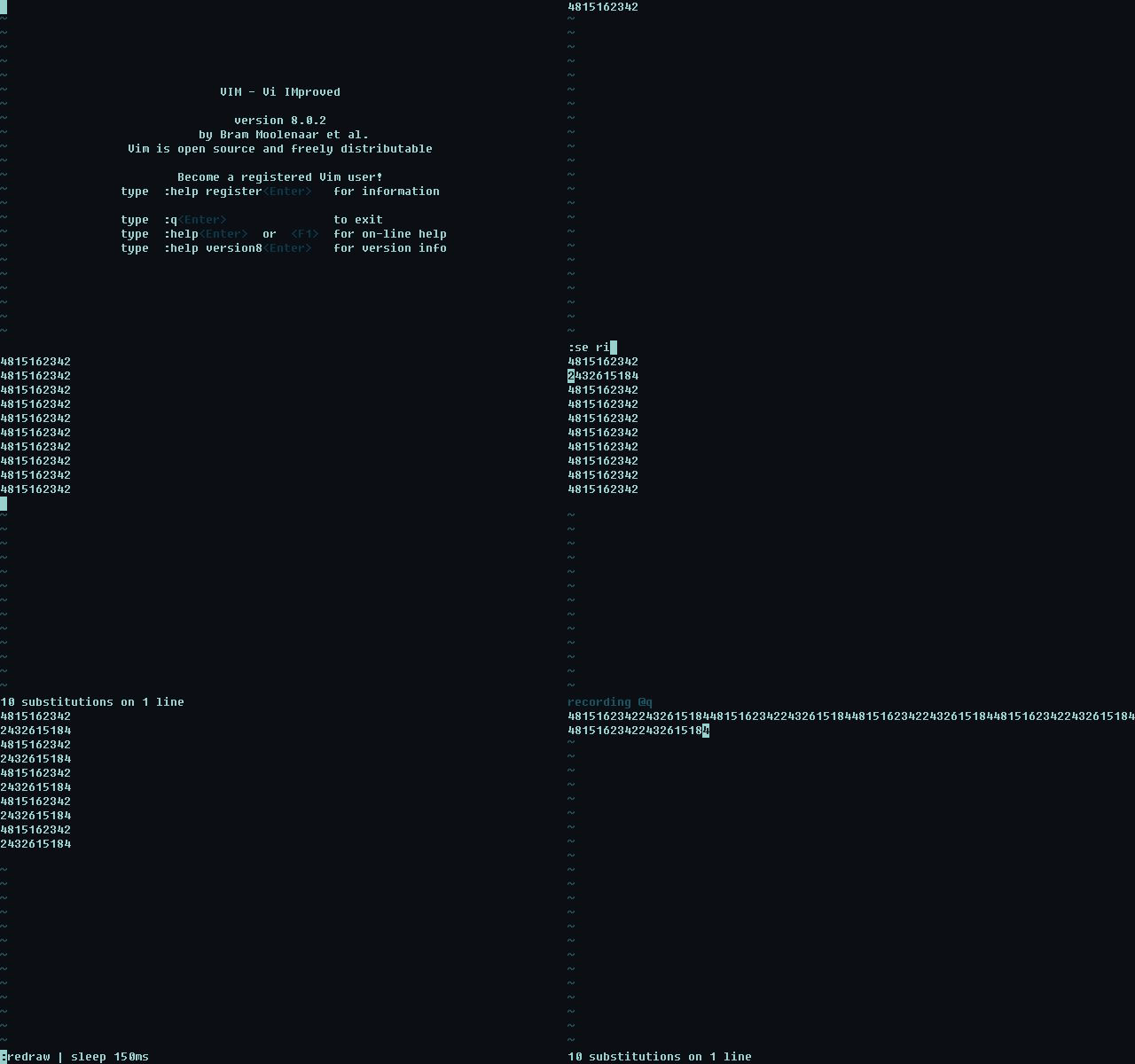
And here is an explanation of how it works:
:se ri                  "Turn 'reverse indent' on.
Y                       "Yank this line
:s/./<C-r>"/g           "Replace every character on this line with the register
                        "We just yanked followed by a newline
<C-o>                   "Jump to our previous location
     qq                 "Start recording in register 'q'
       gJ               "Join these two lines
         C              "Delete this line, and enter insert mode
          <C-r>"<esc>   "Paste the line we just deleted backwards
gJ                      "Join these two lines
  @q                    "Call macro 'q'. This will run until we hit the bottom of the buffer.
    q                   "Stop recording.
     @q                 "Start our recursive macro
On a side note, Y grabs an extra newline, which is usually an obnoxious feature. This is probably the first ever time that it has actually saved several bytes!
C#, 94 bytes
using System.Linq;string R(string n)=>string.Concat(n.SelectMany((c,i)=>1>i%2?n:n.Reverse()));
76 bytes for the method + 18 bytes for LINQ import.
How it works:
using System.Linq; // Required for LINQ extension methods.

string R(string n) =>
    string.Concat( // Concatenate the following chars into a single string
        n.SelectMany( // Enumerate each char in n, flattening the returned IEnumerable<char>'s into a single IEnumerable<char>
            /*IEnumerable<char> Lambda*/(/*char*/ c, /*int*/ i) => // i = index in n
                1 > i % 2 // Check if i is even or odd
                    ? n // if i is even, add n to the concat
                    : n.Reverse() // else reverse n and concat that
        )
    )
;
Swift 2.2 127 bytes
let x={(s:String) in var b = "";for var i in 1...s.characters.count {b += i%2==1 ?s:String(s.characters.reverse());};print(b);}
unGolfed
let x={(s:String) in
  var b = "";
  for var i in 1...s.characters.count {
    b += i%2==1 ?s:String(s.characters.reverse());
  };
  print(b);
}
Perl 6, 31 30 bytes
{[~] (|($_,.flip)xx*)[^.chars]}
Save one byte by misusing .ords, which returns a list of ordinals, then implicitly turn that into a number to create a range with.
{[~] (|($_,.flip)xx*)[^.ords]}
Explanation:
# bare block lambda with implicit parameter 「$_」
{
  # reduce using string concatenation operator 「~」
  [~]

  (
    # create a Slip
    |(
      # of the input, and its string reverse
      $_, .flip

    # list repeated infinitely
    ) xx *

  # get the values in the range from 0 up-to and excluding
  # the number of characters 「0 ..^ +$_.ords」
  )[ ^.ords ]
}
Usage:
my &code = {[~] (|($_,.flip)xx*)[^.ords]}

say code 'a'; # a
say code 'abcd'; # abcddcbaabcddcba
say code 'OK!'; # OK!!KOOK!
say code 4815162342; # 4815162342243261518448151623422432615184481516234224326151844815162342243261518448151623422432615184
Java, 151 bytes
public static void r(String s){String t = new StringBuffer(s).reverse().toString();for(int i=0;i<s.length();i++){System.out.print(((i%2==1)?t:s));}}
}
Ungolfed:
public static void r(String s) {
    String t = new StringBuffer(s).reverse().toString();
    for(int i = 0; i < s.length();i++) {
        System.out.print(((i % 2 == 1) ? t : s));
    }
}
Dyalog APL, 8 bytes
∊≢⍴⊂,⊂∘⌽
∊ flatten
≢ the tally
⍴ cyclically reshaping
⊂ the enclosed argument
, followed by
⊂∘⌽ the enclosed reversed argument
-1 byte thanks to jimmy23013.
PowerShell v2+, 57 bytes
param($a)-join(1..($x=$a.length)|%{($a[$x..0],$a)[$_%2]})
No real clean way to get string lengths or reverse 'em, so this is pretty lengthy.
Takes input $a, loops from 1 to $a.length (stored in $x for use later). Each iteration we use a pseudo-ternary to index into an array of either $a or $a[$x..0] (i.e., reversed), based on whether our input number is odd/even [$_%2]. These are all encapsulated in parens and -joined together to form a single string. That's left on the pipeline, and output is implicit.
PS C:\Tools\Scripts\golfing> .\stringgnirts.ps1 'TimmyD'
TimmyDDymmiTTimmyDDymmiTTimmyDDymmiT
Pyth, 6 bytes
Vzp~_z
Explanation
Vzp~_z
Vz      For every character in z (the input)
  p  z  Print z
   ~_z  Reverse z
Haskell, 40 36 32 Bytes
m s=take(length s^2)$cycle$s++reverse s
Example:
*Main> m "Hello!"
"Hello!!olleHHello!!olleHHello!!olleH"
Even shorter (credit to Damien):
q s=zip(s>>[s,reverse s])s>>=fst
s>>[s,reverse s] cycles ["abc","cba",...] which is zipped to correct size and concatMap'ped with fst
J, 13 8 bytes
Saved 5 bytes thanks to miles!
#;@$];|.
This is a 5-train with the following verbs:
# ;@$ ] ; |.
The inner fork is composed of ] (identity), ; (link), and |. (reverse). Observe:
   (| ; |.) 'Hello!'
+------+------+
|Hello!|!olleH|
+------+------+
The outer two verbs make the rest of the train. # is, in this case, the size of the argument, that is, the length. The verb linking these is ;@$, or ravel over reshape. Observe:
   # 'Hello!'
6
   6 $ (] ; |.) 'Hello!'
+------+------+------+------+------+------+
|Hello!|!olleH|Hello!|!olleH|Hello!|!olleH|
+------+------+------+------+------+------+
   ; 6 $ (] ; |.) 'Hello!'
Hello!!olleHHello!!olleHHello!!olleH
   6 ;@$ (] ; |.) 'Hello!'
Hello!!olleHHello!!olleHHello!!olleH
   (# ;@$ (] ; |.)) 'Hello!'
Hello!!olleHHello!!olleHHello!!olleH
   (# ;@$ ] ; |.) 'Hello!'
Hello!!olleHHello!!olleHHello!!olleH
   (#;@$];|.) 'Hello!'
Hello!!olleHHello!!olleHHello!!olleH
Old solution.
[:,|.^:(i.@#)
Simple enough. |. is reverse, and ^: is power conjunction, which repeats it's left verb (right hand) # of times. When the right argument is a verb, that verb is called on the argument. The right verb in this case is range from zero (i.) to the length (#). When raised to an array, the intermediate results are kept. All that needs to be done is to flatten the array with ,.
Intermediate results
   (i.@#) 'Hello!'
0 1 2 3 4 5
   |.^:0 1 2 3 4 5 'Hello!'
Hello!
!olleH
Hello!
!olleH
Hello!
!olleH
   |.^:(i.@#) 'Hello!'
Hello!
!olleH
Hello!
!olleH
Hello!
!olleH
   ([:,|.^:(i.@#)) 'Hello!'
Hello!!olleHHello!!olleHHello!!olleH
Straw, 10 bytes
<:(:>"),*&
<:(:>"),*&
<          Take the input       (Stack: ["", input])
 :         Duplicate            (Stack: ["", input, input])
  (        Start a string
   :       Duplicate
    >      Output
     "     Reverse
      )    End the string       (Stack: ["", input, input, ':>"'])
       ,   Swap                 (Stack: ["", input, ':>"', input])
        *  Unary multiplication (Stack: ["", input, ':>"'*length of input])
         & Evaluate             (Stack: ["", input])
Perl, 24 bytes
Includes +2 for -lp
Give input on STDIN:
rev.pl <<< Hello!
rev.pl:
#!/usr/bin/perl -lp
s%.%s/.?/chop/eg;$`%eg
Surprisingly this does not use the builtin reverse operator. That name is just soooo long, all solutions I could think of with reverse are at least 1 byte longer.
R, 53 bytes
Assumes that the input is space- or newline-separated for each character.
cat(rep(c(i<-scan(,""),rev(i)),l=length(i)^2),sep="")
Some test cases:
> cat(rep(c(i<-scan(,""),rev(i)),len=length(i)^2),sep="")
1: h e l l o !
7:
Read 6 items
hello!!ollehhello!!ollehhello!!olleh

> cat(rep(c(i<-scan(,""),rev(i)),l=length(i)^2),sep="")
1: a
2:
Read 1 item
a

> cat(rep(c(i<-scan(,""),rev(i)),l=length(i)^2),sep="")
1: a b c d
5:
Read 4 items
abcddcbaabcddcba

> cat(rep(c(i<-scan(,""),rev(i)),l=length(i)^2),sep="")
1: O K !
4:
Read 3 items
OK!!KOOK!

> cat(rep(c(i<-scan(,""),rev(i)),l=length(i)^2),sep="")
1: 4 8 1 5 1 6 2 3 4 2
11:
Read 10 items
4815162342243261518448151623422432615184481516234224326151844815162342243261518448151623422432615184

> cat(rep(c(i<-scan(,""),rev(i)),l=length(i)^2),sep="")
1: P P C G
5:
Read 4 items
PPCGGCPPPPCGGCPP

> cat(rep(c(i<-scan(,""),rev(i)),l=length(i)^2),sep="")
1: 4 2
3:
Read 2 items
4224
Java, 127 111 88 bytes
(s,r)->{for(int i=0;i++<s.length();)r+=i%2<1?new StringBuffer(s).reverse():s;return r;};
Ungolfed test program
    public static void main(String[] args) {
    BiFunction<String, String, String> func = (s, r) -> {
        for (int i = 0; i++ < s.length();) {
            r += i % 2 < 1 ? new StringBuffer(s).reverse() : s;
        }
        return r;
    };
    System.out.println(func.apply("Hello!", ""));
}
C#, 137 bytes
void S(string i){Console.WriteLine(string.Join("",i.Select((c,n)=>(n%2==0)?i:i.Reverse()).Select(x=>new string(x.ToArray())).ToList()));}
Ungolfed:
void S(string i)
{
    Console.WriteLine(string.Join("",
    i.Select((c, n) => (n%2 == 0) ? i : i.Reverse()).Select(x => new
    string(x.ToArray())).ToList()));
}
Retina, 27 bytes
Byte count assumes ISO 8859-1 encoding.
.
±$_
O$^`(?(\G)[^±]|±)

±
Explanation
.
±$_
Replace each character with the entire input, preceded by ± to separate copies.
O$^`(?(\G)[^±]|±)
The regex matches the characters in every other copy, by either matching a ± that is not adjacent to the previous match, or a non-± that is. These characters are reversed. Since each copy is the same width that is identical to reversing each copy individually.
±
Remove the separators.
JavaScript (ES 6), 59 50 bytes
9 Bytes thanks to Hedi and Huntro.
f=(s,n=1)=>s[n]?s+f([...s].reverse().join``,n+1):s
recursive function.
Reversing the string takes almost half of the size (25 22 bytes!) ...
Why isn´t there a native way for that?
Groovy, 51 bytes
def d(s){s.size().times{print(it%2?s.reverse():s)}}
2sable, 3 bytes
Code:
gGÂ
Explanation:
g # Get the length of the input
G # Do the following n - 1 times:
 # Bifurcate, which duplicates a and reverses the duplicate
Uses the CP-1252 encoding. Try it online!
Brachylog, 16 bytes
l-I,?r:?r:Ij@2hc
Explanation
l-I,                I = length(Input) - 1
    ?r              Reverse the Input
      :?r           The list [Input, Reverse of the Input]
         :Ij        Append I times that list to itself
            @2h     Split in half and take the first part
               c    Concatenate into a string
PHP, 54 52 bytes
(49 bytes, but do not work if string contains '0')
for(;($a=$argv[1])[$i++];)echo$i%2?$a:strrev($a);
(52 bytes)
<?=str_pad('',strlen($a=$argv[1])**2,$a.strrev($a));
(54 bytes)
for(;$i++<strlen($a=$argv[1]);)echo$i%2?$a:strrev($a);
PHP, 54 bytes
while($i++<strlen($s=$argv[1])){echo$s;$s=strrev($s);}
There are a lot of ways to do that, in almost every language I guess.
These two are my favourites:
an evil eval (62 bytes)
eval(str_repeat('echo$s;$s=strrev($s);',strlen($s=$argv[1])));
and a substr solution (69 bytes)
<?=substr(str_repeat(($s=$argv[1]).strrev($s),$n=strlen($s)),-$n*$n);
and while we´re at unsensible coding, take these 61:
$s=$argv[1];L:echo$s;$s=strrev($s);if(++$i<strlen($s))goto L;
Actually, 12 bytes
;;l)Rkp;)αHΣ
Explanation:
;;l)Rkp;)αHΣ
;;l           dupe string twice, use one copy to get length (call it L)
   )          move length to bottom of stack
    R         reverse one copy of string
     k        pop entire stack and push as list
      p       pop L from list
       ;)     dupe L, move one copy to bottom
         α    repeat each element (the forward and reversed string) of the list L times
          H   first L elements in list (trim off excess elements)
           Σ  concatenate
Ruby, 39 bytes
->(s){s.reverse!.gsub(/./){s.reverse!}}
I suck at Ruby. Golfing help is appreciated.
Ruby is a really nice language for this because of .reverse!
Explanation
I was hoping it would be someting simple like:
s.gsub(/./){s.reverse!}
but because of boilerplate/challenge restriction it's longer.
What s.reverse! is very useful. s.reverse! is basically s = s.reverse!, meaning it also mutates s.
What each section of the program does is described below:
->(s){             # Lambda with argument s
      s.reverse!   # Reverse `s` see above for details
      .gsub(/./)   # Replace every character with...
      {s.reverse!} # the input reversed!
The thing about s.reverse! that is great is that everytime it is evaluated the string get's flipped. So as it replaces the string. s is modified!
Pip, 11 10 bytes
L#aORVRV:a
Explanation:
            a is first cmdline argument (implicit)
L#a         Loop len(a) times:
      RV:a   Reverse a and assign back to a
   ORV       Output the reverse of a (since it needs to go forward first then backward)
Jelly, 4 3 bytes
,Ṛṁ
Try it online! or Verify all test cases.
Saved a byte thanks to @Maltysen.
Explanation
,Ṛṁ  Input: string S
 Ṛ    Reverse S
,     Join S with reverse of S. Makes a list [S, rev(S)]
  ṁ   Mold [S, rev(S)] to len(S) by repeating elements cyclically
      Return and print implicitly as a string
Ruby, 43 bytes
f=->s,i=s.size{$><<s
i<2||f[s.reverse,i-1]}
See it on eval.in: https://eval.in/642616
Minkolang, 17 bytes:
$oId$z$Dz[rz[O]].
Explanation
$o                   Read in whole input as characters
  Id                 Push the length of stack and duplicate
    $z               Pop top of stack and store in register (z)
      $D             Pop top of stack (n) and duplicate whole stack n-1 times
        z[     ]     z times, do the following:
          r          Reverse the stack
           z[O]      z times, pop the top of stack and output as character
                .    Stop.
Python, 40 bytes
f=lambda s,i=0:s[i:]and s+f(s[::-1],i+1)
A recursive function. Prepends the input string s to the function of the reverse until the counter i exceed the length of s.