| Bytes | Lang | Time | Link |
|---|---|---|---|
| 028 | TIBASIC TI84 Plus CE Python | 250917T133641Z | madeforl |
| 007 | Nekomata | 230916T011728Z | alephalp |
| 022 | Julia 1.0 | 230628T185316Z | Ashlin H |
| 006 | Japt g | 180625T144203Z | Shaggy |
| 046 | PHP 5.6+ | 160826T101944Z | Florin C |
| 007 | Thunno 2 | 230609T145809Z | The Thon |
| 005 | Vyxal m | 221024T215119Z | emanresu |
| 046 | BrainFlak | 160826T023050Z | Leaky Nu |
| nan | 221014T185536Z | bigyihsu | |
| nan | Fig | 221014T135236Z | Seggan |
| 007 | Vyxal | 221011T175013Z | math sca |
| 039 | Red | 210605T055645Z | chunes |
| 032 | AWK | 210605T155341Z | Pedro Ma |
| 246 | MMIX | 210605T151525Z | NoLonger |
| 004 | Oasis | 160831T005640Z | Adnan |
| 028 | JavaScript | 210215T112339Z | atzlt |
| 007 | Husk | 201008T084342Z | Razetime |
| 035 | Zsh | 210215T101433Z | pxeger |
| 029 | Ruby | 200812T042040Z | Razetime |
| 009 | cQuents | 200812T032300Z | Stephen |
| 026 | Flurry | 200812T024009Z | Bubbler |
| 012 | K oK | 180827T164636Z | J. Sall& |
| 043 | C++ | 180827T163418Z | DimChtz |
| 008 | 05AB1E | 180827T152509Z | Kevin Cr |
| 035 | Forth gforth | 180625T200650Z | reffu |
| 053 | Common Lisp | 170619T193033Z | Renzo |
| 027 | Haskell | 170619T155922Z | Wheat Wi |
| 144 | C# | 161021T161249Z | Pete Ard |
| 026 | Groovy | 161020T224446Z | Magic Oc |
| 044 | C | 160827T094240Z | user5898 |
| 074 | Racket | 160923T070759Z | rnso |
| 025 | JavaScript ES2016 | 160826T184052Z | Freyja |
| 034 | dc | 160830T101325Z | Toby Spe |
| 057 | Python 3 | 160828T111343Z | AvahW |
| 051 | Python 2 | 160826T015508Z | Wheat Wi |
| 049 | R | 160826T080853Z | Billywob |
| 022 | Perl | 160829T080123Z | Ton Hosp |
| 011 | Pip | 160826T170849Z | DLosc |
| 015 | Dyalog APL | 160827T222151Z | Adá |
| 193 | ForceLang | 160827T144639Z | SuperJed |
| 041 | R | 160826T083441Z | Mamie |
| 026 | Retina | 160826T190319Z | mbomb007 |
| 025 | Javascript ES6 | 160826T194935Z | Arnauld |
| 035 | Perl | 160826T192540Z | theLambG |
| 009 | Pyke | 160826T182957Z | Blue |
| 201 | SILOS | 160826T182115Z | Rohan Jh |
| 027 | Hexagony | 160826T121155Z | Martin E |
| 015 | UGL | 160826T165050Z | Leaky Nu |
| 017 | Sesos | 160826T163831Z | Leaky Nu |
| 035 | Maple | 160826T163812Z | DSkoog |
| 060 | S.I.L.O.S | 160826T162912Z | Leaky Nu |
| 025 | PARI/GP | 160826T140428Z | Charles |
| 018 | Labyrinth | 160826T152811Z | Martin E |
| 056 | PowerShell v2+ | 160826T130815Z | AdmBorkB |
| 024 | Perl 6 | 160826T022114Z | Brad Gil |
| 049 | Prolog | 160826T144641Z | Leaky Nu |
| 019 | Mathematica | 160826T065904Z | alephalp |
| 052 | Javascript Using external library Enumerable | 160826T131702Z | applejac |
| 012 | MATL | 160826T131446Z | Suever |
| 013 | Brachylog | 160826T124053Z | Leaky Nu |
| 033 | C | 160826T112048Z | Stefano |
| 8551 | Scala | 160826T085705Z | AmazingD |
| 013 | Jellyfish | 160826T083953Z | Martin E |
| 012 | J | 160826T034055Z | Conor O& |
| 010 | GolfScript | 160826T042246Z | Leaky Nu |
| 070 | Batch | 160826T093915Z | Neil |
| 044 | R | 160826T081754Z | JDL |
| 025 | Haskell | 160826T081231Z | xnor |
| 007 | 05AB1E | 160826T063757Z | Emigna |
| 026 | Haskell | 160826T052750Z | nimi |
| 012 | Actually | 160826T040707Z | Sherlock |
| 009 | Actually | 160826T041028Z | Leaky Nu |
| 005 | Jelly | 160826T034525Z | Dennis |
| 032 | C | 160826T033836Z | Dennis |
| 010 | CJam | 160826T030056Z | Dennis |
| 026 | Cheddar | 160826T015504Z | Downgoat |
| 042 | Java 7 | 160826T022120Z | Geobits |
| 154 | BrainFlak | 160826T020622Z | Wheat Wi |
| 036 | Python | 160826T020905Z | Leaky Nu |
| 049 | Perl6 | 160826T022739Z | bb94 |
| 046 | C | 160826T022032Z | Leaky Nu |
| 007 | Jelly | 160826T014738Z | Leaky Nu |
TI-BASIC (TI-84 Plus CE Python), 28 bytes
Input I
{2
For(N,1,I
augment(Ans,{1+prod(Ans
End
Ans(dim(Ans
Nekomata, 7 bytes
2ᶦ{:←*→
Takes no input, and outputs all terms of the Sylvester's sequence.
2ᶦ{:←*→
2           Start with 2
 ᶦ{         Infinite loop:
   :            Duplicate
    ←           Decrement
     *          Multiply
      →         Increment
Julia 1.0, 27 22 bytes
~x=*(1,.~(0:x-1)...)+1
-5 bytes (!!) thanks to MarcMush: Replace prod() with *(); also, pad the argument list with 1 to avoid handling \$a_0\$ as a special case
Japt -g, 6 bytes
Takes input as a singleton integer array, 1-indexed.
ÇÆiU×Ä
Japt -h, 6 bytes
Takes input as an integer, 1-indexed.
ÆßX ×Ä
Original w/o flag, 9 8 bytes
Takes input as an integer, 0-indexed.
@ÒZ×}gNÅ
PHP 5.6+ (46 bytes)
function f($n){return--$n?f($n)**2-f($n)+1:2;}
Thunno 2, 7 bytes
2${D⁻×⁺
Port of Emigna's 05AB1E answer.
Explanation
2${D⁻×⁺  # Implicit input
2        # Start with 2
 ${      # Input number of times:
   D⁻×   #  Multiply by x-1
      ⁺  #  And increment
         # Implicit output
Brain-Flak, 76 68 58 52 46 bytes
<>(()())<>{({}[()])<>({({}[()])({})}{}())<>}<>
Uses this relationship instead:
$$a(n) = 1+\sum^{a(n-1)-1}_{i=0} 2i$$
which is derived from this relationship modified from that provided in the sequence:
$$a(n+1) = a(n)(a(n) - 1) + 1.$$
Explanation
For a documentation of what each command does, please visit the GitHub page.
There are two stacks in Brain-Flak, which I shall name as Stack 1 and Stack 2 respectively.
The input is stored in Stack 1.
<>(()())<>             Store 2 in Stack 2.

{                      while(Stack_1 != 0){
  ({}[()])                 Stack_1 <- Stack_1 - 1;
  <>                       Switch stack.
  ({({}[()])({})}{}())     Generate the next number in Stack 2.
  <>                       Switch back to Stack 1.
}

<>                     Switch to Stack 2, implicitly print.
For the generation algorithm:
({({}[()])({})}{}())      Top <- (Top + Top + (Top-1) + (Top-1) + ... + 0) + 1

(                  )      Push the sum of the numbers evaluated in the process:

 {            }               while(Top != 0){
  ({}[()])                        Pop Top, push Top-1    (added to sum)
          ({})                    Pop again, push again  (added to sum)
                              }

               {}             Top of stack is now zero, pop it.
                 ()           Evaluates to 1 (added to sum).
Alternative 46-byte version
This uses only one stack.
({}<(()())>){({}<({({}[()])({})}{}())>[()])}{}
Go, 59 bytes, int only
func f(n int)int{if n<1{return 2}
k:=f(n-1)
return k*k-k+1}
Go, 126 bytes, arbitrarily large outputs
import."math/big"
func f(n int)*Int{i,l:=NewInt,new(Int)
if n<1{return i(2)}
k:=f(n-1)
return l.Add(l.Sub(l.Mul(k,k),k),i(1))}
Fig, \$5\log_{256}(96)\approx\$ 4.116 bytes
}rMXr
Port of Jelly. Link contains extra code to run all test cases.
}rMXr
    r # Range [0, n)
  MX  # Map by this function
 r    # Product
}     # Increment
Vyxal, 7 bytes
-2 bytes thanks to Steffan
2$(:‹*›
Explanation:
2$(:‹*›
2$          Push 2 and swap it with the input
   (:       Loop through input and duplicate value
     ‹*     Decrement the value and multiply
       ›    Increment value
Red, 55 49 45 39 bytes
func[n][x: 2 loop n[x: x * x - x + 1]x]
- -6 thanks to Galen Ivanov
- -4 thanks to Pedro Maimere
- -6 thanks to 9214
This is the first real thing I wrote in Red. You have been warned.
MMIX, 24 bytes (6 instrs)
Works mod \$2^{64}\$. One-based indexing.
(jxd)
00000000: e3ff0001 2301ff01 1affff01 27000001  ẉ”¡¢#¢”¢ȷ””¢'¡¡¢
00000010: 5b00fffd f8020000                    [¡”’ẏ£¡¡
Disassembly:
sylv    SET  $255,1         // b(1)=1
0H      ADDU $1,$255,$1     // loop: a(n) = b(n) + 1
        MULU $255,$255,$1   // b(n+1) = a(n) * b(n)
        SUBU $0,$0,1
        PBNZ $0,0B          // if(--i) goto loop
        POP  2,0            // return a
Oasis, 4 bytes
Probably my last language from the golfing family! Non-competing, since the language postdates the challenge.
Code:
²->2
Alternative solution thanks to Zwei:
<*>2
Expanded version:
a(n) = ²->
a(0) = 2
Explanation:
²    # Stack is empty, so calculate a(n - 1) ** 2.
 -   # Subtract, arity 2, so use a(n - 1).
  >  # Increment by 1.
Uses the CP-1252 encoding. Try it online!
JavaScript, 28 bytes
A function. Expect a number as input.
f=n=>n?f(n-1)*(f(n-1)-1)+1:2
Using the formula a[n] = a[n-1] * ( a[n-1] - 1 ) + 1.
Explanation. The ungolfed and commented version:
var f = (n) => {                 // Define a function
  n ?                            // If n is not zero...
                                 // (non-negative numbers and TRUE booleans are
                                 // equivalent in JavaScript)
    f(n-1) * (f(n-1) - 1) + 1    // Then use the recurrence formula.
    :                            // Else, if n is zero...
    2                            // Return 2 to end recurrence.
}
Ruby, 29 bytes
f=->a{a<1?2:(b=f[a-1])*~-b+1}
+2 for adding f= to byte count.
-2 from Dingus's suggestion.
cQuents, 9 bytes
=2:ZZ-Z+1
1-indexed.
Explanation
=2          first term is 2
  :         given input n, output nth term
            each term equals
   ZZ-Z+1   previous * previous - previous + 1
Flurry, 26 bytes
{}[(<><<>()>)({})]{{}}{}{}
Verification
$ echo -n "{}[(<><<>()>)({})]{{}}{}{}" | wc -c
26
$ ./flurry -nin -c "{}[(<><<>()>)({})]{{}}{}{}" 0
2
$ ./flurry -nin -c "{}[(<><<>()>)({})]{{}}{}{}" 1
3
$ ./flurry -nin -c "{}[(<><<>()>)({})]{{}}{}{}" 2
7
$ ./flurry -nin -c "{}[(<><<>()>)({})]{{}}{}{}" 3
43
$ ./flurry -nin -c "{}[(<><<>()>)({})]{{}}{}{}" 4
1807
How it works
We have a formula \$a(n+1) = a(n) (a(n) - 1) + 1\$, but pred is well-known to be expensive in SKI calculus, so I defined an auxiliary sequence:
$$ b(n) = a(n)-1 \\ a(n+1) - 1 = (a(n)-1+1)(a(n)-1) \\ b(n+1) = b(n)(b(n)+1), b(0) = 1 $$
Then we can use the nature of Church numerals to calculate the \$n\$-th term as
b = \n. n (\x. x ∘ succ x) 1
a = \n. succ (b n)
  = \n. succ (n (\x. x ∘ succ x) 1)
where succ is the successor function and ∘ is function composition (which acts as multiplication when given two Church numerals).
We can represent the \x. x ∘ succ x part directly in Flurry as {<({})[<><<>()>{}]>}, but we can do better. We can try converting to SKB:
\x. \f. x (succ x f)
\x. \f. K x f (succ x f)
\x. S (K x) (succ x)
\x. (S∘K) x (succ x)
S (S∘K) succ
succ succ  (because succ = S (S∘K))
So we can duplicate succ via the stack, making it [(<><<>()>){}] (-6 bytes). Using it in the full program, we get:
\n. succ (n (\x. x ∘ succ x) 1)
\n. succ (n (succ succ) 1)

<><<>()>[       succ (
 {}[              n (
    (<><<>()>)       succ [push succ]
    {}               succ [pop]
   ]                )
 {}               I [pop from empty stack]
]               )
But I wasn't satisfied because it still has two copies of succ. So I changed the "calculate b(n) and apply succ on it" to "apply succ b(n) times to 1", which gives
\n. n (succ succ) 1 succ 1

{}[           n (
  (<><<>()>)    succ [push succ]
  ({})          succ [pop and push succ]
  ]           )
{{}}          I    [1]
{}            succ [pop]
{}            I    [pop from empty stack]
K (oK), 12 bytes
{2|1+*/o'!x}
Blatantly stolen from Port of Adám's answer.
Prints up to the first 11 elements of the sequence, after which the numbers become too big to handle.
Thanks @ngn for 6 bytes!
How:
{2|1+*/o'!x} # Main function, argument x.
       o'!x  # recursively do (o) for each (') of [0..x-1] (!x)
   1+*/      # 1 + the product of the list
 2|          # then return the maximum between that product and 2.
05AB1E, 8 bytes
2λλP>}sè
Not shorter than the existing 05AB1E (legacy) answer by @Emigna, but I wanted to try out the new recursive function in the 05AB1E Elixir-rewrite.
Try it online or verify all test cases.
Explanation:
2λ   }      # Define a recursive sequence function starting at a(0) = 2
  λ         #  Generates a recursive infinite sequence-list [a(0), a(1), a(2), ...]
   P>       #  where each a(n) takes the product + 1 of all previous results
            #   i.e. [2,3,7,43,1807,3263443,10650056950807,...]
      s     # Swap so the input is at the top of the stack
       è    # Get the 0-indexed value of the infinite recursive sequence-list
            #  i.e. 4 and [2,3,7,43,1807,3263443,10650056950807,...] → 1807
Forth (gforth), 35 bytes
Answer uses 0-indexing
: f 2 swap 0 ?do dup 1- * 1+ loop ;
Explanation
- place 2 on stack
- loop from 0 to n-1
- multiply top of stack by itself minus 1
- add 1
Code Explanation
: f             \ Start a new word definition
  2 swap        \ place 2 on the top of the stack
  0 ?do         \ loop from 0 to n-1 (skip loop if n=0)
    dup 1-      \ duplicate top of stack and subtract 1
    *           \ multiply top two stack values
    1+          \ add 1 to result
  loop          \ end loop
;               \ end word definition
Common Lisp, 53 bytes
(defun f(n)(do((x 2(1+(* x(1- x)))))((<(decf n)0)x)))
The result is computed through the formula a(n+1) = a(n) * (a(n) - 1) + 1, starting from 2 and iterated n times.
Haskell, 27 bytes
f 0=2
f n=f(n-1)^2-f(n-1)+1
Not the shortest Haskell answer but it uses a new method.
C#, 144 Bytes
I used one indexing:
Golfed:
int s(int n){var a=new int[n];int b=1;for(int i=0;i<a.Length;i++){a[i]=b;b=1;a.ToList().GetRange(0,i).ForEach(o=>b*=o);a[i]=b+1;}return a[n-1];}
Ungolfed:
class SylvestersSequence
{
public int s(int n)
{
  var a = new int[n];

  int b = 1;

  for (int i = 0; i < a.Length; i++)
  {
    a[i] = b;

    b = 1;

    a.ToList().GetRange(0, i).ForEach(o => b *= o);

    a[i] = b + 1;
  }

  return a[n - 1];
}
}
Tests:
1 : 2
2 : 3
3 : 7
4 : 43
5 : 1807
6 : 3263443
(Things start to go a bit weird after this...)
Groovy, 26 bytes
This answer was basically stolen from @Geobits.
a={n->n--?a(n)*~-a(n)+1:2}
Took that answer and, using groovy shortcuts, optimized it further.
C, 44 bytes
g(i,j){return i<2?2:(j=g(i-1,0),j*(j-1)+1);}
Racket 74 bytes
(define(f n(l'(2)))(if(< n 2)(reverse l)(f(- n 1)(cons(+(apply * l)1)l))))
Detailed version:
(define (f n (l '(2)))
  (if (< n 2)
      (reverse l)
      (f (- n 1) (cons (+ 1 (apply * l)) l))))
Testing:
(f 7)
Output:
'(2 3 7 43 1807 3263443 10650056950807)
JavaScript (ES2016), 25 bytes
f=x=>x--?f(x)**2-f(x)+1:2
Uses the zero-indexed sequence.
Here's an example:
f=x=>x--?f(x)**2-f(x)+1:2

const output = document.getElementById('output');

for(let i = 0; i < 10; i++)
  output.textContent += 'f(' + i + ') = ' + f(i) + '\n';
<pre id="output"></pre>dc, 34 bytes
0sg[[d1-*1+Lgx]Sg1-d0<f]dsfx2Lgx++
This pops the argument from top of stack, and pushes the result to stack, as normal for dc.
Annotated full program
#!/usr/bin/dc

# accept input
?

# initialise the bottom of the g-stack
0sg
# Add n iterations of recurrence formula
[[d1-*1+Lgx]Sg1-d0<f]dsfx
# Prime the 0th value
2
# Execute all of the g-stack
Lgx
# Last instruction left a zero on the stack
+
# Special case: if input is 0, f left a -1 behind.  This is a correction
# for wrongly doing 2->3 in that case
+

# print output
p
It works by using the recurrence relation described in OEIS: a[n+1] = a[n]² - a[n] + 1, starting with a[0]==2. Equivalently, a[n+1] = a[n](a[n]-1) + 1, written in dc as d1-*1+.
We push n copies of the program d1-*1+ to the stack g, prime the main stack with the initial value 2, and set off. There's a correction for n=0, because we always push at least one instance of the recurrence. Handily, we can fix that, because function f leaves -1 on the stack in that case, and 0 otherwise.
Test output:
0: 2
1: 3
2: 7
3: 43
4: 1807
5: 3263443
6: 10650056950807
7: 113423713055421844361000443
8: 12864938683278671740537145998360961546653259485195807
9: 165506647324519964198468195444439180017513152706377497841851388766535868639572406808911988131737645185443
10: 27392450308603031423410234291674686281194364367580914627947367941608692026226993634332118404582438634929548737283992369758487974306317730580753883429460344956410077034761330476016739454649828385541500213920807
11: 750346333909286311464218348364293017384724140073732363176684391768374238237200233203724274839819736227493060107386942069521875902258281351952761393460726027774387698896086030486687796275661950199835484418384103096899499524666007073298797852932127876923983340497448231960048833094195425231846478785035602339261149953564729371337917773386670133413581537490788020231265093210310224397095644371148893261284201611453610443
12: 563019620811106188735345793029131127645126456201508328395934709948713369875017428398616526515350801978901280848429236023780360625686785326318172135941491985234945009397938528773976977887356630327917721419666751591559883455828027643329740930320548089836575156581070880066847294722353255119648341271402723167206816552066010592134725124376810874159292118224274440907862996344067325025151751506647339684959479438354192989470470488621172745980086435801519575581664038703641801974453354864238123148678312993828328158261237284571445163949954735321181426755485563860804935755099928085508785637606452207007984638610604113718738727804169240213041488645142155664706600019329809186121988322464207409749450811638629159492106903853533242008723387118397794980575878357156285111258733862431522178328441469980110808406224908967784943255608168545045807
13: 316991093418281796980738587324498503465985663563441351614965595710659626509023026378810664917769979749230375616949095839488230630774365784766585678394020150307543448990686716629735821013846949520218610883960194258122308878890968113466913053158083723070515602776324450012006168592325685889943262781933132780014500164781142497008320197365141855119010118077705678576368755229432787283587491897170937657553086679827144799087397199129432233281774986701578182361474362882421927116451702868297347253630717771757957438615228337552613006602138504913204731416596016919892552584014059657038635241014722034375088903021315484876024289828564177721518967548558336213757430766087730295001595138792039193609746512786881659903942227205537012891959828532940594409566163694454653037016800027294499421291400492041597627904670868358757293568071192353450861046220903121264904877170553117406388566305811088048722332066039563082830094354238880920553702156022717609505663704069061610519598560624334935881397512984533454362321248854729174814176943381209734396537109715522733592519084452225492188715705481658124794599731527140827530319488791822858978924780015280035310521766457660381662363459675166288099343838361130665940967928850877954452552005403436587169730515877297387774041696625714088910160966686976352250237188765370786055553236020704945964404004577531357576565107610684603955726197582253686411381871520005412537060114403951740688011605681233186481569161991920354077827812176666950510226500521720520469387009627382085749910481677989034236154462513159644551504513525508614268492165297534777956118363272320828495465015734808069866823697938666550506233479919235237378935603448169915183235443
14: 100483353306517857188816511171973264968130481955993490961776578914384855009465596512878627978186320098524674810822809215084298821790532480217571435837318997038501027166944291436298311859998927368878478765662052261013905379683606908563327049366289350227874801320137528476359434996625155321924896471487253609774383161294073700386567438895729619959183688827019175395384990049660760826706275656247200320644562229907983316938796200727194177710641698165578469600709422183645673081099011178658794923207340118316226811044120124994280172667435132674250477913878334229469634774955766654959747171269329356217729819952093850230832136940392143299736102334976183356619572749168857678782222255344301700168226608019630704240193738779198063738629831841413772846575231497629810592678428725195220732911880790353530776313807267315574488856933933931968726196972550157616749777588888821303729634383570842953721086839502335017753789603211887639264756326943906234925564059713122739441052488376985825209930025027331642643833862623818612641648534007690784009230583997364206027891426162271405399576520661523570494921380174573570295575834537952976231451138917903119690734728050868143651943079046629073247009723903287946523072583428647088990713577505274669321894108556505593299658881909461644436220683735665670039545950199079805499092674406353548516096407916275052371510047476698658893306349068133879014809524920709542592832744670134019181012820484031829100985336532444887396195766078330294774788615792775829183741076029977456631131003360810557200089618493958319779112283680033864350359591347851857639767660909655544622503481811302270128415655545885368248621757558781407774929247336942808205264958129961178967782261436710020914320953492879039247990865098954170193648898076402861312803632817456574773061811978648089614340109760702469211985641224691799075765885167117855362986656144090527289697873066081524676142089795828969028242126025160985084779781007974719610529121366009147473928798323429514961662955075830495059188425232901129844306717176754536658533793214326255403412914373598713551532524170357661947859352181097102731800860434424406585016086605044703266455861041380556886689319004123095655013285849524741495205262970148746426581276319938997140587845485798731493239638046736464142096404810367841352036464369335995230683471276720095626585363049720580305501778636182605592068492151793190258602236893550140479021220581841241476297575889705144565984983772835663470728331437295945770147420128139970898197153180098987682528952187399111614545313650329728193759220800741639763444502297436225484681500013482802572032911312979385547883726365017125898034265710900263014307543995711388447583272341504352098242603013317289071851486202200363353430637400418445403028209289752937101610106546407815385279051077386957963745649023423516876644029840971378691516442745761797057396994687382618710236478541855961623090443801434726418529440871490091117324165342131670988126442133481305788646667033011070351616554711007362680081909808994105138595194669575127185645557552945017168697977343707144183186705714691228418618276386168995938283316172058534438295911377445943568762495111242585896098376432273844229629284777619272064792008892485171141118486114024760197688360378085790695965894817048250719620713759873671293320363983916413298621510321025850259140267373664767105414000002388170807
15: 10096904291722493183368071064267380357661660106693410869782248738635339952029780296539828646172395134010176258872559248732741423552501907091337488535022650906084259275771532963008605081632727310004012388176378536060181935481315268687099524445976260304963174491384169963045142817764845502919067852341670367757214257530633293876394038000350905620840512848346819593805771248299327648920495911888951338828154665350353011028755722053225038368211236471204894130005662338828040087277653058053926026954188748978276428965217873579228638399408512216051253190389034963502534563472810420786777664075947493242192178950439356302457015948704092615392563507116646622139031277627186004366940766141012052387764963550498137526380034475497296039349645231313666622023168074000757905961415842342549436827136456191636706102191216058665157997484620186504093031595354885464177047583044817527035079867175693262594053326482246251372100971181835929117940968577571250416834584873665407254954117674557725158296520696253051564213291342016830516195717769009307399800985739314707922476435511042184118717157710123856432818413241079127700236873849278099459856806348919726613157276845134234932007694512914360885347631604498444654808443385936829467322014251107608292907841706266154583649605962409356906673289214039345980157983585238598611007015744123201308500000501171750479205303582207819895099792053754750437003972197944606653029649026511175714325665022972458270451004669272442201984239750747468526034925512545591753011926422349450964423576514073138580199215901274311120011401651594856947935270421689304827295107046206967840957322813332397883867061874677422607993141403436835194178479678002082797785957214499969042437649907039865138475341601851262738461348829498716689032746766421448268807692569878289178989757874505465513706845654082199878640106345757795320020739808531463815126727793408754933994363877756899864984281822553007221098602810615408658488405255740618942035792348576150930466937442754907072240355711448059483670791970963065005273062169924072707136909529672907160105055146511078451274809649030962702634933950427417208754579558886670435513091693673392184012357060290800383391444894054478864880104489516105493654428700350038712306497215399390236421973359744231122582759112860245414994943705887755550168313104764831522917085274446816071187952611343217412489624486276718615486137440593087587611396073446784461983318011057978917824445958877834279858529200202638788438701918355676112013825796803683126156843171950302720509023656389038392904612771500795961428815515700691617938343841438201393483006625614378303192786900137915585090133838299336587186981703609917848314020827402418570324364874947405687083727868993183779937556273574979260142267138459345033733513139351742945236547818177589597395538573007069591004145636009266460791802852586248255385289853281955169539287181071240815317693402096387634696936821000809631189985664604670044343502290633727054957569135476042643752035180934112239281974650350606386279562906729624417142767675201654289420896239230816419019207223473210929276206272092462056393663617978292734035101190436048576301803958886273461936172885771511862036063913756041537697347875482651037641523871879511678343487920223572132145739383709173152270680681310792907045630147132642987006838913096888964072928407230377138093587963274543641998748031680910300484752483355961271051871764670801481617005498624008434455328965073448480620868102535798012683148073884828324180309706818271859159551486830624586719405678169003856743183359837325497215633938263574447227327183271417291639794183966954289906892687109652179007215463563426176830359892183207233285822949660507077627537452834236906264132679889387996620400887660540962057531356190936101639054478093742499726068975793037082183383865686389498095746349939423534144214424590382440964976484867660771427325735849308944235845015356241354445696546089110157687163547154187467782703339375797651594636517829331851603968540007770827383674978837195667966783942598590005707606899598870358218737372718556947211584091628920829232578301363561094654677362755304340099041557393126374570806664174774672252295969797311898222174146620044760522846344262741406020752321947103535566408000012063814621832503287764621196638959476702017397368768611288471914511970208911319812356033065360580161537672606063147955100825583445007228467438964318530588833314227952807420669509481593752391013652385527265940130738577518623923144732574439124910418367782835256447209415920224852739207102376107549910900016609384699171269913834437302619696395967407403281737973927596729463096846440722701084830141077051693427101822933034765921597611642383174592217106235280063364807994845967928868775308917858901963126456181289228987259157357205165107173015949882380826616387118049560139377785643404568749158677579677208043068040426770373946180960339686720961911527699043135729279627875429387003955052493364045280876757418765025033413409695324102028154397073950951401567130147958372561569250050115315916847340453713208876117379301986667758145971227712872147895344905202887742406317502743062970210845212570078375900706888423049419555978420360921631722072989494341411138773004386281045887595369408041990902949518621346831502701670122393407384031882407604009301423213075983205272951905634691701992363763765888174623813887930919348488342067724581729853334984081939086632732434453956218768468183725430125421255133039599918534162062203667355213720786895392466152263818029440258554305624849880544213626390640948333905744463929627653854612119535445334027593407956380447236951547078528959161595578692429043586756439280569634716651582120200055321411830495982390826367621607002210296561627357116758704330413920956492877559588940623076249085869711793382001280098156479042244980992199856870800160054773199711318857550253043892154687359419493836459018178858912353349265010015483995639971814634269831053349107064945281072025876791515512079928334870219925857377191409571925519964876967440971512831998547786258887266563455459842692713648700908802193837365344293863475229662378317646816581703457458087022086456107898532154008695237892810276905079816989491080554325994079331146736778976547365594121259003534473921615596015201516355517406353725481606002913150708780327087476617568081058821630455774175060733600369172506996856463081328450537659429232435723045704083403070244189764018093741052294003432036465533377161762848539600279097402470862336866023549397815233762584023941563793660829256982551259589645533178920322179582797164662459946595598265241525713404577113113372646314182883627343354869741769162896070344018435127261845682850523004349904479262461514591088185144460723000848892643437542445798485359801018860443
16: (13341 digits)
17: (26681 digits)
18: (53361 digits)
19: (106721 digits)
20: (213441 digits)
21: (426881 digits)
22: (853761 digits)
23: (1707522 digits)
24: (3415043 digits)
25: (6830085 digits)
26: (13660169 digits)
27: (27320338 digits)
28: (54640675 digits)
29: (109281349 digits)
As you can see, these numbers grow quite rapidly; the computation time also increases in the same proportion as the result length. It took me half a minute to compute a(23), and several hours for a(29).
Python 3, 71 69 68 63 57 bytes
Python 3, 71 69 68 bytes
l=[2]
for _ in range(int(input())):
    n=1
    for i in l:n*=i
    l+=[n+1]
print(l[-1])
Also 68 bytes:
l=[2]
a=int(input())
while len(l)<a:
    n=1
    for i in l:n*=i
    l+=[n+1]
print(l[-1])
EDIT:
Thanks @WheatWizard for pointing out about using n instead of no, and removing the space between for i in l and n*=i.
Also thanks for pointing out about moving int(input()) into the range function.
EDIT 2:
Thanks @WheatWizard for pointing out the iteration tip, it has allowed me to write these two, shorter, programs:
Python 3, 63 bytes
l=[2]
for _ in"a"*int(input()):
    n=1
    for i in l:n*=i
    l+=[n+1]
print(l[-2])
Python 3, 57 bytes
l=[2]
for _ in"a"*int(input()):
    b=l[-1]
    l+=[(b-1)*b+1]
print(b)
The second code (57 bytes) does not follow the instructions for making the sequence (i.e: product of the sequence+1) instead it works on the fact that the last number will always be the product of the rest+1 meaning that instead of iterating through the sequence, I can multiply the last number by itself-1 and then add 1 back on.
Python 2, 87 73 64 60 51 bytes
14 23 25 bytes saved thanks to Leaky Nun
9 bytes saved thanks to Specter Terrasbane
Here's my go at my own challenge.
f=lambda x:reduce(int.__mul__,[1]+map(f,range(x)))+1
R, 56 49 bytes
n=scan();x=2;for(i in 1:n){x=c(x,prod(x)+1)};cat(x[n+1])
Ungolfed:
n=scan()            # Take input n
x=2                 # Initialize sequence to 2
for(i in 1:n){
  x=c(x,prod(x)+1)  # Append the product of the previous numbers + 1
}
cat(x[n+1])         # Print the nth + 1 number in seq
Slightly golfed thanks to @Frédéric:
n=scan();x=2;for(i in 1:n)x=c(x,prod(x)+1);x[n+1]
Perl, 28 26 23 22 bytes
Includes +1 for -p
Run with the input (with 1-based indexing) on STDIN:
sylvester.pl <<< 5
sylvester.pl:
#!/usr/bin/perl -p
$.*=$_=$.+1for($_)x$_
Pip, 11 bytes
Lao*:o+1o+1
The shortest way I've found so far. Uses the formula from Martin's Hexagony answer: define b(0) = 1, b(n) = b(n-1) * (b(n-1) + 1), and then a(n) = b(n) + 1.
La           Loop number of times equal to cmdline input:
  o*:o+1     Multiply o by o+1 in place (o is a variable preinitialized to 1)
        o+1  Output o+1
Dyalog APL, 15 bytes
{×⍵:1+×/∇¨⍳⍵⋄2}
×⍵: if the argument is grater than zero:
1+ one plus
×/ the product of
∇¨ this function applied to each of
⍳⍵ first n integers (beginning with zero)
⋄ else:
2 return two
0-based indexing – needs ⎕IO←0.
ForceLang, 193 bytes
Noncompeting, as for some reason I forgot to give the language's lists a len method when I first implemented them.
def s set
def l a.len()
s g goto
s n io.readnum()
s n n+1
s a []
s b 1
label 1
s n n+-1
s a[l] b+1
if n=0
g 3
s b 1
s i 0
label 2
s b b.mult a[i]
s i i+1
if i=l
g 1
g 2
label 3
io.write a[l+-1]
R, 44 42 41 bytes
2 bytes save thanks to JDL
1 byte save thanks to user5957401
f=function(n)ifelse(n,(a=f(n-1))^2-a+1,2)
Retina, 43 26 bytes
Input and output are in unary (input in 1's, output in x's.) The result is computed using a(n+1) = a(n) * (a(n) - 1) + 1, iterated n times.
^
xx
{`x(?=.*1)
$`$`
x1
xx
Input and output in decimal (53 36 bytes):
.*
$*
^
xx
{`x(?=.*1)
$`$`
}`x1
xx
.
Thanks to Martin for golfing 17 bytes
Javascript (ES6), 25 bytes
f=n=>n--?(n=f(n))*--n+1:2
Returns:
- the exact result for
n=0ton=6 - an approximated value for
n=7ton=10 Infinityforn>10
f=n=>n--?(n=f(n))*--n+1:2

console.log(f(0))
console.log(f(1))
console.log(f(2))
console.log(f(3))
console.log(f(4))
console.log(f(5))
console.log(f(6))
console.log(f(7))
Perl, 35 bytes
$a=2;$a=$a**2-$a+1 for 1..<>;say $a
Might be shorter with a recursive function but I couldn't get that to work in my few attempts
SILOS 201 bytes
readIO
def : lbl
set 128 2
set 129 3
j = i
if j z
print 2
GOTO e
:z
j - 1
if j Z
print 3
GOTO e
:Z
i - 1
:a
a = 127
b = 1
c = 1
:b
b * c
a + 1
c = get a
if c b
b + 1
set a b
i - 1
if i a
printInt b
:e
Feel free to try it online!
Hexagony, 27 bytes
1{?)=}&~".>")!@(</=+={"/>}*
Unfolded:
    1 { ? )
   = } & ~ "
  . > " ) ! @
 ( < / = + = {
  " / > } * .
   . . . . .
    . . . .
Explanation
Let's consider the sequence b(a) = a(n) - 1 and do a little rearranging:
b(a) = a(n) - 1
     = a(n-1)*(a(n-1)-1) + 1 - 1
     = (b(n-1) + 1)*(b(n-1) + 1 - 1)
     = (b(n-1) + 1)*b(n-1)
     = b(n-1)^2 + b(n-1)
This sequence is very similar but we can defer the increment to the very end, which happens to save a byte in this program.
So here is the annotated source code:
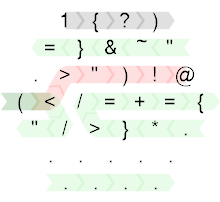
Created with Timwi's HexagonyColorer.
And here is a memory diagram (the red triangle shows the memory pointer's initial position and orientation):
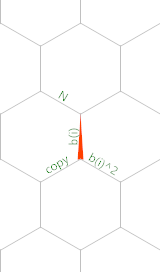
Created with Timwi's EsotericIDE.
The code begins on the grey path which wraps the left corner, so the initial linear bit is the following:
1{?)(
1      Set edge b(1) to 1.
 {     Move MP to edge N.
  ?    Read input into edge N.
   )(  Increment, decrement (no-op).
Then the code hits the < which is a branch and indicates the start (and end) of the main loop. As long as the N edge has a positive value, the green path will be executed. That path wraps around the grid a few times, but it's actually entirely linear:
""~&}=.*}=+={....(
The . are no-ops, so the actual code is:
""~&}=*}=+={(
""             Move the MP to edge "copy".
  ~            Negate. This is to ensure that the value is negative so that &...
   &           ...copies the left-hand neighbour, i.e. b(i).
    }=         Move the MP to edge b(i)^2 and turn it around.
      *        Multiply the two copies of b(i) to compute b(i)^2.
       }=      Move the MP back to edge b(i) and turn it around.
         +     Add the values in edges "copy" and b(i)^2 to compute
               b(i) + b(i)^2 = b(i+1).
          ={   Turn the memory pointer around and move to edge N.
            (  Decrement.
Once this decrementing reduces N to 0, the red path is executed:
")!@
"     Move MP back to edge b(i) (which now holds b(N)).
 )    Increment to get a(N).
  !   Print as integer.
   @  Terminate the program.
Maple 35 bytes
f:=n->`if`(n>0,f(n-1)^2-f(n-1)+1,2)
Usage:
> f:=n->`if`(n>0,f(n-1)^2-f(n-1)+1,2):
> seq(f(i),i=0..4);
  2, 3, 7, 43, 1807
S.I.L.O.S, 60 bytes
readIO
p = 2
lblL
r = p
r + 1
p * r
i - 1
if i L
printInt r
Port of my answer in C.
PowerShell v2+, 56 bytes
param($n)$a=,2;0..$n|%{$a+=($a-join'*')+'+1'|iex};$a[$n]
Iterative version. Takes input, sets the first value in our array $a, loops. Each loop we take all of $a, -join them together with *, tack on a +1, and pipe to Invoke-Expression (similar to eval). That's stored as a new value on the end of $a. Then, we just index into $a for the requested number.
Calculates one index higher than necessary, which shouldn't be a problem. Output is solid until you reach the limits of round-trip precision issues and/or formatting issues where PowerShell converts to scientific notation.
PS C:\Tools\Scripts\golfing> 0..10|%{"$_ -> "+(.\sylvesters-sequence.ps1 $_)}
0 -> 2
1 -> 3
2 -> 7
3 -> 43
4 -> 1807
5 -> 3263443
6 -> 10650056950807
7 -> 1.13423713055422E+26
8 -> 1.28649386832787E+52
9 -> 1.65506647324521E+104
10 -> 2.73924503086033E+208
The recursive version is one byte longer, at 57 bytes, using PowerShell's equivalent of a lambda -- $x={param($n)if(!$n){2}else{(&$x(--$n))*((&$x($n))-1)+1}}. Call it via something like &$x(4)
You could tack on a [bigint] for the iex expression to carry forward the good precision as follows -- param($n)$a=,2;0..$n|%{$a+='[bigint]"'+($a-join'"*"')+'"+"1"'|iex};$a[$n] for 73 bytes (corrected thanks to Brad Gilbert b2gills).
PS C:\Tools\Scripts\golfing> 0..10|%{"$_ -> "+(.\sylvesters-sequence.ps1 $_)}
0 -> 2
1 -> 3
2 -> 7
3 -> 43
4 -> 1807
5 -> 3263443
6 -> 10650056950807
7 -> 113423713055421844361000443
8 -> 12864938683278671740537145998360961546653259485195807
9 -> 165506647324519964198468195444439180017513152706377497841851388766535868639572406808911988131737645185443
10 -> 273924503086030314234102342916746862811943643675809146279473679416086920262269936343321184045824386349295487372839923697584879743063177305807538834294603
44956410077034761330476016739454649828385541500213920807
Perl 6, 24 bytes
{(2,{1+[*] @_}...*)[$_]}
{(2,{1+.²-$_}...*)[$_]}
Explanation
# bare block with implicit parameter 「$_」
{
  (
    # You can replace 2 with 1 here
    # so that it uses 1 based indexing
    # rather than 0 based
    2,

    # bare block with implicit parameter 「@_」
    {
      1 +

      # reduce the input of this inner block with 「&infix:<*>」
      # ( the input is all of them generated when using a slurpy @ var )
      [*] @_

      # that is the same as:
      # 「@_.reduce: &infix:<*>」
    }

    # keep calling that to generate more values until:
    ...

    # forever
    *

  # get the value as indexed by the input
  )[ $_ ]
}
Usage:
my &code = {(2,{1+[*] @_}...*)[$_]}

say code 0; # 2
say code 1; # 3
say code 2; # 7
say code 3; # 43
say code 4; # 1807

# you can even give it a range
say code 4..7;
# (1807 3263443 10650056950807 113423713055421844361000443)

say code 8;
# 12864938683278671740537145998360961546653259485195807
say code 9;
# 165506647324519964198468195444439180017513152706377497841851388766535868639572406808911988131737645185443
say code 10;
# 27392450308603031423410234291674686281194364367580914627947367941608692026226993634332118404582438634929548737283992369758487974306317730580753883429460344956410077034761330476016739454649828385541500213920807

my $start = now;
# how many digits are there in the 20th value
say chars code 20;
# 213441

my $finish = now;
# how long did it take to generate the values up to 20
say $finish - $start, ' seconds';
# 49.7069076 seconds
Prolog, 49 bytes
a(0,2).
a(N,R):-N>0,M is N-1,a(M,T),R is T*T-T+1.
Mathematica, 19 bytes
Nest[#^2-#+1&,2,#]&
Or 21 bytes:
Array[#0,#,0,1+1##&]&
Javascript (Using external library - Enumerable) (52 bytes)
n=>_.Sequence(n,(i,a)=>_.From(a).Product()+1).Last()
Link to lib: https://github.com/mvegh1/Enumerable
Code explanation: Static method on library "Sequence" will generate a sequence of elements for a count of 'n', according to the predicate accepting params "i"teration, "a"ccumulated-array. The predicate states to cast the array to the library's Enumerable data-type, use the built in Product method on it, then add 1 to that value. After the sequence is generated, take the last value because the problem states to just find the 'N'th element of the sequence

MATL, 12 bytes
This can definitely be golfed further
Hiq:"tpQh]0)
This solution uses 1-based indexing.
Brachylog, 13 bytes
0,2|-:0&-y+*+
Uses this relationship instead:
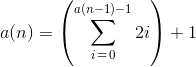
which is derived from this relationship modified from that provided in the sequence:
a(n+1) = a(n) * (a(n) - 1) + 1.
C, 43, 34, 33 bytes
1-indexed:
F(n){return--n?n=F(n),n*n-n+1:2;}
Test main:
int main() {
  printf("%d\n", F(1));
  printf("%d\n", F(2));
  printf("%d\n", F(3));
  printf("%d\n", F(4));
  printf("%d\n", F(5));
}
Scala, 85 bytes (51?)
val s:Stream[BigInt]=2#::3#::s.tail.map{c=>c*c-c+1}
print(s.take(args(0).toInt).last)
3 less if I stick with an Int. The stream bit which actually does all the work is 51 bytes. The rest is just printing
Usage:
$ scala sylvester.scala 20
Jellyfish, 13 bytes
p
\Ai
&(*
><2
Explanation
Let's start from the bottom up:
(*
<
This is a hook, which defines a function f(x) = (x-1)*x.
&(*
><
This composes the previous hook with the increment function so it gives us a function g(x) = (x-1)*x+1.
\Ai
&(*
><
Finally, this generates a function h which is an iteration of the previous function g, as many times as given by the integer input.
\Ai
&(*
><2
And finally, we apply this iteration to the initial value 2. The p at the top just prints the result.
Alternative (also 13 bytes)
p
>
\Ai
(*
>1
This defers the increment until the very end.
J, 18 14 12 bytes
This version thanks to randomra. I'll try to write a detailed explanation later.
0&(]*:-<:)2:
J, 14 bytes
This version thanks to miles. Used the power adverb ^: instead of an agenda as below. More explanation to come.
2(]*:-<:)^:[~]
J, 18 bytes
2:`(1+*/@$:@i.)@.*
0-indexed.
Examples
   e =: 2:`(1+*/@$:@i.)@.*
   e 1
3
   e 2
7
   e 3
43
   e 4
1807
   x: e i. 10
2 3 7 43 1807 3263443 10650056950807 113423713055421862298779648 12864938683278674737956996400574416174101565840293888 1655066473245199944217466828172807675196959605278049661438916426914992848    91480678309535880456026315554816
   |: ,: x: e i. 10
                                                                                                        2
                                                                                                        3
                                                                                                        7
                                                                                                       43
                                                                                                     1807
                                                                                                  3263443
                                                                                           10650056950807
                                                                              113423713055421862298779648
                                                    12864938683278674737956996400574416174101565840293888
165506647324519994421746682817280767519695960527804966143891642691499284891480678309535880456026315554816
Explanation
This is an agenda that looks like this:
           ┌─ 2:
           │    ┌─ 1
       ┌───┤    ├─ +
       │   └────┤           ┌─ / ─── *
── @. ─┤        │     ┌─ @ ─┴─ $:
       │        └─ @ ─┴─ i.
       └─ *
(Generated using (9!:7)'┌┬┐├┼┤└┴┘│─' then 5!:4<'e')
Decomposing:
       ┌─ ...
       │
── @. ─┤
       │
       └─ *
Using the top branch as a the gerund G, and the bottom as the selector F, this is:
e n <=> ((F n) { G) n
This uses the constant function 2: when 0 = * n, that is, when the sign is zero (thus n is zero). Otherwise, we use this fork:
  ┌─ 1
  ├─ +
──┤           ┌─ / ─── *
  │     ┌─ @ ─┴─ $:
  └─ @ ─┴─ i.
Which is one plus the following atop series:
            ┌─ / ─── *
      ┌─ @ ─┴─ $:
── @ ─┴─ i.
Decomposing further, this is product (*/) over self-reference ($:) over range (i.).
Batch, 70 bytes
@set/ap=r=2
@for /l %%i in (1,1,%1)do @set/at=p,p*=r,r=t+1
@echo %r%
Zero indexed, uses @LeakyNun's recurrence relation. Conveniently set/a works inside a for loop, because I'm not using % substitution.
R, 50 46 44 bytes
n=scan();v=2;if(n)for(i in 1:n){v=v^2-v+1};v
Rather than tracking the whole sequence, we just keep track of the product, which follows the given quadratic update rule as long as n>1 n>0. (This sequence uses the "start at one zero" convention)
Using the start at zero convention saves a couple of bytes since we can use if(n) rather than if(n>1)
Haskell, 25 bytes
(iterate(\m->m*m-m+1)2!!)
05AB1E, 7 bytes
2sFD<*>
Explained
Uses zero-based indexing.
2         # push 2 (initialization for n=0)
 sF       # input nr of times do
   D<*    # x(x-1)
      >   # add 1
Haskell, 26 bytes
f n|n<1=2|m<-f$n-1=1+m*m-m
Usage example: f 4 -> 1807.
Actually, 14 12 bytes
This used 0-indexing. Golfing suggestions welcome. Try it online!
2#,`;πu@o`nF
Ungolfing:
2#              Start with [2]
  ,`     `n     Take 0-indexed input and run function (input) times
    ;           Duplicate list
     πu         Take product of list and increment
       @o       Swap and append result to the beginning of the list
           F    Return the first item of the resulting list
Actually, 9 bytes
2@`rΣτu`n
Uses this relationship instead:
which is derived from this relationship modified from that provided in the sequence:
a(n+1) = a(n) * (a(n) - 1) + 1.
Jelly, 5 bytes
Ḷ߀P‘
This uses 0-based indexing and the definition from the challenge spec.
Try it online! or verify all test cases.
How it works
Ḷ߀P‘  Main link. Argument: n

Ḷ      Unlength; yield [0, ..., n - 1].
 ߀    Recursively apply the main link to each integer in that range.
   P   Take the product. This yields 1 for an empty range.
    ‘  Increment.
Cheddar, 26 bytes
n g->n?g(n-=1)**2-g(n)+1:2
Pretty idiomatic.
Explanation
n g ->    // Input n, g is this function
  n ?     // if n is > 1
    g(n-=1)**2-g(n)+1   // Do equation specified in OEIS
  : 2     // if n == 0 return 2
Java 7, 46 42 bytes
int f(int n){return--n<0?2:f(n)*~-f(n)+1;}
Uses 0-indexing with the usual formula. I swapped n*n-n for n*(n-1) though, since Java doesn't have a handy power operator, and the f() calls were getting long.
Brain-Flak, 158 154 bytes
Leaky Nun has me beat here
({}<(()())>){({}[()]<<>(())<>([]){{}<>({}<<>(({}<>))><>)<>({<({}[()])><>({})<>}{})<>{}([])}{}<>({}())([]){{}({}<>)<>([])}{}<>>)}{}([][()]){{}{}([][()])}{}
Explanation
Put a two under the input a(0)
({}<(()())>)
While the input is greater than zero subtract one from the input and...
{
({}[()]
Silently...
<
Put one on the other stack to act as a catalyst for multiplication <>(())<>
While the stack is non-empty
 ([])
 {
  {}
Move the top of the list over and copy
<>({}<<>(({}<>))><>)
Multiply the catalyst by the copy
  <>({<({}[()])><>({})<>}{})<>{}
  ([])
 }
 {}
Add one
<>({}())
Move the sequence back to the proper stack
 ([])
 {
 {}
 ({}<>)<>
 ([])
 }
 {}
 <>
>)
}{}
Remove all but the bottom item (i.e. the last number created)
([][()])
{
{}
{}
([][()])
}
{}
Python, 38 36 bytes
2 bytes thanks to Dennis.
f=lambda n:0**n*2or~-f(n-1)*f(n-1)+1
Uses this relationship modified from that provided in the sequence instead:
a(n+1) = a(n) * (a(n) - 1) + 1
Explanation
0**n*2 returns 2 when n=0 and 0 otherwise, because 0**0 is defined to be 1 in Python.
Perl6, 49 bytes
my &f={my @c=2;@c.push: 1+[*] @c for ^$_;@c[*-1]}
Ungolfed:
sub f($n) {
  my @sylvester = 2; # declare an array to store the previous
                     # values of the sequence
  # insert S(1) ... S(n) (n iterations)
  @sylvester.push(1 + [*] @sylvester) for 0..^$n;
  return @sylvester[* - 1]; # return last element
}
C, 46 bytes
s(n,p,r){for(p=r=2;n-->0;p*=r)r=p+1;return r;}
Uses p as the temporary storage of the product.
Basically, I defined two sequences p(n) and r(n), where r(n)=p(n-1)+1 and p(n)=p(n-1)*r(n).
r(n) is the required sequence.
Jelly, 7 bytes
²_’
2Ç¡
Uses this relationship provided in the sequence instead: a(n+1) = a(n)^2 - a(n) + 1
Explanation
2Ç¡   Main chain, argument in input

2     Start with 2
  ¡   Repeat as many times as the input:
 Ç        the helper link.


²_’   Helper link, argument: z
²     z²
  ’   z - 1
 _    subtraction, yielding z² - (z-1) = z² - z + 1