| Bytes | Lang | Time | Link |
|---|---|---|---|
| 056 | Juby | 250506T164315Z | Jordan |
| 005 | Thunno 2 S | 230507T083509Z | The Thon |
| 054 | Scala | 230504T011857Z | 138 Aspe |
| 004 | Japt hx | 230503T110849Z | Shaggy |
| 046 | FunStack alpha | 230503T212922Z | DLosc |
| 011 | J | 230503T190435Z | south |
| 005 | Vyxal sm | 230419T122837Z | emirps |
| 019 | dc | 180530T163651Z | Toby Spe |
| 050 | Perl 5 | 160422T124221Z | Sake |
| 006 | Pyt | 180217T163839Z | mudkip20 |
| 036 | R | 180216T155823Z | Michael |
| 049 | Java 8 | 160421T124925Z | Kevin Cr |
| 060 | R | 160730T233953Z | Forgotte |
| 010 | MATL | 160421T132559Z | Luis Men |
| 064 | PHP | 160707T152219Z | Business |
| 030 | Mathematica | 160523T151911Z | DavidC |
| 053 | Clojure | 160523T132824Z | cliffroo |
| 036 | Reng v.3.3 | 160421T160019Z | Conor O& |
| 057 | Factor | 160422T013327Z | cat |
| 026 | Julia | 160422T005227Z | Dennis |
| 086 | bash + bc | 160422T101935Z | rexkogit |
| 015 | CJam | 160421T115413Z | A Simmon |
| 023 | Octave | 160421T120356Z | Stewie G |
| 097 | Oracle SQL 11.2 | 160422T082532Z | Jeto |
| 007 | Actually | 160422T041734Z | user4594 |
| 048 | C | 160421T173449Z | DJMcMayh |
| 029 | Julia | 160421T204527Z | Alex A. |
| 007 | Pyke | 160421T184859Z | Blue |
| 031 | Haskell | 160421T155423Z | nimi |
| 026 | PARI/GP | 160421T172156Z | Charles |
| 057 | Racket | 160421T181324Z | Winny |
| 030 | Haskell | 160421T174905Z | xnor |
| 032 | Ruby | 160421T174155Z | Value In |
| 038 | Python 2 | 160421T173328Z | xnor |
| 031 | Mathcad | 160421T173222Z | Stuart B |
| 038 | Python | 160421T151811Z | orlp |
| 039 | Python | 160421T162416Z | xnor |
| 049 | Python 3 | 160421T150537Z | 8BitTRex |
| 010 | Pyth | 160421T153929Z | izzyg |
| 049 | Python 2 | 160421T150844Z | mbomb007 |
| 006 | Jelly | 160421T141445Z | Dennis |
| 007 | Jelly | 160421T135147Z | FryAmThe |
| 008 | 05AB1E | 160421T122903Z | Adnan |
| 030 | JavaScript ES6 | 160421T125058Z | Neil |
| 131 | C# | 160421T115033Z | Thomas |
Thunno 2 S-, 5 bytes
ƭRœɗ²
Thunno 2, 7 bytes
⁻ƭRœɗ²S
Alternatively, a port of Dennis's Jelly answer:
ƭṃ1Æ|3c
Explanation
ƭRœɗ²  # Implicit input
       # - flag decrements the input
ƭ      # Square root of (input - 1)
 R     # Pop and push [1..that]
  œɗ   # Only keep odd numbers
    ²  # Square each number in this list
       # S flag sums the list
       # Implicit output
ƭṃ1Æ|3c  # Implicit input
ƭṃ       # Push ceil(sqrt(input))
  1Æ|    # Bitwise OR with 1
     3c  # Get nCr with r=3
         # Implicit output
Screenshot

Scala, 54 bytes
Golfed version. Try it online!
def f(n:Int)=(1 to n by 2).map(x=>x*x).filter(_<n).sum
57 bytes version:
def f(n:Int)=(1 to n by 2).map(x=>x*x).takeWhile(_<n).sum
Japt -hx, 6 4 bytes
¬o²ó
¬o²ó     :Implicit input of integer
¬        :Square root
 o       :Range [0,ceil(¬))
  ²      :Square each
   ó     :Uninterleave
         :Implicit output of sum of last element
FunStack alpha, 46 bytes
Sum Greater? @0 takewhile Square Inc Double #N
Try it at Replit!
Explanation
Compute the infinite list of odd square numbers:
                  #N  Infinite list of natural numbers
           Double     Each times 2
       Inc            Each plus 1
Square                Each squared
Sum those that are less than the input:
                takewhile  Take elements from the list while this function is true:
             @0             First program argument
    Greater?                is greater than the list element
Sum                        Sum those elements
Vyxal sm, 5 bytes
~∷~∆²
~     # range 1..n-1 (due to m flag) filtered by
 ∷    # is odd
  ~   # filtered by
   ∆² # is a perfect square
      # sum is taken by s flag
dc, 19 bytes
1-v1+2/dd+1+d2-**3/
This uses the closed-form formula ⅓k(2k+1)(2k-1) for the largest k such that (2k-1)² < n
Ungolfed version
As a full program:
#!/usr/bin/dc -f

?                   # input

1-v1+2/             # k
dd+1+d2-            # k, 2k+1, 2k-1
**3/                # multply

p                   # output
Perl 5, 51 50 bytes
-1 byte thanks to TuukkaX.
Not sure if I can golf this more...
$s=0;map{$_%2?$s+=$_**2:()}(1..(<>-1)**.5);print$s
map checks whether the current value in the array [1.. sqrt(input-1)] is odd or even. If it's odd, increase $s with the odd number squared.
R, 38 36 bytes
function(n,x=(2*0:n+1)^2)sum(x[x<n])
@Giuseppe saved two bytes by moving x into the arguments list to save the curly braces. Cool idea!
Ungolfed
function(n, x = (2*(0:n) + 1)^2)  # enough odd squares (actually too many)
  sum(x[x < n])                   # subset on those small enough
}
Java 8, 128 119 117 111 49 bytes
n->{int s=0,i=1;for(;i*i<n;i+=2)s+=i*i;return s;}
Based on @Thomas' C# solution.
Explanation:
n->{           // Method with integer as both parameter and return-type
  int s=0,     //  Sum, starting at 0
      i=1;     //  Index-integer, starting at 1
  for(;i*i<n;  //  Loop as long as the square of `i` is smaller than the input
      i+=2)    //    After every iteration, increase `i` by 2
    s+=i*i;    //   Increase the sum by the square of `i`
  return s;}   //  Return the result-sum
R, 60 bytes
function(n){i=s=0;while((2*i+1)^2<n){s=s+(2*i+1)^2;i=i+1};s}
Does exactly as described in challenge, including returning 0 for the n = 1 case. Degolfed, ';' represents linebreak in R, ignored below:
function(n){         # Take input n
i = s = 0            # Declare integer and sum variables
while((2*i+1)^2 < n) # While the odd square is less than n
s = s + (2*i+1)^2    # Increase sum by odd square
i = i + 1            # Increase i by 1
s}                   # Return sum, end function expression
MATL, 10 bytes
qX^:9L)2^s
EDIT (July 30, 2016): the linked code replaces 9L by 1L to adapt to recent changes in the language.
q    % Implicit input. Subtract 1
X^   % Square root
:    % Inclusive range from 1 to that
9L)  % Keep odd-indexed values only
2^   % Square
s    % Sum of array
PHP, 64 bytes
function f($i){$a=0;for($k=-1;($k+=2)*$k<$i;$a+=$k*$k);echo $a;}
Expanded:
function f($i){
    $a=0;
    for($k=-1; ($k+=2)*$k<$i; $a+=$k*$k);
    echo $a;
}
On every iteration of the for loop, it will add 2 to k and check if k2 is less than $i, if it is add k2 to $a.
Mathematica 30 bytes
Total[Range[1,Sqrt[#-1],2]^2]&
This unnamed function squares all odd numbers less than the input (Range[1,Sqrt[#-1],2]) and adds them.
Clojure, 53 bytes
#(reduce +(map(fn[x](* x x))(range 1(Math/sqrt %)2)))
You can check it here: https://ideone.com/WKS4DA
Reng v.3.3, 36 bytes
0#ci#m1ø>$a+¡n~
:m%:1,eq^c2*1+²c1+#c
Explanation
1: initialization
0#ci#m1ø
Sets c to 0 (the counter) and the input I to the max. 1ø goes to the next line.
2: loop
:m%:1,eq^c2*1+²c1+#c
: duplicates the current value (the squared odd number) and [I m puts max down. I used the less-than trick in another answer, which I use here. %:1,e checks if the STOS < TOS. If it is, q^ goes up and breaks out of the loop. Otherwise:
c2*1+²c1+#c
c puts the counter down, 2* doubles it, 1+ adds one, and ² squares it. c1+#C increments c, and the loop goes again.
3: final
>$a+¡n~
$ drops the last value (greater than desired), a+¡ adds until the stack's length is 1, n~ outputs and terminates.
Factor, 58 57 bytes
[| n | n 2 * iota [ 2 * 1 + 2^ ] map [ n < ] filter sum ]
Well, this was simpler than I thought!
[| n |       ! new local var n
    n 2 *    ! double n
    iota     ! fixnum>range
    [
        2 *  ! double
        1 +  ! + 1
        2^  ! square
    ] map    ! each item in range(0, n*2)
    [
        n <  ! entries over n
    ] filter ! keep-only
    sum ]    ! sum the resulting array
Unit tests, if you like:
{ 0 }  [ 1  sum-odds-lt ] unit-test
{ 1 }  [ 2  sum-odds-lt ] unit-test
{ 1 }  [ 9  sum-odds-lt ] unit-test
{ 10 } [ 10 sum-odds-lt ] unit-test
{ 156849 } [ 9801 sum-odds-lt ] unit-test
{ 166650 } [ 9802 sum-odds-lt ] unit-test
{ 166650 } [ 10000 sum-odds-lt ] unit-test
Julia, 26 bytes
x->sum((r=1:2:x-1)∩r.^2)
This constructs the range of all odd, positive integers below n and the array of the squares of the integers in that range, then computes the sum of the integers in both iterables.
bash + bc, 86 bytes
s=0
for((n=0;;n++));{
w=`bc<<<"(2*$n+1)^2"`
[ $w -ge $1 ]&&break;
s=$((s+w))
}
echo $s
This piece of code is quite self explaining, as it simply sums up the values. It is not quite a magic code, as formatting it properly helps... The stop condition is not in the header of the loop, but after evaluating the step and before adding, since here we have all the values we need without initalising them beforehand.
CJam, 15 Bytes
qi(mq,2%:)2f#1b
Hardcoded 10000 solutions:
Martin's 12 byte solution:
99,2%:)2f#1b
My original 13 byte solution:
50,{2*)2#}%:+
Octave, 23 bytes
@(x)(x=1:2:(x-1)^.5)*x'
Testing:
[f(1); f(2); f(3); f(10); f(9801); f(9802); f(10000)]
ans =
        0
        1
        1
       10
   156849
   166650
   166650
Oracle SQL 11.2, 97 bytes
SELECT NVL(SUM(v),0)FROM(SELECT POWER((LEVEL-1)*2+1,2)v FROM DUAL CONNECT BY LEVEL<:1)WHERE v<:1;
Actually, 7 bytes
√K1|3@█
Also for 7 bytes:
3,√K1|█
This uses the same formula as in Dennis's Jelly answer.
Explanation:
√K1|3@█
√K       push ceil(sqrt(n))
  1|     bitwise-OR with 1
    3@█  x C 3
C, 51, 50 48 bytes
f(n,s,i)int*s;{for(*s=0,i=1;i*i<n;i+=2)*s+=i*i;}
Because why not golf in one of the most verbose languages? (Hey, at least it's not Java!)
Full ungolfed program, with test I/O:
int main()
{
    int s;
    f(10, &s);
    printf("%d\n", s);
    char *foobar[1];
    gets(foobar);
}

f(n,s,i)int*s;{for(*s=0,i=1;i*i<n;i+=2)*s+=i*i;}
Julia, 29 bytes
f(n,i=1)=i^2<n?i^2+f(n,i+2):0
This is a recursive function that accepts an integer and returns an integer.
We start an index at 1 and if its square is less than the input, we take the square and add the result of recusing on the index + 2, which ensures that even numbers are skipped, otherwise we return 0.
Pyke, 7 bytes (noncompetitive)
Add up_to function which repeats until the rtn is above inp.
#}hX)Os
Explanation:
#   )   -  While rtn < input:
        -   i = 0
 }hX    -    rtn = ((i*2)+1)**2
        -   i+=1
     O  -  rtn[:-1]
      s - sum(^)
Haskell, 32 31 bytes
 n#x=sum[x^2+n#(x+2)|x^2<n]
 (#1)
Usage example: (#1) 9802 -> 166650.
Edit: @xnor saved a byte, with a clever list comprehension. Thanks!
PARI/GP, 33 32 26 bytes
Adapted from Dennis' code:
n->t=(1-n^.5)\2*2;(t-t^3)/6
My first idea (30 bytes), using a simple polynomial formula:
n->t=((n-1)^.5+1)\2;(4*t^3-t)/3
This is an efficient implementation, actually not very different from the ungolfed version I would write:
a(n)=
{
  my(t=ceil(sqrtint(n-1)/2));
  t*(4*t^2-1)/3;
}
An alternate implementation (37 bytes) which loops over each of the squares:
n->s=0;t=1;while(t^2<n,s+=t^2;t+=2);s
Another alternate solution (35 bytes) demonstrating summing without a temporary variable:
n->sum(k=1,((n-1)^.5+1)\2,(2*k-1)^2)
Yet another solution, not particularly competitive (40 bytes), using the L2 norm. This would be better if there was support for vectors with step-size indices. (One could imagine the syntax n->norml2([1..((n-1)^.5+1)\2..2]) which would drop 8 bytes.)
n->norml2(vector(((n-1)^.5+1)\2,k,2*k-1))
Racket, 57 bytes
(λ(n)(for/sum([m(map sqr(range 1 n 2))]#:when(< m n))m))
Haskell, 30 bytes
f n=sum[x^2|x<-[1,3..n],x^2<n]
Surprisingly normal-looking.
Ruby, 32 bytes
f=->n,i=1{i*i<n ?i*i+f[n,i+2]:0}
Python 2, 38 bytes
s=(1-input()**.5)//2*2;print(s-s**3)/6
Based off Dennis's formula, with s==-2*k. Outputs a float. In effect, the input is square rooted, decremented, then rounded up to the next even number.
Mathcad, 31 "bytes"
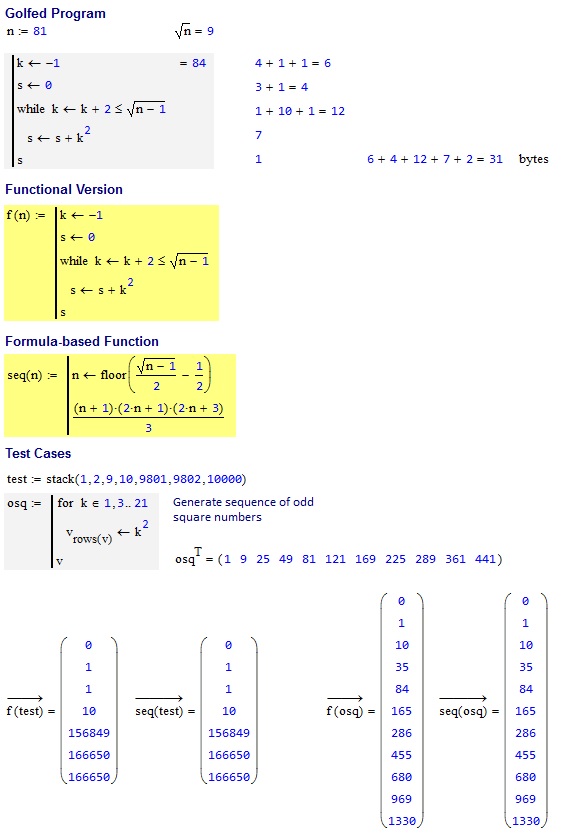
Note that Mathcad uses keyboard shortcuts to enter several operators, including the definition and all programming operators. For example, ctl-] enters a while loop - it cannot be typed and can only be entered using the keyboard shortcut or from the Programming toolbar. "Bytes" are taken to be the number of keyboard operations needed to enter a Mathcad item (eg, variable name or operator).
As I have no chance of winning this competition, I thought I'd add a bit of variety with a direct formula version.
Python, 42 38 bytes
f=lambda n,i=1:i*i<n and i*i+f(n,i+2)
Python, 39 bytes
f=lambda n,i=1:+(i*i<n)and i*i+f(n,i+2)
If, for n=1, it's valid to output False rather than 0, then we can avoid the base case conversion to get 37 bytes
f=lambda n,i=1:i*i<n and i*i+f(n,i+2)
It's strange that I haven't found a shorter way to get 0 for i*i>=n and nonzero otherwise. In Python 2, one still gets 39 bytes with
f=lambda n,i=1:~-n/i/i and i*i+f(n,i+2)
Python 3, 61 49 bytes
lambda n:sum(i*i for i in range(1,n,2)if i*i<n)
plenty of savings, thanks for helping me out
Pyth, 10 bytes
s<#Qm^hyd2
Explanation:
s<#Qm^hyd2
    m          Map over the range of input (0 ... input - 1)
       yd      Double the number
      h        Add 1
     ^   2     Square it
 <#            Filter the resulting list on being less than
   Q           The input
s              Add up what's left
Python 2, 49 bytes
This ended up being shorter than a lambda.
x=input()
i=1;k=0
while i*i<x:k+=i*i;i+=2
print k
My shortest lambda, 53 bytes:
lambda x:sum((n-~n)**2for n in range(x)if(n-~n)**2<x)
Jelly, 6 bytes
½Ċ|1c3
Try it online! or verify all test cases.
Background
For all positive integers k, we have 1² + 3² + ⋯ + (2k - 1)² = k(2k - 1)(2k +1) ÷ 3.
Since there are m C r = m! ÷ ((m-r)!r!) r-combinations of a set of m elements, the above can be calculated as (2k + 1) C 3 = (2k + 1)2k(2k - 1) ÷ 6 = k(2k - 1)(2k + 1) ÷ 3.
To apply the formula, we must find the highest 2k + 1 such that (2k - 1)² < n. Ignoring the parity for a moment, we can compute the highest m such that (m - 1)² < n as m = ceil(srqt(n)). To conditionally increment m if it is even, simply compute m | 1 (bitwise OR with 1).
How it works
½Ċ|1c3  Main link. Argument: n

½       Compute the square root of n.
 Ċ      Round it up to the nearest integer.
  |1    Bitwise OR with 1 to get an odd number.
    c3  Compute (2k + 1) C 3 (combinations).
Jelly, 7
’½R²m2S
Try it online or try a modified version for multiple values
Shh... Dennis is sleeping...
Thanks to Sp3000 in chat for their help!
Explanation:
’½R²m2S
’           ##  Decrement to prevent off-by-one errors
 ½R²        ##  Square root, then floor and make a 1-indexed range, then square each value
    m2      ##  Take every other value, starting with the first
      S     ##  sum the result
05AB1E, 10 8 bytes
Code:
<tLDÉÏnO
Explanation:
<         # Decrease by 1, giving a non-inclusive range.
 t        # Take the square root of the implicit input.
  L       # Generate a list from [1 ... sqrt(input - 1)].
   DÉÏ    # Keep the uneven integers of the list.
      n   # Square them all.
       O  # Take the sum of the list and print implicitly.
Might come in handy: t;L·<nO.
Uses CP-1252 encoding. Try it online!.
JavaScript (ES6), 30 bytes
f=(n,i=1)=>n>i*i&&i*i+f(n,i+2)
31 bytes if f(1) needs to return zero instead of false:
f=(n,i=1)=>n>i*i?i*i+f(n,i+2):0
C#, 126 131 bytes
Edited version to conform with the new question:
class P{static void Main(){int x,s=0,n=int.Parse(System.Console.ReadLine());for(x=1;x*x<n;x+=2)s+=x*x;System.Console.Write(s);}}
Using hardcoded limit:
using System;namespace F{class P{static void Main(){int x,s=0;for(x=1;x<100;x+=2)s+=x*x;Console.Write(s);Console.Read();}}}