| Bytes | Lang | Time | Link |
|---|---|---|---|
| nan | Pxem rpxem v0.0.7 | 240910T125723Z | 鳴神裁四点一号 |
| 082 | MATL | 160203T014137Z | Luis Men |
| 127 | Julia | 220717T090205Z | Czylabso |
| 139 | Pxem ABORT_ILLEGAL_INTEGER=0 | 210813T020610Z | user1004 |
| 181 | TSQL | 200309T140309Z | t-clause |
| 030 | Mathematica | 200311T134340Z | DavidC |
| 062 | LabVIEW | 160203T111925Z | Eumel |
| 110 | PowerShell | 200309T144812Z | Veskah |
| 115 | PowerShell | 200309T155322Z | mazzy |
| 164 | Swift | 200309T115952Z | sam-w |
| 176 | APL Dyalog Unicode | 200302T203201Z | Jeff Zei |
| 034 | 05AB1E | 200303T132934Z | Kevin Cr |
| 147 | Kotlin | 180102T202643Z | jrtapsel |
| 078 | K oK | 180102T180811Z | mkst |
| 097 | Vitsy | 160203T014501Z | Addison |
| 131 | Lua 5.3 | 160207T062234Z | tehtmi |
| 120 | Python 2 | 160203T080536Z | Sp3000 |
| 060 | CJam | 160204T153214Z | kaine |
| 140 | C | 160203T102540Z | Alexande |
| 162 | C | 160204T135505Z | Cole Cam |
| 161 | Python 2 | 160203T083846Z | Alexande |
| 144 | JavaScript | 160203T233012Z | Christal |
| 096 | Perl 6 | 160203T183534Z | Brad Gil |
| 077 | Japt | 160203T171407Z | ETHprodu |
| 097 | Retina | 160203T013531Z | Digital |
| 124 | Perl 5 | 160203T085356Z | ChatterO |
| 165 | Java 8 lambda | 160203T031914Z | Addison |
| 107 | JavaScript ES6 | 160203T013513Z | ETHprodu |
| 200 | JavaScript ES6 | 160203T012744Z | Conor O& |
| 104 | dc | 160203T012125Z | Digital |
Pxem (rpxem v0.0.7), 0 + 115 = 115 bytes
Golfed off 139-byte answer!
Filename ([\xHH] means such binary of character)
[\x01].r[\x19]quarter[\x0A]dime[\x05]nickel[\x01]penny._.i6.+.!.i0.-[\x0A].!.+._.+.tA.w.c.m[\x01].+.y.c.m.$.n.m.%.tAB .x.o.c[\x0A].a .oXXx.aAB.x.s.c[\x0A].a.c.a
Input format
Due to rpxem's implementation I had to force fractions part to be exactly two-digit: therefore inputs such as 0.1 have to be fixed to 0.10.
Explained
Program overall:
[\x01].r[\x19]quarter[\x0A]dime[\x05]nickel[\x01]penny
._.i6.+.!
.i0.-[\x0A].!.+
._.+.t
A.w
  .c.m[\x01].+.y
    .c.m.$.n
    .m.%.t
    AB .x.o.c[\x0A].a .o
  XXx.a
  AB.x.s.c[\x0A].a
.c.a
Set stack to 25, "quarter", 10, "dime", 5, "nickel", 1, "penny", 0. The last 0 is the sentry:
[\x01].r[\x19]quarter[\x0A]dime[\x05]nickel[\x01]penny
Given a decimal input, multiply 100.
Get integer part and a period (0x2E, which is 46 in decimal). Then multiple the integer with 100 (= 46 (".") + 54 ("6")):
._.i6.+.!
Get one digit as character. Then interpret as a integer to multiple it with 10 to add to result of previous chunk:
.i0.-[\x0A].!.+
Now read the final digit to add to the result of previous chunk. Now store the result to the register.
._.+.t
Loop 1. do { ... } while @stack.pop != 0:
A.w
  .c.m[\x01].+.y.c.m.$.n.m.%.tAB .x.o.c[\x0A].a .oXXx.aAB.x.s.c[\x0A].a
.c.a
Compare coin value (top of stack) and given input as cents (register). If (coin value) < (input as cents + 1), enter the block. Otherwise don't:
  .c.m[\x01].+.y
    .c.m.$.n.m.%.tAB .x.o.c[\x0A].a .o
  XXx.a
Output register divided by coin value:
.c.m.$.n
Update register to register modulo coin value:
.m.%.t
Now top of stack is first character of coin name. Output coin name, with leading and trailing spaces:
AB .x.o.c[\x0A].a .o
Before getting out of the block push "x", which is greater than \x0A:
XXx.a
Let top of stack to next coin value (or the sentry zero):
AB.x.s.c[\x0A].a
Break the loop if reached to sentry zero (remember .w):
.c.a
Reached to end of program: program terminates.
MATL, 82 106 107
'%i quarter %i dime %i nickel %i penny'i[.25 .1 .05]"@2#\w]100*Yo5$YD'0 \S+ ?'[]YX
Try it at MATL Online!
Julia, 128 127 bytes
- -1 byte: @MarcMush
readable version:
!s=(
  x=floor(Int,100s);
  join("$v $w "^(v>0) for (v,w)=zip(
      [25,10,5,1].|>u->(t=x÷u;x=x%u;t),"quarter dime nickel penny"|>split
    )
  )
)
Pxem (ABORT_ILLEGAL_INTEGER=0), 139 bytes (filename only).
Backslash followed by four-digit of octet character means a character with the codepoint.
Also this uses a implementation-defined feature that "pushes zero for non-integer input for ._", which is adopted from nk.'s pxemi.7z (though the implementation is terrible).
._\0012.!.i.s.i0.-.+\0012.!._.+.c\0030.x.c\0031.$.n\0031.%.t quarter .p.mBB.a.c\0011.x.c\0012.$.n\0012.%.t dime .p.mBB.a.c\0004.x.c\0005.$.n\0005.$.t nickel .p.mBB.a.c.w.n penny.p.d.a
Usage
- Full program.
- stdin/stdout.
- Input shall be a line and shall match this POSIX ERE:
^[0-9]+\.[0-9][0-9]?$
T-SQL, 181 bytes
I added some linebreaks to make it readable
DECLARE @2 decimal(10,2)=1.43

DECLARE @ INT=@2*100
SELECT string_agg(left(nullif(c,0),99)
+' '+trim(substring('quarterdime    nickle  penny',b*8,8)),' ')
FROM(values(0,@/25),(1,@%25/10),(2,@%25%10/5),(3,@%5))p(b,c)
Mathematica 30 bytes
This submission may not qualify, as it makes use of a readily available built-in! But some may find it useful for understanding the connection to Frobenius equations.
The task can be understood as a search for all solutions to the Frobenius equation, 25q+10d+5n+p=t, where q, d, n, p, and t, represent quarters, dimes, nickels, pennies, and total, respectively.
FrobeniusSolve[{25,10,5,1},#]&
The Frobenius equation 25q+10d+5n+p=100 represents all cases that sum to 100 cents.
The first solution, below, represents 100 pennies; the second solution represents 1 nickel and 95 pennies. And so on...
FrobeniusSolve[{25,10,5,1},100]


{{0, 0, 0, 100}, {0, 0, 1, 95}, {0, 0, 2, 90}, {0, 0, 3, 85}, {0, 0, 4, 80}, {0, 0, 5, 75}, {0, 0, 6, 70}, {0, 0, 7, 65}, {0, 0, 8, 60}, {0, 0, 9, 55}, {0, 0, 10, 50}, {0, 0, 11, 45}, {0, 0, 12, 40}, {0, 0, 13, 35}, {0, 0, 14, 30}, {0, 0, 15, 25}, {0, 0, 16, 20}, {0, 0, 17, 15}, {0, 0, 18, 10}, {0, 0, 19, 5}, {0, 0, 20, 0}, {0, 1, 0, 90}, {0, 1, 1, 85}, {0, 1, 2, 80}, {0, 1, 3, 75}, {0, 1, 4, 70}, {0, 1, 5, 65}, {0, 1, 6, 60}, {0, 1, 7, 55}, {0, 1, 8, 50}, {0, 1, 9, 45}, {0, 1, 10, 40}, {0, 1, 11, 35}, {0, 1, 12, 30}, {0, 1, 13, 25}, {0, 1, 14, 20}, {0, 1, 15, 15}, {0, 1, 16, 10}, {0, 1, 17, 5}, {0, 1, 18, 0}, {0, 2, 0, 80}, {0, 2, 1, 75}, {0,2, 2, 70}, {0, 2, 3, 65}, {0, 2, 4, 60}, {0, 2, 5, 55}, {0, 2, 6, 50}, {0, 2, 7, 45}, {0, 2, 8, 40}, {0, 2, 9, 35}, {0, 2, 10, 30}, {0, 2, 11, 25}, {0, 2, 12, 20}, {0, 2, 13, 15}, {0, 2, 14, 10}, {0, 2, 15, 5}, {0, 2, 16, 0}, {0, 3, 0, 70}, {0, 3, 1, 65}, {0, 3, 2, 60}, {0, 3, 3, 55}, {0, 3, 4, 50}, {0, 3, 5, 45}, {0, 3, 6, 40}, {0, 3, 7, 35}, {0, 3, 8, 30}, {0, 3, 9, 25}, {0, 3, 10, 20}, {0, 3, 11, 15}, {0, 3, 12, 10}, {0, 3, 13, 5}, {0, 3, 14, 0}, {0, 4, 0, 60}, {0, 4, 1, 55}, {0, 4, 2, 50}, {0, 4, 3, 45}, {0, 4, 4, 40}, {0, 4, 5, 35}, {0, 4, 6, 30}, {0, 4, 7, 25}, {0, 4, 8, 20}, {0, 4, 9, 15}, {0, 4, 10, 10}, {0, 4, 11, 5}, {0, 4, 12, 0}, {0, 5, 0, 50}, {0, 5, 1, 45}, {0, 5, 2, 40}, {0, 5, 3, 35}, {0, 5, 4, 30}, {0, 5, 5, 25}, {0, 5, 6, 20}, {0, 5, 7, 15}, {0, 5, 8, 10}, {0, 5, 9, 5}, {0, 5, 10, 0}, {0, 6, 0, 40}, {0, 6, 1, 35}, {0, 6, 2, 30}, {0, 6, 3, 25}, {0, 6, 4, 20}, {0, 6, 5, 15}, {0, 6, 6, 10}, {0, 6, 7, 5}, {0, 6, 8, 0}, {0, 7, 0, 30}, {0, 7, 1, 25}, {0, 7, 2, 20}, {0, 7, 3, 15}, {0, 7, 4, 10}, {0, 7, 5, 5}, {0, 7, 6, 0}, {0, 8, 0, 20}, {0, 8, 1, 15}, {0, 8, 2, 10}, {0, 8, 3, 5}, {0, 8, 4, 0}, {0, 9, 0, 10}, {0, 9, 1, 5}, {0, 9, 2, 0}, {0, 10, 0, 0}, {1, 0, 0, 75}, {1, 0, 1, 70}, {1, 0, 2, 65}, {1, 0, 3, 60}, {1, 0, 4, 55}, {1, 0, 5, 50}, {1, 0, 6, 45}, {1, 0, 7, 40}, {1, 0, 8, 35}, {1, 0, 9, 30}, {1, 0, 10, 25}, {1, 0, 11, 20}, {1, 0, 12, 15}, {1, 0, 13, 10}, {1, 0, 14, 5}, {1, 0, 15, 0}, {1, 1, 0, 65}, {1, 1, 1, 60}, {1, 1, 2, 55}, {1, 1, 3, 50}, {1, 1, 4, 45}, {1, 1, 5, 40}, {1, 1, 6, 35}, {1, 1, 7, 30}, {1, 1, 8, 25}, {1, 1, 9, 20}, {1, 1, 10, 15}, {1, 1, 11, 10}, {1, 1, 12, 5}, {1, 1, 13, 0}, {1, 2, 0, 55}, {1, 2, 1, 50}, {1, 2, 2, 45}, {1, 2, 3, 40}, {1, 2, 4, 35}, {1, 2, 5, 30}, {1, 2, 6, 25}, {1, 2, 7, 20}, {1, 2, 8, 15}, {1, 2, 9, 10}, {1, 2, 10, 5}, {1, 2, 11, 0}, {1, 3, 0, 45}, {1, 3, 1, 40}, {1, 3, 2, 35}, {1, 3, 3, 30}, {1, 3, 4, 25}, {1, 3, 5, 20}, {1, 3, 6, 15}, {1, 3, 7, 10}, {1, 3, 8, 5}, {1, 3, 9, 0}, {1, 4, 0, 35}, {1, 4, 1, 30}, {1, 4, 2, 25}, {1, 4, 3, 20}, {1, 4, 4, 15}, {1, 4, 5, 10}, {1, 4, 6, 5}, {1, 4, 7, 0}, {1, 5, 0, 25}, {1, 5, 1, 20}, {1, 5, 2, 15}, {1, 5, 3, 10}, {1, 5, 4, 5}, {1, 5, 5, 0}, {1, 6, 0, 15}, {1, 6, 1, 10}, {1, 6, 2, 5}, {1, 6, 3, 0}, {1, 7, 0, 5}, {1, 7, 1, 0}, {2, 0, 0, 50}, {2, 0, 1, 45}, {2, 0, 2, 40}, {2, 0, 3, 35}, {2, 0, 4, 30}, {2, 0, 5, 25}, {2, 0, 6, 20}, {2, 0, 7, 15}, {2, 0, 8, 10}, {2, 0, 9, 5}, {2, 0, 10, 0}, {2, 1, 0, 40}, {2, 1, 1, 35}, {2, 1, 2, 30}, {2, 1, 3, 25}, {2, 1, 4, 20}, {2, 1, 5, 15}, {2, 1, 6, 10}, {2, 1, 7, 5}, {2, 1, 8, 0}, {2, 2, 0,  30}, {2, 2, 1, 25}, {2, 2, 2, 20}, {2, 2, 3, 15}, {2, 2, 4, 10}, {2, 2, 5, 5}, {2, 2, 6, 0}, {2, 3, 0, 20}, {2, 3, 1, 15}, {2, 3, 2, 10}, {2, 3, 3, 5}, {2, 3, 4, 0}, {2, 4, 0, 10}, {2, 4, 1, 5}, {2, 4, 2, 0}, {2, 5, 0, 0}, {3, 0, 0, 25}, {3, 0, 1, 20}, {3, 0, 2,  15}, {3, 0, 3, 10}, {3, 0, 4, 5}, {3, 0, 5, 0}, {3, 1, 0, 15}, {3,  1, 1, 10}, {3, 1, 2, 5}, {3, 1, 3, 0}, {3, 2, 0, 5}, {3, 2, 1, 0}, {4, 0, 0, 0}}
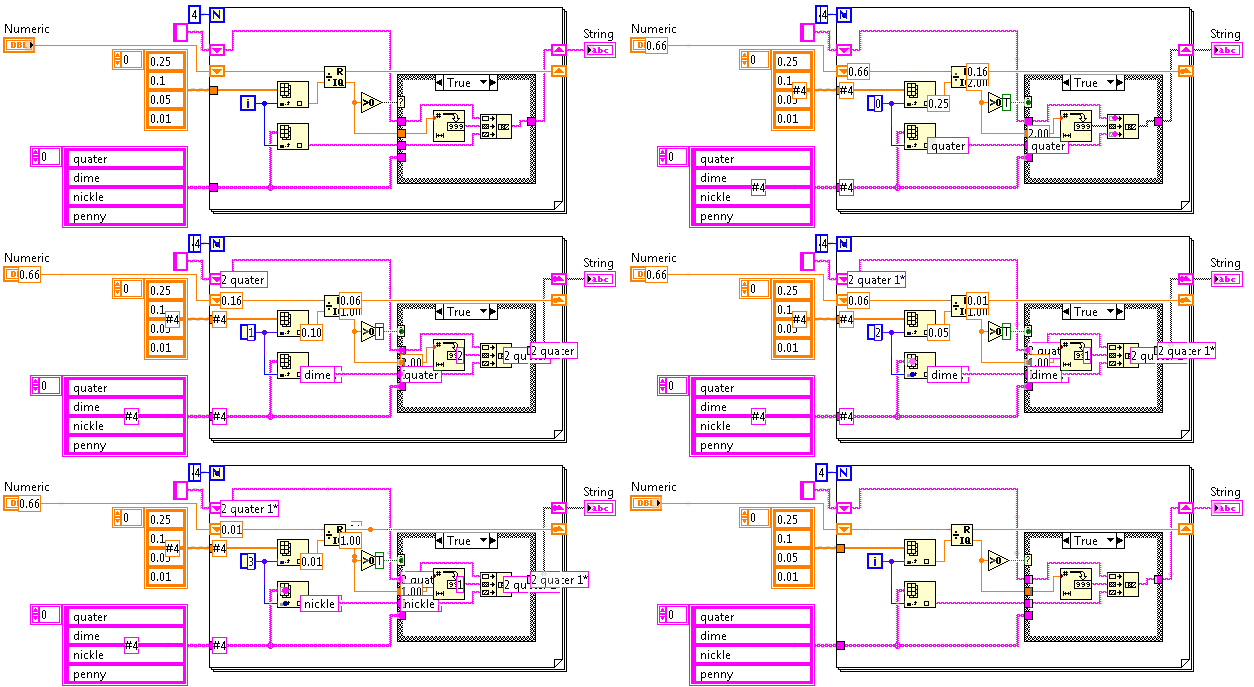
LabVIEW, 62 LabVIEW Primitives
I created 2 arrays for the names and values and iterate through them from the top (index array with i) using a modulo operator (the R IQ thing). The remaining coins are passed into the shift register.
If the value is bigger than 0 I convert the number to string and concatenate the passed down string, the number and the name of the coin and put it back into the shift register.
I just realized my gif doesn´t show the false case but there is nothing to see anyway, it just passes through the string that came in.
PowerShell, 133 131 130 123 110 bytes
-8 bytes by snagging several tricks from mazzy's answer
-13 bytes thanks directly to mazzy
$n=100*"$args"
''+(25,10,5,1|%{($y=$n/$_-replace'\..*');(echo quarter dime nickel penny)[$i++];$n%=$_}|?{+$y})
Each iteration (i.e. 25,10,5,1) generates two lines of output through the pipeline: the number and the coin size. |?{+$y} is a where clause that filters out both generations if $y is 0, which is the truncated result of $n/$coin_size.
PowerShell, 120 118 115 bytes
Inspired by Veskah
$n=100*"$args"
''+(25,10,5,1|%{for($i=0;($n-=$_)-ge0){++$i}$n+=$_
$i;(echo quarter dime nickel penny)[$p++]}|?{$i})
Swift, 164 bytes
Assuming input is i
let m=[("quarter",25),("dime",10),("nickel",5),("penny",1)]
var b=Int(i*100)
print(m.reduce(""){o,t in
let(n,v)=t,
x=Int(b/v)
b-=x*v
return x==0 ?o:o+"\(x) \(n) "})
APL (Dyalog Unicode), 185 176 bytes
{' '∘(1↓,(/⍨)1(⊢∨⌽)0,≠)⍕,⍉(z[1;]≠0)/z←'quarter' 'dime' 'nickel' 'penny',[0.5]⍨{(⌊(⍵÷25)),(⌊(25|⍵)÷10),(⌊(10|25|⍵)÷5),⌊5|⍵}⍵×100}
The decomposition is in two parts: Computation, and Formatting
Computation:
{(⌊(⍵÷25)),(⌊(25|⍵)÷10),(⌊(10|25|⍵)÷5),⌊5|⍵}⍵×100
{                                           }         A dfn that takes...
                                             ⍵×100    ...the input argument of the entire function, and multiplies by 100 to convert
                                                        from dollars-and-cents to cents, then generates a vector, consisting of ...
 (⌊(⍵÷25)),                                          ...the number of quarters, computed as the the round-down-to-integer of
                                                        the number of cents divided by 25, followed by...
           (⌊(25|⍵)÷10),                             ...the number of dimes, computed as the round-down-to-integer of the remainder of
                                                        the number of cents divided by 25, divided by 10, followed by...
                        (⌊(10|25|⍵)÷5),              ...the number of nickels, computed as the round-down-to-integer of the remainder
                                                        from dividing (the remainder of the number of cents divided by 25) by ten,
                                                        divided by five, followed by...
                                       ⌊5|⍵          ...the number of pennies, computed as the round-down-to-integer of the
                                                        remainder from dividing the number of cents by five.
Computation is complete, and gives a vector of coin counts; the remainder is formatting:
' '∘(1↓,(/⍨)1(⊢∨⌽)0,≠)⍕,⍉(z[1;]≠0)/z←'quarter' 'dime' 'nickel' 'penny',[0.5]⍨    Append the result of the computation to this expression
                                       'quarter' 'dime' 'nickel' 'penny'           Take a vector of coin names, and...
                                                                              ⍨    ...swap it with the computation result, then...
                                                                        ,[0.5]     ...append the two along a 'side-by-side' axis. This gives
                                                                                    a matrix which, if printed out, would have the coin counts
                                                                                    above the coin name.  Then...
                                    z←                                            ...assign it to a temporary variable, and...
                          (z[1;]≠0)                                               ...generate a vector of 1s and 0s such that the 0s in this
                                                                                    vector are in the same position as any 0s in the computation, then...
                                   /                                              ...use that vector to compress out the columns in the matrix where the
                                                                                    coin count is zero, then...
                         ⍉                                                        ...transpose the matrix along its main diagonal. This converts it to two
                                                                                    columns; left is coin counts, right is coin names. Then...
                        ,                                                         ..."unravel" the matrix into a linear vector; the result now has the coin
                                                                                     count followed by the coin name - but there will be too many spaces, so...
                      ⍕                                                          ...convert to a character representation instead of a vector of
                                                                                    mixed objects, then...
' '               0,≠                                                            ...this is a fork, with left argument being the space all the way at the
                                                                                    beginning (S), and right argument being the formatted string (F). It is
                                                                                    interpreted as S 0 F , S ≠ F. S ≠ F generates a vector C of 0s and 1s,
                                                                                    where the 0s are at the same positions as the spaces. S 0 F is a
                                                                                    constant 0. 0 , C prepends a 0 to the vector C (C2). Then...
            1(⊢∨⌽)                                                               ...we "go up a level" and see a new fork, 1 (⊢∨⌽) C2. This is interpreted
                                                                                    as S 1 F (which is constant 1) (⊢∨⌽) S C2 F (which is constant C2). The
                                                                                    central (⊢∨⌽) is itself a fork with arguments 1 and C2, so is interpreted
                                                                                    as (1⊢C2)∨(1⌽C2). Dyadic ⊢ is right-identity, or C2, and 1⌽C2 takes the
                                                                                    zero at the beginning of C2 and moves it to the end (C3). ∨ is logical OR,
                                                                                    so C2 OR C3 gives a vector C4 of 1s and 0s where the 0s are positioned to
                                                                                    correspond with the first space of a pair of consecutive spaces. This...
       ,(/⍨)                                                                     ...becomes the right argument to /⍨ with the left argument being S , F.
                                                                                    S , F is the formatted string with a space prepended (SF), so we now have
                                                                                    SF /⍨ C4. ⍨ is an operator saying "swap the arguments of (in this case) /"
                                                                                    so that we're really computing C4 / SF. Dyadic / with a left argument of
                                                                                    1s and 0s is "compression"; it returns those elements of its right
                                                                                    argument that corresponds to 1s in the left argument. So, where C4 has a 0,
                                                                                    the corresponding character in SF is omitted. Since C4 only had 0s where
                                                                                    there was a space immediately before another space, the result is the
                                                                                    compression of all multi-space substrings to single spaces. Then...
     1↓                                                                          ...we drop the first character (a space) of the result. This gives us a string
                                                                                    which contains no leading or trailing spaces, and no sequence of more than
                                                                                    one space within the string.
05AB1E, 34 bytes
т*ò25‰`T‰`5‰`)“œ¤æáeàë×ä“#øʒнĀ}˜ðý
Outputs with spaces like the examples.
Try it online or verify all test cases.
Explanation:
т*              # Multiply the (implicit) input-decimal by 100
  ò             # Bankers-round this to the nearest integer (to both prevent floating point
                # inaccuracies, as well as removing the ".0" from the ouput-numbers)
   25‰          # Take the divmod-25
      `         # Push both values separated to the stack
       T‰       # Take the divmod 10 on the top value
         `      # Push both values separated to the stack
          5‰    # Take the divmod 5 on the top value
            `   # Push both values separated to the stack
             )  # Wrap all values on the stack into a list
“œ¤æáeàë×ä“     # Push dictionary string "quarter dime nickel penny"
           #    # Split it on spaces
            ø   # Zip/transpose, creating pairs with the earlier integer list
ʒ               # Filter this list by:
 н              #  Where the first item (the integer)
  Ā             #  Is not 0
}˜              # After the filter: flatten the list of pairs
  ðý            # And join this list with a space delimiter
                # (after which this is output implicitly as result)
See this 05AB1E tip of mine (section How to use the dictionary?) to understand why “œ¤æáeàë×ä“ is "quarter dime nickel penny".
Kotlin, 147 bytes
{listOf("quarter" to 25,"dime" to 10,"nickel" to 5,"penny" to 1).fold((it*100).toInt()){d,(n,a)->val z=d/a
if(z>0){print("$z $n ")
d-(z*a)}else d}}
Beautified
{
    listOf(
            "quarter" to 25,
            "dime" to 10,
            "nickel" to 5,
            "penny" to 1).fold((it * 100).toInt()) { d, (n, a) ->
        val z = d / a
        if (z > 0) {
            print("$z $n ")
            d - (z * a)
        } else d
    }
}
Test
import java.io.ByteArrayOutputStream
import java.io.PrintStream

var f:(Double)->Unit =
{listOf("quarter" to 25,"dime" to 10,"nickel" to 5,"penny" to 1).fold((it*100).toInt()){d,(n,a)->val z=d/a
if(z>0){print("$z $n ")
d-(z*a)}else d}}

val TEST = listOf(
        0.1 to "1 dime",
        0.01 to "1 penny",
        0.28 to "1 quarter 3 penny",
        0.56 to "2 quarter 1 nickel 1 penny",
        1.43 to "5 quarter 1 dime 1 nickel 3 penny"
)

fun main(args: Array<String>) {
    val temp = ByteArrayOutputStream()
    System.setOut(PrintStream(temp))
    for ((input, output) in TEST) {
        temp.reset()
        f(input)
        println()
        val text = temp.toString().trim()
        if (text != output) {
            throw AssertionError("$input '$output' != '$text'")
        }
    }
}
TIO
K (oK), 95 78 bytes
Solution:
{" "/,/`quarter`dime`nickel`penny{("";$y,x)y>0}'(-c,1)!'{y!x}\x,c:25 10 5}100*
Example:
{" "/,/`quarter`dime`nickel`penny{("";$y,x)y>0}'(-c,1)!'{y!x}\x,c:25 10 5}100*0.92
"3 quarter 1 dime 1 nickel 2 penny"
{" "/,/`quarter`dime`nickel`penny{("";$y,x)y>0}'(-c,1)!'{y!x}\x,c:25 10 5}100*0.95
"3 quarter 2 dime"
Explanation:
Modulo the input by each coin, then divide coins by the result.
Feed each result along with the name of the coin into a function, returning the string value of both if number of coins is non-zero.
Flatten everything down and join together with whitespace.
Vitsy, 110 100 97 bytes
Yeah, hold on, I'm still methodizing this.
aa**Dv52^1m([N' retrauq 'Z]v52^MDva1m([N' emid 'Z]vDvaM51m([N' lekcin 'Z]v5MD([N'ynnep 'Z]
/D1M-D
Explanation in soon-to-come verbose mode:
push a;
push a;
multiply top two;
multiply top two;
duplicate top item;
save top as temporary variable;
push 5;
push 2;
push second to top to the power of top;
push 1;
goto top method;
if (int) top is 0;
begin recursive area;
output top as number;
push " quarter ";
output stack as chars;
end recursive area;
save top as temporary variable;
push 5;
push 2;
push second to top to the power of top;
modulo top two;
duplicate top item;
save top as temporary variable;
push a;
push 1;
goto top method;
if (int) top is 0;
begin recursive area;
output top as number;
push " dime ";
output stack as chars;
end recursive area;
save top as temporary variable;
duplicate top item;
save top as temporary variable;
push a;
modulo top two;
push 5;
push 1;
goto top method;
if (int) top is 0;
begin recursive area;
output top as number;
push " nickel ";
output stack as chars;
end recursive area;
save top as temporary variable;
push 5;
modulo top two;
duplicate top item;
if (int) top is 0;
begin recursive area;
output top as number;
push " penny";
output stack as chars;
end recursive area;
:
divide top two;
duplicate top item;
push 1;
modulo top two;
subtract top two;
duplicate top item;Lua 5.3, 141 139 132 131 bytes
Sort of based on Sp3000's Python answer, but with my own magic formula.
n=.5+100*io.read'n'a=25
for s in("quarter dime nickle penny "):gmatch".- "do
_=n<a or io.write(s,~~(n//a)," ")n=n%a
a=35%a|#s%2
end
Edit -- improved the a formula. Previously it was a=a*3%13~#s%4.
Edit 2 -- previously I was using math.ceil to round and convert to integer. Now I am reusing // to round and adding ~~ to convert to integer.
Edit 3 -- shaved a character by changing the pattern from "%w+ " to ".- ".
Python 2, 120 bytes
n=int(round(input()*100))
a=25
for b in"quarter","dime","nickel","penny":
 if n>=a:print"%d "%(n/a)+b,
 n%=a;a=40/a+5^12
Just to be safe, changed to something that definitely works to fix @Ogaday's comment, for now at least. I'm uncertain whether or not I need the int() as well, but I'm having trouble convincing myself that I don't.
print`n/a`+" "+b,
is an extra byte off, but prints an extra L for large inputs (although this code doesn't work for extremely large inputs anyway, due to float precision).
CJam, 60
q~e2i[25A5]{md}/]" quarterx dimex nickelx penny"'x/.+{0#},S*
This script seems to have alot of room for improvement but this is shorter than any so far. This makes use of the built in "md" command which returns both the integer result of a division and the remainder. It does the following:
- reads input (if it were a function I guess you can remove q~ for two less characters)
- multiples the input by 100 and converts it to an integer
- performs "md" using [25 10 5] which results in the remainders on the stack
- combines the numbers and coin names
- removes the number and coin name if the former is 0
- adds pre-number zeros
Try it here
prior versions:
q~e2i[25A5]{md}/]_:!:!" quarter x dime x nickel x penny"'x/.*.+e_0-
q~e2i[25A5]{md}/]_:!:!\" quarter x dime x nickel x penny"'x/.+.*
C, 147 144 142 140 bytes
a[]={25,10,5,1},m,i=0;f(float n){for(m=n*100;i<4;m%=a[i++])m/a[i]&&printf("%d %s ",m/a[i],(char*[]){"quarter","dime","nickel","penny"}[i]);}
Ungolfed with tests:
#include <stdio.h>

a[]={25,10,5,1},m,i=0;

f(float n)
{
    for(m=n*100;i<4;m%=a[i++])
        if(m/a[i])
            printf("%d %s ",m/a[i],(char*[]){"quarter","dime","nickel","penny"}[i]);
}

int main()
{
    float test[] = {.1, .01, .28, .56, 1.43};
    for(int j = 0; j < 5; i = 0)
    {
        f(test[j++]);
        printf("\n");
    }
}
C, 162 bytes
Unfortunately, doesn't work without the #include.
#include <stdlib.h>
i,a[]={25,10,5,1};main(c,v)char**v;{for(c=atof(v[1])/.01;c;c%=a[i++])c/a[i]?printf("%d %s ",c/a[i],"quarter\0dime\0   nickel\0 penny"+8*i):0;}
Ungolfed
#include <stdlib.h>

i,a[]={25,10,5,1}; /* loop index, coin values */

main(c,v) char**v;
{
    /* Get dollar amount from command line, convert to pennies */
    for (c=atof(v[1])/.01;c;c%=a[i++]) /* loop while still change... */
    {
        c/a[i] /* if there are coins at this index... */
            ? printf("%d %s ", c/a[i], "quarter\0dime\0   nickel\0 penny"+8*i) /* print out how many */
            : 0;
    }
}
Python 2, 167 161 bytes
Update 1: Stole Sp3000's idea to use input() and make my code a script instead of a function.
a=input()*100;k={25:0,10:0,5:0,1:0}
for i in k:k[i]=a//i;a%=i
print' '.join(['%d %s'%(k[x],{25:'quarter',10:'dime',5:'nickel',1:'penny'}[x]) for x in k if k[x]])
JavaScript, 156 145 144 bytes
No match to ETHproduction's formula answer, but anyway...
function c(t){n=['quarter','dime','nickel','penny'];v=[.25,.1,.05,.01];s='';for(i in v){c=t/v[i]|0;if(c>0)s+=c+' '+n[i]+' ';t-=c*v[i];}return s}
This is one of my first rounds of golfs, so any improvements are highly appreciated! I already stole ETH's "xor trunc" -- sorry man, it was just too smart :-)
More readable:
function c(t)
{
  n = ['quarter', 'dime', 'nickel', 'penny'];
  v = [.25, .1, .05, .01];
  s = '';
  for(i in v)
  {
    c = t/v[i]|0;
    if(c>0) s += c+' '+n[i]+' ';
    t -= c*v[i];
  }
  return s
}
Note: While testing I realised that JavaScript (at least on my machine?) divides 1.13 / 0.01 to 1.12999..., making my (and probably all other JS submissions) not work 100% properly...
Perl 6, 96 bytes
$/=get;put map {$_=Int($//$^a);$/%=$a;"$_ $^b" if $_},<.25 quarter .1 dime .05 nickel .01 penny>
$/ = get; # set $/ to the input

# print the following list with spaces between
# and a newline at the end
put map {
  # the parameters to this block are $a, and $b
  # which are declared as placeholder parameters $^a, and $^b

  $_ = Int( $/ / $^a ); # set $_ to the count of the current coin

  $/ %= $a;             # set $/ to the modulus of itself and the current coin

  "$_ $^b" if $_        # return a string if $_, otherwise return Empty
},
<
  .25 quarter
  .1  dime
  .05 nickel
  .01 penny
>
Usage:
for amount in  0.1  0.01  0.28  0.56  1.43; do
  echo $amount | perl6 -e'…';
done
1 dime
1 penny
1 quarter 3 penny
2 quarter 1 nickel 1 penny
5 quarter 1 dime 1 nickel 3 penny
Japt, 77 bytes
` {U*=L /25|0} quÂòr {U%=25 /A|0} ÜX {U%A/5|0} Íõel {U%5|0} p¿ny` r" 0 %S+" x
Thankfully, all four coin names are compressable. The ¿ should be the literal byte 0x81. Test it online!
Retina, 97
Thanks (as always) to @randomra - saved 1 byte.
Assumes input is either in the form xxx.yy or xxx.y.
\..$
$&0
\.

.+
$0$*:
(:{25})+
$#1 quarter
(:{10})+
$#1 dime
(:{5})+
$#1 nickel
(:)+
$#1 penny
Perl 5 - 128 124 bytes
I guess this can be re-written to be much shorter but I really can't see it.
$s=<>*100;@v=($s/25,$s%2.5,$s%25%10/5,$s%250%5);map{$l=int($_);print$l.$".qw(quarter dime nickel penny)[$i].$"if$l>0;$i++}@v
EDIT: Just a math trick to save 4 chars.
Java 8 lambda, 165 bytes
Expects input y as either double or float.
y->{int c,d=(int)(y*100);return(((c=d/25)>0)?c+" quarter ":"")+(((c=(d=d%25)/10)>0)?c+" dime ":"")+(((c=(d=d%10)/5)>0)?c+" nickel ":"")+(((d=d%5)>0)?d+" penny":"");}So much ternary. ;-;
JavaScript ES6, 107 bytes
n=>((n*=100)/25|0)+` quarter ${(n%=25)/10|0} dime ${n%10/5|0} nickel ${n%5|0} penny`.replace(/ ?0 \S+/g,"")
Simple maths.
JavaScript ES6, 202 200 bytes
I hope this can be golfed...
r=>eval('i=[.25,.1,.05,.01];v=[0,0,0,0];for(k=0;k<4;k++)for(;r>=i[k];v[k]++,r-=i[k],r=((r*100+.01)|0)/100);v.map((x,i)=>x?x+" "+"quarter0dime0nickel0penny".split(0)[i]:"").join` `.replace(/ +/g," ")')
Ungolfed code:
function m(r){
    i=[.25,.1,.05,.01]
    v=[0,0,0,0]
    for(k=0;k<4;k++)for(;r>=i[k];v[k]++,r-=i[k],r=((r*100+.01)|0)/100);
    return v.map((x,i)=>x?x+" "+"quarter0dime0nickel0penny".split(0)[i]:"").join(" ").replace(/ +/g," ");
}
dc, 104
Newlines added for "readability":
[dn[ quarter ]n]sq
[dn[ dime ]n]sd
[dn[ nickel ]n]sn
[d1/n[ penny ]n]sp
?A0*
25~rd0<qst
A~rd0<dst
5~rd0<nst
d0<p