| Bytes | Lang | Time | Link |
|---|---|---|---|
| 036 | CASIO BASIC CASIO fx9750GIII | 250127T175524Z | madeforl |
| 073 | Desmos | 250210T051106Z | DesmosEn |
| 190 | Python | 130331T142205Z | AMK |
| 018 | Japt R | 250128T151857Z | Shaggy |
| 050 | YASEPL | 240411T141558Z | madeforl |
| 013 | Uiua | 240410T054931Z | noodle p |
| 051 | Binary Lambda Calculus BLC 51 bits 6.375 bytes | 240409T164611Z | Legendar |
| 027 | 8086 Machine code 18 bytes unknown author / | 220816T043517Z | vedranm |
| 070 | JavaScript | 130323T105117Z | MaiaVict |
| 063 | Mathematica | 130306T145613Z | chyanog |
| 094 | Bash | 201017T202044Z | Tinmarin |
| 219 | asm2bf | 200418T160303Z | Kamila S |
| 009 | 05AB1E | 200415T003640Z | golf69 |
| 054 | Lua script in Golly | 190417T034644Z | alephalp |
| 035 | J | 190417T023321Z | Jonah |
| 154 | Haskell | 180528T142929Z | Sacchan |
| 029 | Mathematica | 180528T145407Z | alephalp |
| 152 | Asymptote | 180122T090954Z | algmyr |
| 012 | APL Dyalog Classic | 180120T230133Z | ngn |
| 019 | Pyt | 180119T220304Z | mudkip20 |
| 134 | 6502 ASM | 170605T172705Z | MD XF |
| 400 | JavaFx | 170526T200732Z | David Co |
| 246 | Applesoft BASIC | 170526T182454Z | MD XF |
| nan | HTML + JavaScript | 120609T130927Z | Kevin Re |
| nan | 80x86 Code / MsDos 10 Bytes | 161006T162856Z | HellMood |
| 018 | J | 160404T215728Z | Vivek Ra |
| 009 | J | 130324T184313Z | Mark All |
| 075 | Python | 140727T194025Z | DenDenDo |
| nan | Postscript | 120712T060701Z | luser dr |
| 080 | Common Lisp | 130325T221748Z | Florian |
| 234 | Python | 120615T221516Z | Oleh Pry |
| 056 | matlab | 130324T091735Z | chyanog |
| 030 | 8086 Machine code | 130312T191536Z | JoeFish |
| nan | 120609T232419Z | Gareth | |
| 075 | Logo | 130227T064034Z | hal9000w |
| 023 | APL | 130101T211124Z | TwiN |
| 120 | PostScript | 120716T154134Z | Thomas W |
| 032 | Mathematica | 120731T063248Z | Vitaliy |
| 106 | C | 120626T043241Z | breadbox |
| 042 | Python | 120612T125042Z | quasimod |
| 042 | GolfScript | 120612T150428Z | Peter Ta |
| 086 | Python | 120610T170723Z | boothby |
| 151 | QBasic 151 Characters | 120609T024433Z | Kibbee |
| 209 | Python | 120610T072151Z | beary605 |
| 291 | Haskell | 120611T084020Z | saeedn |
| 065 | C | 120609T124855Z | walpen |
| 051 | APL | 120609T133003Z | marinus |
CASIO BASIC (CASIO fx-9750GIII), 36 bytes
Lbl A
Plot 6ReP Ans,6ImP Ans-3
.5(Ans+e^(.5iπInt (3Ran#
Goto A
If only this language had bitwise operators.
nowhere near good
translated from this ti-basic developer forum post
CASIO BASIC (CASIO fx-9750GIII), 32 bytes
this requires the program to be named "2"
Ans+1
For 1→R To Ans
Ans𝐂R Rmdr 2⟹PxlOn Ans,R
Next
Prog "2"
You have to keep running it until it produces an error. It stops automatically after ~15 iterations because of a safety measure to stop programs calling itself infinitely here is a recreation of what the output of it looks like when it's done:

CASIO BASIC (CASIO fx-9750GIII), 236 224 100 96 bytes
this is a more accurate albeit very slow version
For 59→R To 1 Step -1
For 59→Q To R Step -1
{Q-R,R
Int logab(2,Max(List Ans
Σ(2^K(Prod (List Ans Int÷ 2^K) Rmdr 2),K,0,Ans
Not Ans And Q-R≥0⟹PxlOn Q,R
Next
Next
uses this funky little formula for bitwise AND:
$$ a\&b=\sum_{i=0}^{\left\lfloor\log_2max(a,b)\right\rfloor}([(\left\lfloor2^{-i}a\right\rfloor\times\left\lfloor2^{-i}b\right\rfloor)\mod2]\times2^i) $$
Desmos, 73 bytes
f(\ceil(x),\ceil(y))>0
f(x,y)=0^{xx+yy}+\{y<0:2\var(f(x+[-1,1],y+1)),0\}
This makes use of the fact that 1D cellular automata rule 90 produces a Serpinski triangle structure. It recursively calls the autamata function back to the base case with one starting point pixel activated. See more about it here.
(Fair warning, these graphs might take a long time to load)
Python (190 bytes)
from turtle import*
def l():left(60)
def r():right(60)
def f():forward(1)
def L(n):
 if n:n-=1;R(n);l();L(n);l();R(n)
 else:f()
def R(n):
 if n:n-=1;L(n);r();R(n);r();L(n)
 else:f()
l();L(8)
Draw fractal line filling Sierpinsky Triangle
Japt -R, 18 bytes
Left aligned output, using 1 for the filled areas an 0 for the gaps.
Change the H (32) to any power of 2 to adjust the size of the output or replace HNp1ì with [1ì] to be able to take input.
Èä+T ³mu}hHNp1ì¹m¸
Test it (footer prettifies things a bit)
Èä+T ³mu}hHNp1ì¹m¸
È                      :Function taking an array as argument
 ä+                    :  Consecutive pairs reduced by addition
   T                   :  After first prepending 0
     ³                 :  Push 3
      m                :  Map
       u               :    Modulo 2
        }              :End function
         h             :Repeatedly pass the last element of the array below through that function
                       : and push the result back, until it reaches length
          H            :  32
           N           :  The (empty) array of all inputs
            p          :  Push
             1ì        :    1 converted to a digit array
               ¹       :End function call
                m      :Map
                 ¸     :  Join with spaces
                       :Implicit output joined with newlines
YASEPL, 56 55 52 50 bytes
=y$17`1--=x$17`2--!t$x-yœy]3#" "?39`3~!x+[2>""!+[
output:
0
00
0 0
0000
0   0
00  00
0 0 0 0
00000000
0       0
00      00
0 0     0 0
0000    0000
0   0   0   0
00  00  00  00
0 0 0 0 0 0 0 0
0000000000000000
Uiua, 13 bytes
⍥⬚0(⊂≡⊂..)9¤1
Here's the output, you can get more iterations by changing the 9 to a higher number.

Explanation:
Starting with [1], 9 times do: duplicate horizontally, and prepend to current result, all with a fill-value of 0.
Intermediate values (using o instead of 1 and _ instead of 0):
o

oo
o_

oooo
o_o_
oo__
o___

oooooooo
o_o_o_o_
oo__oo__
o___o___
oooo____
o_o_____
oo______
o_______

[etc]
Binary Lambda Calculus (BLC): 51 bits (6.375 bytes)
000100011010000100000101010110110000010110110011010
Equivalent to the term \(\(0 0) \(\\(0 1 \\0 1 1) (0 0))).
Since BLC has no graphical output, this solution assumes a screen as defined in this blog post.
The term has no normal form and generates an infinitely detailed Sierpinski triangle. Rendered using lambda-screen which stops after a finite amount of reductions:

8086 Machine code - 18 bytes (unknown author) / 27 bytes (mine)
In early 1990s, I organized a small competition on programmer's board on a Croatian BBS, who can write the smallest program to draw the Sierpinski triangle.
My best solution was 27 bytes long, but there were several even smaller and unique solutions, with smallest one being only 18 bytes of machine code. Unfortunately, I forgot the name of the person who wrote it - so if the original author is reading this, please contact me. :)
18 bytes solution by an unknown Croatian programmer:
Bytes: B0 13 CD 10 B5 A0 8E D9 30 84 3F 01 AC 32 04 E2 F7 C3

0100 B013          MOV     AL,13
0102 CD10          INT     10
0104 B5A0          MOV     CH,A0
0106 8ED9          MOV     DS,CX
0108 30843F01      XOR     [SI+013F],AL
010C AC            LODSB
010D 3204          XOR     AL,[SI]
010F E2F7          LOOP    0108
0111 C3            RET
Which draws this:
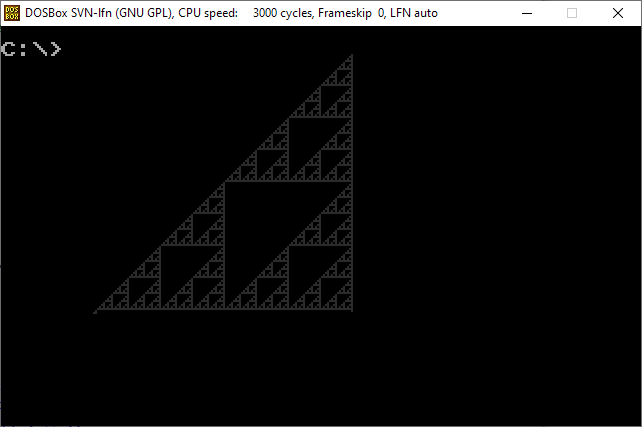
My 27 bytes solution:
Bytes: B0 13 CD 10 B7 A0 8E C3 8E DB BF A0 00 AA B9 C0 9E BE 61 FF AC 32 04 AA E2 FA C3

0100 B013          MOV     AL,13
0102 CD10          INT     10
0104 B7A0          MOV     BH,A0
0106 8EC3          MOV     ES,BX
0108 8EDB          MOV     DS,BX
010A BFA000        MOV     DI,00A0
010D AA            STOSB
010E B9C09E        MOV     CX,9EC0
0111 BE61FF        MOV     SI,FF61
0114 AC            LODSB
0115 3204          XOR     AL,[SI]
0117 AA            STOSB
0118 E2FA          LOOP    0114
011A C3            RET
Which draws this:
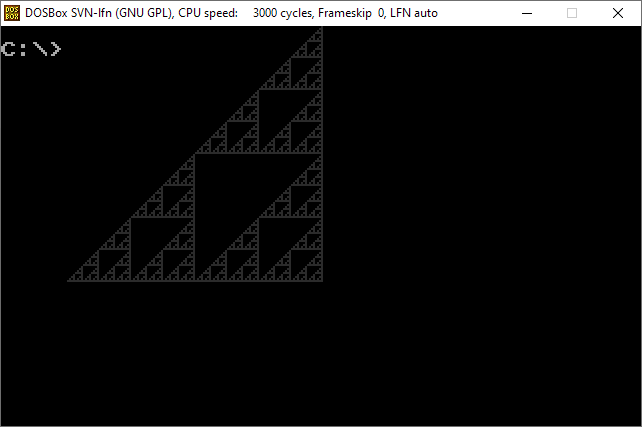
JavaScript (70 chars):
for(y=32;y--;){for(s="",x=32;x--;)s+=(x-y/2)&y?" ":"o";console.log(s)}
Using HTML guy's method. This feels like cheating, though. He gets the thread.
               oo
               oo
              o oo
              oooo
             o   oo
             oo  oo
            o o o oo
            oooooooo
           o       oo
           oo      oo
          o o     o oo
          oooo    oooo
         o   o   o   oo
         oo  oo  oo  oo
        o o o o o o o oo
        oooooooooooooooo
       o               oo
       oo              oo
      o o             o oo
      oooo            oooo
     o   o           o   oo
     oo  oo          oo  oo
    o o o o         o o o oo
    oooooooo        oooooooo
   o       o       o       oo
   oo      oo      oo      oo
  o o     o o     o o     o oo
  oooo    oooo    oooo    oooo
 o   o   o   o   o   o   o   oo
 oo  oo  oo  oo  oo  oo  oo  oo
o o o o o o o o o o o o o o o oo
oooooooooooooooooooooooooooooooo
Mathematica 63
ListPlot@ReIm@NestList[#/2+RandomChoice[{0,1,-1}^(1/3)]&,0.,8!]
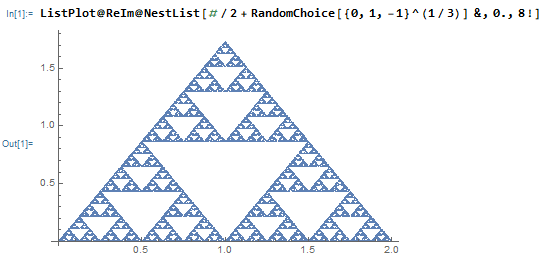
Mathematica 67
Region@Polygon@ReIm@Nest[Tr/@Tuples[{p,#}/2]&,{p={0,1,-1}^(1/3)},6]
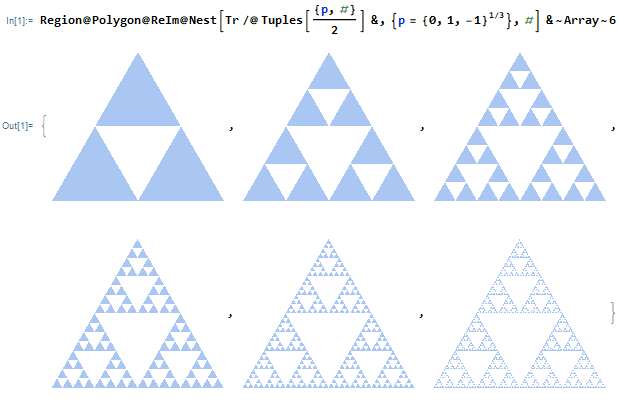
Bash (94 chars)
Copyed from the html guy of this thread
for((y=64;y--;));do s="";for((x=64;x--;));do(((x-y/2)&y))&&s+=" "||s+="Δ";done;echo "$s";done
asm2bf, 219 bytes
Code
@a
clrr2
@b
pshr1
movr4,r2
@c
movr5,r1
modr5,2
movr6,r4
modr6,2
mulr5,r6
cger5,1
cmor5,1
cjn%d
asrr1
asrr4
jnzr1,%c
jnzr4,%c
clrr3
@d
cger3,1
movr3,42
cmor3,32
outr3
popr1
incr2
cger2,64
cjz%b
out10
incr1
cger1,64
cjz%a
The output

05AB1E, 9 bytes
1=IGx^Db,
The number of rows is equal to the input.
Explanation:
1=IGx^Db,
1=         print "1" and push 1
  IG       for N in range(1, I): (where I is the input)
    x      push last element on stack multiplied by 2
     ^     pop last two elements, push their bitwise xor (output is in decimal)
      D    duplicate last element of stack
       b,  replace last element of stack with its binary representation, then print/pop
This takes advantage of the fact that a(n+1) = a(n) XOR 2*a(n), which I found on this relevant OEIS page
Lua script in Golly, 54 bytes
g=golly()
g.setrule("W60")
g.setcell(0,0,1)
g.run(512)
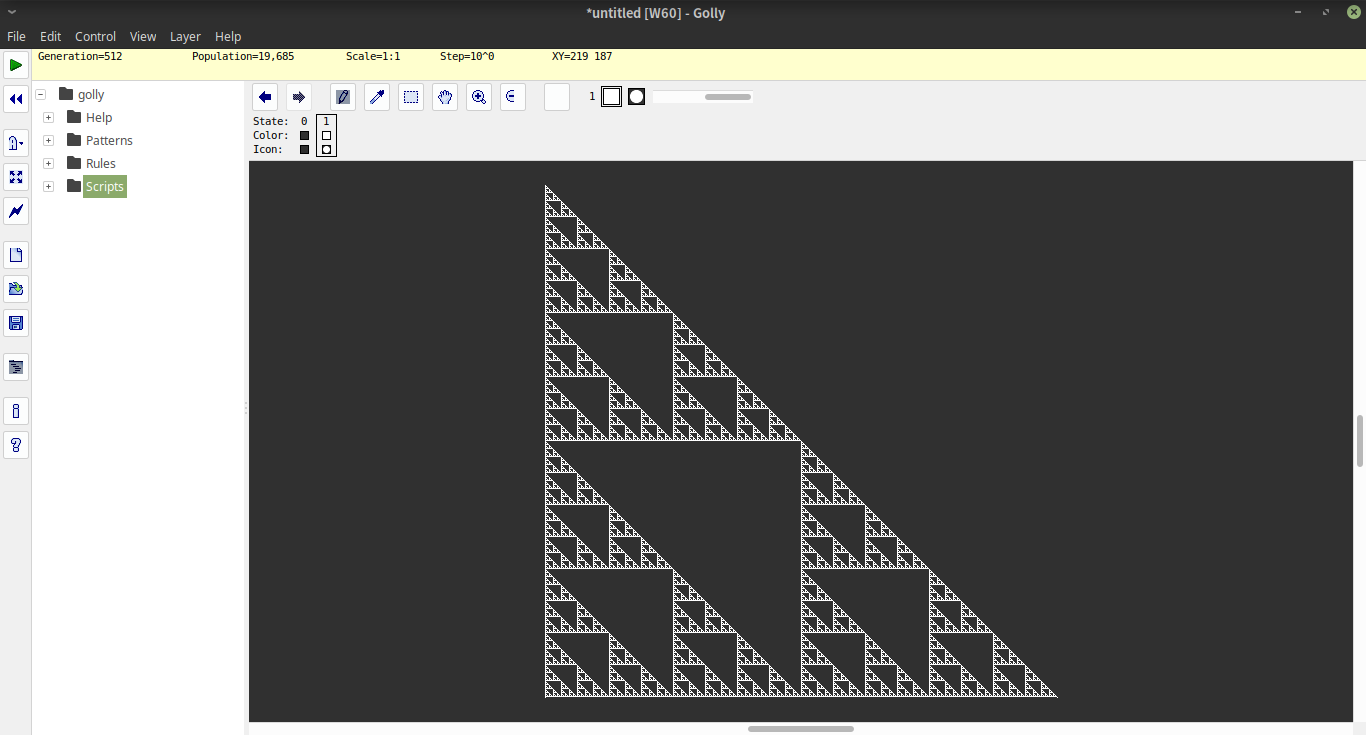
Golly is a cellular automata simulator with Lua and Python scripting support.
This script sets the rule to Wolfram Rule 60, sets the cell at (0,0) to 1, and runs 512 steps.
J, 37 35 bytes
-2 bytes thanks to FrownyFrog
(,.~,~' '&,.^:#)@[&0' /\',:'/__\'"_
This is Peter Taylor's ascii art version converted to J. Could save bytes with a less pretty version, but why?
       /\
      /__\
     /\  /\
    /__\/__\
   /\      /\
  /__\    /__\
 /\  /\  /\  /\
/__\/__\/__\/__\
Haskell, 166 154 bytes
(-12 bytes thanks to Laikoni, (zip and list comprehension instead of zipWith and lambda, better way of generating the first line))
i#n|let k!p=p:(k+1)![m*l*r+(m*(l*r-l-r)+1)*0^mod k(2^(n-i))|(l,m,r)<-zip3(1:p)p$tail p++[1]];x=1<$[2..2^n]=mapM(putStrLn.map("M "!!))$take(2^n)$1!(x++0:x)
Explanation:
The function i#n draws an ASCII-Triangle of height 2^n after i steps of iteration.
The encoding used internally encodes empty positions as 1 and full positions as 0. Therefore, the first line of the triangle is encoded as [1,1,1..0..1,1,1] with 2^n-1 ones on both sides of the zero. To build this list, we start with the list x=1<$[2..2^n], i.e. the list [2..2^n] with everything mapped to 1. Then, we build the complete list as x++0:x
The operator k!p (detailed explanation below), given a line index k and a corresponding p generates an infinite list of lines that follow p. We invoke it with 1 and the starting line described above to get the entire triangle, and then only take the first 2^n lines. Then, we simply print each line, replacing 1 with space and 0 with M (by accessing the list "M " at location 0 or 1).
Operator k!p is defined as follows:
k!p=p:(k+1)![m*l*r+(m*(l*r-l-r)+1)*0^mod k(2^(n-i))|(l,m,r)<-zip3(1:p)p$tail p++[1]]
First, we generate three versions of p: 1:p which is p with a 1 prepended, p itself and tail p++[1] which is everything but the first element of p, with a 1 appended. We then zip these three lists, giving us effectively all elements of p with their left and right neighbors, as (l,m,r). We use a list comprehension to then calculate the corresponding value in the new line:
m*l*r+(m*(l*r-l-r)+1)*0^mod k(2^(n-i))
To understand this expression, we need to realise there are two basic cases to consider: Either we simply expand the previous line, or we are at a point where an empty spot in the triangle begins. In the first case, we have a filled spot if any of the spots in the neighborhood is filled. This can be calculated as m*l*r; if any of these three is zero, then the new value is zero. The other case is a bit trickier. Here, we basically need edge detection. The following table gives the eight possible neighborhoods with the resulting value in the new line:
000 001 010 011 100 101 110 111
 1   1   1   0   1   1   0   1
A straightforward formula to yield this table would be 1-m*r*(1-l)-m*l*(1-r) which simplifies to m*(2*l*r-l-r)+1. Now we need to choose between these two cases, which is where we use the line number k. If mod k (2^(n-i)) == 0, we have to use the second case, otherwise, we use the first case. The term 0^(mod k(2^n-i)) therefore is 0 if we have to use the first case and 1 if we have to use the second case. As a result, we can use
m*l*r+(m*(l*r-l-r)+1)*0^mod k(2^(n-i))
in total - if we use the first case, we simply get m*l*r, while in the second case, an additional term is added, giving the grand total of m*(2*l*r-l-r)+1.
Mathematica, 29 bytes
Image@Array[BitAnd,{2,2}^9,0]
![Image@Array[BitAnd,{2,2}^9,0]](https://i.sstatic.net/7IR6g.jpg)
The Sierpinski tetrahedron can be drawn in a similar way:
Image3D[1-Array[BitXor,{2,2,2}^7,0]]
![Image3D[1-Array[BitXor,{2,2,2}^7,0]]](https://i.sstatic.net/TUzsq.jpg)
Asymptote, 152 bytes
I'll add this, mostly since I've seen more or less no answers in asymptote on this site. A few wasted bytes for nice formatting and generality, but I can live with that. Changing A,B and C will change where the corners of the containing triangle are, but probably not in the way you think. Increase the number in the inequality to increase the depth.
pair A=(0,0),B=(1,0),C=(.5,1);void f(pair p,int d){if(++d<7){p*=2;f(p+A*2,d);f(p+B*2,d);f(p+C*2,d);}else{fill(shift(p/2)*(A--B--C--cycle));}}f((0,0),0);
or ungolfed and readable
pair A=(0,0), B=(1,0), C=(.5,1);

void f(pair p, int d) {
    if (++d<7) {
        p *= 2;
        f(p+A*2,d);
        f(p+B*2,d);
        f(p+C*2,d);
    } else {
        fill(shift(p/2)*(A--B--C--cycle));
    }
}

f((0,0),0);
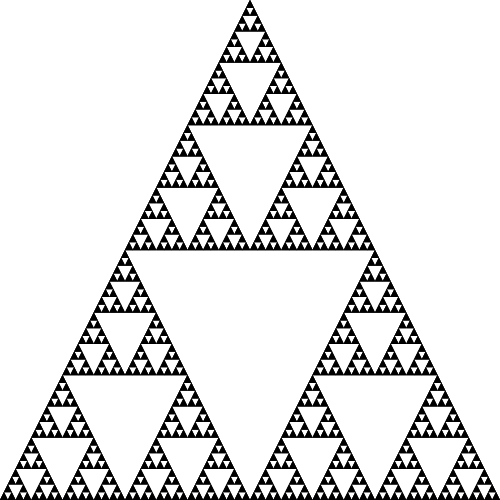
So asymptote is a neat vector graphics language with somewhat C-like syntax. Quite useful for somewhat technical diagrams. Output is of course in a vector format by default (eps, pdf, svg) but can be converted into basically everything imagemagick supports. Output:
Pyt, 19 bytes
02⁵ř↔Á`⁻Đ0⇹Řć2%ǰƥłŕ
Result:
1
11
101
1111
10001
110011
1010101
11111111
100000001
1100000011
10100000101
111100001111
1000100010001
11001100110011
101010101010101
1111111111111111
10000000000000001
110000000000000011
1010000000000000101
11110000000000001111
100010000000000010001
1100110000000000110011
10101010000000001010101
111111110000000011111111
1000000010000000100000001
11000000110000001100000011
101000001010000010100000101
1111000011110000111100001111
10001000100010001000100010001
110011001100110011001100110011
1010101010101010101010101010101
11111111111111111111111111111111
Explanation:
0                        Push 0
 2⁵                      Push 32
   ř↔                    Pop 32, and push [32,31,30,29,...,3,2,1]
     Á                   Push contents of array onto stack
      `          ł       While the top of the stack is not zero, loop:
       ⁻                 Decrement the number at the top of the stack
        Đ0⇹Řć2%ǰƥ        Calculate the kth row of Pascal's Triangle mod 2 and print
                  ŕ      Remove the 0
6502 ASM, 134 bytes
start:
lda #$e1
sta $0
lda #$01
sta $1
ldy #$20
w_e:
ldx #$00
eor ($0, x)
sta ($0),y
inc $0
bne w_e
inc $1
ldx $1
cpx #$06
bne w_e
rts
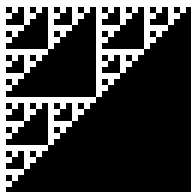
Pretty simple. Displays the triangles. Note that the top and left sides of the image are invisible due to the white background of PPCG.
JavaFx, 400 bytes
import javafx.scene.*;import javafx.scene.canvas.*;public class S extends javafx.application.Application{public void start(javafx.stage.Stage s){Canvas v=new Canvas(640,640);int[]xs={320,0,640},ys={0,640,640};for(int i=0,x=0,y=0,n=0;i<999999;i++){n=new java.util.Random().nextInt(3);v.getGraphicsContext2D().fillRect(x+=(xs[n]-x)/2,y+=(ys[n]-y)/2,1,1);}s.setScene(new Scene(new Group(v)));s.show();}}
Operates via the move-halfway-to-a-random-vertex method. 999,999 iterations, 640x640 canvas. I could have golfed a few more bytes by reducing the size or the number of iterations, but when you're at 400 bytes what's the point? No one wants to look at postage stamp-sized output.

Ungolfed, mostly:
import javafx.scene.*;
import javafx.scene.canvas.*;

public class S extends javafx.application.Application {
    public void start(javafx.stage.Stage s) {
        Canvas v = new Canvas(640, 640);
        int[] xs = {320,0,640}, ys = {0,640,640};
        for (int i=0, x=0, y=0, n=0; i < 999999; i++) {
            n = new java.util.Random().nextInt(3);
            v.getGraphicsContext2D().fillRect(
                x += (xs[n]-x)/2, y += (ys[n]-y)/2, 1, 1);
        }
        s.setScene(new Scene(new Group(v)));
        s.show();
    }
}
JavaFx has a very annoying way of putting every class you might want to use in separate javafx.application, javafx.stage, javafx.scene, javafx.canvas packages. Grr!
Applesoft BASIC, 246 bytes
1 HGR:HCOLOR=3:HOME:DIM x(3),y(3):x(0)=0:y(0)=160:x(1)=90:y(1)=0:x(2)=180:y(2)=160:FOR i=0 to 2:HPLOT x(i),y(i):NEXT i
2 x=int(RND(1)*180):y=int(RND(1)*150):HPLOT x,y:FOR i=1 to 2000:v=int(rnd(1)*3):x=(x+x(v))/2:y=(y+y(v))/2:HPLOT x,y:NEXT:GOTO 2
Not the most efficient, nor does it draw a perfect Sierpinski, but it's fun. May stick pixels in random places or miss a few points depending on your system's pRNG quality.

Ungolfed:
100 HGR : HCOLOR=3 : HOME
110 REM set up three points to form a triangle
120 DIM x(3), y(3)
130 x(0) = 0 : y(0) = 160
140 x(1) = 90 : y(1) = 0
150 x(2) = 180 : y(2) = 160
160 REM plot the vertices of the triangle
170 FOR i= 0 to 2
180 HPLOT x(i), y(i)
190 NEXT i
200 REM pick a random starting point
210 x = int(RND(1)*180) : y = int(RND(1)*150)
220 hplot x,y
230 FOR i = 1 to 2000
240 REM randomly pick one of the triangle vertices
250 v = int(rnd(1)*3)
260 REM move the point half way to the triangle vertex
270 x = (x + x(v)) / 2 : y = (y + y(v)) / 2
280 HPLOT x,y
290 NEXT
HTML + JavaScript, 150 characters (see notes for 126 characters)
Whitespace inserted for readability and not counted.
<title></title><canvas></canvas><script>
for(x=k=128;x--;)for(y=k;y--;)
  x&y||document.body.firstChild.getContext("2d").fillRect(x-~y/2,k-y,1,1)
</script>
The core of it is applying the rule of coloring pixels for which x & y == 0 by the conditional x&y||, which produces a “Sierpinski right triangle”; and x-~y/2,k-y are a coordinate transformation to produce the approximately equilateral display.
A less correct (HTML-wise) version is 126 characters:
<canvas><script>
for(x=k=128;x--;)for(y=k;y--;)
  x&y||document.body.firstChild.getContext("2d").fillRect(x-~y/2,k-y,1,1)
</script>
(The way in which this is less correct is that it omits the title element and the end tag of the canvas element, both of which are required for a correct document even though omitting them does not change the interpretation of the document.)
Three characters can be saved by eliminating k in favor of the constant 64, at the cost of a smaller result; I wouldn't count the 8 option as it has insufficient detail.
Note that a size of 256 or higher requires attributes on the <canvas> to increase the canvas size from the default.
80x86 Code / MsDos - 10 Bytes
As a sizecoder specialized for very tiny intros on MsDos i managed to come up with a program that occupies only 10 bytes.
in hex:
04 13 CD 10 20 E9 B4 0C E2 F6
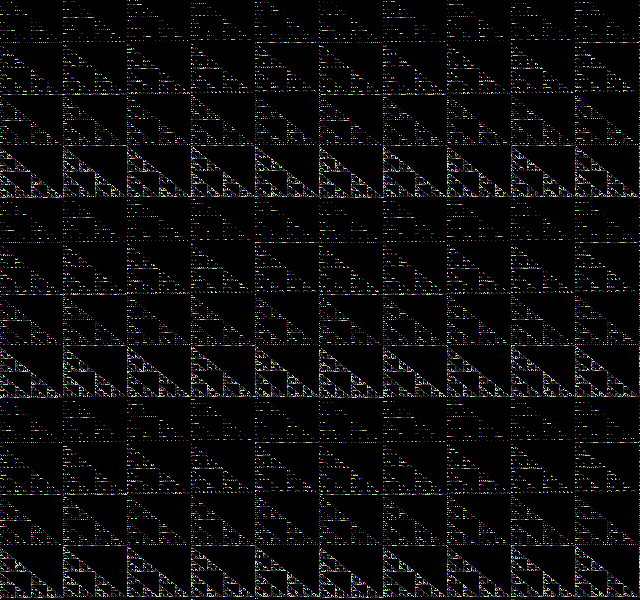
in asm:
X: add al,0x13
int 0x10
and cl,ch
mov ah,0x0C
loop X
The first version i coded was "Colpinski" which is 16 bytes in size, and even interactive in a way that you can change the color with the keyboard and the mouse. Together with "Frag" - another sizecoder - we brought that one down to 13 bytes, allowing for a 10 byte program which just contains the core routine.
It gets a bit more interesting when things are animated, so i'll mention another version, Zoompinski 64 - trying to mimic the exact behavior of "Zoompinski C64" in 512 bytes - also for MsDos, 64 bytes in size as the name suggests.
It's possible to optimize this further downto 31 Bytes, while losing elegance, colors and symmetry (source and executable available behind the link above)
J (18 characters)
' *'{~(,,.~)^:9 ,1
Result
*
**
* *
****
*   *
**  **
* * * *
********
*       *
**      **
* *     * *
****    ****
*   *   *   *
**  **  **  **
* * * * * * * *
****************
*               *
**              **
* *             * *
****            ****
*   *           *   *
**  **          **  **
* * * *         * * * *
********        ********
*       *       *       *
**      **      **      **
* *     * *     * *     * *
****    ****    ****    ****
*   *   *   *   *   *   *   *
**  **  **  **  **  **  **  **
* * * * * * * * * * * * * * * *
********************************
J (9 characters)
Easily the ugliest, you really need to squint to see the output ;)
2|!/~i.32
produces the output
1 1 1 1 1 1 1 1 1 1 1 1 1 1 1 1 1 1 1 1 1 1 1 1 1 1 1 1 1 1 1 1
0 1 0 1 0 1 0 1 0 1 0 1 0 1 0 1 0 1 0 1 0 1 0 1 0 1 0 1 0 1 0 1
0 0 1 1 0 0 1 1 0 0 1 1 0 0 1 1 0 0 1 1 0 0 1 1 0 0 1 1 0 0 1 1
0 0 0 1 0 0 0 1 0 0 0 1 0 0 0 1 0 0 0 1 0 0 0 1 0 0 0 1 0 0 0 1
0 0 0 0 1 1 1 1 0 0 0 0 1 1 1 1 0 0 0 0 1 1 1 1 0 0 0 0 1 1 1 1
0 0 0 0 0 1 0 1 0 0 0 0 0 1 0 1 0 0 0 0 0 1 0 1 0 0 0 0 0 1 0 1
0 0 0 0 0 0 1 1 0 0 0 0 0 0 1 1 0 0 0 0 0 0 1 1 0 0 0 0 0 0 1 1
0 0 0 0 0 0 0 1 0 0 0 0 0 0 0 1 0 0 0 0 0 0 0 1 0 0 0 0 0 0 0 1
0 0 0 0 0 0 0 0 1 1 1 1 1 1 1 1 0 0 0 0 0 0 0 0 1 1 1 1 1 1 1 1
0 0 0 0 0 0 0 0 0 1 0 1 0 1 0 1 0 0 0 0 0 0 0 0 0 1 0 1 0 1 0 1
0 0 0 0 0 0 0 0 0 0 1 1 0 0 1 1 0 0 0 0 0 0 0 0 0 0 1 1 0 0 1 1
0 0 0 0 0 0 0 0 0 0 0 1 0 0 0 1 0 0 0 0 0 0 0 0 0 0 0 1 0 0 0 1
0 0 0 0 0 0 0 0 0 0 0 0 1 1 1 1 0 0 0 0 0 0 0 0 0 0 0 0 1 1 1 1
0 0 0 0 0 0 0 0 0 0 0 0 0 1 0 1 0 0 0 0 0 0 0 0 0 0 0 0 0 1 0 1
0 0 0 0 0 0 0 0 0 0 0 0 0 0 1 1 0 0 0 0 0 0 0 0 0 0 0 0 0 0 1 1
0 0 0 0 0 0 0 0 0 0 0 0 0 0 0 1 0 0 0 0 0 0 0 0 0 0 0 0 0 0 0 1
0 0 0 0 0 0 0 0 0 0 0 0 0 0 0 0 1 1 1 1 1 1 1 1 1 1 1 1 1 1 1 1
0 0 0 0 0 0 0 0 0 0 0 0 0 0 0 0 0 1 0 1 0 1 0 1 0 1 0 1 0 1 0 1
0 0 0 0 0 0 0 0 0 0 0 0 0 0 0 0 0 0 1 1 0 0 1 1 0 0 1 1 0 0 1 1
0 0 0 0 0 0 0 0 0 0 0 0 0 0 0 0 0 0 0 1 0 0 0 1 0 0 0 1 0 0 0 1
0 0 0 0 0 0 0 0 0 0 0 0 0 0 0 0 0 0 0 0 1 1 1 1 0 0 0 0 1 1 1 1
0 0 0 0 0 0 0 0 0 0 0 0 0 0 0 0 0 0 0 0 0 1 0 1 0 0 0 0 0 1 0 1
0 0 0 0 0 0 0 0 0 0 0 0 0 0 0 0 0 0 0 0 0 0 1 1 0 0 0 0 0 0 1 1
0 0 0 0 0 0 0 0 0 0 0 0 0 0 0 0 0 0 0 0 0 0 0 1 0 0 0 0 0 0 0 1
0 0 0 0 0 0 0 0 0 0 0 0 0 0 0 0 0 0 0 0 0 0 0 0 1 1 1 1 1 1 1 1
0 0 0 0 0 0 0 0 0 0 0 0 0 0 0 0 0 0 0 0 0 0 0 0 0 1 0 1 0 1 0 1
0 0 0 0 0 0 0 0 0 0 0 0 0 0 0 0 0 0 0 0 0 0 0 0 0 0 1 1 0 0 1 1
0 0 0 0 0 0 0 0 0 0 0 0 0 0 0 0 0 0 0 0 0 0 0 0 0 0 0 1 0 0 0 1
0 0 0 0 0 0 0 0 0 0 0 0 0 0 0 0 0 0 0 0 0 0 0 0 0 0 0 0 1 1 1 1
0 0 0 0 0 0 0 0 0 0 0 0 0 0 0 0 0 0 0 0 0 0 0 0 0 0 0 0 0 1 0 1
0 0 0 0 0 0 0 0 0 0 0 0 0 0 0 0 0 0 0 0 0 0 0 0 0 0 0 0 0 0 1 1
0 0 0 0 0 0 0 0 0 0 0 0 0 0 0 0 0 0 0 0 0 0 0 0 0 0 0 0 0 0 0 1
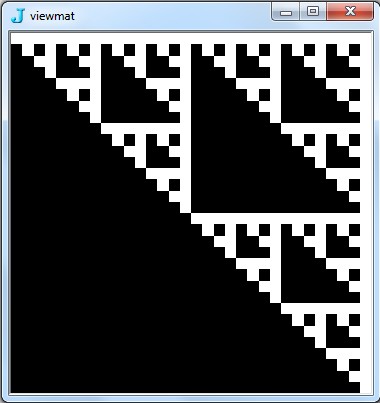
of course you can display it graphically:
load 'viewmat'
viewmat 2|!/~i.32
Python (75)
I'm two years late to the party, but I'm surprised that nobody has taken this approach yet
from pylab import*
x=[[1,1],[1,0]]
for i in'123':x=kron(x,x)
imsave('a',x)
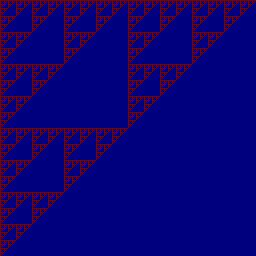
Uses the Kronecker product to replace a matrix by multiple copies of itself.
I could save two chars by using x=kron(x,x);x=kron(x,x) in line three to get a 16x16 pixel image with three visible levels or add another char to the iterator and end up with a 2^16 x 2^16 = 4.3 Gigapixel image and 15 triangle levels.
Postscript, 205 203
[48(0-1+0+1-0)49(11)43(+)45(-)/s{dup
0 eq{exch{[48{1 0 rlineto}49 1 index
43{240 rotate}45{120 rotate}>>exch
get exec}forall}{exch{load
exch 1 sub s}forall}ifelse 1 add}>>begin
9 9 moveto(0-1-1)9 s fill
Rewrite using strings and recursion ends up at exactly the same count. But the depth-limitations of the macro-approach are overcome.
Edit: fill is shorter than stroke.
Indented and commented.
%!
[   % begin dictionary
    48(0-1+0+1-0) % 0
    49(11)        % 1
    43(+)         % +
    45(-)         % -
    /s{ % string recursion-level
        dup 0 eq{ % level=0
            exch{  % iterate through string
                [
                    48{1 0 rlineto} % 0
                    49 1 index      % 1
                    43{240 rotate}  % +
                    45{120 rotate}  % -
                >>exch get exec % interpret turtle command
            }forall
        }{ % level>0
            exch{  % iterate through string
                load exch  % lookup charcode
                1 sub s    % recurse with level-1
            }forall
        }ifelse
        1 add  % return recursion-level+1
    }
>>begin
9 9 moveto(0-1-1)9 s fill % execute and fill
Adding 0 setlinewidth gives a better impression of how deep this one goes.

Common Lisp, 80 chars
(#1=dotimes(i 32)(#1#(j 32)(princ(if(logtest(- j(ash i -1))i)' 'Δ)))(terpri))
Output:
ΔΔΔΔΔΔΔΔΔΔΔΔΔΔΔΔΔΔΔΔΔΔΔΔΔΔΔΔΔΔΔΔ
Δ Δ Δ Δ Δ Δ Δ Δ Δ Δ Δ Δ Δ Δ Δ Δ
 ΔΔ  ΔΔ  ΔΔ  ΔΔ  ΔΔ  ΔΔ  ΔΔ  ΔΔ
 Δ   Δ   Δ   Δ   Δ   Δ   Δ   Δ
  ΔΔΔΔ    ΔΔΔΔ    ΔΔΔΔ    ΔΔΔΔ
  Δ Δ     Δ Δ     Δ Δ     Δ Δ
   ΔΔ      ΔΔ      ΔΔ      ΔΔ
   Δ       Δ       Δ       Δ
    ΔΔΔΔΔΔΔΔ        ΔΔΔΔΔΔΔΔ
    Δ Δ Δ Δ         Δ Δ Δ Δ
     ΔΔ  ΔΔ          ΔΔ  ΔΔ
     Δ   Δ           Δ   Δ
      ΔΔΔΔ            ΔΔΔΔ
      Δ Δ             Δ Δ
       ΔΔ              ΔΔ
       Δ               Δ
        ΔΔΔΔΔΔΔΔΔΔΔΔΔΔΔΔ
        Δ Δ Δ Δ Δ Δ Δ Δ
         ΔΔ  ΔΔ  ΔΔ  ΔΔ
         Δ   Δ   Δ   Δ
          ΔΔΔΔ    ΔΔΔΔ
          Δ Δ     Δ Δ
           ΔΔ      ΔΔ
           Δ       Δ
            ΔΔΔΔΔΔΔΔ
            Δ Δ Δ Δ
             ΔΔ  ΔΔ
             Δ   Δ
              ΔΔΔΔ
              Δ Δ
               ΔΔ
               Δ
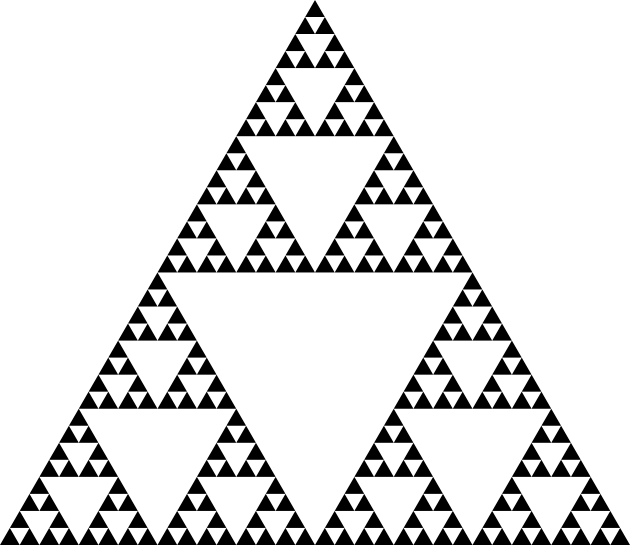
Python (234)
Maximal golfing, tiny image:
#!/usr/bin/env python3
from cairo import*
s=SVGSurface('_',97,84)
g=Context(s)
g.scale(97,84)
def f(w,x,y):
 v=w/2
 if w>.1:f(v,x,y);f(v,x+w/4,y-v);f(v,x+v,y)
 else:g.move_to(x,y);g.line_to(x+v,y-w);g.line_to(x+w,y);g.fill()
f(1,0,1)
s.write_to_png('s.png')
Requires python3-cairo.
To get a nice large image I needed 239 characters.
matlab 56
v=[1;-1;j];plot(filter(1,[1,-.5],v(randi(3,1,1e4))),'.')
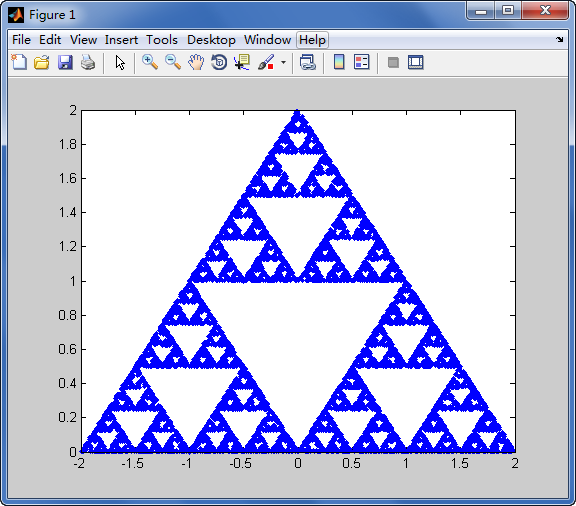
8086 Machine code - 30 bytes.
NOTE: This is not my code and should not be accepted as an answer. I found this while working on a different CG problem to emulate an 8086 CPU. The included text file credits David Stafford, but that's the best I could come up with.
I'm posting this because it's clever, short, and I thought you'd want to see it.
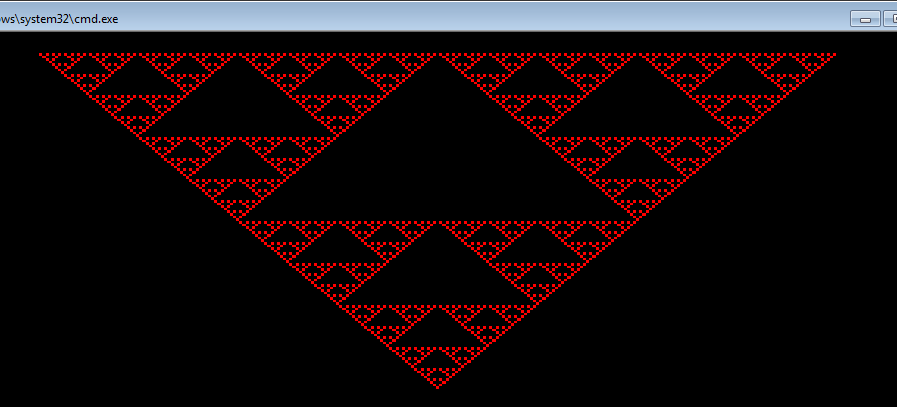
It makes use of overlapping opcodes to pack more instructions in a smaller space. Amazingly clever. Here is the machine code:
B0 13 CD 10 B3 03 BE A0 A0 8E DE B9 8B 0C 32 28 88 AC C2 FE 4E 75 F5 CD 16 87 C3 CD 10 C3
A straight-up decode looks like this:
0100: B0 13              mov AL, 13h
0102: CD 10              int 10h
0104: B3 03              mov BL, 3h
0106: BE A0 A0           mov SI, A0A0h
0109: 8E DE              mov  DS, SI
010B: B9 8B 0C           mov CX, C8Bh
010E: 32 28              xor  CH, [BX+SI]
0110: 88 AC C2 FE        mov  [SI+FEC2h], CH
0114: 4E                 dec SI
0115: 75 F5              jne/jnz -11
When run, when the jump at 0x0115 happens, notice it jumps back to 0x010C, right into the middle of a previous instruction:
0100: B0 13              mov AL, 13h
0102: CD 10              int 10h
0104: B3 03              mov BL, 3h
0106: BE A0 A0           mov SI, A0A0h
0109: 8E DE              mov  DS, SI
010B: B9 8B 0C           mov CX, C8Bh
010E: 32 28              xor  CH, [BX+SI]
0110: 88 AC C2 FE        mov  [SI+FEC2h], CH
0114: 4E                 dec SI
0115: 75 F5              jne/jnz -11
010C: 8B 0C              mov  CX, [SI]
010E: 32 28              xor  CH, [BX+SI]
0110: 88 AC C2 FE        mov  [SI+FEC2h], CH
0114: 4E                 dec SI
0115: 75 F5              jne/jnz -11
010C: 8B 0C              mov  CX, [SI]
Brilliant! Hope you guys don't mind me sharing this. I know it's not an answer per se, but it's of interest to the challenge.
Here it is in action:
J
,/.(,~,.~)^:6,'o'
Not ideal, since the triangle is lopsided and followed by a lot of whitespace - but interesting nonetheless I thought.
Output:
o
oo
o o
oooo
o   o
oo  oo
o o o o
oooooooo
o       o
oo      oo
o o     o o
oooo    oooo
o   o   o   o
oo  oo  oo  oo
o o o o o o o o
oooooooooooooooo
o               o
oo              oo
o o             o o
oooo            oooo
o   o           o   o
oo  oo          oo  oo
o o o o         o o o o
oooooooo        oooooooo
o       o       o       o
oo      oo      oo      oo
o o     o o     o o     o o
oooo    oooo    oooo    oooo
o   o   o   o   o   o   o   o
oo  oo  oo  oo  oo  oo  oo  oo
o o o o o o o o o o o o o o o o
oooooooooooooooooooooooooooooooo
o                               o
oo                              oo
o o                             o o
oooo                            oooo
o   o                           o   o
oo  oo                          oo  oo
o o o o                         o o o o
oooooooo                        oooooooo
o       o                       o       o
oo      oo                      oo      oo
o o     o o                     o o     o o
oooo    oooo                    oooo    oooo
o   o   o   o                   o   o   o   o
oo  oo  oo  oo                  oo  oo  oo  oo
o o o o o o o o                 o o o o o o o o
oooooooooooooooo                oooooooooooooooo
o               o               o               o
oo              oo              oo              oo
o o             o o             o o             o o
oooo            oooo            oooo            oooo
o   o           o   o           o   o           o   o
oo  oo          oo  oo          oo  oo          oo  oo
o o o o         o o o o         o o o o         o o o o
oooooooo        oooooooo        oooooooo        oooooooo
o       o       o       o       o       o       o       o
oo      oo      oo      oo      oo      oo      oo      oo
o o     o o     o o     o o     o o     o o     o o     o o
oooo    oooo    oooo    oooo    oooo    oooo    oooo    oooo
o   o   o   o   o   o   o   o   o   o   o   o   o   o   o   o
oo  oo  oo  oo  oo  oo  oo  oo  oo  oo  oo  oo  oo  oo  oo  oo
o o o o o o o o o o o o o o o o o o o o o o o o o o o o o o o o
oooooooooooooooooooooooooooooooooooooooooooooooooooooooooooooooo
A quick explanation:
The verb (,~,.~) is what's doing the work here. It's a hook which first stitches ,. the argument to itself (o -> oo) and then appends the original argument to the output:
oo
becomes
oo
o
This verb is repeated 6 times ^:6 with the output of each iteration becoming the input of the next iteration. So
oo
o
becomes
oooo
o o
oo
o
which in turn becomes
oooooooo
o o o o
oo  oo
o   o
oooo
o o
oo
o
etc. I've then used the oblique adverb on append ,/. to read the rows diagonally to straighten(ish) the triangle. I didn't need to do this, as randomra points out. I could have just reversed |. the lot to get the same result. Even better, I could have just used (,,.~)^:6,'o' to save the reverse step completely.
Ah well, you live and learn. :-)
Logo, 75 characters
59 characters for just the first function, the second one calls the first with the size and the depth/number of iterations. So you could just call the first function from the interpreter with the command: e 99 5, or whatever size you want to output
to e :s :l
if :l>0[repeat 3[e :s/2 :l-1 fd :s rt 120]]
end
to f
e 99 5
end
APL, 37 32 (28 23)
Upright triangle (37 32-char)
({((-1⌷⍴⍵)⌽⍵,∊⍵)⍪⍵,⍵}⍣⎕)1 2⍴'/\'
Explanation
1 2⍴'/\': Create a 1×2 character matrix/\{((-1⌷⍴⍵)⌽⍵,∊⍵)⍪⍵,⍵}: A function that pad the right argument on both sides with blanks to create a matrix double as wide, then laminates the right argument itself doubled onto the bottom.
E.g./\would become
 /\
/\/\
⍣⎕: Recur the function (user input) times.
Example output
               /\
              /\/\
             /\  /\
            /\/\/\/\
           /\      /\
          /\/\    /\/\
         /\  /\  /\  /\
        /\/\/\/\/\/\/\/\
       /\              /\
      /\/\            /\/\
     /\  /\          /\  /\
    /\/\/\/\        /\/\/\/\
   /\      /\      /\      /\
  /\/\    /\/\    /\/\    /\/\
 /\  /\  /\  /\  /\  /\  /\  /\
/\/\/\/\/\/\/\/\/\/\/\/\/\/\/\/\
Skewed Triangle (28 23-char)
({(⍵,∊⍵)⍪⍵,⍵}⍣⎕)1 1⍴'○'
Explaination
1 1⍴'○': Create a 1×1 character matrix○{(⍵,∊⍵)⍪⍵,⍵}: A function that pad the right argument on the right with blanks to create a matrix double as wide, then laminates the right argument itself doubled onto the bottom.
E.g.○would become
○
○○
⍣⎕: Recur the function (user input) times.
Example output
○
○○
○ ○
○○○○
○   ○
○○  ○○
○ ○ ○ ○
○○○○○○○○
○       ○
○○      ○○
○ ○     ○ ○
○○○○    ○○○○
○   ○   ○   ○
○○  ○○  ○○  ○○
○ ○ ○ ○ ○ ○ ○ ○
○○○○○○○○○○○○○○○○
PostScript, 120 chars
-7 -4 moveto
14 0 rlineto
7{true upath dup
2{120 rotate uappend}repeat[2 0 0 2 7 4]concat}repeat
matrix setmatrix
stroke
Ghostscript output:
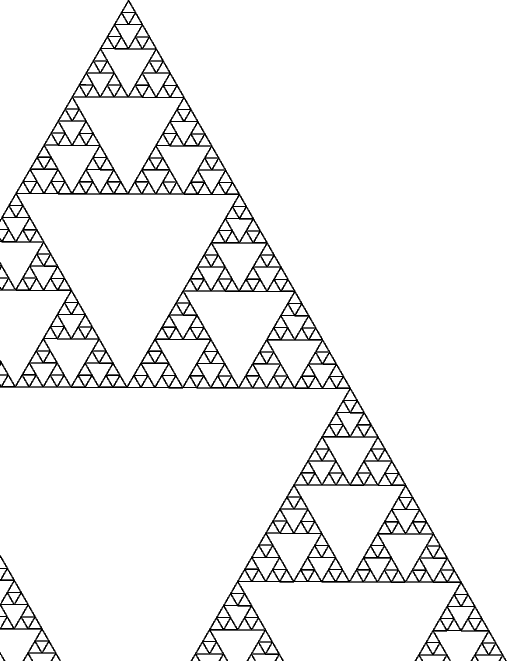
This is drawing the figure by recursively tripling what's already drawn.
First step is drawing a line. The line is saved as a userpath, then the userpath is added two more times after rotating 120 degrees each time. [2 0 0 2 7 4]concat moves the "rotation point" to the center of the next big white "center triangle" that is to be enclosed by replications of the triangle we already have. Here, we're back to step 1 (creating a upath that's tripled by rotation).
The number of iterations is controlled by the first number in line 3.
Mathematica - 32 characters
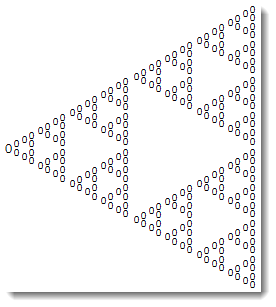
Nest[Subsuperscript[#,#,#]&,0,5]
Mathematica - 37 characters
Grid@CellularAutomaton[90,{{1},0},31]
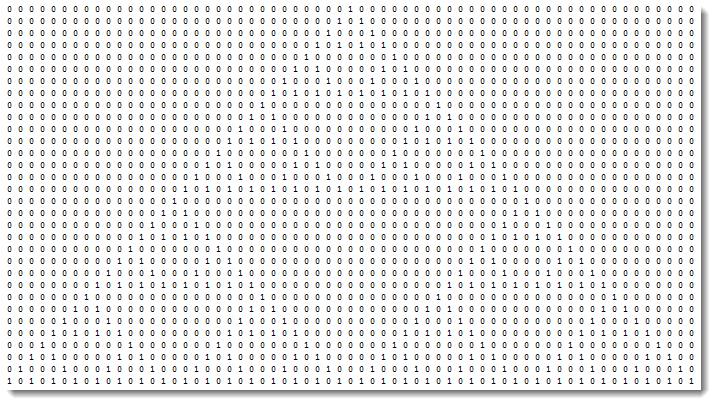
This will produce a 2D table of 0 and 1, where 1s are drawing Sierpinski Triangle.
C, 106 chars
i,j;main(){for(;i<32;j>i/2?puts(""),j=!++i:0)
printf("%*s",j++?4:33-i+i%2*2,i/2&j^j?"":i%2?"/__\\":"/\\");}
(It still amuses me that puts("") is the shortest way to output a newline in C.)
Note that you can create larger (or smaller) gaskets by replacing the 32 in the for loop's test with a larger (smaller) power of two, as long as you also replace the 33 in the middle of the printf() with the power-of-two-plus-one.
Python (42)
I originally wanted to post a few suggestions on boothbys solution (who actually uses rule 18 :), but i didn't have enough reputation to comment, so i made it into another answer. Since he changed his approach, i added some explanation. My suggestions would have been:
- use '%d'*64%tuple(x) instead of ''.join(map(str,x)
- shift in zeros instead of wraping the list around
which would have led to the following code (93 characters):
x=[0]*63
x[31]=1
exec"print'%d'*63%tuple(x);x=[a^b for a,b in zip(x[1:]+[0],[0]+x[:-1])];"*32
But i optimzed further, first by using a longint instead of an integer array and just printing the binary representation (75 characters):
x=2**31
exec"print'%d'*63%tuple(1&x>>i for i in range(63));x=x<<1^x>>1;"*32
And finally by printing the octal representation, which is already supported by printf interpolation (42 characters):
x=8**31
exec"print'%063o'%x;x=x*8^x/8;"*32
All of them will print:
000000000000000000000000000000010000000000000000000000000000000
000000000000000000000000000000101000000000000000000000000000000
000000000000000000000000000001000100000000000000000000000000000
000000000000000000000000000010101010000000000000000000000000000
000000000000000000000000000100000001000000000000000000000000000
000000000000000000000000001010000010100000000000000000000000000
000000000000000000000000010001000100010000000000000000000000000
000000000000000000000000101010101010101000000000000000000000000
000000000000000000000001000000000000000100000000000000000000000
000000000000000000000010100000000000001010000000000000000000000
000000000000000000000100010000000000010001000000000000000000000
000000000000000000001010101000000000101010100000000000000000000
000000000000000000010000000100000001000000010000000000000000000
000000000000000000101000001010000010100000101000000000000000000
000000000000000001000100010001000100010001000100000000000000000
000000000000000010101010101010101010101010101010000000000000000
000000000000000100000000000000000000000000000001000000000000000
000000000000001010000000000000000000000000000010100000000000000
000000000000010001000000000000000000000000000100010000000000000
000000000000101010100000000000000000000000001010101000000000000
000000000001000000010000000000000000000000010000000100000000000
000000000010100000101000000000000000000000101000001010000000000
000000000100010001000100000000000000000001000100010001000000000
000000001010101010101010000000000000000010101010101010100000000
000000010000000000000001000000000000000100000000000000010000000
000000101000000000000010100000000000001010000000000000101000000
000001000100000000000100010000000000010001000000000001000100000
000010101010000000001010101000000000101010100000000010101010000
000100000001000000010000000100000001000000010000000100000001000
001010000010100000101000001010000010100000101000001010000010100
010001000100010001000100010001000100010001000100010001000100010
101010101010101010101010101010101010101010101010101010101010101
Of course there is also a graphical solution (131 characters):
from PIL.Image import*
from struct import*
a=''
x=2**31
exec"a+=pack('>Q',x);x=x*2^x/2;"*32
fromstring('1',(64,32),a).save('s.png')
 :D
:D
GolfScript (43 42 chars)
' /\ /__\ '4/){.+\.{[2$.]*}%\{.+}%+\}3*;n*
Output:
               /\
              /__\
             /\  /\
            /__\/__\
           /\      /\
          /__\    /__\
         /\  /\  /\  /\
        /__\/__\/__\/__\
       /\              /\
      /__\            /__\
     /\  /\          /\  /\
    /__\/__\        /__\/__\
   /\      /\      /\      /\
  /__\    /__\    /__\    /__\
 /\  /\  /\  /\  /\  /\  /\  /\
/__\/__\/__\/__\/__\/__\/__\/__\
Change the "3" to a larger number for a larger triangle.
Python, 101 86
Uses the rule 90 automaton.
x=' '*31
x+='.'+x
exec"print x;x=''.join(' .'[x[i-1]!=x[i-62]]for i in range(63));"*32
This is longer, but prettier.
x=' '*31
x+=u'Δ'+x
exec u"print x;x=''.join(u' Δ'[x[i-1]!=x[i-62]]for i in range(63));"*32
Edit: playing with strings directly, got rid of obnoxiously long slicing, made output prettier.
Output:
                               Δ
                              Δ Δ
                             Δ   Δ
                            Δ Δ Δ Δ
                           Δ       Δ
                          Δ Δ     Δ Δ
                         Δ   Δ   Δ   Δ
                        Δ Δ Δ Δ Δ Δ Δ Δ
                       Δ               Δ
                      Δ Δ             Δ Δ
                     Δ   Δ           Δ   Δ
                    Δ Δ Δ Δ         Δ Δ Δ Δ
                   Δ       Δ       Δ       Δ
                  Δ Δ     Δ Δ     Δ Δ     Δ Δ
                 Δ   Δ   Δ   Δ   Δ   Δ   Δ   Δ
                Δ Δ Δ Δ Δ Δ Δ Δ Δ Δ Δ Δ Δ Δ Δ Δ
               Δ                               Δ
              Δ Δ                             Δ Δ
             Δ   Δ                           Δ   Δ
            Δ Δ Δ Δ                         Δ Δ Δ Δ
           Δ       Δ                       Δ       Δ
          Δ Δ     Δ Δ                     Δ Δ     Δ Δ
         Δ   Δ   Δ   Δ                   Δ   Δ   Δ   Δ
        Δ Δ Δ Δ Δ Δ Δ Δ                 Δ Δ Δ Δ Δ Δ Δ Δ
       Δ               Δ               Δ               Δ
      Δ Δ             Δ Δ             Δ Δ             Δ Δ
     Δ   Δ           Δ   Δ           Δ   Δ           Δ   Δ
    Δ Δ Δ Δ         Δ Δ Δ Δ         Δ Δ Δ Δ         Δ Δ Δ Δ
   Δ       Δ       Δ       Δ       Δ       Δ       Δ       Δ
  Δ Δ     Δ Δ     Δ Δ     Δ Δ     Δ Δ     Δ Δ     Δ Δ     Δ Δ
 Δ   Δ   Δ   Δ   Δ   Δ   Δ   Δ   Δ   Δ   Δ   Δ   Δ   Δ   Δ   Δ
Δ Δ Δ Δ Δ Δ Δ Δ Δ Δ Δ Δ Δ Δ Δ Δ Δ Δ Δ Δ Δ Δ Δ Δ Δ Δ Δ Δ Δ Δ Δ Δ
QBasic 151 Characters
As an example, here is how it can be done in QBasic.
SCREEN 9
H=.5
P=300
FOR I=1 TO 9^6
    N=RND
    IF N > 2/3 THEN
        X=H+X*H:Y=Y*H
    ELSEIF N > 1/3 THEN
        X=H^2+X*H:Y=H+Y*H
    ELSE
        X=X*H:Y=Y*H
    END IF
    PSET(P-X*P,P-Y*P)
NEXT
Python (215 209)
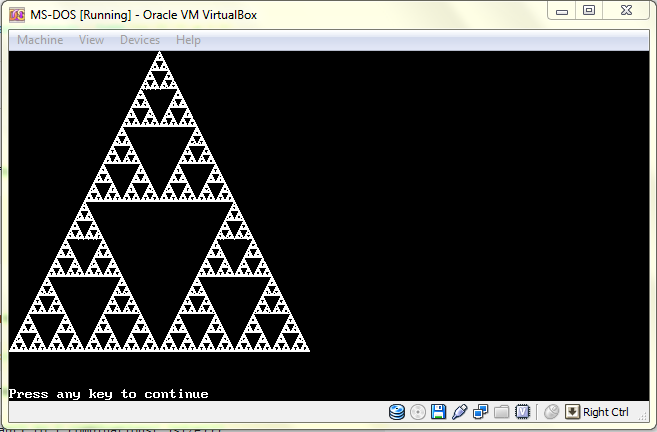
Uses the Chaos Theory method of generating Sierpinski's Triangle.
import random as r,pygame as p
d=p.display
x=99;X=49;y=x,x
s=d.set_mode(y)
c=[X,X]
P=(X,0),(0,x),y
while 1:
 a=r.choice(P)
 for i in 0,1:c[i]=(c[i]+a[i])/2
 p.draw.rect(s,[x]*3,p.Rect(c[0],c[1],2,2))
 d.flip()
Haskell (291)
I'm not very good at golfing haskell codes.
solve n = tri (putStrLn "") [2^n] n
tri m xs 1 =
  do putStrLn (l1 1 xs "/\\" 0)
     putStrLn (l1 1 xs "/__\\" 1)
     m
tri m xs n=tri m' xs (n-1)
  where m'=tri m (concat[[x-o,x+o]|x<-xs]) (n-1)
        o=2^(n-1)
l1 o [] s t=""
l1 o (x:xs) s t=replicate (x-o-t) ' '++s++l1 (x+2+t) xs s t
Output of solve 4 is:
               /\
              /__\
             /\  /\
            /__\/__\
           /\      /\
          /__\    /__\
         /\  /\  /\  /\
        /__\/__\/__\/__\
       /\              /\
      /__\            /__\
     /\  /\          /\  /\
    /__\/__\        /__\/__\
   /\      /\      /\      /\
  /__\    /__\    /__\    /__\
 /\  /\  /\  /\  /\  /\  /\  /\
/__\/__\/__\/__\/__\/__\/__\/__\
C 127 119 116 108 65
This one uses the trick of the HTML answer of ^ i & j getting it to print pretty output would take 1 more char (you can get really ugly output by sacrificing the a^).
a=32,j;main(i){for(;++i<a;)putchar(a^i&j);++j<a&&main(puts(""));}
To make it pretty turn (32^i&j) to (32|!(i&j)) and turn it from ++i<a to ++i<=a. However wasting chars on looks seems ungolfish to me.
Ugly output:
 ! ! ! ! ! ! ! ! ! ! ! ! ! ! !
""  ""  ""  ""  ""  ""  ""  ""
"# !"# !"# !"# !"# !"# !"# !"#
  $$$$    $$$$    $$$$    $$$$
 !$%$% ! !$%$% ! !$%$% ! !$%$%
""$$&&  ""$$&&  ""$$&&  ""$$&&
"#$%&' !"#$%&' !"#$%&' !"#$%&'
      ((((((((        ((((((((
 ! ! !()()()() ! ! ! !()()()()
""  ""((**((**  ""  ""((**((**
"# !"#()*+()*+ !"# !"#()*+()*+
  $$$$((((,,,,    $$$$((((,,,,
 !$%$%()(),-,- ! !$%$%()(),-,-
""$$&&((**,,..  ""$$&&((**,,..
"#$%&'()*+,-./ !"#$%&'()*+,-./
              0000000000000000
 ! ! ! ! ! ! !0101010101010101
""  ""  ""  ""0022002200220022
"# !"# !"# !"#0123012301230123
  $$$$    $$$$0000444400004444
 !$%$% ! !$%$%0101454501014545
""$$&&  ""$$&&0022446600224466
"#$%&' !"#$%&'0123456701234567
      ((((((((0000000088888888
 ! ! !()()()()0101010189898989
""  ""((**((**0022002288::88::
"# !"#()*+()*+0123012389:;89:;
  $$$$((((,,,,000044448888<<<<
 !$%$%()(),-,-010145458989<=<=
""$$&&((**,,..0022446688::<<>>
"#$%&'()*+,-./0123456789:;<=>?
I actually kind of like how it looks. But if you insist on it being pretty you can dock four chars. Pretty Output:
!!!!!!!!!!!!!!!!!!!!!!!!!!!!!!!
! ! ! ! ! ! ! ! ! ! ! ! ! ! ! !
  !!  !!  !!  !!  !!  !!  !!  !
  !   !   !   !   !   !   !   !
!!    !!!!    !!!!    !!!!    !
!     ! !     ! !     ! !     !
      !!      !!      !!      !
      !       !       !       !
!!!!!!        !!!!!!!!        !
! ! !         ! ! ! !         !
  !!          !!  !!          !
  !           !   !           !
!!            !!!!            !
!             ! !             !
              !!              !
              !               !
!!!!!!!!!!!!!!                !
! ! ! ! ! ! !                 !
  !!  !!  !!                  !
  !   !   !                   !
!!    !!!!                    !
!     ! !                     !
      !!                      !
      !                       !
!!!!!!                        !
! ! !                         !
  !!                          !
  !                           !
!!                            !
!                             !
                              !
                              !
Leaving up the older 108 char, cellular automata version.
j,d[99][99];main(i){d[0][31]=3;for(;i<64;)d[j+1][i]=putchar(32|d[j][i+2]^d[j][i++]);++j<32&&main(puts(""));}
So I don't think I'm going to get it much shorter than this so I'll explain the code. I'll leave this explanation up, as some of the tricks could be useful.
j,d[99][99]; // these init as 0
main(i){ //starts at 1 (argc)
  d[0][48]=3; //seed the automata (3 gives us # instead of !)
  for(;i<98;) // print a row
    d[j+1][i]=putchar(32|d[j][i+2]]^d[j][i++]);
    //relies on undefined behavoir. Works on ubuntu with gcc ix864
    //does the automata rule. 32 + (bitwise or can serve as + if you know
    //that (a|b)==(a^b)), putchar returns the char it prints
  ++j<32&&main(puts(""));
  // repeat 32 times
  // puts("") prints a newline and returns 1, which is nice
}
Some output
                             # #
                            #   #
                           # # # #
                          #       #
                         # #     # #
                        #   #   #   #
                       # # # # # # # #
                      #               #
                     # #             # #
                    #   #           #   #
                   # # # #         # # # #
                  #       #       #       #
                 # #     # #     # #     # #
                #   #   #   #   #   #   #   #
               # # # # # # # # # # # # # # # #
              #                               #
             # #                             # #
            #   #                           #   #
           # # # #                         # # # #
          #       #                       #       #
         # #     # #                     # #     # #
        #   #   #   #                   #   #   #   #
       # # # # # # # #                 # # # # # # # #
      #               #               #               #
     # #             # #             # #             # #
    #   #           #   #           #   #           #   #
   # # # #         # # # #         # # # #         # # # #
  #       #       #       #       #       #       #       #
 # #     # #     # #     # #     # #     # #     # #     # #
#   #   #   #   #   #   #   #   #   #   #   #   #   #   #   #
 # # # # # # # # # # # # # # # # # # # # # # # # # # # # # # #
APL (51)
A←67⍴0⋄A[34]←1⋄' ○'[1+32 67⍴{~⊃⍵:⍵,∇(1⌽⍵)≠¯1⌽⍵⋄⍬}A]
Explanation:
A←67⍴0: A is a vector of 67 zeroesA[34]←1: the 34th element is 1{...}A: starting with A, do:~⊃⍵:: if the first element of the current row is zero⍵,∇: add the current row to the answer, and recurse with:(1⌽⍵)≠¯1⌽⍵: the vector where each element is the XOR of its neighbours in the previous generation⋄⍬: otherwise, we're done32 67⍴: format this in a 67x32 matrix1+: add one to select the right value from the character array' ○'[...]: output either a space (not part of the triangle) or a circle (when it is part of the triangle)
Output:
                                 ○
                                ○ ○
                               ○   ○
                              ○ ○ ○ ○
                             ○       ○
                            ○ ○     ○ ○
                           ○   ○   ○   ○
                          ○ ○ ○ ○ ○ ○ ○ ○
                         ○               ○
                        ○ ○             ○ ○
                       ○   ○           ○   ○
                      ○ ○ ○ ○         ○ ○ ○ ○
                     ○       ○       ○       ○
                    ○ ○     ○ ○     ○ ○     ○ ○
                   ○   ○   ○   ○   ○   ○   ○   ○
                  ○ ○ ○ ○ ○ ○ ○ ○ ○ ○ ○ ○ ○ ○ ○ ○
                 ○                               ○
                ○ ○                             ○ ○
               ○   ○                           ○   ○
              ○ ○ ○ ○                         ○ ○ ○ ○
             ○       ○                       ○       ○
            ○ ○     ○ ○                     ○ ○     ○ ○
           ○   ○   ○   ○                   ○   ○   ○   ○
          ○ ○ ○ ○ ○ ○ ○ ○                 ○ ○ ○ ○ ○ ○ ○ ○
         ○               ○               ○               ○
        ○ ○             ○ ○             ○ ○             ○ ○
       ○   ○           ○   ○           ○   ○           ○   ○
      ○ ○ ○ ○         ○ ○ ○ ○         ○ ○ ○ ○         ○ ○ ○ ○
     ○       ○       ○       ○       ○       ○       ○       ○
    ○ ○     ○ ○     ○ ○     ○ ○     ○ ○     ○ ○     ○ ○     ○ ○
   ○   ○   ○   ○   ○   ○   ○   ○   ○   ○   ○   ○   ○   ○   ○   ○
  ○ ○ ○ ○ ○ ○ ○ ○ ○ ○ ○ ○ ○ ○ ○ ○ ○ ○ ○ ○ ○ ○ ○ ○ ○ ○ ○ ○ ○ ○ ○ ○