| Bytes | Lang | Time | Link |
|---|---|---|---|
| 081 | AWK | 250307T160551Z | xrs |
| 054 | Tcl | 250302T015419Z | sergiol |
| 002 | Jalapeño | 250302T220048Z | ATaco |
| 045 | Swift 6 | 250302T185945Z | macOSist |
| 031 | Bash +coreutils | 250302T105851Z | roblogic |
| 001 | Thunno 2 ṠB | 230615T172602Z | The Thon |
| 006 | K ngn/k | 220515T074107Z | oeuf |
| 116 | Go | 220515T190157Z | sech1p |
| 045 | Rust | 220515T052945Z | Sapherey |
| 030 | Zsh extendedglob | 190831T235016Z | GammaFun |
| 001 | 05AB1E | 201117T192204Z | Makonede |
| 003 | Vyxal S | 210506T190631Z | Aaroneou |
| 356 | brainfuck | 200903T171024Z | RezNesX |
| 076 | MUMPS | 201118T174825Z | Joã |
| 040 | Rust | 201118T161534Z | Aiden4 |
| 007 | Husk | 201117T082429Z | Dominic |
| 006 | Pip s | 200904T034957Z | Razetime |
| 052 | JavaScript V8 | 200630T222745Z | nph |
| nan | x8616 machine code | 190415T155821Z | 640KB |
| 003 | Shakti | 200222T080202Z | chrispsn |
| 044 | PHP | 200221T214423Z | 640KB |
| 010 | Burlesque | 200221T184446Z | DeathInc |
| 047 | Elixir | 190903T171905Z | Hauleth |
| 041 | Erlang | 190903T180853Z | Hauleth |
| 004 | Japt S | 190416T100103Z | Shaggy |
| 039 | Python 3 | 190903T092620Z | Divy |
| 039 | Python 3 | 190903T072646Z | Jitse |
| 004 | Gaia | 190813T132308Z | Edgex42 |
| 010 | 05AB1E | 190419T071715Z | Elcan |
| 016 | Perl 6 | 190418T230708Z | Jo King |
| 000 | MITS Altair 8800 | 190418T191911Z | 640KB |
| 021 | Perl 5 | 190416T185415Z | Xcali |
| 004 | 05AB1E | 190416T155034Z | Kevin Cr |
| 034 | ><> | 190416T114503Z | Emigna |
| 024 | Ruby | 190415T213710Z | Jordan |
| 045 | Forth gforth | 190415T132911Z | reffu |
| 071 | JavaScript ES6 | 190413T004328Z | thomasco |
| 046 | PowerShell | 190413T173251Z | GMills |
| 112 | Java 8 | 190413T221555Z | Benjamin |
| 101 | Commodore VIC20/C64/128 and TheC64Mini | 190413T152441Z | Shaun Be |
| 008 | Deorst | 171106T212010Z | caird co |
| 059 | PHP | 171102T051843Z | Jo. |
| 039 | Python 3.6 | 171101T153942Z | ovs |
| 102 | Shell utils | 171101T153100Z | juh |
| 018 | q/kdb+ | 171101T144453Z | mkst |
| 023 | Julia | 171101T141819Z | EricSher |
| 012 | APL Dyalog | 171101T132959Z | Erik the |
| 052 | Tcl | 171101T120622Z | sergiol |
| 003 | Jelly | 171101T123249Z | Erik the |
| 055 | Scala 55 Bytes | 150124T233318Z | Dominik |
| 071 | Erlang | 150123T065029Z | c.P.u1 |
| 024 | Ruby | 150122T231636Z | Martin E |
| 043 | Python 3 | 150123T223404Z | matsjoyc |
| 063 | JavaScript ES6 | 150122T233342Z | NinjaBea |
| 038 | Ruby 38 Bytes | 150123T222745Z | kyle k |
| 078 | JavaScript | 150123T201934Z | wolfhamm |
| nan | Postscript | 150123T184043Z | AJMansfi |
| 148 | Java 148 Bytes | 150123T113949Z | Bryan De |
| 119 | C++ | 150123T040313Z | BMac |
| 010 | Pyth | 150122T225522Z | Optimize |
| 065 | Haskell | 150123T104428Z | proud ha |
| 064 | Cobra | 150123T101442Z | Οurous |
| nan | Never will C# win these kinds of questions but here's a try | 150123T085514Z | Abbas |
| 068 | Golang | 150123T025008Z | hmatt1 |
| 009 | J | 150123T015753Z | swish |
| 041 | Python 3 | 150123T014256Z | Sp3000 |
| 158 | STATA | 150123T003400Z | bmarks |
| nan | 150123T001158Z | David | |
| 052 | Python | 150122T225450Z | KSFT |
| 008 | CJam | 150122T230003Z | Optimize |
AWK, 81 bytes
@load "ordchr";{for(;i++<NF;s=s" ")for(b=7;b;)s=s and(rshift(ord($i),--b),1)}$0=s
Jalapeño, 2 bytes
Bβ
Converts the string to a list bytes, then each byte to their binary representation.
Hex-Dump of Bytecode
       0  1  2  3  4  5  6  7  8  9  A  B  C  D  E  F
0000: 1e 47
Swift 6, 45 bytes
{($0+"").map{String($0.asciiValue!,radix:2)}}
Go, 116 bytes
package main
import(."fmt";"os";."io/ioutil")
func main(){b,_:=ReadAll(os.Stdin);for c:=range b{Printf("%b ",b[c])}}
Rust, 47 45 bytes
|s:&str|for i in s.bytes(){print!("{:b} ",i)}
A closure iterating over the string, converting each character to its ascii number, then printing out it's binary equivalent with :b
Turns out you don't need {} always to define a closure
Zsh --extendedglob, 30 bytes
<<<${1//(#m)?/$[[##2]#MATCH] }
//Replace every (#m) matched ? single character with its binary representation. [#2] leaves a 2# prefix on, [##2] strips it.
Zsh, 43 36 bytes
for c (${(s::)1})printf $[[##2]#c]\
Try it online!
Try it online!
Try it online!
for c (${(s::)1})                           # for character in string $1   (e.g. H)
                       $[       ]          # arithmetic evaluation
                       $[     #c]          # get character code           (e.g. 72)
                       $[[##2]#c]          # convert to base 2            (e.g. 1001000)
               printf  $[       ]\    # append space, print
If all binary strings need to be 8 characters long, +5 bytes:
for c (${(s::)1})printf %08d\ $[[##2]#c]
Vyxal S, 3 bytes
bƛṅ
Explanation:
b    # Convert each letter to a list of bits
 ƛ   # In each list of bits:
  ṅ  #   Join elements
     # 'S' flag - join top of stack with spaces and output
brainfuck, 465 455 443 356 bytes
>>,[<+<+>>-]<[[-]>+++++++>+[>[-]>>[-]<<<<<<[>>>>+>+<<<<<-]>>>>[<<<<+>>>>-]<<[>>+>>+<<<<-]>>>>[<<<<+>>>>-]<<[>>[-]++<[->-[>+>>]>[+[-<+>]>+>>]<<<<<]>>[-]>[<<<+>>>-]<<<<-]>>[-]++<[>->+<[>]>[<+>-]<<[<]>-]<<[-]>>>>[<<<+<+>>>>-]<<<<<<[>>>+<<<-]>>>[[-]>>[-]-[<+>-----]<---[<<+<<+>>>>-]<<.[-]>]<<[>+>+<<-]>>-[<<+>>-]<]++++[>++++++++<-]>.<<<<[-]>[-]>[-],[<+<+>>-]<]
MUMPS, 77 76 bytes
r s,! f i=1:1:$l(s) s r=$a($e(s,i)) s b=" " f s b=(r#2)_b,r=r\2 i r=0 w b q
Example
REPL > r s w ! f i=1:1:$l(s) s r=$a($e(s,i)) s b=" " f  s b=(r#2)_b,r=r\2 i r=0 w b q
Hello World!
1001000 1100101 1101100 1101100 1101111 100000 1010111 1101111 1110010 1101100 1100100 100001
Explanation
- M is great at keeping things to one line.
- We assign user input to variable
sand write a newline (!). - For each character in our string, get the ASCII value with
$ascii()and$extract()(intrinsic functions can be abbreviated). bis meant to hold the binary value of our character, but we will quickly set it to be a space since we need that to separate the binary representation of each character.- Now we enter an unconditional loop (two spaces after declaring the for loop). We prefix
bwith out ascii value (r) modulo 2. You can do string operations on numbers in M. - We then reduce our ascii value by half, disregarding the remainder (
\is floor division) - We do this until our ascii value hits 0, at which point we write our binary value
Rust, 40 bytes
|s|for c in s.bytes(){print!("{:b} ",c)}
An anonymous function that takes in an &str, iterates over bytes, and prints them as a binary string.
JavaScript (V8), 52 bytes
a=>[...a].map(p=>p.charCodeAt().toString(2)).join` `
Beats all existing JS answers.
x86-16 machine code, IBM PC DOS, 33 31 28 bytes
Binary:
00000000: d1ee ad8a c849 b308 ac92 b000 d0e2 1430  .....I.........0
00000010: cd29 4b75 f5b0 20cd 29e2 ebc3            .)Ku.. .)...
Listing:
D1 EE       SHR  SI, 1          ; point SI to DOS PSP (80H)
AD          LODSW               ; load input string length into AL, SI to 82H
8A C8       MOV  CL, AL         ; set up loop counter
49          DEC  CX             ; remove leading space/slash from char count
        LOOP_CHAR:
B3 08       MOV  BL, 8          ; loop 8 bits
AC          LODSB               ; load next char
92          XCHG AX, DX         ; use DX for bit shift
        LOOP_BIT:
B0 00       MOV  AL, 0          ; clear AL
D0 E2       SHL  DL, 1          ; high-order bit into CF
14 30       ADC  AL, '0'        ; AL = '0' + CF
CD 29       INT  29H            ; write AL to screen
4B          DEC  BX             ; decrement bit counter
75 F5       JNZ  LOOP_BIT       ; loop next bit
B0 20       MOV  AL, ' '        ; display a space
CD 29       INT  29H            ; write AL to screen
E2 EB       LOOP LOOP_CHAR      ; loop next char
C3          RET                 ; return to DOS
A standalone PC DOS executable COM file. Input is via command line, output to screen.

Shakti, 8 3 bytes
In 2020.02.19:
10/2\`c?
Example:
 10/2\`c?"Hello World!"
1001000 1100101 1101100 1101100 1101111 100000 1010111 1101111 1110010 1101100 1100100 100001
Update: 3 bytes in 2020.02.23, via Arthur: 2\'
Burlesque, 10 bytes
XX{**b2}mw
XX  # Break into characters
{
 ** # Convert to ascii val
 b2 # Convert to binary
}mw # Map and spaces between elements
Elixir 47
for c<-:io.read(''),do: :io.fwrite('~.2B ',[c])
As function:
& for<<c<-&1>>,do: :io.fwrite('~.2B ',[c])
As function working on charlists (' delimited strings):
& for c<-&1,do: :io.fwrite('~.2B ',[c])
Erlang 41
[io:fwrite('~.2B ',[C])||C<-io:read("")].
Japt -S, 4 bytes
¬®c¤
¬®c¤     :Implicit input input of string U
¬        :Split
 ®       :Map
  c      :  Character code
   ¤     :  To binary string
         :Implicitly join with spaces and output
Or, if we can take input as an array of characters ...
Japt -mS, 2 bytes
c¤
Python 3, 39 bytes
print(*[f'{ord(i):b}'for i in input()])
Slight improvement over the current leading Python answer
Gaia, 4 bytes
ċb¦ṡ
Pretty happy with this
How it works
ċ   Get a list of all the code points in the input string
b¦  Convert every number in that list to binary
ṡ   Joins the element of the list with spaces
Implicit Output
05AB1E, 10 bytes
SvyÇ2Bнð«?

S           //Split string
 v          //Loop on every character
  y         //Push current character to the stack
   Ç        //Get ASCII value of character
    2B      //Convert to base 2
      н     //Convert from 1-element array to string
       ð«   //Append space
         ?  //Print with no newline
MITS Altair 8800, 0 bytes
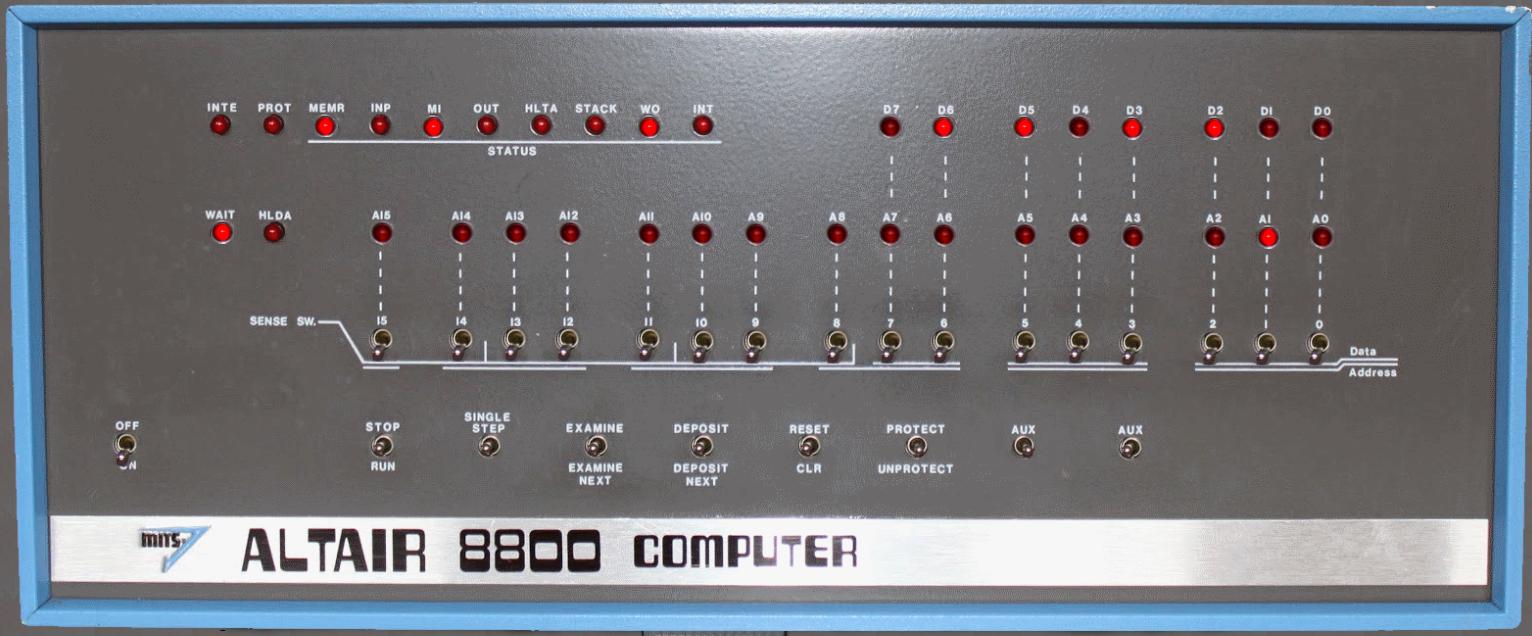
Input string is at memory address #0000H (allowed). Output in binary via front panel I/O lights D7-D0.
Example, do RESET, then EXAMINE to see the first byte, followed by repeating EXAMINE NEXT to see the rest.
"H" = 01 001 000:
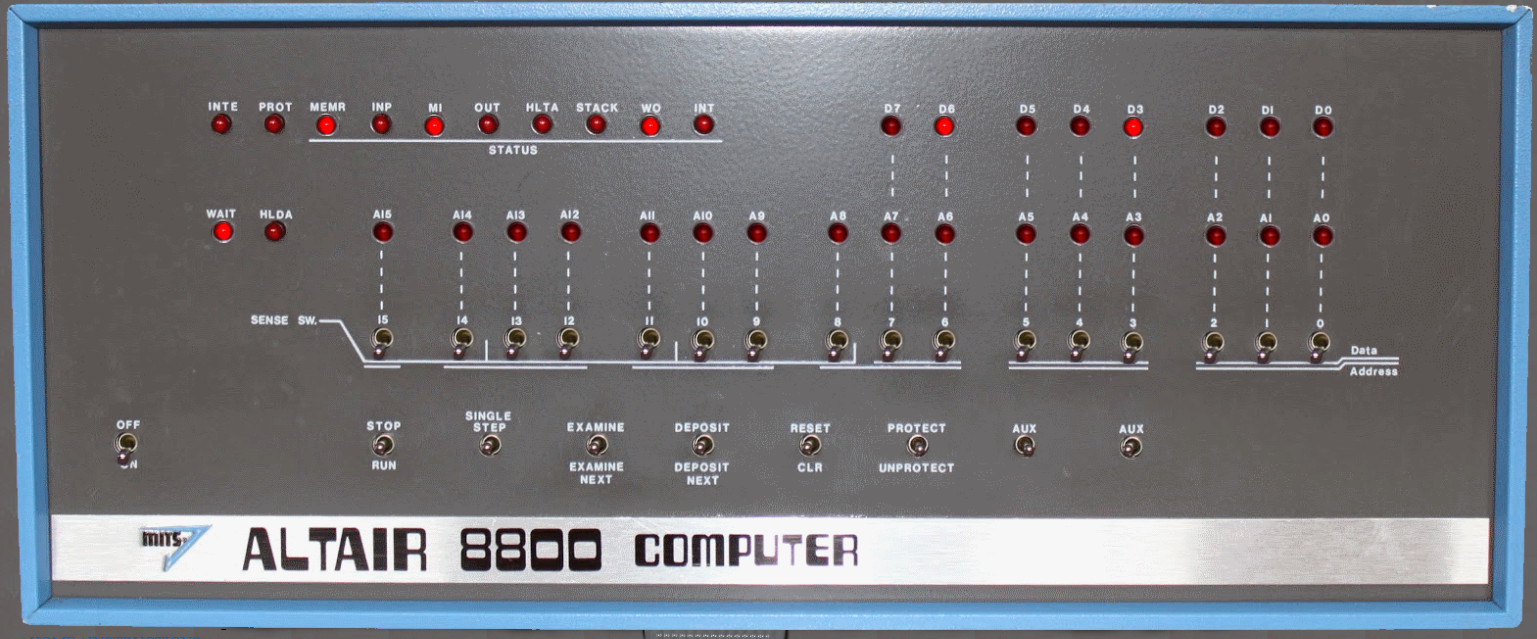
"e" = 01 100 101:

"l" = 01 101 100:
Non-competing, of course. :)
05AB1E, 4 bytes
Çbðý
Explanation:
Ç     # Convert the (implicit) input-string to a list of unicode values
 b    # Convert each integer to a binary string
  ðý  # Join by spaces (and output the result implicitly)
Could be just the first two bytes if a list output is allowed, or 3 bytes with » if a newline delimiter instead of space delimiter is allowed.
Ruby, 24 bytes
I was hoping to beat Martin Ender, but I only managed to tie him.
Takes input on STDIN; +1 bytes for -p flag.
gsub(/./){"%b "%$&.ord}
Forth (gforth), 45 bytes
: f 0 do dup i + c@ 2 base ! . decimal loop ;
Code Explanation
: f           \ start a new word definition
  0 do        \ start a loop from 0 to string length - 1
    dup i +   \ duplicate the address and add the loop index to get addr of current character
    c@        \ get the character at that address
    2 base !  \ set the base to binary
    .         \ print the ascii value (in binary)
    decimal   \ set the base back to decimal
  loop        \ end the loop
;             \ end the word definition
JavaScript ES6, 71 bytes
alert(prompt().split('').map(c=>c.charCodeAt(0).toString(2))).join(' ')
PowerShell, 63 59 46 bytes
-13 bytes thanks to @mazzy
"$($args|% t*y|%{[Convert]::ToString(+$_,2)})"
Java 8, 112 bytes
Takes input as a command line argument
interface M{static void main(String[]a){a[0].chars().forEach(i->System.out.print(Long.toBinaryString(i)+" "));}}
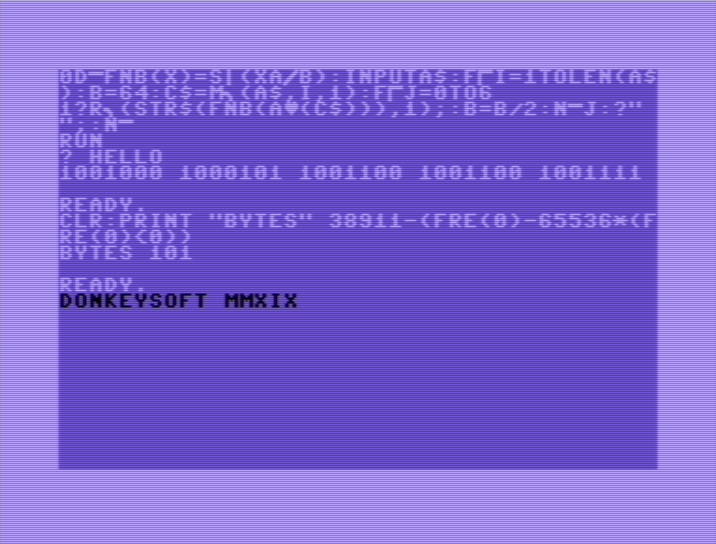
Commodore VIC-20/C64/128 and TheC64Mini, 101 tokenized BASIC bytes
Here is the obfuscated listing using Commodore BASIC keyword abbreviations:
 0dEfnb(x)=sG(xaNb):inputa$:fOi=1tolen(a$):b=64:c$=mI(a$,i,1):fOj=0to6
 1?rI(str$(fnb(aS(c$))),1);:b=b/2:nEj:?" ";:nE
Here for explanation purposes is the non-obfuscated symbolic listing:
 0 def fn b(x)=sgn(x and b)
 1 input a$
 2 for i=1 to len(a$)
 3 let b=64
 4 let c$=mid$(a$,i,1)
 5 for j=0 to 6
 6 print right$(str$(fn b(asc(c$))),1);
 7 let b=b/2
 8 next j
 9 print " ";
10 next i
The function fn b declared on line zero accepts a numeric parameter of x which is ANDed with the value of b; SGN is then used to convert x and b to 1 or 0.
Line one accept a string input to the variable a$, and the loop starts (denoted with i) to the length of that input. b represents each bit from the 6th to 0th bit. c$ takes each character of the string at position i.
line 5 starts the loop to test each bit position; right$ is used in line 6 to remove a auto-formatting issue when Commodore BASIC displays a number, converting the output of fn b to a string; asc(c$) converts the current character to its ascii code as a decimal value.
Line 7 represents the next bit value. The loop j is ended before printing a space, then the last loop i is ended.
Deorst, 8 bytes
vombkE]_
How it works
Example input: ab
vo       - Map ordinal;      STACK = [[97, 98]]
  mb     - Map binary;       STACK = [['1100001', '1100010']]
    k    - Turn off sort;    STACK = [['1100001', '1100010']]
     E]  - Flatten;          STACK = ['110001', '1100010']
       _ - Join with spaces; STACK = ['110001 1100010']
Shell utils, 102 bytes
I'm kind of ashamed of this.
xxd -b|sed -r "s/^.*: //;s/ .+$//;s/0*([01]+)/\1/g"|tr \n\r " "|sed -r "s/ +/ /g;s/ *1101 *1010 *$//"
Since I'm (possibly) running utilities from various archives across the Internet on Windows, I'll list the version information for each:
xxd V1.10 27oct98 by Juergen Weigert
GNU sed version 4.2.1
tr (GNU textutils) 2.0
Microsoft Windows [Version 10.0.15063]
q/kdb+, 18 bytes
Solution:
" "sv"01"0b vs'4h$
Example:
q)" "sv"01"0b vs'4h$"Hello World!"
"01001000 01100101 01101100 01101100 01101111 00100000 01010111 01101111 01110010 01101100 01100100 00100001"
Explanation:
Convert string to byte array, convert each byte to binary, index into the string "01" and then join strings together with whitespace " ":
" "sv"01"0b vs'4h$ / the solution
               4h$ / cast ($) to type byte (4h)
         0b vs'    / convert each (') byte to binary (0b vs)
     "01"          / (implicit) index into "01" (false;true)
" "sv              / join (sv) with " "
Julia, 23 bytes
f(n)=[bin(a)for a in n]
Scala - 59 - 55 Bytes
readLine().map(x=>print(x.toByte.toInt.toBinaryString))
Normally, one should use foreach and not map.
Erlang, 71 Bytes
f(S)->L=lists,L:droplast(L:flatten([integer_to_list(X,2)++" "||X<-S])).
If a trailing whitespace at the end is allowed then
55 Bytes
f(S)->lists:flatten([integer_to_list(X,2)++" "||X<-S]).
Ruby, 34 28 24 bytes
$<.bytes{|c|$><<"%b "%c}
Takes input via STDIN. 6 bytes saved thanks for AShelly and another 4 thanks to britishtea.
Python 3 - 43 bytes
print(*map("{:b}".format,input().encode()))
No quite the shortest, but an interesting approach IMO. It has the added advantage that if the number of significant bits varies, E.G. Hi!, padding with zeros is trivial (2 more bytes, as opposed to 9 for .zfill(8)):
print(*map("{:08b}".format,input().encode()))
JavaScript ES6, 63 65 bytes
alert([for(c of prompt())c.charCodeAt().toString(2)].join(' '))
This is rather long, thanks to JavaScript's long function names. The Stack Snippet below is the rough ES5 equivalent, so it can be run in any browser. Thanks to edc65 for the golfing improvements.
alert(prompt().split('').map(function(e){return e.charCodeAt().toString(2)}).join(' '))Ruby 38 Bytes
p gets.bytes.map{|i|i.to_s 2}.join ' '
JavaScript 78
alert(eval('""'+prompt().replace(/./g,"+' '+'$&'.charCodeAt().toString(2)")))
Postscript, 17 bytes (13 byte program + 4 character command line switch)
s { 2 7 string cvrs = } forall
Which is 31 bytes in tokenized form: (backticks denote literal characters, everything else is hexidecimal)
`s{2 7` 92A5 9230 `=}` 9249
Run using Ghostscript as:
gs -ss="Hello World!" string-to-binary.ps
Java - 148 Bytes
public class sToB{public static void main(String[] a){for(int i=0;i<a[0].length();i++){System.out.print(Integer.toString(a[0].charAt(i) ,2)+" ");}}}
Edited to include full file
C++ - 119 bytes
Freeing memory? What's that?
#include<cstdio>
#include<cstdlib>
int main(int c,char**v){for(*v=new char[9];c=*(v[1]++);printf("%s ",itoa(c,*v,2)));}
(MSVC compiles the code with warning)
Pyth, 10 bytes
jdmjkjCd2z
Python mapping and explanation:
j           # join(                               "Join by space"
 d          #      d,                             "this space"
 m          #      Pmap(lambda d:                 "Map characters of input string"
  j         #                    join(            "Join by empty string"
   k        #                        k,           "this empty string"
    j       #                        join(        "This is not a join, but a base conversion"
     C      #                             Pchr(   "Convert the character to ASCII"
      d     #                                  d  "this character"
            #                                 ),
     2      #                             2       "Convert to base 2"
            #                            )
            #                        ),
  z         #           z)))                      "mapping over the input string"
Input is the string that needs to be converted without the quotes.
Haskell, 65
m s=tail$do c<-s;' ':do j<-[6,5..0];show$mod(fromEnum c`div`2^j)2
heavy use of the list monad. it couldn't be converted to list comprehentions because the last statements weren't a return.
Cobra - 64
As a Lambda:
do(s='')=(for c as int in s get Convert.toString(c,2)).join(' ')
Never will C# win these kinds of questions but here's a try, completely without encoding. :)
C# - 84
Console.Write(String.Join(" ",Console.ReadLine().Select(x=>Convert.ToString(x,2))));
Golang - 68
I'm new to Go and I'm not sure on the rules for counting characters in this language on here either.
Imports (11 bytes):
import"fmt"
Function (55 bytes):
func c(s string){for _,r:=range s{fmt.Printf("%b ",r)}}
You can run it here.
J - 9
1":#:3&u:
No idea how to make this in a row without doubling the length of the code, I need J gurus to tell me :)
1":#:3&u:'Hello world!'
1001000
1100101
1101100
1101100
1101111
0100000
1110111
1101111
1110010
1101100
1100100
0100001
Python 3, 41 bytes
print(*[bin(ord(x))[2:]for x in input()])
Like KSFT's answer, but I thought I'd point out that, in addition to raw_input -> input, Python 3 also has an advantage here due to the splat for print.
STATA 158
I used a different approach than most. Read in via the display _request() prompt (shortened to di _r(r)). Write the string to a file called b in text mode. Open b in binary mode and read each character as a byte and convert to binary. Technically the b file should be closed at the end, but it is a valid program and runs successfully without it.
di _r(r)
file open a using "b",w
file w a "$r"
file close a
file open a using "b",b r
file r a %1bu t
while r(eof)==0 {
loc q=t
inbase 2 `q'
file r a %1bu t
}
Matlab
This is an anonymous function
f=@(x) dec2bin(char(x))
usage is f('Hello World').
Alternatively, if x is defined as the string Hello World! in the workspace, then just dec2bin(char(x)) will work.
Python - 52
print" ".join([bin(ord(i))[2:]for i in raw_input()])
I'll work on translating this into Pyth. Someone else did a Pyth answer already.
If you don't care about it being a full program or about I/O format and use Python 3, you can do it in 23 bytes like this:
[bin(ord(i))for i in x]
x is the input.
I know this doesn't count because the interpreter wasn't released before the challenge was posted, but here it is in KSFTgolf:
oan
CJam, 8 bytes
l:i2fbS*
Easy-peasy:
l:i           "Read the input line and convert each character to its ASCII value";
   2fb        "Put 2 on stack and use that to convert each ASCII value to base 2";
      S*      "Join the binary numbers by space";