| Bytes | Lang | Time | Link |
|---|---|---|---|
| 138 | brainfuck | 240805T194926Z | Andrew B |
| 011 | Japt R | 201019T110442Z | Shaggy |
| 009 | Vyxal C | 230502T192823Z | emirps |
| 013 | V | 161207T211413Z | DJMcMayh |
| 049 | Python 2 | 210527T065755Z | dingledo |
| 018 | Vyxal | 210527T043603Z | emanresu |
| 057 | /// | 210527T043022Z | Samuel W |
| 016 | Jelly | 210527T032727Z | DLosc |
| 008 | Charcoal | 200401T124658Z | Kevin Cr |
| 011 | 05AB1E | 200401T115853Z | Kevin Cr |
| 072 | Rockstar | 201014T151619Z | Shaggy |
| 027 | Notepad++ | 201014T024228Z | DLosc |
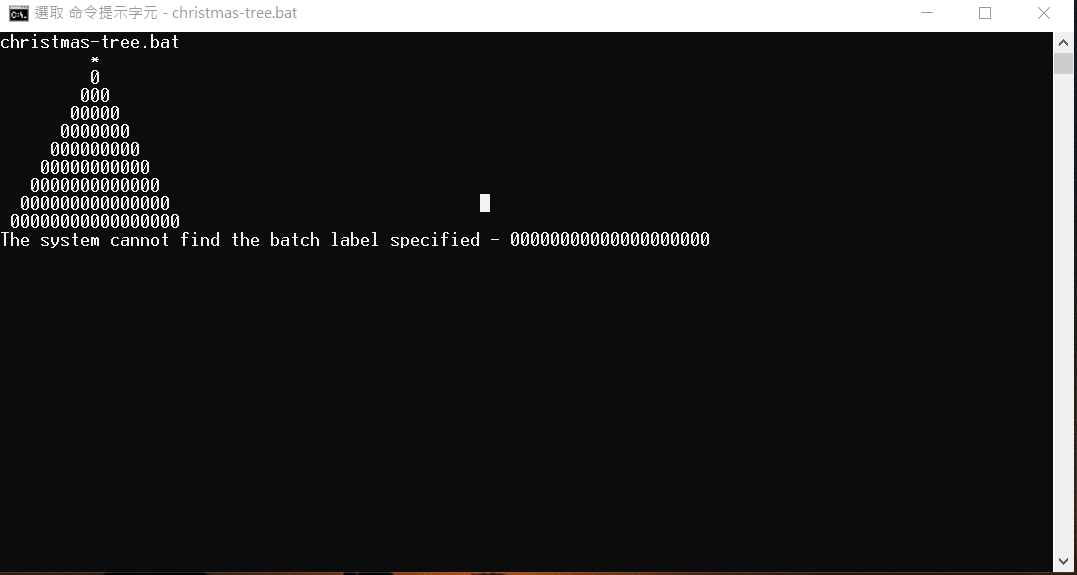
| 071 | BATCH | 200329T080551Z | ScriptKi |
| 128 | C | 200413T082203Z | Muskovet |
| 142 | TSQL | 120611T213703Z | Cristian |
| 134 | Erlang escript | 200401T115139Z | user9206 |
| nan | I know this doesn't comply with the spec | 111205T203839Z | Ilmari K |
| 038 | Powershell | 181008T113632Z | mazzy |
| 108 | Kotlin | 181008T023929Z | JohnWell |
| 069 | PHP | 180202T002056Z | Titus |
| 165 | Java OpenJDK 8 | 180202T001100Z | Addison |
| 025 | APL Dyalog Classic | 180201T233531Z | ngn |
| 071 | AWK | 180201T215543Z | Robert B |
| 095 | MYBASIC | 180201T185857Z | Taylor R |
| 063 | uBASIC | 180201T184042Z | Taylor R |
| 143 | jQuery | 161207T221647Z | HaLo2FrE |
| 109 | PHP | 111207T155722Z | Vladimir |
| 133 | CSV | 120703T174348Z | NRGdalla |
| 113 | Kotlin | 180201T163319Z | jrtapsel |
| 167 | F# | 111207T190742Z | m0sa |
| 2155 | Whitespace | 120327T225500Z | r.e.s. |
| 051 | Ruby | 111209T052034Z | scott |
| 074 | Scala | 111206T164243Z | Zvezdoch |
| 230 | Java | 111206T141920Z | Averroes |
| 073 | Scala | 160110T090728Z | Nitin Ni |
| 119 | Javascript | 111206T075649Z | Joshua |
| 070 | Python | 111205T215219Z | Ante |
| 527 | LOLCODE | 120725T031302Z | Kevin Tr |
| 106 | PHP | 111206T141027Z | Graham C |
| 114 | PostScript with parameterised height | 111206T145301Z | MrMRDuby |
| 018 | Vim | 161207T211823Z | DJMcMayh |
| 163 | Brainf*ck | 161207T200250Z | Esolangi |
| 092 | JavaScript | 161207T004053Z | Hyan Chr |
| 071 | JavaScript | 161207T051553Z | ETHprodu |
| 136 | C# | 140219T163531Z | RobIII |
| nan | 140219T204033Z | Christop | |
| 100 | Common Lisp 100 [nonblank] chars | 120818T190525Z | Haile |
| 092 | VimScript | 120802T202022Z | Kazark |
| 075 | PHP | 120726T223518Z | Leigh |
| nan | 120725T044451Z | Phan | |
| 275 | PHP275 Chars | 120621T180424Z | Event_Ho |
| 067 | C | 120621T173721Z | JoeFish |
| 181 | C# | 111206T225124Z | ICR |
| 089 | R | 120216T130950Z | Paolo |
| 181 | VALA | 111219T220239Z | MARTIN D |
| nan | 111213T225054Z | Skizz | |
| 079 | Python | 111206T110656Z | Anders |
| nan | 111212T025349Z | bnjf | |
| 127 | Java | 111208T143852Z | Armand |
| 127 | Prolog | 111208T125729Z | Rob Fox |
| 3037 | Maple | 111206T230412Z | Ilmari K |
| 027 | Golfscript | 111207T153803Z | Ventero |
| 143 | Applesoft BASIC | 111207T172607Z | sirchris |
| 8997 | Lua 83 | 111206T143850Z | Paul But |
| 141 | Java | 111207T124859Z | SiZ |
| 064 | Python | 111207T085308Z | Steven R |
| 073 | Haskell | 111207T072734Z | MtnViewM |
| 083 | Haskell | 111206T143019Z | stusmith |
| 068 | R | 111207T000437Z | Tommy |
| 080 | C | 111206T102942Z | litchie |
| 132 | JavaScript Rhino 108 | 111207T004529Z | Weston C |
| 136 | PHP | 111206T213526Z | Weston C |
| 046 | Ruby | 111205T201805Z | Howard |
| 186 | Prolog 183 or | 111206T171445Z | Paul But |
| nan | Java | 111206T150520Z | Jochem |
| 044 | Shell script | 111206T121705Z | Evan Kra |
| 177 | Java | 111206T114250Z | Tobias M |
| 062 | Python 3 | 111206T004420Z | Kazark |
| nan | Java | 111206T102431Z | Daniel S |
| 077 | C | 111206T090938Z | Patrick |
| 059 | Python | 111206T073757Z | Patrick |
| 145 | C | 111206T072444Z | Wade Tan |
| 113 | PHP | 111206T064457Z | Kris |
| 041 | PowerShell | 111206T060003Z | Jaykul |
| 050 | Mathematica | 111206T013433Z | Mr.Wizar |
| 033 | GolfScript | 111205T202615Z | Peter Ta |
| 065 | Groovy | 111205T170619Z | Armand |
| 042 | Perl | 111205T151903Z | Ilmari K |
brainfuck, 138 bytes
++++++++[->++++>+++++>++++++>+>+>+<<<<<<]>>++>>++>+<<<<........>.>>>>>>+<<<[-<.>>[->+<<<<<<.>>>>>]->[-<+>]>[->+<<<<<<.>>>>>]++>[-<+>]<<<<]
output:
        *
        0
       000
      00000
     0000000
    000000000
   00000000000
  0000000000000
 000000000000000
00000000000000000
ungolfed:
++++++++
[->++++>+++++>++++++>+>+>+<<<<<<]
>>++>>++>+
<<<<........>.>>>
>>>+<<<
[-
  <.>
  >
  [-
    >+
    <<<<<<.
    >>>>>
  ]
  ->
  [-
    <+>
  ]
  >
  [-
    >+
    <<<<<<.
    >>>>>
  ]
  ++>
  [-
    <+>
  ]
  <<<<
]
Japt -R, 12 11 bytes
AÇçT êÃh* û
AÇçT êÃh* û :(Remove A to input the height instead)
A :10
Ç :Map the range [0,A) (or [0,input))
ç : Repeat
T : 0
ê : Palindromise
à :End map
h* :Replace the first element with "*"
û :Centre pad with spaces to the length of the longest
:Implicit output joined with newlines
Vyxal C, 9 bytes
17~∷\0*×p
17~       # the range 1..17 filtered by
   ∷      # is odd
    \0*   # "0" repeated n times for n in those odd nums
       ×p # with an asterisk prepended
          # C flag joins by newlines and centers output
V, 13 bytes
17é0òÄlxx>òr*
It's fun to beat the accepted answer by a huge margin. :D
Explanation:
17é0            " Insert 17 '0's
    ò     ò     " Recursively:
     Ä          "   Copy this line upwards
      l         "   Move one char to the right
       xx       "   Delete two characters
         >      "   Indent this line
           r*   " Replace the last character with an asterisk
Python 2, 49 bytes
n=-1
exec"print' '*(8-n/2%n),n*'0'or'*';n+=2;"*10
Python 3, 47 bytes
n=-1
while n<19:print(f"{n*'0'or'*':^19}");n+=2
Vyxal, 18 bytes
9\*꘍₀(,9n-\0n›*꘍øm
Fairly well golfed.
9                  # 9
 \*                # '*'
   ꘍               # ' ' * 9 + '*'
    ₀(             # 10 times
      ,            # output
       9n-         # 9 - (iteration number)
          \0       # String '0'
            n›     # iteration number + 1
              *    # That many 0s
               ꘍   # (9 - (iteration number)) spaces + 0s
                øm # Palindromised
Tree:
         *
         0
        000
       00000
      0000000
     000000000
    00000000000
   0000000000000
  000000000000000
 00000000000000000
///, 57 bytes
/i/         /i*/> /
i0\/ \\0\/a\\a\/\/a\\a\/000\/>//>//>i
Normally I would have another replacement for the escaped "/" in the loop bit, but it happens to be the same length without so why not.
Change the number of spaces in the first line, after the /i/. Technically, there is one less space that the 'size' but size 0, 1 etc aren't defined so I don't think it matters.
Jelly, 17 16 bytes
⁶ẋ8⁾*¶9µ>þa⁶UŒBY
This is my first time golfing in Jelly; I'm sure this could be golfed further. Advice welcome. :^)
Explanation
⁶                 Space character
 ẋ8               Repeated 8 times
                  Since this niladic chain doesn't connect to anything, just output it
   ⁾*¶            Two-character string containing * and newline
                  Since this niladic chain doesn't connect to anything, just output it
      9µ          Apply the following monadic chain to a starting value of 9:
        >þ        Make a 9x9 table, where each entry is 1 if the column number is
                  greater than the row number, 0 if not
          a⁶      Logical AND with space (replaces the 1's with spaces)
            U     Reverse each row
             ŒB   Bounce, mirroring each row to the right
               Y  Join with newlines
Charcoal, fixed height: 10 8 bytes
↓*G↙→→⁹0
-2 bytes thanks to @Neil.
Try it online (verbose) or try it online (pure).
Explanation:
Print the "*", and move the cursor down:
Print(:Down, "*");
↓*
Draw a polygon in the shape of a triangle, with the initial arm as size 9 and using the character "0" as filler:
Polygon(:DownRight, :Left, :Left, 9, "0");
G↙→→⁹0
Variable height through input: 14 9 bytes:
↓*G↘←←⊖θ0
-5 bytes thanks to @Neil.
Try it online (verbose) or try it online (pure).
Explanation:
Print the "*", and move the cursor down:
Print(:Down, "*");
↓*
Draw a polygon in the shape of a triangle, with the initial arm as size input-1 and using the character "0" as filler:
Polygon(:DownRight, :Left, :Left, Decremented(q), "0");
G↘←←⊖θ0
05AB1E, fixed height: 11 bytes
¾17ÅÉ×'*š.c
Variable height through input: 12 11 bytes:
ηÍÅÉ×'*š.c
Explanation:
¾             # Push 0 (push the counter_variable, which is 0 by default)
 17ÅÉ         # Push a list of the positive odd numbers <= 17: [1,3,5,7,9,11,13,15,17]
     ×        # Repeat the 0 that many times as string:
              #  ["0", "000", "00000", ..., "00000000000000000"]
      '*š    '# Prepend a "*": ["*", "0", "000", "00000", ..., "00000000000000000"]
         .c   # Centralize each line by padding with leading spaces
              # (which also implicitly joins a list by newlines at the same time)
              # (after which it is output implicitly as result)

Î             # Push 0 and the input-integer
 ·            # Double the input
  Í           # Decrease it by 2
   ÅÉ×'*š.c  '# Same as above
Rockstar, 72 bytes
say " "*8+"*"
X's0
while 9-X
let Y be 8-X
say " "*Y+0+"0"*X*2
let X be+1
Try it here (Code will need to be pasted in)
Notepad++, 27 keystrokes
0000<Ctrl-A><Ctrl-D><Ctrl-A><Ctrl-D><Home>0<Ctrl-Shift-R><Ctrl-D><Del><Backsp><Space>
→<Ctrl-Shift-R><Ctrl-Shift-P><Ctrl-Shift-P><Ctrl-Shift-P><Ctrl-Shift-P>
<Ctrl-Shift-P><Ctrl-Shift-P><Ctrl-Shift-P><Ctrl-D><Backsp>*
(Newlines included only for readability.)
Explanation
We'll build the tree from the bottom up:
The setup
Starting with four 0s, we CtrlA CtrlD (select all, duplicate) twice to get sixteen 0s. We need seventeen 0s on the bottom row, so we go Home and add another one. The cursor is now positioned right after the first 0 on the line.
The macro
CtrlShiftR starts recording a macro, which we'll use to generate each line from the one below it:
- CtrlD duplicates the line, leaving the cursor on the upper of the two copies
- Since the cursor is just after the first
0on the line, Del Backsp Space removes two0s and prepends a space - Finally, → moves one character rightward, so that we are once again right after the first
0on the line
A second CtrlShiftR ends the macro, and then CtrlShiftP seven times calls the macro repeatedly to generate the rest of the body of the tree.
The finishing touch
For the star, we need only duplicate the top row with CtrlD, remove the 0 with Backsp, and replace it with a *.
        *
        0
       000
      00000
     0000000
    000000000
   00000000000
  0000000000000
 000000000000000
00000000000000000
BATCH, 96 90 83 73 71 bytes
Fixed height=10:
@set[=          0
@echo%[:0=*%
:0
@echo%[%
@set[=%[:~1%00
@goto:0%[:~1%
Saved 6 bytes by replacing \r\n line terminators with \n (still works)
P.S I'm new to golf, so I'm not sure if Removed pause is required.@pause, saved 7 bytes.
2020/4/30 - Abused token delimiters [, golfed 2 bytes.
C, 128
h=10;y,w,i,j;main(){for(y=-1;y<h;y++){w=1+max(y,0)*2;i=((h*2)-w)/2;for(j=0;j<i+w;j+1)printf(j<i?" ":y+1?"0":"*");printf("\n");}}
         *
         0
        000
       00000
      0000000
     000000000
    00000000000
   0000000000000
  000000000000000
 00000000000000000
0000000000000000000
h is the tree's height without the star.
T-SQL, 151 142 bytes
declare @ int
set @=10;with t as(select space(@-1)+'*'z,1 i
union all
select space(@-i)+replicate('0',i*2-1),i+1 from t)
select top(@)z from t
The height of the tree can be adjusted (just change the value of the @h variable)
The query uses a Recursive CTE.
Test link: http://sqlfiddle.com/#!3/d41d8/1695 (from the "Run SQL" dropdown button, select "Plaintext Output")
If run from the SQL Management Studio select "Results to Text" and use this query, as SSMS displays the data left aligned:
declare @h int
set @h=10;with t as(select space(@h-1)+'*'as z,1 as i
union all
select space(@h-i)+replicate('0',i*2-1),i+1 from t)
select top(@h)z from t
Sample SQL Server Management Studio output:
z
----------------------------------------------------------------------------------------------------------------------------------------------------------------------------------------------------------------------------------------------------------------
         *
         0
        000
       00000
      0000000
     000000000
    00000000000
   0000000000000
  000000000000000
 00000000000000000
EDIT: Saved 9 chars thanks to BradC!
Erlang (escript), 134 bytes
The tree is resizable.
r(-1,_)->"";r(X,Y)->lists:duplicate(X," ")++lists:duplicate(Y,"0")++"\n"++r(X-1,Y+2).
t(X)->lists:duplicate(X-1," ")++"*\n"++r(X-1,1).
I know this doesn't comply with the spec, but I thought I'd try to add some diversity to the trees here by imitating this classic ASCII art Christmas scene by Joan G. Stark.
I didn't try to reproduce the whole picture — that would've been a bit too much — but just the tree, for which I present this 138-byte Perl program:
$_=join$/,qw'11| 8\2_2/ 9(\o/) 5---2/1\2--- 10>*<',map(11-$_.A.AA x$_,2..11),'9\|H|/';s/\d+/$"x$&/eg,s/A/substr">>>@*O<<<",rand 9,1/eg,say
And, of course, here's a sample of the output:
           |
        \  _  /
         (\o/)
     ---  / \  ---
          >*<
         >O><@
        <><<>><
       @><><>@<<
      @<O><*@*>>O
     OO@@*O<<<*<OO
    ><<>@><<>@<><><
   >><O<>>><@*>>><<O
  *<>*<><<>@><O*>><*<
 O><><<@<*>><O*@>O><>*
O<><<><@O>>*O*OO<><<>O>
         \|H|/
The code uses the Perl 5.10+ say feature, and so needs to be run with the -M5.010 (or -E) command line switch. (Actually, just replacing the say at the end with print would avoid that, at the cost of two more bytes and the loss of the newline after the last line of output.)
Note that the bulk of the tree is randomly generated, so the placement of the ornaments will vary between runs. The angel, the stand and the top row of the tree are fixed, though.
To keep this popular answer from being summarily deleted under a policy instituted after it was posted, here's a token spec-compliant solution as well (45 bytes, also Perl 5):
$_=$"x10 ."*";say,s/ 0/00/,s/\*?$/0/ while/ /
Like the program above, this one also needs to be run on Perl 5.10+ with the -M5.010 switch to enable the say feature. Obviously (this being a kolmogorov-complexity challenge) it produces the exact same boring output as all the other compliant entries, which I won't bother repeating here. (It's also trivially resizable by changing the number 10 to any other other value.)
Powershell, 38 bytes
' '*8+'*'
8..0|%{' '*$_+'0'*(17-2*$_)}
Output:
        *
        0
       000
      00000
     0000000
    000000000
   00000000000
  0000000000000
 000000000000000
00000000000000000
Powershell with parameter, 49 bytes
param($h)' '*$h+'*'
$h..0|%{' '*$_+'0'*(17-2*$_)}
Kotlin, 108 bytes
A few years late, but I was searching for something else and it was in my search results. Accepts a input for the rows. Fixing it to 10 rows saves 6 bytes (code below).
{n:Int->(0..n).map{if(it<1)" ".repeat(n)+"*"
else " ".repeat(n-it+1)+"0".repeat(it*2-1)}.joinToString("\n")}
Output:
          *
          0
         000
        00000
       0000000
      000000000
     00000000000
    0000000000000
   000000000000000
  00000000000000000
 0000000000000000000
Hardcoded with 10:
{(0..10).map{if(it<1)" ".repeat(10)+"*"
else " ".repeat(11-it)+"0".repeat(it*2-1)}.joinToString("\n")}
PHP, 69 bytes
while($i<10)printf("%".(8+$i+!$i)."s
",$i++?str_pad(0,$i*2-3,0):'*');
Run with php -nr '<code>' or try it online.
Resizable version, 76+1 bytes (run as pipe with -nR):
while($i<$argn)printf("%".($argn+$i+!$i)."s
",$i++?str_pad(0,$i*2-3,0):'*');
Java (OpenJDK 8), 165 bytes
I saw some possible changes in the existing Java answer and thought I'd add my answer. (trims off 65 bytes, so I'm pretty proud tbh)
interface p{static void main(String[]a){String s=" ",o=s+"*";for(int i=0;i<9;i++){o+="\n"+s.substring(i);for(int j=0;j<=2*i;j++)o+=0;}System.out.println(o);}}
APL (Dyalog Classic), 25 bytes
' *0'[(⊣⌿⍪+⍨)(⊖,~)∘.≤⍨⍳⎕]
        *
        0
       000
      00000
     0000000
    000000000
   00000000000
  0000000000000
 000000000000000
00000000000000000
it's resizable:
                   *
                   0
                  000
                 00000
                0000000
               000000000
              00000000000
             0000000000000
            000000000000000
           00000000000000000
          0000000000000000000
         000000000000000000000
        00000000000000000000000
       0000000000000000000000000
      000000000000000000000000000
     00000000000000000000000000000
    0000000000000000000000000000000
   000000000000000000000000000000000
  00000000000000000000000000000000000
 0000000000000000000000000000000000000
000000000000000000000000000000000000000
AWK, 71 bytes
{for(;$1--;)printf"%"$1-(a==0)"s%0"2*++F-3(a?"d":"s")"\n","",a++?0:"*"}
It seems like some simplification should be possible, but I can't find it.
NOTE: The TIO link has a few extra bytes to allow printing multiple trees.
        *
        0
       000
      00000
     0000000
    000000000
   00000000000
  0000000000000
 000000000000000
00000000000000000
MY-BASIC, 95 bytes
S="         *"
Print S;
For I=0 To 8
Print Left(S,9-I)d
For J=0 To 2*I
Print 0
Next
Print;
Next
jQuery, 160 152 143 bytes
Well, I recognize that it's late, and that it didn't beat the other jQuery entries, but it's been a LONG time since I've done any javascript, so here goes:
$.fn.x=function(h){for(var i=1,o=" ".repeat(h-2)+"*\n";i++<h;)o+=(i==h?"0".repeat(i+(i-3)):" ".repeat(h-i)+"0".repeat(i+(i-3)))+"\n";return o};
Can be run from your browser's javascript console with $().x(10), and accepts any height parameter. Keep in mind, Chrome's console puts a quotation mark at the beginning and end of console output, so that makes the * appear out of place, but it's not.
PHP, 109 characters
for($i=10,$j=1,$k=0;$i;$i--,$j+=2,$k=2)echo str_pad(str_repeat($j<2?'*':0,$j-$k),$i+$j-(!$k?1:2),' ',0)."\n";
Not the shortest code possible, but easily resizable with changing only the value of $i.
CSV, 133 bytes
Thought I would Cheat Just a little on this one for a few laughs :)
        0,
       000,
      00000,
     0000000,
    000000000,
   00000000000,
  0000000000000,
 000000000000000,
00000000000000000
Kotlin, 113 bytes
{(0..9).map{print(' ')}
println('*')
(0..9).map{(it..9).map{print(' ')}
(0..it-1).map{print("00")}
println('0')}}
Beautified
{
    (0..9).map { print(' ') }
    println('*')
    (0..9).map {
        (it..9).map { print(' ') }
        (0..it-1).map { print("00") }
        println('0')
    }
}
Test
var f:()->Unit =
{(0..9).map{print(' ')}
println('*')
(0..9).map{(it..9).map{print(' ')}
(0..it-1).map{print("00")}
println('0')}}

fun main(args: Array<String>) {
    f()
}
TIO
F#, 167 bytes
let r n s=String.replicate n s
let rec x h i=
 let w=r i" "
 match h with|0->w+"*\n"|1->(x(h-1)i)+w+"0\n"|z->(x(h-1)(i+1))+w+(r(z+z-1)"0")+"\n"
printfn "%s"(x 8 0)
Whitespace, 2155 bytes
Program (replace S,T,L with Space,Tab,Linefeed characters respectively):
SSSTSSSSSLTLSSSSSTSSSSSLTLSSSSSTSSSSSLTLSSSSSTSSSSSLTLSSSSSTSSSSSLTLSSSSSTSSSSSLTLSSSSSTSSSSSLTLSSSSSTSSSSSLTLSSSSSTSSSSSLTLSSSSSTSSSSSLTLSSSSSTSTSTSLTLSSSSSTSTSLTLSSSSSTSSSSSLTLSSSSSTSSSSSLTLSSSSSTSSSSSLTLSSSSSTSSSSSLTLSSSSSTSSSSSLTLSSSSSTSSSSSLTLSSSSSTSSSSSLTLSSSSSTSSSSSLTLSSSSSTSSSSSLTLSSSSSTSSSSSLTLSSSSSTTSSSSLTLSSSSSTSTSLTLSSSSSTSSSSSLTLSSSSSTSSSSSLTLSSSSSTSSSSSLTLSSSSSTSSSSSLTLSSSSSTSSSSSLTLSSSSSTSSSSSLTLSSSSSTSSSSSLTLSSSSSTSSSSSLTLSSSSSTSSSSSLTLSSSSSTTSSSSLTLSSSSSTTSSSSLTLSSSSSTTSSSSLTLSSSSSTSTSLTLSSSSSTSSSSSLTLSSSSSTSSSSSLTLSSSSSTSSSSSLTLSSSSSTSSSSSLTLSSSSSTSSSSSLTLSSSSSTSSSSSLTLSSSSSTSSSSSLTLSSSSSTSSSSSLTLSSSSSTTSSSSLTLSSSSSTTSSSSLTLSSSSSTTSSSSLTLSSSSSTTSSSSLTLSSSSSTTSSSSLTLSSSSSTSTSLTLSSSSSTSSSSSLTLSSSSSTSSSSSLTLSSSSSTSSSSSLTLSSSSSTSSSSSLTLSSSSSTSSSSSLTLSSSSSTSSSSSLTLSSSSSTSSSSSLTLSSSSSTTSSSSLTLSSSSSTTSSSSLTLSSSSSTTSSSSLTLSSSSSTTSSSSLTLSSSSSTTSSSSLTLSSSSSTTSSSSLTLSSSSSTTSSSSLTLSSSSSTSTSLTLSSSSSTSSSSSLTLSSSSSTSSSSSLTLSSSSSTSSSSSLTLSSSSSTSSSSSLTLSSSSSTSSSSSLTLSSSSSTSSSSSLTLSSSSSTTSSSSLTLSSSSSTTSSSSLTLSSSSSTTSSSSLTLSSSSSTTSSSSLTLSSSSSTTSSSSLTLSSSSSTTSSSSLTLSSSSSTTSSSSLTLSSSSSTTSSSSLTLSSSSSTTSSSSLTLSSSSSTSTSLTLSSSSSTSSSSSLTLSSSSSTSSSSSLTLSSSSSTSSSSSLTLSSSSSTSSSSSLTLSSSSSTSSSSSLTLSSSSSTTSSSSLTLSSSSSTTSSSSLTLSSSSSTTSSSSLTLSSSSSTTSSSSLTLSSSSSTTSSSSLTLSSSSSTTSSSSLTLSSSSSTTSSSSLTLSSSSSTTSSSSLTLSSSSSTTSSSSLTLSSSSSTTSSSSLTLSSSSSTTSSSSLTLSSSSSTSTSLTLSSSSSTSSSSSLTLSSSSSTSSSSSLTLSSSSSTSSSSSLTLSSSSSTSSSSSLTLSSSSSTTSSSSLTLSSSSSTTSSSSLTLSSSSSTTSSSSLTLSSSSSTTSSSSLTLSSSSSTTSSSSLTLSSSSSTTSSSSLTLSSSSSTTSSSSLTLSSSSSTTSSSSLTLSSSSSTTSSSSLTLSSSSSTTSSSSLTLSSSSSTTSSSSLTLSSSSSTTSSSSLTLSSSSSTTSSSSLTLSSSSSTSTSLTLSSSSSTSSSSSLTLSSSSSTSSSSSLTLSSSSSTSSSSSLTLSSSSSTTSSSSLTLSSSSSTTSSSSLTLSSSSSTTSSSSLTLSSSSSTTSSSSLTLSSSSSTTSSSSLTLSSSSSTTSSSSLTLSSSSSTTSSSSLTLSSSSSTTSSSSLTLSSSSSTTSSSSLTLSSSSSTTSSSSLTLSSSSSTTSSSSLTLSSSSSTTSSSSLTLSSSSSTTSSSSLTLSSSSSTTSSSSLTLSSSSSTTSSSSLTLSSSSSTSTSLTLSSSSSTSSSSSLTLSSSSSTSSSSSLTLSSSSSTTSSSSLTLSSSSSTTSSSSLTLSSSSSTTSSSSLTLSSSSSTTSSSSLTLSSSSSTTSSSSLTLSSSSSTTSSSSLTLSSSSSTTSSSSLTLSSSSSTTSSSSLTLSSSSSTTSSSSLTLSSSSSTTSSSSLTLSSSSSTTSSSSLTLSSSSSTTSSSSLTLSSSSSTTSSSSLTLSSSSSTTSSSSLTLSSSSSTTSSSSLTLSSSSSTTSSSSLTLSSSSSTTSSSSLTLSSLLL
or download the whitespace-only program text-file christmas_tree.ws.
Output:
          *
          0
         000
        00000
       0000000
      000000000
     00000000000
    0000000000000
   000000000000000
  00000000000000000
This program simply outputs the 164 successive characters that make up the ten rows of the tree (averaging just over 13 program characters per output character). No doubt there's a much shorter Whitespace program that uses some logic to generate the blocks of repeated tree characters.
Ruby, 51 bytes
puts' '*8+'*';9.times{|a|puts' '*(8-a)+'0'*(a*2+1)}
Output:
        *
        0
       000
      00000
     0000000
    000000000
   00000000000
  0000000000000
 000000000000000
00000000000000000
Scala, 74 bytes
val h=10;println(" "*h+"*");for(i<-0 to h-2)println(" "*(h-i)+"0"*(i*2+1))
h - height of the tree
Output
        *
        0
       000
      00000
     0000000
    000000000
   00000000000
  0000000000000
 000000000000000
00000000000000000
Java, 230 characters
My own take.
class p{public static void main(String[]a){new p().m();}void m(){int h=0;x(20,1,"*");while(h<9)x(20-h,2*h+++1,"0");}void x(int s,int f,String c){for(;s>0;s--)d(" ");while(f-->0)d(c);d("\n");}void d(String s){System.out.print(s);}}
And the output:
                *
                0
               000
              00000
             0000000
            000000000
           00000000000
          0000000000000
         000000000000000
        00000000000000000
The code indented:
class p {
public static void main(String[] a) {
    new p().m();
}

void m() {
    int h = 0;
    x(20, 1, "*");
    while (h < 9)
        x(20 - h, 2 * h++ + 1, "0");
}

void x(int s, int f, String c) {
    for (; s > 0; s--)
        d(" ");
    while (f-- > 0)
        d(c);
    d("\n");
}

void d(String s) {
    System.out.print(s);
}
}
Adding parameters for height should take only a few more characters, but I am very far way of winning :P
Scala, 73 bytes
var(h,c)=(10,"*");0+:(0 to h-2)map{i=>println(" "*(h-i)+c*(i*2+1));c="0"}
Output
          *
          0
         000
        00000
       0000000
      000000000
     00000000000
    0000000000000
   000000000000000
  00000000000000000
Javascript, 119 characters
Outputs to firebug console
i=h=9;a=new Array(h);a[0]=a.join(' ');b=a.join('000');a[0]+='*';while(i)a[i--]=b.substr(i,h+i);console.log(a.join('\n'))


        *
        0
       000
      00000
     0000000
    000000000
   00000000000
  0000000000000
 000000000000000
00000000000000000
Python, 70 characters
Not so short, but recursive solution :-)
def a(s):
 print s
 if s<"0":a(s[1:]+"00")
print" "*8+"*"
a(" "*8+"0")
Change 8's to set height.
LOLCODE, 527 bytes
CAN HAS STDIO?
HAI 1.2
IM IN YR LOOP UPPIN YR VAR TIL BOTH SAEM VAR AN 8
    VISIBLE " "!
IM OUTTA YR LOOP
VISIBLE "*"
I HAS A SPACES
SPACES R 8
I HAS A ZEROS
ZEROS R 1
IM IN YR LOOP UPPIN YR VAR TIL BOTH SAEM VAR AN 9
    IM IN YR LOOP UPPIN YR VAR2 TIL BOTH SAEM VAR2 AN SPACES
        VISIBLE " "!
    IM OUTTA YR LOOP
    IM IN YR LOOP UPPIN YR VAR2 TIL BOTH SAEM VAR2 AN ZEROS
        VISIBLE "0"!
    IM OUTTA YR LOOP
    VISIBLE ""
    SPACES R DIFF OF SPACES AN 1
    ZEROS R SUM OF ZEROS AN 2
IM OUTTA YR LOOP
KTHXBYE
Output:
        *
        0
       000
      00000
     0000000
    000000000
   00000000000
  0000000000000
 000000000000000
00000000000000000
PHP, 106 characters
7 fewer than the previous:
<?php echo str_pad(' ',9)."*\n";for($i=0;$i<9;$i++){echo str_pad("",9-$i).str_pad("",($i*2)+1,"0")."\n";}
PostScript (with parameterised height), 114 characters
/h 9 def/b{{( )=print}repeat}def
h -1 0{dup h eq{dup b(*)=}if dup b h sub neg 2 mul 1 add{(0)=print}repeat()=}for
Output:
         *
         0
        000
       00000
      0000000
     000000000
    00000000000
   0000000000000
  000000000000000
 00000000000000000
0000000000000000000
What, you wanted it to print out?
Vim, 18 bytes
17i0<esc>qqYPxr q8@qa*
Try it online in the backwards-compatible V interpreter!
Although this is a very similar approach as my V answer, this one is not non-competing since vim is crazy old. :)
Explanation:
17i0<esc>               " Insert 17 '0's
         qq     q       " Start recording into register 'q'
           YP           " Duplicate this line upwards
             x          " Delete one character
              r         " Replace this character with a space
                 8@q    " Playback macro 'q' 8 times
                    a*  " Append an asterisk
Brainf*ck, 163 bytes
This could be golfed further, but this is my first serious attempt at golfing in general, so oh well...
++++++++++[->+>+>+<<<]>>>++++++[->>++>+++<<<]>>.<<<-[>>>.<<+<-]>>>>------.++++++>+<<<<+.-[-[-<+>>+<]<[->+<]>>>..<[->.<]>>>[->+>+<<]>[-<+>]>[-<<<.>>>]<<++<<<<<<.>>]
Output:
          *
          0
         000
        00000
       0000000
      000000000
     00000000000
    0000000000000
   000000000000000
  00000000000000000
JavaScript, 108 bytes 92 bytes
i=9,n=Array(i).join(' '),s='0',a=[n+'*'];while(i--)a.push(n.substr(0,i)+s),s+='00';console.log(a.join('\n'))
edited:
i=10,n=' '.repeat(i-1),s='0',t=n+'x';for(;i--;s+='00')t+='\n'+n.substr(0,i)+s;console.log(t)
ungolfed:
i=10,n=' '.repeat(i-1),s='0',t=n+'x';

for(;i--;s+='00')t+='\n'+n.substr(0,i)+s;

console.log(t);
JavaScript, 71 bytes
for(i=z='10';i--;z+='00')console.log(' *'.slice(0,i)+z.slice(3))
This challenge seemed to be suffering from a distinct lack of super-short JavaScript answers, so I thought I'd try to make up for that. This is the shortest ES5 solution I have found thus far.
Test snippet
for(i=z='10';i--;z+='00')console.log(' *'.slice(0,i)+z.slice(3))C#, Fixed height, 136 chars
class P{static void Main(){for(int i=0;i<10;i++)System.Console.WriteLine((i>0?new string('0',(i-1)*2+1):"*").PadLeft(10+(i>0?i-1:0)));}}
Formatted:
class P
{
    static void Main()
    {
        for (int i = 0; i < 10; i++)
            System.Console.WriteLine((i > 0 ? new string('0', (i - 1) * 2 + 1) : "*").PadLeft(10 + (i > 0 ? i - 1 : 0)));
    }
}
Output when run:
         *
         0
        000
       00000
      0000000
     000000000
    00000000000
   0000000000000
  000000000000000
 00000000000000000
Variable height: 165 chars
Use commandline parameter to specify height
class P{static void Main(string[]a){int h=int.Parse(a[0]);for(int i=0;i<h;i++)System.Console.WriteLine((i>0?new string('0',(i-1)*2+1):"*").PadLeft(h+(i>0?i-1:0)));}}
Formatted:
class P
{
    static void Main(string[] a)
    {
        int h = int.Parse(a[0]);
        for (int i = 0; i < h; i++)
            System.Console.WriteLine((i > 0 ? new string('0', (i - 1) * 2 + 1) : "*").PadLeft(h + (i > 0 ? i - 1 : 0)));
    }
}
Output for foo.exe 15:
              *
              0
             000
            00000
           0000000
          000000000
         00000000000
        0000000000000
       000000000000000
      00000000000000000
     0000000000000000000
    000000000000000000000
   00000000000000000000000
  0000000000000000000000000
 000000000000000000000000000
Haskell
tree x=unlines $ (insert 1 '*'):[insert o '0'|o<-[1,3..r]]
    where insert n c=let sur = replicate ((r-n) `div` 2) ' ' in sur++(replicate n c)++sur
          r=2*x+1
Here is the output:
λ <*Main>: putStr $ tree 10
          *
          0
         000
        00000
       0000000
      000000000
     00000000000
    0000000000000
   000000000000000
  00000000000000000
 0000000000000000000
000000000000000000000
Common Lisp - 100 [nonblank] chars
No Common Lisp solutions? =) Here's mine:
(or
   (format t "~17:@<*~>~%")
   (format t "~{~17:@<~{0~*~}~>~%~}"
      (loop for x upto 8 collect
         (make-list (1+ (* 2 x))))))
result:
        *
        0
       000
      00000
     0000000
    000000000
   00000000000
  0000000000000
 000000000000000
00000000000000000
for higher trees just replace "8" with (height - 2) and "17" with 1+2x(height-2). Here's a 14 rows tree:
CL-USER> (or
          (format t "~25:@<*~>~%")
          (format t "~{~25:@<~{0~*~}~>~%~}"
                  (loop for x upto 12 collect
                       (make-list (1+ (* 2 x))))))
            *
            0
           000
          00000
         0000000
        000000000
       00000000000
      0000000000000
     000000000000000
    00000000000000000
   0000000000000000000
  000000000000000000000
 00000000000000000000000
0000000000000000000000000
VimScript: 92 characters
I am working at learning Vim and it occurred to me that it could be a neat platform for code golfing. I don't know how to script in Vim that well yet, so any optimization suggestions are appreciated. Note: ^[ does not mean a literal caret next to a literal bracket, but is Vim's way of displaying a literal ESC character in the text.
norm8a ^[a*^[9o^[17a0^[ka ^[15a0^[k2a ^[13a0^[k3a ^[11a0^[k4a ^[9a0^[k5a ^[7a0^[k6a ^[5a0^[k7a ^[3a0^[k8a ^[a0
Here is the output. One of the unique things about this answer is that the output is created in a buffer in Vim (use a :new buffer). The brackets indicate the final cursor location, which ended up where it did for optimization reasons but I think that is cool:
        *
       [0]
       000
      00000
     0000000
    000000000
   00000000000
  0000000000000
 000000000000000
00000000000000000
Updated: 71 characters
Using mapping to reduce number of characters:
map b a0^[k
map c a ^[
norm8ca*^[9o^[17bc15b2c13b3c11b4c9b5c7b6c5b7c3b8ca0
Updated: 69 characters
Use punctuation instead of letters for the mapped characters in order to save two space characters.
map- a0^[k
map. a ^[
norm8.a*^[9o^[17-.15-2.13-3.11-4.9-5.7-6.5-7.3-8.a0
Updated: 66 characters
Use nn ("normal, no remap") for map to save 2 letters. Also swap final a0 for -. Note that this results in the cursor resting on the star in the final output rather than on the tip-top of the tree right below the star.
nn- a0^[k
nn. a ^[
norm8.a*^[9o^[17-.15-2.13-3.11-4.9-5.7-6.5-7.3-8.-
Updated: 63 characters
Moving/substituting a few more things allows yet another reduction (ignore the , -> . change):
nn- a0^[O^[
nn, a ^[
norm17-,15-2,13-3,11-4,9-5,7-6,5-7,3-8,-8,a*
PHP - 75
<?=($p='          ').'*
';for($s=' 0';$p=substr($p,1);$s.='00')echo"$p$s
";
For variable heights of 12 or below, modify the hard-coded padding in the above. (Code gets smaller the lower the height)
For variable heights of 13 or more use the following, height param is the second argument to str_pad. (Code starts at 77 bytes and doesn't grow as fast as the version with static padding)
<?=($p=str_pad('',13)).'*
';for($s=' 0';$p=substr($p,1);$s.='00')echo"$p$s
";
Output of php -d short_open_tag=1 tree.php
          *
          0
         000
        00000
       0000000
      000000000
     00000000000
    0000000000000
   000000000000000
  00000000000000000
Oracle
select lpad('*', 11) from dual
union all
select rpad(' ', 10 - level) || rpad(' ', level * 2, '0') from dual
connect by level <= 9;


          *
          0
         000
        00000
       0000000
      000000000
     00000000000
    0000000000000
   000000000000000
  00000000000000000

10 rows selected.
PHP-275 Chars
Count is not including any whitespace, resizable by changing function parameter number:
function Tenenbaum($n)
{
$r="<br/>";
$x=2;
$v=" ";
$z="0";
$l=str_repeat($v,$n);
echo "$l*$r".$l."0$r";

for($i=1;$i<=$n;$i++)
{
$s=$n-3;
$p=str_repeat($v,$s);
$q=str_repeat($z,5);
echo str_repeat($v,$n-$i).str_repeat($z,$i+$x).$r;

if($i==$n)
{
echo "$p$q$r$p$q$r$p$q";
}
$x+=1;
}
}

Tenenbaum(20);
Output:
                    *
                    0
                   000
                  00000
                 0000000
                000000000
               00000000000
              0000000000000
             000000000000000
            00000000000000000
           0000000000000000000
          000000000000000000000
         00000000000000000000000
        0000000000000000000000000
       000000000000000000000000000
      00000000000000000000000000000
     0000000000000000000000000000000
    000000000000000000000000000000000
   00000000000000000000000000000000000
  0000000000000000000000000000000000000
 000000000000000000000000000000000000000
00000000000000000000000000000000000000000
                 00000
                 00000
                 00000
C, 67
I know this is long over, but it's my first attempt at code golf, and I think I've got a pretty nice C solution.
Interestingly, I came up with this independently of @Patrick's very similar solution.
And yes, I won't win any ties with my hardcoded values ;) I'm quite pleased, anyway.
i;main(){for(;i<10;++i)printf("%*s%0*c\n",i?9-i:8,"",i*2,i?32:42);}
        *
        0
       000
      00000
     0000000
    000000000
   00000000000
  0000000000000
 000000000000000
00000000000000000
Press any key to continue . . .
C#, 181 Characters
using System;
class T{static void Main(string[]a){
int h=int.Parse(a[0])-2,i=0;
Console.WriteLine("*".PadLeft(h+1));
while(i<=h)
Console.WriteLine(new string('O',i++*2+1).PadLeft(h+i));
}}
Output:
        *
        O
       OOO
      OOOOO
     OOOOOOO
    OOOOOOOOO
   OOOOOOOOOOO
  OOOOOOOOOOOOO
 OOOOOOOOOOOOOOO
OOOOOOOOOOOOOOOOO
R, 89 chars
A fixed-height 10-layer tree can be done in 89 characters:
cat(rep("",9),"*\n");for(i in 1:10)cat(rep(" ",10-i),rep("0",seq(1,20,2)[i]),"\n",sep="")
Providing a height parameter takes it to 97:
h=10;cat(rep("",h-1),"*\n");for (i in 1:h)cat(rep(" ",h-i),rep("0",seq(1,2*h,2)[i]),"\n",sep="")
Output:
         *
         0
        000
       00000
      0000000
     000000000
    00000000000
   0000000000000
  000000000000000
 00000000000000000
0000000000000000000
VALA, 181
void main(string[] argv){int i,h=int.parse(argv[1]);stdout.printf(string.nfill(h-1,' ')+"*\n");for(i=0;i<h;i++)stdout.printf(string.nfill(h-i-1,' ')+string.nfill(2*i+1,'0')+"\n");}
The result :
[damien@caturday ~]$ ./christmas_tree 5
    *
    0
   000
  00000
 0000000
000000000
C
This is Wade Tandy's C version but modified a little bit:
           ;
          int
         main(
        ){int i
       =-1,j=0,c
      =10;while(j
     ++<c){printf(
    " ");}{;printf(
   "*");}while(++i<c
  ){for(j=-2;++j<c-i;
 )printf(" ");for(j=0;
++j<2*i;){printf("0");}
          ;;;
        printf(
         "\n")
          ;}}
Python, 79 chars
s,h=1,10;print " "*(h-s/2)+"*"
for x in range(h):print " "*(h-s/2)+"0"*s;s=s+2
          *
          0
         000
        00000
       0000000
      000000000
     00000000000
    0000000000000
   000000000000000
  00000000000000000
 0000000000000000000
with sed:
$ echo $'\n\n\n\n\n\n\n\n\n'|sed -e '1{ s/^/ */;h;}' -e '2,${x;/ 0/s//000/;/\*/s//0/;h;}'
Output:
        *
        0
       000
      00000
     0000000
    000000000
   00000000000
  0000000000000
 000000000000000
00000000000000000
Java, 155 127
enum t{_;{for(char c=42,i=9,j;--i<0;c=48){j=i;String b="";while(--j>0)b+=" ";while(++j<(10-i)*2)b+=c;System.out.println(b);}}}
and a tree
        *
        0
       000
      00000
     0000000
    000000000
   00000000000
  0000000000000
 000000000000000
00000000000000000
Prolog: 127 characters
p:-write('        *'),h(1).
h(L):-(L<10,nl,w(L,-8),h(L+1));!.
w(L,N):-(N<9,N<L,(L>abs(N)->write('0');write(' ')),w(L,N+1));!.
Output:
        *
        0
       000
      00000
     0000000
    000000000
   00000000000
  0000000000000
 000000000000000
00000000000000000
true
Used Prolog because I was not able to beat the Groovy record without looking at his code :(.
Maple, 30 / 37 chars
Inspired by Mr.Wizard's Mathematica entry, I present this 30-char Maple 12 command:
<`*`,('cat(0$2*i+1)'$i=0..8)>;
Output:
                              [        *        ]
                              [                 ]
                              [        0        ]
                              [                 ]
                              [       000       ]
                              [                 ]
                              [      00000      ]
                              [                 ]
                              [     0000000     ]
                              [                 ]
                              [    000000000    ]
                              [                 ]
                              [   00000000000   ]
                              [                 ]
                              [  0000000000000  ]
                              [                 ]
                              [ 000000000000000 ]
                              [                 ]
                              [00000000000000000]
I can also get rid of the brackets at the cost of seven more chars:
`*`;for i in$0..8 do;cat(0$2*i+1);od;
Output omitted — it looks just like above, only without the brackets. Unfortunately, I don't know any way to keep Maple from inserting blank lines between the output rows in text mode. It looks better in classic worksheet mode. I guess I could include a screenshot...
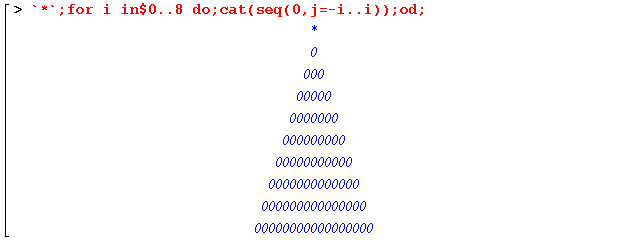
(The screenshot shows an earlier 44-char version of the command, but I'm too lazy to retake it. The output is still the same.)
Oh, and yes, the size is fully adjustable: just replace the 8 with n-2 for an n-row tree. With the first solution, going above 25 rows (or 10 in the GUI) requires also setting interface(rtablesize = n), though.
(Ps. I thought I'd managed to beat GolfScript with the latest version, but alas...)
Golfscript, 27 characters
" "9*"*"9,{n\.4$>\.+)"0"*}%
The resulting tree looks like this:
         *
         0
        000
       00000
      0000000
     000000000
    00000000000
   0000000000000
  000000000000000
 00000000000000000
A version which uses the height parameter only once is one character longer:
9." "*"*"@,{n\.4$>\.+)"0"*}%
Reading the height from stdin (with input "10" to generate the example tree) takes the same amount of characters (28):
~,)" "*"*"@{n\.4$>\.+)"0"*}%
Applesoft BASIC, 143 chars
Since this question reminds me of a homework assignment I had back in high school (when they were teaching on an Apple //e):
1INPUTH:X=(H*2)-2:C=(X/2):S$="*":O=0:GOSUB2:S$="0":FORO=0TOX-2STEP2:GOSUB2:NEXT:END
2FORS=0TOC-(O/2):?" ";:NEXT:FORI=0TOO:?S$;:NEXT:?"":RETURN
I used the JavaScript Applesoft BASIC found here: http://www.calormen.com/applesoft/
OUTPUT:
?10
          *
          0
         000
        00000
       0000000
      000000000
     00000000000
    0000000000000
   000000000000000
  00000000000000000
Lua: 83, 89 or 97
A fixed-height 10-layer tree can be done in 83
a=string.rep
for i=0,9 do
print(i<1 and a(" ",8).."*" or a(" ",9-i)..a(0,i+i-1))end
Providing a height parameter takes it to 89
h=9
a=string.rep
for i=0,h do
print(i<1 and a(" ",h-1).."*" or a(" ",h-i)..a(0,i+i-1))end
Changing the first line to h=io.read() takes it up to 97, but allows the program to read the height from stdio.
Prints:
        *
        0
       000
      00000
     0000000
    000000000
   00000000000
  0000000000000
 000000000000000
00000000000000000
Note that the value of h is the size of the tree itself, excluding the star.
Java, 141
class t{public static void main(String a[]){char s[]=new char[21];s[9]='*';for(int i=0; i<10;System.out.println(s),s[9+i]=s[9-i]='0',i++);}}
Using a char array ..
Python, 64
Yet another python answer.
def f(i,c='0'):print' '*(9-i)+c*(i*2+1)
f(0,'*')
map(f,range(9))
Haskell, 73 characters
main=mapM_ putStrLn$" *":take 9(iterate((++"00").tail)" 0")
And the output:
        *
        0
       000
      00000
     0000000
    000000000
   00000000000
  0000000000000
 000000000000000
00000000000000000
Haskell, 83 chars
r=replicate
main=mapM_ putStrLn$(r 8' '++"*"):map(\x->r(9-x)' '++r(x*2-1)'0')[1..9]
...not as short as I thought it might be.
R, 68 characters
s=sprintf;cat(s('%10s','*'),s('% *s%0*d',9:1,'',1:9*2-1,0),sep='\n')
And here's a parameterized version:
n=12 # Tree height (without star)
s=sprintf;cat(s('%*s',n+1,'*'),s('% *s%0*d',n:1,'',1:n*2-1,0),sep='\n')
Old version, 85 characters
cat(' *\n 0\n');cat(sprintf('% *d%0*d',9:2,0,seq(2,16,2),0),sep='\n')
I know, not the prettiest - R is not that great at formatting output using compact code.
C, 80
i=9,k=10,j;main(F){while(i)putchar(++j<i?32:j<k?48-F*6:(i-=!F,k+=!F,F=j=0,10));}
Initialize k to the tree height, i to k-1. F is first line flag. Given no argument, then F should be 1 upon entry.
A slightly longer(81) version where f is non first line flag:
i=9,k=10,j,f;main(){while(i)putchar(++j<i?32:j<k?42+f*6:(i-=f,k+=f,f=1,j=0,10));}
JavaScript (Rhino: 108, Node: 114, Webkit Dev Console: 119, jQuery Plugin: 132)
Rhino is the shortest (at 108 characters) because (a) its print function has a short name and (b) it'll let you assign built-in functions into a shorter variable name. So:
h=10,p=print,m='0',a=Array(h-1),s=a.join(' ');p(s+'*\n'+s+m);while(h-->2){m+='00';a.pop();p(a.join(' ')+m);}
Node.js comes in a close second (at 114 chars) because its print function console.log has a longer name, but it'll let us assign that to a short variable as well:
h=10,p=console.log,m='0',a=Array(h-1),s=a.join(' ');p(s+'*\n'+s+m);while(h-->2){m+='00';a.pop();p(a.join(' ')+m);}
However, the Webkit Dev Console (and probably Firebug, too) thinks p=console.log is a bit too sneaky (when you try to call p(), it'll complain at you). So, we have to lengthen things out to 119 characters:
h=10,m='0',a=Array(h-1),s=a.join(' ');with(console){log(s+'*\n'+s+m);while(h-->2){m+='00';a.pop();log(a.join(' ')+m);}}
(Interestingly, with only saves us a character).
Finally... a jQuery plugin (still tweetable at 132 characters!):
$.fn.xms=function(h){var m='0',w=2,l=['*',m];while(w++<h)l.push(m+='00');$(this).css({textAlign:'center'}).html(l.join('\n<br/>'));}
And you can invoke it on the footer of this very page: $('#footer').xms(3)
Of course, it doesn't have to be a plugin... since we'd probably have to use a JavaScript console to add it to a page and invoke it, we could've just done a snippet of jQuery:
h=10,m='0',w=2,l=['*',m];while(w++<h)l.push(m+='00');$('#footer').css({textAlign:'center'}).html(l.join('\n<br/>'));
which weighs in at a more competitive 116 characters -- in fact, it beats out the other dev console implementation. But, then again, using jQuery and/or the browser's layout engine might be considered cheating. :)
PHP, 136 Characters
        *
        0
       000
      00000
     0000000
    000000000
   00000000000
  0000000000000
 000000000000000
00000000000000000
;)
Ruby, 46 characters
puts" "*8+?*;9.times{|i|puts"%8s0"%(v=?0*i)+v}
In order to change the height you would have to change both 8s and of course also the 9. The output of the program is as follows:
        *
        0
       000
      00000
     0000000
    000000000
   00000000000
  0000000000000
 000000000000000
00000000000000000
Edit: Inexcusably I omitted the output in the first submission.
Prolog: 183 or 186
r(0,_,L,L).
r(N,C,L,[C|T]):-N>0,M is N-1,r(M,C,L,T).
y(S,T,C):-r(T,C,[10],X),r(S,32,X,Y),atom_codes(A,Y),write(A).
x(A,B):-A>0,y(A,B,48),C is A-1,D is B+2,x(C,D).
x(N):-y(N,1,42),x(N,1).
Prints:
         *
         0
        000
       00000
      0000000
     000000000
    00000000000
   0000000000000
  000000000000000
 00000000000000000
false.
Could be squeezed further for certain interpreters (e.g. using tab/1 on SWI)
Invoke with x(N). Where N is the number of rows in the actual tree (excluding star). Giving it a fixed height would bring it down to 183
Java, 147 chars (or 153)
class V{public static void main(String[]a){int c=10,i=-1,j;while(++i<c){for(j=0;++j<c+i;)System.out.print(j>c+i-2?i<1?"*\n":"\n":j<c-i?" ":"0");}}}
I based this on Daniel Schneller's solution, although I changed a lot. In line with Daniels solution, this one can be parameterized as well, where the number of command line parameters represents the height of the tree:
class V{public static void main(String[]a){int c=a.length,i=-1,j;while(++i<c){for(j=0;++j<c+i;)System.out.print(j>c+i-2?i<1?"*\n":"\n":j<c-i?" ":"0");}}}
Output (how surprising :):
        *
        0
       000
      00000
     0000000
    000000000
   00000000000
  0000000000000
 000000000000000
00000000000000000
Shell script, 44 characters
printf %9c\\n \* 0|sed ':x
p;s/ 0/000/;tx
d'
Prints this tree:
        *
        0
       000
      00000
     0000000
    000000000
   00000000000
  0000000000000
 000000000000000
00000000000000000
Java, 177 Chars
import java.util.Arrays;class C{public static void main(String[]a){
char[]r=new char[17];r[8]='*';int c=10;while(c-->0){if(c<9)Arrays.fill(r,c,17-c,'0');System.out.println(r);}}}
(Line break after main(...){ only for better readability.)
Uses API method Arrays.fill() to reduce number of while loops.
Prints this tree:
        *
        0
       000
      00000
     0000000
    000000000
   00000000000
  0000000000000
 000000000000000
00000000000000000
Python 3: 62 characters
print(' '*9+'*',*('\n'+' '*(9-i)+'0'*(i*2+1)for i in range(9)))
Output:
        *
        0
       000
      00000
     0000000
    000000000
   00000000000
  0000000000000
 000000000000000
00000000000000000
Note that this essentially beats @Ante's answer by 11 characters, because that answer, when converted to Python 3, uses 73 characters.
Change each 9 to another value for a different height.
Java, 192 (198 with param)
class V{public static void main(String[]a){int c=10,i=-1,j=0;String s="";while(j++<c)s+=" ";s+="*";while(++i<c){for(j=-2;++j<c-i;)s+=" ";for(j=0;++j<2*i;)s+="0";System.out.println(s);s="";}}}
Prints the requested tree:
        *
        0
       000
      00000
     0000000
    000000000
   00000000000
  0000000000000
 000000000000000
00000000000000000
For variable height, slightly longer:
class W{public static void main(String[]a){int c=a.length,i=-1,j=0;String s="";while(j++<c)s+=" ";s+="*";while(++i<c){for(j=-2;++j<c-i;)s+=" ";for(j=0;++j<2*i;)s+="0";System.out.println(s);s="";}}}
Length of command line argument list determines height (e. g. java W a a a a a will give height 5).
(This is basically the Java version of Wade Tandy's C solution.)
C, 77
i;main(c){printf("%*c\n",c,42);while(i<c)printf("%*s%0*d\n",c-i,"",i++*2+1,0);}
Before reading the printf spec more carefully, I had this cute little number down to 138 chars:
#define x sprintf(b,
#define y printf(b,
i;main(c){char b[9]="%%%dc\n",*t="%%%ds%%0%dd\n";x b,c);y 42);while(i<c)x t,c-i,i++*2+1),y "",0);}
Python, 59
print' '*9+'*'
for i in range(9):print' '*(9-i)+'0'*(i*2+1)
C 145
Takes its heigh param from argc, so set the number of rows by setting the number of arguments:
#define x printf
int main(int c){int i=-1,j=0;while(j++<c)x(" ");x("*");while(++i<c){for(j=-2;++j<c-i;)x(" ");for(j=0;++j<2*i;)x("0");x("\n");}}
To generate the ten line spec output, you call:
christmastree 1 2 3 4 5 6 7 8 9
Or if you'd prefer to hardcode the height, change c in this version:
#define x printf
int main(){int i=-1,j=0,c=10;while(j++<c)x(" ");x("*");while(++i<c){for(j=-2;++j<c-i;)x(" ");for(j=0;++j<2*i;)x("0");x("\n");}}
PHP 113
Figured i'd chime in with a php version:
113 chars (adjust $h to change the height, the number of lines includes the star):
$h=10;for($n=0;$n<$h;$n++){$i=$n>0?$n:1;$c=$n<1?"*":"0";echo str_repeat(" ",$h-$i).str_repeat($c,($i*2)-1)."\n";}
I tried to make it short, not readable and we already knew php can't compete on conciseness so this isn't going to win anything, still a fun little puzzle tho.
output is as spec:
        *
        0
       000
      00000
     0000000
    000000000
   00000000000
  0000000000000
 000000000000000
00000000000000000
PowerShell, 41
" "*8+"*";0..8|%{" "*(8-$_)+"0"+"0"*$_*2}
Unsurprisingly, outputs the same tree as everyone else's :-p
If you parametrize that 8, it will yield up to the size of your console, in, say, 48 characters:
" "*($w=8)+"*";0..$w|%{" "*($w-$_)+"0"+"0"*$_*2}
Or, as a full-blown script which takes an argument, 53 characters:
param($w)" "*$w+"*";0..$w|%{" "*($w-$_)+"0"+"0"*$_*2}
Called, it looks like:
PS>: Get-Tree.ps1 8
        *
        0
       000
      00000
     0000000
    000000000
   00000000000
  0000000000000
 000000000000000
00000000000000000
Mathematica, 50
MatrixForm@Prepend[Row/@Table[0,{n,9},{2n-1}],"*"]
GolfScript (33 chars)
Fixed-height version:
;8:^' '*.'*'+\'0'+^{.(;'00'+}*]n*
Or for exactly the same length
;8:^' '*.'*'+n@'0'+^{.n\(;'00'+}*
The tree looks remarkably similar to everyone else's:
        *
        0
       000
      00000
     0000000
    000000000
   00000000000
  0000000000000
 000000000000000
00000000000000000
Version which takes height from stdin:
~((:^' '*.'*'+\'0'+^{.(;'00'+}*]n*
The start of the previous line is one of the better smilies I've made in a "useful" GolfScript program.
Groovy, 65
(p={c,r->println' '*(9-r)+(c*(r*2-1))})'*',1;(1..9).each{p'0',it}
Surprisingly, the tree looks like this:
        *
        0
       000
      00000
     0000000
    000000000
   00000000000
  0000000000000
 000000000000000
00000000000000000
Perl, 42 chars
say$"x9,"*";say$"x(9-$_),"00"x$_,0for 0..8
Output:
         *
         0
        000
       00000
      0000000
     000000000
    00000000000
   0000000000000
  000000000000000
 00000000000000000
The height of the tree can be changed between 1 and 11 rows by replacing the 8 at the end with values from -1 to 9. Going above 11 rows requires also increasing the two 9s earlier in the code, which control how far from the left side of the screen the tree is indented.