| Bytes | Lang | Time | Link |
|---|---|---|---|
| 085 | Tcl | 241203T180831Z | sergiol |
| 069 | C clang | 241224T165858Z | jdt |
| 039 | Charcoal | 241128T060509Z | Neil |
| 055 | Perl 5 p | 241202T055557Z | Xcali |
| 061 | Python | 241129T092809Z | Albert.L |
| 027 | Jelly | 241201T005303Z | Jonathan |
| 076 | AWK | 241129T141202Z | xrs |
| 071 | Java JDK | 241129T084957Z | Fhuvi |
| 064 | Google Sheets | 241127T224424Z | doubleun |
| 081 | Kotlin | 241128T151405Z | Joon Yor |
| 058 | APL+WIN | 241128T110600Z | Graham |
| 029 | 05AB1E | 241128T104608Z | Kevin Cr |
| 061 | JavaScript Node.js | 241128T020109Z | l4m2 |
| 056 | Bash + coreutils | 241127T225007Z | Digital |
| 075 | Retina 0.8.2 | 241128T004907Z | Neil |
| 072 | Python 3 | 241127T230049Z | xnor |
Tcl, 85 bytes
puts [lindex [set L {Cut Bomb Ice Fire Oil Elec Time Guts Cut}] [lsearch $L $argv]+1]
C (clang), 69 bytes
f(*s){strncpy(s,"GutsElecCut\0FireTimeOil\0Ice\0Bomb"+*s%405%8*4,4);}
Charcoal, 40 39 bytes
§⪪”↶0²«gR→X?→?ïM↘⌈⟦ⅈH×↷⟲&↨⟧‽≧jβ” ﹪⍘Sγ⁹⁷
Try it online! Link is to verbose version of code. Explanation: The input string is converted from base 95, then reduced modulo 97 and again modulo 9 via modular indexing into a compressed string of the relevant words split on spaces.
Perl 5 -p, 55 bytes
CutBombIceFireOilElecTimeGutsCutX=~/$_(.+?)[A-Z]/;$_=$1
Input must have first letter capitalized.
Python, 61 bytes
-3 thanks to @Jonathan Allan
lambda b:"FGBTEOCIiuoiliucrtmmelteesbec"[int(b,36)%9075&7::8]
Was:
Python, 66 bytes
lambda b:"GBFETCIOuoiliucitmremtelsbece"["TCIOEGBF".find(b[0])::8]
A bit boring.
Python, 67 bytes
for f in 0,eval:*Cut,Guts,Time,Elec,Oil,Fire,Ice,Bomb,Cut=globals()
This one is exhilaratingly dirty.
How?
Creates global variables named Cut, Guts, etc. such that eval can be used to retrieve their robot master (or whatever the story is) from their names.
The assignment needs to be done twice: First pass adds the variable names to the global dictionary (which remembers insertion order). Note that the packed assignment ignores the values of globals() and assigns whatever names happen to have been last inserted (we don't care in the first pass) as values to the new variables .
At the second pass the names (rotated by one because we list Cut twice) will be at the end of the dictionary. So the value "Cut" will be assigned to variable Guts etc.
Jelly, 27 bytes
“B¢ċḅßṗœyœḳlsɲṀƥṆQ_»ḲṖ€ṙiḢɗ
A monadic link that accepts a list of characters and yields a list of characters.
How?
“...»ḲṖ€ṙiḢɗ - Link: list of characters, Name
“...»        - compressed string -> "Icel Fired Oily Elect Timex Gutsy Cute Bombe"
     Ḳ       - split at spaces
      Ṗ€     - pop each -> Names = ["Ice","Fire","Oil","Elec","Time","Guts","Cut","Bomb"]
           ɗ - last three links as a dyad - f(Names, Name)
         i   -   1-indexed index of {Name} in {Names}
        ṙ    -   rotate {Names} left by {that}
          Ḣ  -   head
AWK, 76 bytes
{for(split("Cut Bomb Ice Fire Oil Elec Time Guts",a);a[i++]!~$1;);}$0=a[i%8]
Try it at home!
awk '{for(split("Cut Bomb Ice Fire Oil Elec Time Guts",a);a[i++]!~$1;);}$0=a[i%8]' <<< Guts
However, it would get stuck in a loop with invalid input.
{for(split("Cut Bomb Ice Fire Oil Elec Time Guts",a); # Robot Masters
a[i++]!~$1;);}                                        # match and next
$0=a[i%8]                                             # output/catch loop
Java (JDK), 71 bytes
It seems splitting is shorter than regex here.
s->"Cut Bomb Ice Fire Oil Elec Time Guts Cut".split(s)[1].split(" ")[1]
Alternative solution (74 bytes) if lowercase is allowed in the output:
s->"CbombCBiceBIfireIFoilFOelecOEtimeETgutsTGcut".split(""+s.charAt(0))[1]
Google Sheets, 64 bytes 83 bytes 93 bytes
=regexextract("CutBombIceFireOilElecTimeGutsCut",A1&"(.[a-z]+)")
Using l4m2's regex approach.
The other way:
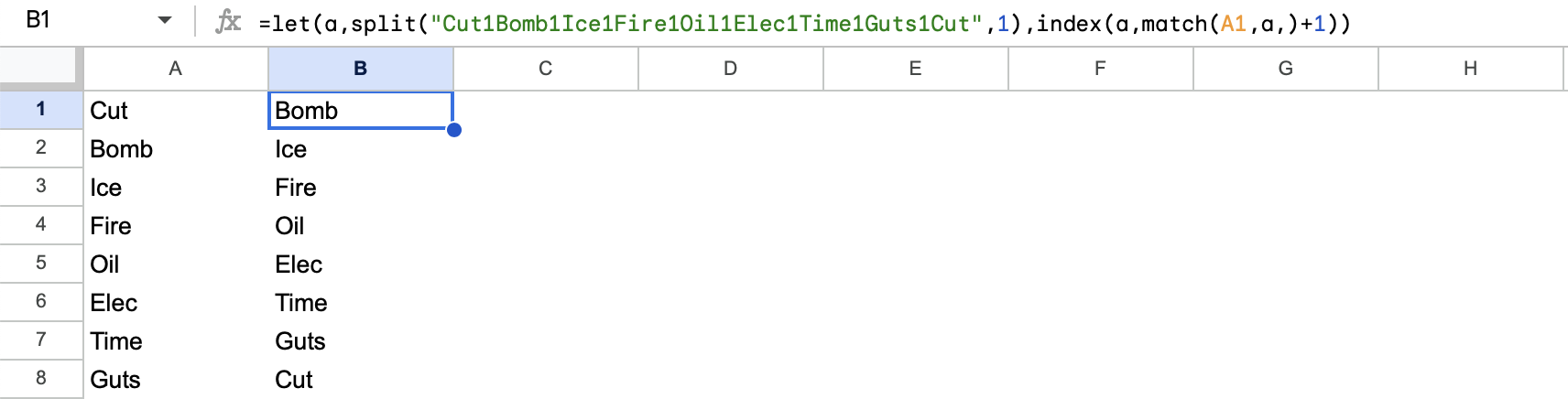
=let(a,split("Cut1Bomb1Ice1Fire1Oil1Elec1Time1Guts1Cut",1),index(a,match(A1,a,)+1))
Kotlin, 81 bytes
{s->"Cut Bomb Ice Fire Oil Elec Time Guts Cut".split(" ").run{get(indexOf(s)+1)}}
or if you accept leading spaces:
Kotlin, 67 bytes
{s->"CutBomb IceFire OilElecTimeGutsCut".substringAfter(s).take(4)}
both of these use val f:(String)->String= as the header
APL+WIN, 58 bytes
Prompts for name.
↑(r⍳⊂⎕)⌽r←(+\(⎕av⍳r)>43)⊂r←'CutBombIceFireOilElecTimeGuts'
05AB1E, 29 bytes
”GutsížÆ™ĊĊٵـº”#4δ£Dyk>è
Try it online or verify all test cases.
Explanation:
”GutsížÆ™ĊĊٵـº”
           # Push dictionary string "Guts Cut Bomb Ice Fire Oil Electricity Time"
 #         # Split it on spaces
   δ       # Map over each word:
  4 £      # Only keep the first 4 characters to fix "Electricity"→"Elec"
     D     # Duplicate this list
      Ik   # Get the index of the input in this list
        >  # Increase it by 1
         è # Modular index it into the list again
           # (after which the result is output implicitly)
See this 05AB1E tip of mine (section How to use the dictionary?) to understand why ”GutsížÆ™ĊĊٵـº” is "Guts Cut Bomb Ice Fire Oil Electricity Time".
JavaScript (Node.js), 61 bytes
x=>'CutGutsTimeElecOilFireIceBombCut'.match(`(.[a-z]*)`+x)[1]
-2B emanresu A
Retina 0.8.2, 75 bytes
T`B-H\OITcel-obs`IB_T\OC-Gemit_c_
But
Bomb
ct
ce
em
ire
ii
lec
itm
uts
rm
l
Try it online! Link includes test cases. Explanation:
T`B-H\OITcel-obs`IB_T\OC-Gemit_c_
Transliterate as many letters as possible, including all of the upper case letters. This is enough to handle Elec to Time and Guts to Cut. (O normally means 13579 so it needs to be escaped. Other escaped letters are avoided by including them in a range.)
But
Bomb
Cut transliterates to But so fix it to become Bomb without changing Cut transliterated from Guts.
ct
ce
Bomb transliterates to Ict so fix it to become Ice without changing Guts or Cut.
em
ire
Ice transliterates to Fem so fix it to become Fire.
ii
lec
Oil transliterates to Eii to fix it to become Elec.
itm
uts
Time transliterates to Gitm to fix it to become Guts.
rm
l
Fire transliterates to Oirm to fix it to become Oil.
Python 3, 72 bytes
dict(zip(l:="Cut Bomb Ice Fire Oil Elec Time Guts".split()*2,l[1:])).get
Creates a dictionary whose keys in order are Cut, Bomb, ... (doubled), and whose corresponding values are those with the first item removed. The main function is the .get method of the dictionary; if the dictionary itself suffices, those 4 bytes can be cut.
Also 72 bytes, using id just for as the shortest predefined variable:
{id:(id:=x)for x in"Cut Bomb Ice Fire Oil Elec Time Guts".split()*2}.get
Python, 73 bytes
lambda s:l[l.index(s)-1]
l="Guts Time Elec Oil Fire Ice Bomb Cut".split()
Uses that indices wrap around into the negatives, so the index before 0 is -1 which selects the last element.
Python 3, 73 bytes
lambda s:"Guts Time Oil Cut Elec Fire | Ice Bomb".split()[ord(s[0])%25%9]
Only looks at the boss's letter (which are all distinct), and uses a mod chain to classify it. Bytestring input would save 5 bytes.