| Bytes | Lang | Time | Link |
|---|---|---|---|
| 034 | K ngn/k | 240602T174836Z | akamayu |
| 110 | sed | 240605T211702Z | Jan Blum |
| 087 | Python 3 | 240603T201206Z | Jonathan |
| 071 | Wolfram Language Mathematica | 240603T170942Z | Greg Mar |
| 105 | Perl 5 | 240603T170835Z | Xcali |
| 025 | 05AB1E | 240603T081907Z | Kevin Cr |
| 069 | Retina 0.8.2 | 240602T085538Z | Neil |
| 084 | JavaScript ES11 | 240601T174736Z | Arnauld |
| 100 | Python | 240602T075636Z | boothby |
| 032 | Charcoal | 240601T215240Z | Neil |
| 021 | Jelly | 240601T190721Z | Jonathan |
| 120 | APL+WIN | 240601T182041Z | Graham |
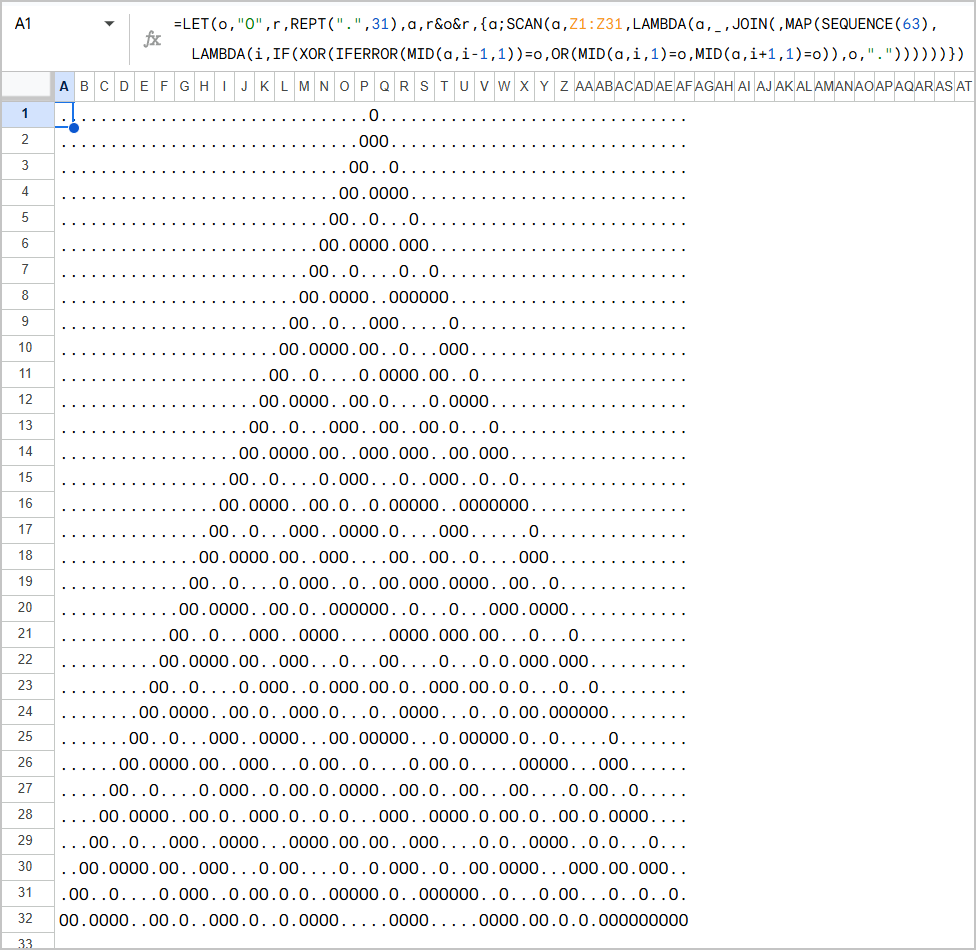
| 171 | Google Sheets | 240601T173725Z | z.. |
K (ngn/k), 36 34 bytes
-2 bytes thanks to @Jonathan Allan's bit table
".O"@31{~{x=y|z}.+3':0,x,0}\31=!63
                            31=!63   /0 0 0 ... 0 1 0 ... 0 0 0
       {          3':0,x,0}          /3-wise windowed bits
       {~{x=y|z}.+        }          /the next iteration in Rule 30
     31{                  }\         /apply function repeatedly for 31 times
                                     / and collect intermediate results
".O"@                                /index into ".O"
sed, 110 bytes
:0
p
/^O/b
y/.O/_x/
s/.*/_&_/
:1
s/[_x]/&:/
/:__/s/:/_:/
//!s/:/x:/
s/(.)\1:/./
s/..:/O/
/[_x]../b1
s/..$//
b0
Python 3, 88 87 bytes
-1 thanks to Jitse! (Reverse the order, strip leading character at each step to avoid some slice offsets.)
I started with boothby,'s answer and tweaked quite a bit...
s=f"..{'O':.^63}"
i=2048
while i:i%64or print(s[2:]);s=s[1:]+'.O'[s[:3]in'.O..OO'];i-=1
A full program that takes no arguments and prints the first thirty-two states as prescribed.
Wolfram Language (Mathematica), 71 bytes
StringRiffle[CellularAutomaton[30,{{1},0},31]/.{1->"1",0->"."},"\n",""]
Try it online! A code snippet that produces a string.
Gotta have the OG in the house. Note the 30 in this code is precisely why this cellular automaton is called Rule 30! See the CellularAutomaton documentation for how it encodes the rule of evolution.
Perl 5, 105 bytes
@a=(0)x63;$a[31]=1;for$z(1..32){say map$_?O:".",@a;@a=map{($b=join'',@a[$_-1..$_+1])<101&&$b>0||0}0..$#a}
05AB1E, 29 25 bytes
31°ÂûsvJDT„O.‡,0.øü3εćsàÊ
-4 bytes porting @JonathanAllan's Jelly answer.
Explanation:
31° # Push 10 to the power 31
 # Bifurcate it; short for Duplicate & Reverse copy
û # Palindromize this reversed copy
sv # Swap and foreach-loop; aka loop 32 times:
J # Join the current list (from 2nd iteration onward) to a string
D # Duplicate this string of 0s/1s
T„O.‡ # Transliterate "10" to "O." in this copy
, # Pop and output it with trailing newline
0.ø # Surround the current line with trailing/leading 0
ü3 # Pop and convert it into overlapping triplets
ε # Map over each triplet:
ć # Head extracted (abc → bc,a)
s # Swap so the remainder (bc) is at the top
à # Pop and get the maximum digit of this pair
Ê # Check that it's NOT equal to the head: a != max(b,c)
Retina 0.8.2, 100 69 bytes
2080$*.
M!`.{65}
33=`.
0
+s`.(?<=(0\.\.|\.0.|\..0).{65})
0
.(.+).
$1
Try it online! Explanation:
2080$*.
Insert 2080 .s.
M!`.{65}
Split it into 32 lines of 65 ..
33=`.
0
Change the middle . on the first line to a 0.
+`
Repeat the following change until no more .s can be changed into 0s.
s`.(?<=(0\.\.|\.0.|\..0).{65})
0
Change all .s to 0s if there is either 0.., .00, .0. or ..0 on the line above.
.(.+).
$1
Remove the left and right columns.
JavaScript (ES11), 84 bytes
f=(r=1n<<32n,k,q=r>>62n&7n)=>k^63?"._O"[q&2n]+f(r+r|30n>>q&1n,-~k):q>1?"":`
`+f(r+r)
Method
At each iteration:
- the bit at position 63 in the bitmask
ris read to figure out the next output character - the bits at positions 62, 63 and 64 are turned into a new bit according to rule 30
- the bitmask is left-shifted and the new bit is inserted at position 0
We stop when we reach the end of a row and bit #63 is set.
Notes
Because we shift to the left and the bitmask is never cleared, it keeps growing up and eventually reaches a size of 2080 bits.
Another way to get the same result is to use rule 86 (a horizontally-mirrored version of rule 30) and shift the bitmask to the right:
85 bytes
f=(r=1n<<32n,k)=>k^63?"._O"[r&2n]+f(r/2n|(86n>>r%8n&1n)<<64n,-~k):r&1n?"":`
`+f(r/2n)
Python, 100 byes
l='.'*32
l+='O'+l
exec("print(l);l=''.join('.O'[f'.{l}.'[i:i+3]in'OO..O.']for i in range(65));"*33)
Charcoal, 32 bytes
UB.׳¹ψ0F³¹«⸿F⁶³℅↔⁻℅§KM⁰℅⌈✂KM¹¦³
Try it online! Link is to verbose version of code. Explanation:
UB.
Set the "background", which is anywhere where the null character or no character all is printed, to ..
׳¹ψ0
Write a 0 in the 32nd column in the canvas.
F³¹«
Repeat for each of the remaining 31 rows.
⸿
Start at the beginning of the next line.
F⁶³
Repeat for each of the 63 columns.
℅↔⁻℅§KM⁰℅⌈✂KM¹¦³
Peek the cells adjacent to the current cell. Using @JonathanAllan's formula, take the absolute difference of the ordinal of the cell above and to the left (a in his formula) with the ordinal of the maximum of the cells above (b) and above and to the right (c), and output the character with that ordinal.
When the two values are equal, i.e. either all three cells are empty or a has a 0 and at least one of b and c have a 0, then the result is zero, and a null character is written, which is then considered to be part of the background, while if the two values are different then one will be a 0 and the other will not, and the absolute difference of the ordinals will be the ordinal of 0 and that will be output.
33 bytes using the actual definition of the rule:
UB.׳¹ψ0F³¹«⸿F⁶³§⁺ψ0÷³⁰X²⍘…KM³⁺ψ0
Attempt This Online! Link is to verbose version of code. Needs to use ATO instead of TIO because AtIndex is broken on TIO. Explanation: As above but decodes the presence of the cells in the row above using a custom base, right-shifts 30 by that amount, then outputs the presence according to the LSB.
Jelly, 22 21 bytes
32ṬŒḄØ0jḢ⁻ṀƊ3ƤƊƬḣị⁾O.
A niladic Link that yields a list of lines.
How?
32ṬŒḄØ0jḢ⁻ṀƊ3ƤƊƬḣị⁾O. - Link: no arguments
32                    - set the left argument to 32
  Ṭ                   - untruth -> [0,0,...,0,1] (31 zeros and a one)
   ŒḄ                 - bounce -> [0,0,...,0,1,0,...,0,0] (the top line)
               Ƭ      - collect while distinct, applying:
              Ɗ       -   last three links as a monad - f(Line):
     Ø0               -     literal [0,0]
       j              -     join with {Line} (wrap the Line with zeros)
            3Ƥ        -     for overlapping infixes of length three:
           Ɗ          -       last three links as a monad - f([a,b,c]):
        Ḣ             -         head and yield {[a,b,c]} -> a
          Ṁ           -         max {[b,c]} -> M
         ⁻            -         {a} not equal? {M}
                ḣ     - head to index {32} -> first 32 lines
                 ị⁾O. - index into "O."
Possible triples and their new state:
| a | b | c | max(b,c) -> M | a != M -> New State |
|---|---|---|---|---|
| 0 | 0 | 0 | 0 | 0 |
| 0 | 0 | 1 | 1 | 1 |
| 0 | 1 | 0 | 1 | 1 |
| 0 | 1 | 1 | 1 | 1 |
| 1 | 0 | 0 | 0 | 1 |
| 1 | 0 | 1 | 1 | 0 |
| 1 | 1 | 0 | 1 | 0 |
| 1 | 1 | 1 | 1 | 0 |
APL+WIN, 120 bytes
m←32 63⍴0
m[0;62]←1
:for i :in 1+⍳31
n←m[i-1;]
:for j :in ⍳63
m[i;j]←(↑v)≠(↑1↓v)∨¯1↑v←3↑n
n←1↓n
:end
:end
'.o'[(⌽⍳32)⌽m]
Google Sheets, 171 bytes
=LET(o,"O",r,REPT(".",31),a,r&o&r,{a;SCAN(a,Z1:Z31,LAMBDA(a,_,JOIN(,MAP(SEQUENCE(63),LAMBDA(i,IF(XOR(IFERROR(MID(a,i-1,1))=o,OR(MID(a,i,1)=o,MID(a,i+1,1)=o)),o,"."))))))})