| Bytes | Lang | Time | Link |
|---|---|---|---|
| 104 | Python 3 | 240723T080740Z | Jitse |
| 006 | Vyxal | 230228T035820Z | lyxal |
| 013 | Haskell + hgl | 240723T013730Z | Wheat Wi |
| 046 | APLDyalog Unicode | 230228T045642Z | user1069 |
| 242 | Scala | 230409T084424Z | 138 Aspe |
| 013 | Jelly | 230304T101513Z | caird co |
| 016 | Nekomata | 230228T150447Z | alephalp |
| 014 | Japt h | 230228T124012Z | Shaggy |
| 136 | Excel ms365 | 230228T110953Z | JvdV |
| 075 | JavaScript Node.js | 230302T092330Z | tsh |
| 072 | vim | 230228T223011Z | Ray |
| 3534 | J | 230228T062523Z | Jonah |
| 130 | JavaScript | 230228T105343Z | EzioMerc |
| 035 | Charcoal | 230228T133702Z | Neil |
| 095 | JavaScript ES6 | 230228T113445Z | Arnauld |
| 039 | Retina 0.8.2 | 230228T101330Z | Neil |
| 135 | ><> Fish | 230228T082456Z | mousetai |
| 013 | 05AB1E | 230228T074659Z | Kevin Cr |
| 030 | BQN | 230228T070141Z | ovs |
| 030 | Raku | 230228T061118Z | Jo King |
Python 3, 104 bytes
f=lambda s:max(f(s[1:]),f(s[:-1]))if g(s)else len(s)
g=lambda s:g(s.replace('()',''))if'()'in s else''<s
Vyxal, 7 6 bytes
ǎ~øβ@G
-1 byte thanks to modern innovations like vectorising length
Explained
ǎ~øβ@G
~ # Get all
ǎ # substrings of the input
~ # where
øβ # the brackets are balanced.
@G # Get the longest length
💎
Created with the help of Luminespire.
Haskell + hgl, 13 bytes
xMl<fl blp<cG
blp isn't on ato yet ...
Explanation
cGget all contiguous substrings.fl blpfilter the ones that are balanced.xMlget the length of the longest one.
Reflection
This is pretty short but ...
There could definitely be functions for
- "prefixes such that"
- "suffixes such that"
- "infixes such that"
The final one would be useful here.
APL(Dyalog Unicode), 46 bytes SBCS
(⌈/≢¨×{0(∧.≤∧=∘⊃∘⌽)+\-⌿'()'∘.=⍵}¨)⍤⊃⍳∘≢,.(,/)⊂
⊃⍳∘≢,.(,/)⊂                 substrings
{0(∧.≤∧=∘⊃∘⌽)+\-⌿'()'∘.=⍵}¨ map balanced?
≢¨×                         times lengths
⌈/                          max
Scala, 242 bytes
I first know replaceAllLiterally in scala, it saved several bytes.
Golfed version, try it online!
def f1(s:String):Int={f(s,s)};def f(s:String,S:String):Int={if(s!=s.replaceAllLiterally("()","")){f(s.replaceAllLiterally("()",""),S)}else if(s.nonEmpty){val left=S.dropRight(1);val right=S.drop(1);math.max(f1(left),f1(right))}else{S.length}}
Ungolfed version, try it online!
object Main {
  def f1(s: String): Int = {f(s,s)}
  def f(s: String, S: String ): Int = {
    if (s != s.replaceAllLiterally("()", "")) {
      f(s.replaceAllLiterally("()", ""), S)
    } else if (s.nonEmpty) {
      val left = S.dropRight(1)
      val right = S.drop(1)
      math.max(f1(left), f1(right))
    } else {
      S.length
    }
  }

  def main(args: Array[String]): Unit = {
    println(f1("(()())")) // 6
    println(f1(")()())")) // 4
    println(f1("()(())")) // 6
    println(f1("()(()" )) // 2
    println(f1("))"    )) // 0
    println(f1(""      )) // 0
  }
}
Jelly, 13 bytes
ẆœṣØ(F$ÐLÐḟẈṀ
Uses Kevin Cruijssen's 05AB1E algorithm, be sure to give them an upvote!
How it works
ẆœṣØ(F$ÐLÐḟẈṀ - Main link. Takes a string S on the left
Ẇ             - All contiguous sublists of S
         Ðḟ   - Filter sublists, keeping those which return [] under:
      $       -   Group the last 2 links as a monad f(W):
   Ø(         -     Yield "()"
 œṣ           -     Split W on "()"
     F        -     Flatten
       ÐL     -   Repeatedly apply f(W) until a fixed point
           Ẉ  - Lengths of those remaining
            Ṁ - Maximum
Nekomata, 16 bytes
qe7%3%∫:çlR≥¤#aṀ
qe7%3%∫:çlR≥¤#aṀ
q                     Non-deterministically choose a contiguous subsequence
 e7%3%                Convert the subsequence to a list of 2's and 0's
      ∫               Take the cumsum
       :              Duplicate
        çl            Prepend 0 and get the last item
          R           Range from 1 to this number
           ≥¤         Compare the cumsum and this range;
                        fail if the two list has different length,
                        or if any item in the cumsum is less than
                        the corresponding item in the range
             #        Get the length
              a       Get all possible values
               Ṁ      Get the maximum
Japt -h, 14 bytes
Outputs undefined instead of 0 (pending confirmation).
ã ke"%(%)" mÊÍ
9 bytes
This version takes input as a string of 1s & 0s, representing ( & ) respectively, which the comments on the challenge would seem to allow.
ã keA mÊÍ
ã ke"%(%)" mÊÍ     :Implcit input of string
ã                  :Substrings
  k                :Remove items that return truthy (non-empty string)
   e               :  Recursively replace
    "%(%)"         :  RegEx /\(\)/ (or A=10, in the second version)
           m       :Map
            Ê      :  Length
             Í     :Sort
                   :Implicit out output of last element
Excel (ms365), 136 bytes
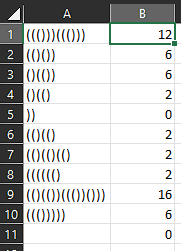
Formula in B1:
=LET(x,ROW(A:A),y,SCAN(")"&A1,x,LAMBDA(a,b,SUBSTITUTE(a,"("&REPT("|",(b-1)*2)&")",REPT("|",b*2)))),MAX(ISNUMBER(FIND(REPT("|",x),y))*x))
The idea here is that we create a loop to iteratively replace the fundamental base of balanced paranthesis, "()". The 1st replacement is simply "||". Next we replace all occurences of "(||)", with "||||" etc, untill we can't replace any more. Finally we calculate the longest occurence of consecutive "|" characters.
Yes, 136 bytes is a lot though!
JavaScript (Node.js), 75 bytes
s=>[...s].map((c,i)=>q=(p=c>'('?i-a.pop():a.push(i+~p)*0)>q?p:q,q=p=a=[])|q
Or 71 bytes if we take input as array of characters.
Let us denote the input sting as s. Let use denote the length of longest valid parentheses string which ends by s[i] as d[i]. Then question is asking for the greatest value in array d.
- If
s[i]is(,d[i]is0- It is trivial, as the last
(does not have a matching)and therefore be invalid.
- It is trivial, as the last
- If
s[i]is), we first find out the matching(for it- If there is no matching
(for it,d[i]is0 - If
s[j]is some(character which matchs[i], thens[j..i]is a valid parentheses string. Andd[i]=i-j+1+d[j-1].
- If there is no matching
To find out matching ( for s[i], we use a stack named a in the source code, and push j-1-d[j-1] into it.
vim, 72 bytes
o:s/(\(a*\))/a\1a/g<C-v><CR>@"<ESC>v0dk@":s/[()]/<C-v><CR>/g
:g/^/.!wc -c
:%!sort -nr
jdG<C-x>
Annotated
o:s/(\(a*\))/a\1a/g<C-v><CR>@"<ESC>   # insert command that recursively replaces (a*) with aa*a as long as there are matches
v0dk@"                                # pulls the above command into register " and invokes it. (Any resemblance to the word "vodka" is entirely coincidental.)
:s/[()]/<C-v><CR>/g                   # Any parentheses that remain are invalid. Split the string into separate lines with them as delimiters
:g/^/.!wc -c                          # strlen of each line (including newline)
:%!sort -nr                           # put the largest number on top
jdG<C-x>                              # delete the rest, decrement the newline away
<C-v> is 0x16, <C-x> is 0x18 <ESC> is 0x1b, and <CR> is 0x0d.
J, 35 34 bytes
[:>./@,(#*''-:#rplc&('()';'')])\\.
-1 thanks to ovs
- For every every substring...
- Continually replace
()with the empty string - If the result is the empty string, return the length, otherwise 0
- Max of all results
JavaScript, 130 bytes
s=>[...s,0].map((_,i,a)=>a.map((_,j,$,S=s.slice(i,j),b=0)=>{for(l of S)if((l==')'?--b:++b)<0)break;r=b|r>(l=S.length)?r:l}),r=0)|r
Try it:
f=s=>[...s,0].map((_,i,a)=>a.map((_,j,$,S=s.slice(i,j),b=0)=>{for(l of S)if((l==')'?--b:++b)<0)break;r=b|r>(l=S.length)?r:l}),r=0)|r

;[
  '(()())', // 6

  ')()())', // 4

  '()(())', // 6

  '()(()', // 2

  '))', // 0

  '', // 0
].forEach(s=>console.log(f(s)))Algorithm:
Take the all substrings of string and check if it is balanced parentheses. If yes, then check if the length of substring is maximum? If yes then update the max value. Else don't change the max value
Charcoal, 35 bytes
⊞υ⁰≔⮌υθFS«≦⊕υ≡ι(⊞υ⁰¿∧⊟υυ⊞θ⌊υ⊞υ⁰»I⌈θ
Try it online! Link is to verbose version of code. Explanation:
⊞υ⁰
Start with no characters at the current indent level.
≔⮌υθ
Also start with a maximum balanced run length of zero.
FS«
Loop over the input characters.
≦⊕υ
Increase the characters at all depths.
≡ι(⊞υ⁰
If this is a ( then start a new depth level. Otherwise:
¿∧⊟υυ
Remove a depth level, and if there is still at least one level left, then...
⊞θ⌊υ
... push the length of the deepest level left to the list of found balanced substring lengths, otherwise...
⊞υ⁰
.. the ) was unbalanced, so start a new empty indent level.
»I⌈θ
Output the maximum balanced substring length found.
JavaScript (ES6), 95 bytes
f=(s,S=s)=>s!=(s=s.split`()`.join``)?f(s,S):s?Math.max(f(S.slice(1)),f(S.slice(0,-1))):S.length
Retina 0.8.2, 39 bytes
M!`((\()|(?<-2>\)))+(?(2)^)
.
.
O^`
\G.
Try it online! Link includes test cases. Explanation:
M!`((\()|(?<-2>\)))+(?(2)^)
Find all nontrival substrings of balanced parentheses, using .NET's balancing groups; ?<-2> prevents the number of matched )s from exceeding the number of (s seen so far, while the ?(2) ensures that there are no unmatched (s.
.
.
Take the length of each substring in unary.
O^`
Sort in reverse order.
\G.
Output the first length or 0 if there were no matches.
><> (Fish), 135 bytes
0:i:0(?v$6p1+00. ;n+1-~~.?&52~\
@$:@02.\~~1-:0>:
>0&:6g2%2*1-&+:0(?v&1-$:@$:@)?^22.
>1+$1+$:{:})?v$d1.
 .1f0v!?:-1-$/ .55/
^~~~ \0n;

Uses the classic paste the input on the source block for easy indexing trick
05AB1E, 13 bytes
Œʒ„()õ:õQ}éθg
Try it online or verify all test cases
Explanation:
Π# Get all substrings of the (implicit) input
ʒ # Filter it by:
„() # Push string "()"
õ: # Keep replacing "()" with "" until it's no longer possible
õQ # Check if what remains is an empty string ""
}é # After the filter: sort the remaining strings by length
θ # Pop and keep the last/longest
g # Pop and push its length
# (which is output implicitly as result)
BQN, 30 bytesSBCS
{0⌈´∾1+/¨0(=∧∧`¨∘≤)+`¨↓¯1⋆𝕩-@}
¯1⋆𝕩-@ Map ( to 1 and ) to ¯1.
+`¨↓ Take the cumulative sum of each suffix.
0(=∧∧`¨∘≤) For each value in each suffix, is it equal to 0 and are all preceding values non-negative?
∾1+/¨ All 1-based indices of 1s.
0⌈´ Take the maximum or 0 if there is no such index.
Raku, 30 bytes
{m:g/(\(<~~>\))*/>>.chars.max}
Uses a recursive regex to find all sets of balanced parenthesis, then takes the maximum length of those strings.
Explanation
{                            }   # Anonymous codeblock
 m:g/           /                # Find all non-overlapping matches in string
     (        )*                  # Zero or more of
      \(    \)                      # Literal brackets
        <~~>                        # Containing balanced parenthesises
                >>.chars         # Map to length of string
                        .max     # Maximum