| Bytes | Lang | Time | Link |
|---|---|---|---|
| 002 | Rust | 250508T211324Z | Themooni |
| nan | Rust | 250507T135047Z | Themooni |
| 016 | Vyxal | 210717T110919Z | lyxal |
| 006 | Vim | 210712T094150Z | user1004 |
| nan | Zsh | 210612T133534Z | user1004 |
| nan | Python 3 | 210319T205953Z | The Fift |
| nan | Desmos | 210317T225855Z | Ethan Ch |
| nan | JavaScript | 210311T180746Z | Makonede |
| nan | JavaScript | 210311T174831Z | Makonede |
| nan | Desmos | 210311T155051Z | Cloudy7 |
| nan | Python 3 | 210222T164306Z | Unrelate |
| nan | Python 3 | 210222T151106Z | user |
| 007 | Python 2 | 201106T021750Z | tsh |
| nan | Python 3 | 210218T210932Z | EasyasPi |
| nan | Python 3 | 210218T184635Z | EasyasPi |
| nan | Python 3 | 210218T182303Z | EasyasPi |
| nan | Rust Z unstableoptions pretty normal | 210217T172017Z | EasyasPi |
| nan | Desmos | 210217T161532Z | Cinaski |
| nan | Python 3 | 210206T045522Z | EasyasPi |
| nan | R | 201114T003543Z | Dominic |
| 012 | Julia | 201112T003323Z | Dingus |
| 005 | Desmos | 201110T002841Z | PkmnQ |
| 012 | Julia | 201107T023538Z | Dingus |
| 021 | Ruby | 201106T233413Z | Dingus |
| 026 | Haskell | 201106T231405Z | Wheat Wi |
| 006 | Jelly | 201106T123142Z | Unrelate |
| 006 | Jelly | 201106T014708Z | hyperneu |
Rust, cracks deadbeef's v2 (no #)
macro_rules! yay { ("'"'a) => () }

fn main() {

}
generates a warning for the unused macro, which i don't know how one would go about using. supressing the warning requires a #, but warnings aren't errors :)
Vyxal, 16 bytes, Cracks A Username's answer
Q
«Wi«»Wi»`Wi`Wi
Ez. Just quit before you get to the unavoidable stuff.
Vim, 6 bytes, cracks Aaron Miller's
<C-w>n<Esc><Esc>ZQ
What it does
- Make a new window first.
- Close it by last four keys.
Vim, 5 bytes, cracks Aaron Miller's
<C-w>n<Esc>ZQ
Same as above.
Zsh, cracks pxeger's post, cracked after being safe.
Did I get the rules correctly?
a=1;: "
#include <cstdlib>
#include <iostream>

int main() {
    srand(time(NULL));
    hello();
    return rand() % 2;
}

/*
  main
  a=0
  \
  print "$((1/$a))"
*/

void hello() std::cout << "Hello, World!" << std::endl;
 "
Python 3, cracks Makonede's answer
Code contains unprintable characters, so is provided as a hexdump:
00000000: 2300 0400 040a 3f22 2222 3f27 2727 3f #.....?"""?'''?
Derived from feersum's comment on an identical Python answer to the original find an illegal string challenge. I made it slightly shorter and adjusted it to the banned characters in this challenge, but have no idea how or why this works.
Desmos, cracks HitchHacker's answer
\sort(3,2
Desmos programs are normally scored based on the text pasted into the textbox. Pasting in invalid-formatted text simply does nothing, which doesn't meet the error criteria of showing a "danger sign" laid out by HitchHacker. The easiest way to do this is by using a \ before sort. Desmos doesn't recognize "sort" as an escapable sequence like \left or \operatorname or even \sin so it simply ignores the whole program.
JavaScript, cracks Etheryte's answer
void$=Array();console.log(...void$)
This seems way too easy... Uses spread syntax ...expression to use the elements of void$ (initialized to Array(), an empty array []) as separate arguments to console.log. Since it's empty, it uses no arguments, which is perfectly valid as well; it just calls console.log().
Desmos, to crack HitchHacker's cop
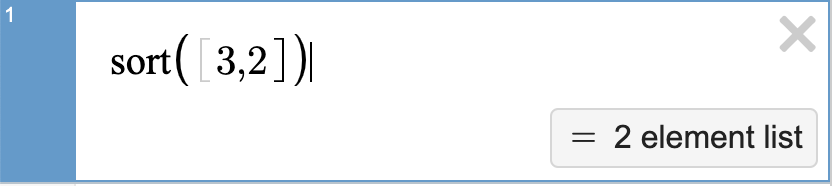
There is in fact a way to crack this answer without using notes. Type the closing parenthesis ) after the expression, then go back one character and type the closing bracket ]. The result, sort(3,2]), should be interpreted as sort([3,2]).
Python 3, cracks qwatry's revised answer
x: 1=2
or
x: 1+1=2
(not entirely sure which it's supposed to be but it works either way).
I completely forgot how flexible type hints are until I cheated searched the grammar for the = character.
Python 2, 7 bytes, cracks xnor's post
0xbin()
The answer is easy to understand if syntax highlighting for above snippet works correctly.
So bad. The syntax highlighting did work correctly. But SO changed their render library... Anyway, above code is:
0xb in ()
Python 3, cracks Makonede's revised second challenge
raiser:str
Uses a type annotation. I think this is the actual solution you meant. 😏
Python 3, cracks Makonede's second challenge
raiseTABSystemExit
I am sure this is another unintended loophole…
Rust -Z unstable-options --pretty normal, cracks @Deadbeef's answer
const x:! =1;
Not sure if this is the intended interpretation of "you may pass any flags to rustc if you like." or a loophole.
I could just do --help but this one actually parses the file and needs a sorta valid Rust program.
Specifically, the --pretty option on Nightly will just format the code instead of compiling it.
Desmos, cracks HitchHacker answer
The solution is in the answer, note is the key: instead of evaluating it as an expression the illegal string is put in a note ¯\_(ツ)_/¯

Python 3, cracks qwatry's challenge
Illegal text: int(A,B,C), with all ASCII but ~+2() and newlines banned.
𝔢𝔵𝔢𝔠(𝔠𝔥𝔯(22+22+22+~2+2)+𝔠𝔥𝔯(22+22+22+~2+2+~2+~2+2)+𝔠𝔥𝔯(22+22+22)+𝔠𝔥𝔯(22+22+22+~2+2+~2+~2+2)+𝔠𝔥𝔯(22+22+22+2+2+~2)+𝔠𝔥𝔯(22+22+22+~2+2+~2+~2+2)+𝔠𝔥𝔯(22+22+2+2))
𝔭𝔯int(A,B,C)
Python 3 normalizes Unicode identifiers, so "𝔣𝔞𝔫𝔠𝔶 𝔲𝔫𝔦𝔠𝔬𝔡𝔢" is turned into "fancy unicode".
This turns it into
exec(chr(22+22+22+~2+2)+chr(22+22+22+~2+2+~2+~2+2)+chr(22+22+22)+chr(22+22+22+~2+2+~2+~2+2)+chr(22+22+22+2+2+~2)+chr(22+22+22+~2+2+~2+~2+2)+chr(22+22+2+2))
print(A,B,C)
And when we expand the chr statements, we get 'A=B=C=0':
exec('A=B=C=0')
print(A,B,C)
And you can figure it out from there.
I would love to say I discovered it, but nah. This isn't the first time normalization memes have been posted here.
Also, I brute forced the ASCII arithmetic instead of calculating it, so it is not optimized. 😂
R, cracks Robin Ryder's challenge
try(x %'"% y,T)
The 'almost illegal' string we're trying to use is '".
try attempts to run the code contained in its first argument. The second argument, silent (not explicitly named here) is set to TRUE to prevent output if the result is an error.
The first argument here attempts to apply the (nonexistant) %'"% function to (nonexistant) variables x and y.
The %...% notation - known as SPECIAL in R - allows us to incorporate characters that are usually forbidden for variables and function names, like '" in this case.
Julia, 12 bytes, cracks @binarycat's answer
`\?""":"`
Backticks in Julia delimit shell commands, as in Perl or Ruby. But unlike Perl or Ruby, the command isn't actually executed; rather, a Cmd object representing the command is created. Hence it doesn't matter that \?""":" isn't a valid shell command.
Desmos, 5 bytes, cracks Aiden Chow's answer
\{\}Julia, 12 bytes, cracks @dogedoge's answer
"""?"""::Any
Define a (triple-quoted) string and assert it to be of type Any (String also works).
Ruby, 21 bytes, cracks @dogedoge's first answer
%q(=end
#{"""'}
=end)
Wraps the almost illegal string in a single-quoted string (which doesn't allow interpolation).
Ruby, 23 bytes, cracks @dogedoge's first and second answers
/#{'}=end
#{"""'}
=end/
Here's an alternative that doesn't use % (in response to a comment). This time we wrap in a regexp, interpolating a single quote to close the """' sequence that occurs later.
Ruby, 28 bytes, cracks @dogedoge's third answer
<<S
#{'}=end
#{/"""'}
=end
S
Now the wrapper is a here doc. This approach also works for the first two cops (which don't include the /).
Haskell, doge doge's answer, 26 bytes
main=print()where{3
#""=3}
The idea here is that within a {} block whitespace rules are weakened a good deal. With that we can turn #" into the declaration of an infix function and write the rest of our program with no issues. From there we use where attached to our main function to start the block.
I don't really know why these blocks have weaker rules. I am just learning about this now as well. But for some reason I had a suspicion it might work and it does.
Jelly, 6 bytes, cracks caird coinheringaahing's
«{0¡
Instead of string literal weirdness, this uses the fact that arity mismatches don't cause errors until things are actually evaluated--{ doesn't try to turn a monad into a dyad so much as it calls a Python lambda assumed to have one argument from a Python lambda with two arguments, and 0¡ repeats it zero times.
Jelly, 6 bytes, cracks caird coinheringaahing's
“

«{”
EDIT
I actually don't know why this works lmao