| Bytes | Lang | Time | Link |
|---|---|---|---|
| 044 | Juby | 250506T151232Z | Jordan |
| 039 | Python 3 | 220106T011338Z | Larry Ba |
| 024 | Julia 1.0 | 210625T210836Z | MarcMush |
| 009 | Jelly | 200209T230450Z | Jonathan |
| 010 | Japt | 200209T234232Z | Shaggy |
| 022 | Perl 5 p | 200330T002903Z | Xcali |
| 119 | W d | 200211T105349Z | user8505 |
| 029 | Wolfram Language Mathematica | 200211T032031Z | ZaMoC |
| 008 | W d | 200222T072611Z | user9206 |
| 052 | bc | 200211T022835Z | David G. |
| 045 | C gcc | 200210T000110Z | S.S. Ann |
| 029 | JavaScript ES6 | 200209T222256Z | Arnauld |
| 031 | Octave / MATLAB | 200210T101107Z | Luis Men |
| 028 | J | 200210T145111Z | Finn G&# |
| 027 | Burlesque | 200209T233152Z | DeathInc |
| 009 | Pyth | 200210T144755Z | Citty |
| 020 | GolfScript | 200210T172236Z | Mathgeek |
| 033 | R | 200210T152845Z | John |
| 043 | Java 8 | 200210T125520Z | Kevin Cr |
| 020 | K Kona | 200210T093110Z | Galen Iv |
| 034 | Haskell | 200210T093746Z | ovs |
| 053 | Red | 200210T082622Z | Galen Iv |
| 030 | Ruby | 200210T080817Z | G B |
| 035 | Python 3 | 200210T061956Z | xnor |
| 013 | APL Dyalog | 200210T000931Z | Jo King |
| 049 | C gcc | 200210T001544Z | Noodle9 |
| nan | Scratch 3.0 | 200210T003303Z | lyxal |
| 040 | Python 3 | 200210T001928Z | Noodle9 |
| 012 | Keg | 200210T002129Z | lyxal |
| 008 | 05AB1E | 200209T224348Z | Grimmy |
| 019 | Charcoal | 200209T234630Z | Neil |
| 027 | Perl 6 | 200209T224852Z | Jo King |
Jelly, 9 bytes
1İ€S<¬ʋ1#
A monadic Link accepting a number which yields a list containing one integer; as a full program it prints that integer.
How?
1İ€S<¬ʋ1# - Link: number, x
1 - set left to one
1# - count up (from n=left) finding the first (1) n such that:
ʋ - last four links as a dyad - f(n, x)
İ€ - inverse each (of [1..n])
S - sum
< - less than (x)?
¬ - logical NOT
‘!İ€Ä<⁸S‘
Is another 9 but it's much less efficient as \$x\$ gets bigger since it builds a list of the first \$(x+1)!\$ harmonic numbers.
W d, 11 9 bytes
╪ª4PĽ┌∙×
Uncompressed:
i1ak/+rb<!W
Explanation
i         W % Find the first number from 1 to positive infinity
            % That satisfies this condition
  ak        % Generate a range from 1 to the number
 1  /       % Find the reciprocal of every item (automatically vectorises)
     +r     % Reduce by addition
       b<!  % Is this number greater than or equal to the input?
W d, 8 bytes
Let's see if I can come tied with 05AB1E ...
♠wⁿ=^φ→§
Uncompressed:
kJrJb<!iX
Explanation
       iX % Foreach in [1 .. +inf],
          % find first number that satisfies:
k         % Range of 1 .. number
 Jr       % Reciprocal each
   J      % Summation of entire list
    b<!   % Is that >= the input?
bc, 52 bytes
define f(x){
scale=999
for(s=i=0;s<x;s=s+1/i)i=i+1
}
If you need more precision, change the 999 to 9E3 or 9E9. Expect memory usage to skyrocket and performance to plummet.
I'm testing a variant that prints as it passes integers. It matches OEIS A004080 so far (23 -> 5471312310). With scale=9, it is correct to 11 -> 33617 but is off by 4 for 12. With scale=99, it is so far accurate to 25 -> 40427833596. Since scale=99 can't be extended without adding another byte, I'm not going to claim it.
C (gcc), 45 bytes
Some inspiration taken from @Noodle9; go upvote their answer!
i;g(x,s)float x,s;{for(s=i=0;s<x;s+=1./++i);}
i;g(x,s)float x,s;: Old-style function definition. Abuses the fact that old-style function definition don't require all the arguments to be passed (so old-style variadic functions would work) to declare an extra local variable. Having theias a global variable causes the exploit below to work.for(s=i=0;s<x;s+=1./++i);: same old stuff as before, harmonic function, yada yada. Note thats=i=0is allowed; thei=0is an integer that is converted to afloatand assigned tos.The
ivariable is stored in the%eax(return) register, so nothing is required to initialize it. (thanks @Cody Gray!)
C (gcc), 72 bytes
Recursive solution.
i;float h(n){return n?h(n-1)+1./n:0;}g(float x){for(i=0;h(i++)<x;);--i;}
Explanation:
i;: counter for finding the first integernwhereh(n) >= x.float h(n): recursive function taking anintparameter and returning the term of the Harmonic series forn.return n?h(n-1)+1./n:0;- recursive function calculating the Harmonic series and stopping at0.g(float x): function finding the firstiwhereh(i) >= x.for(i=0;: start loop and initializeito0(functions must be reusable).h(i++)<x: loop whileh(i) < x.--i;returnsi-1by exploiting GCC's behavior when compiling without optimization; intermediate results are all stored in theeax/raxregister.
C (gcc), 83 bytes
Non-recursive solution.
i;float h(n){float r=0;for(;n;)r+=1./n--;r=r++;}g(float x){for(i=0;h(i++)<x;);--i;}
Explaining the part that's different from the previous solution:
float r=0;: this is our result. Initialize it to0.for(;n;): Loop untilnis0.r+=1./n--;: Add the next iteration of the Harmonic series. Also decrementnso we don't have to do that in the last part of theforloop.r=r++;is likereturn n;but shorter. It's similar to the fakereturnin the previous solution but does it with the floating-point return register instead of the integer return register. We have to have the++just so GCC doesn't optimize it out as redundant (and yes, some optimizations are enabled without a flag).
JavaScript (ES6), 32 29 bytes
Saved 3 bytes thanks to @Shaggy
f=(n,k=0)=>n>0?f(n-1/++k,k):k
Non-recursive version, 35 bytes
n=>eval("for(k=0;(n-=1/++k)>0;);k")
Approximation (25 bytes, not fully working)
This gives the correct result for all but the first test case.
n=>Math.exp(n-.5772)+.5|0
Octave / MATLAB, 31 bytes
Thanks to @Giuseppe (based on @John's answer) for making a correction and saving 1 byte at the same time.
@(n)sum(cumsum(1./(1:3^n))<n)+1
Explanation
The code uses the fact that 1+1/2+···+1/m is lower-bounded by log(m). Therefore, given n the solution to the challenge is less than exp(n), or less than 3^n (to save bytes).
So the code computes the cumulative sum of the vector [1, 1/2, 1/3, ..., 1/(3^n)], and the solution is 1 plus the number of entries that are less than n.
J, 29 28 bytes
-1 byte thanks to RGS
Shameless translation of Jo King's APL answer.
3 :'>:1 i.~y&<:+/\%}.i.<.^y'
Probably a lot of room for improvement, but I couldn't find a shorter tacit way.
Burlesque, 27 bytes
rds1@1moiT{1j?/g1++cm0>=}fi
For some reason save/load seems to be working a bit funny with this one on TIO. To test the code, use the following:
Burlesque, 28 bytes
rd@1moiT{1j?/++cm0>=}x/4iafi
rd    # Read input as double
[s1]  # Save slot 1
@1    # 1.0
mo    # Infinite multiples of {1.0, 2.0, 3.0...}
iT    # All tails of {{}, {1.0}, {1.0,2.0}, {1.0,2.0,3.0},...}}
{
 1j?/ # Reciprocal
 ++   # Sum
 [g1] # Get slot 1 (not working)
 cm   # UFO operator (-1 on <, 0 on ==, 1 on >)
 -1.> # 0 or 1
}
x/   # Reorder stack
3ia  # Insert input at position 3 of array (before compare)
fi   # Find first index
Pyth, 11 10 9 bytes
fgZ=-Qc1T
Explaination:
            # Implicit Q=eval(input())
f           # The first element T of [1,2,3,...] where
 gZ         # 0 >=
   =-Qc1T   # Q = Q - (1/T)
            # Implicit print
-1 -2 bytes thanks to @issacg
GolfScript, 21 20 [bytes]
New Solution TIO
Old Solution TIO
The new solution takes our input and recursively subtracts the inverses from it until we get the solution. Very messy stack management, could probably be done cleaner.
New Solution (20)
0{).-1?@\-.@\0>}do\;
New Solution Explanation
0{).-1?@\-.@\0>}do\; #Take in a number c as input, and output the lowest n s.t. Hn<x
0                    # The stack is now [c n=0]. We're just using n here for clarity.
 {             }do   # Until we pop a TRUE, loop the following
 {)            }do   # Increment n by 1
 {  .           }do   # Then duplicate it
 {  -1?        }do   # Raise the dupe to the power of 1 (inverse)
 {     @\      }do   # Move our c to the second element of the stack, between n and 1/n
 {       -     }do   # Subtract. Stack is now [n c-(1/n)]
 {        .    }do   # Duplicate c-(1/n)
 {         @\  }do   # Move n back to the second element of the stack
 {           0>}do   # Check if our c-(1/n) is less than zero. If so, leave the loop.
 {             }do   # If not, repeat, but with c-(1/n) as our new c.
                  \; # Remove c once it's below 0, leaving our tally. This gets outputted.
Old Solution (21)
:c;0.{\).-1?@+.c<}do;
Old Solution Explanation
:c;0.{\).-1?@+.c<}do; # Take in a number c and find the lowest n s.t. Hn>c
:c;                   # Set c to our goal number, then pop it from our stack.
   0.                 # Make our stack [0 0]. Let will be our n, right will be our running sum.
     {           }do  # At the end of each loop, if the top of the stack isn't 0, repeat.
     {\)         }do  # Move the n to the top of the stack and increment it by 1.
     {  .-1?     }do  # Duplicate it, then inverse it.
     {      @    }do  # Bring our running total to the top (now third in the stack behind 1/n and n)
     {       +   }do  # Add the top two elements (running total + 1/n)
     {        .  }do  # Duplicate the running total
     {         c<}do  # If it's less than c, print 1 (repeat do), else 0 (stop do)
                    ; # Pop our running total, leaving behind just our n.
Shouldn't be too hard to shave a char off somewhere.
Got one.
R, 39 33 bytes
x=scan();sum(cumsum(1/1:x^x)<x)+1
For a more limited x:
29 bytes
sum(cumsum(1/1:9^8)<scan())+1
Java 8, 71 43 bytes
x->{int n=0;for(;(x-=1d/++n)>0;);return n;}
-28 bytes by porting @Arnauld's non-recursive JavaScript answer.
Explanation:
x->{                // Method with double as both parameter and integer as return-type
  int n=0;          //  Result-integer `n`, starting at 0
  for(;(x-=1d/++n)  //  Decrease `x` by 1/(n+1), by first increasing `n` by 1 with `++n`
       >0;);        //  And continue doing this until `x` is 0
  return n;}        //  Then return `n` as result
K (Kona), 21 20 bytes
{1+*&~x>+\1.%1+!3^x}
Inspired by Jo King's APL solution
Switched from oK to Kona, as it has power
Red, 53 bytes
f: func[n][i: 0 until[0 >= n: n -(1.0 /(i: i + 1))]i]
Simple iterative solution.
Red, 78 bytes
f: func[n /a i][either a[either n > 0[f/a n -(1.0 / i)i + 1][i - 1]][f/a n 1]]
I know this is way longer than other recursive solutions, but I wanted to post it because of the fact that Red functions have fixed arity. In order to simulate default values for the additional parameters, we need to use a refinement - here it's /a- whenever we need the value of the i parameter.
APL (Dyalog), 13 bytes
-1 bytes thanks to ngn
{⊃⍸⍵≤+\÷⍳⌈*⍵}
A dfn solution that takes a right argument.
Explanation:
{           }   ⍝ dfn
 ⊃              ⍝ Take the first of
  ⍸             ⍝ The indexes of the truthy values of
   ⍵≤           ⍝ The right argument is smaller than or equal to
     \+         ⍝ The cumulative sum
       ÷        ⍝ The reciprocal of each of
        ⍳       ⍝ The range 1 to
         ⌈      ⍝ The ceiling of
          *⍵    ⍝ e to the power of the right argument
C (gcc), 52 51 49 bytes
Saved a bytes thanks to @ceilingcat!!!
Saved 2 bytes thanks to @S.S.Anne!!!
i;f(n,s)float n,s;{for(s=i=0;s<n;s+=1./++i);n=i;}
Scratch 3.0, 15 blocks / 127 bytes
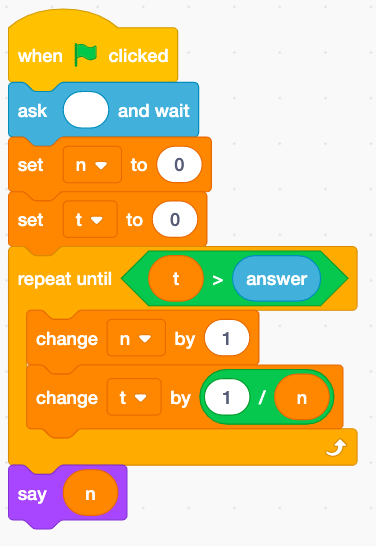
when gf clicked
ask()and wait
set[n v]to(0
set[t v]to(0
repeat until<(t)>(answer
change[n v]by(1
change[t v]by((1)/(n
end
say(n
Just a port of my Keg answer, so Try it online Scratch!
Keg, -hr, 12 bytes
0&0{¿⑻>|:⑨⑱⑼
Uses the most recent Keg interpreter, so no TIO thus far.
Explained
0&
We store 0 in the register as this will be the means of storing the total sum of the series.
0
We then push 0 onto the stack, as this will be what keeps track of the term number (n)
{¿⑻>|
The condition of the while loop is that it will repeat while the input (which is automatically filled if no input is given -- the reason why this doesn't have a TIO link) is greater than the value in the register.
⑨
We then increment the top of the stack to get to the next term. This is done before the reciprocal is taken so that we avoid an "off-by-one" error.
:⑱⑼
We then take the reciprocal of the top of the stack and add it to the register (⑱ = 1/x and ⑼ = register += t.o.s). -hr will automatically print the top of the stack at end of execution as an integer.
Here is a Try it online version that uses a variable to keep track of the input. This is mainly just so that y'all can see that the algorithm works, as the variables can be replaced with the above 12 byter.
05AB1E, 8 bytes
∞.ΔLzOI@
∞.Δ        # first integer y such that:
   L       #  range [1..y]
    z      #  invert each [1, 1/2, .., 1/y]
     O     #  sum
      I@   #  >= input
Charcoal, 19 bytes
⊞υ¹W‹ΣυIθ⊞υ∕¹⊕LυILυ
Try it online! Link is to verbose version of code. Explanation:
⊞υ¹
Start off with n=1, pushing 1/1 to the predefined list.
W‹ΣυIθ
Repeat while the list sums to less than the target...
⊞υ∕¹⊕Lυ
... push the next Egyptian fraction to the list.
ILυ
Output the length of the list, i.e. n.
It might be possible to reduce the floating-point inaccuracy slightly by adding a Reverse after the Sum.
Perl 6, 27 bytes
{+([\+](1 X/1..*)...*>=$_)}
Explanation:
{                         } # Anonymous code block taking one argument
 +(                      )  # Return the length of
   [\+](        )             # The cumulative sum
        1 X/                    # Of the reciprocal of all of
            1..*                  # 1 to infinity
                 ...          # Take from this until
                    *>=$_     # It is larger than or equal to the input