| Bytes | Lang | Time | Link |
|---|---|---|---|
| 007 | Uiua | 240819T133058Z | janMakos |
| 007 | Vyxal | 240818T012032Z | lyxal |
| 045 | Vyxal s | 240818T011318Z | lyxal |
| 011 | Uiua | 230929T191905Z | chunes |
| 005 | Thunno 2 S | 230614T050524Z | The Thon |
| 005 | Nekomata | 230614T035451Z | alephalp |
| 033 | Arturo | 230210T081050Z | chunes |
| 006 | Japt x | 190204T130334Z | Shaggy |
| nan | 220503T122231Z | Dr.jacky | |
| 011 | Dyalog APL | 220406T072355Z | Brian BE |
| 024 | Factor + math.unicode | 220406T083242Z | chunes |
| 004 | Husk | 210321T030342Z | Leo |
| 087 | Common Lisp | 190207T002726Z | Charlim |
| 032 | Haskell | 190204T144613Z | Wheat Wi |
| 057 | Java JDK | 190206T081808Z | Olivier |
| 050 | Clojure | 190206T062236Z | Tried Cr |
| 034 | Wolfram Language Mathematica | 190206T045109Z | alephalp |
| 008 | Stax | 190205T194741Z | wastl |
| 008 | Pyth | 190205T110540Z | Sok |
| 030 | R | 190204T125104Z | digEmAll |
| 047 | C# Visual C# Interactive Compiler with flag /uSystem.Math | 190204T195929Z | Gymhgy |
| 032 | Haskell | 190205T023934Z | xnor |
| 021 | Perl 5 | 190204T142408Z | Nahuel F |
| 007 | K oK | 190204T115851Z | Galen Iv |
| 035 | Haskell | 190204T154437Z | lynn |
| 005 | 05AB1E | 190204T121134Z | Arnauld |
| 038 | JavaScript Node.js | 190204T114723Z | tsh |
| 037 | Python 3 | 190204T114027Z | TFeld |
| 005 | Jelly | 190204T130832Z | Arnauld |
| 021 | Retina 0.8.2 | 190204T130451Z | Neil |
| 008 | MATL | 190204T123847Z | Sanchise |
| 008 | Japt | 190204T115607Z | Luis fel |
| 010 | 05AB1E | 190204T115804Z | Kevin Cr |
| 013 | MATL | 190204T115657Z | Luis Men |
Uiua, 7 bytes
/+↥0°\+
Explanation
/+↥0°\+

    °\+ # Get deltas (inverse of prefix sum)
  ↥0 # Max with 0 (remove negatives)
/+ # Sum
Vyxal, 7 bytes
×*§Ġ~ȧL
Unlike all the other answers, this sort of visually solves the problem. Let me show you how:
Explained
×*§Ġ~ȧL
×* # Push n asterisks for each n in the input
§ # The magic. Vertically join the list (that is, transpose, join on newlines, filling with spaces)
Ġ # Group by consecutive characters
~ȧ # And remove those which are just whitespace
L # Get the length of that list
💎
Created with the help of Luminespire.
Given an input of [1,3,2,1,2,1,5,3,3,4,2], it first becomes:
["*", "***", "**", "*", "**", "*", "*****", "***", "***", "****", "**"]
Then, we create the skyline:
      *
      *  *
 *    ****
 ** * *****
***********
From here, we can find each unique cluster of asterisks.
      (*)
      (*)  (*)
 (*)    (****)
 (**) (*) (*****)
(***********)
(The answer doesn't insert the brackets, but it does do the grouping part). Count the number of clusters, and you get the required answer.
Vyxal s, 36 bitsv2, 4.5 bytes
0p¯~Ṡ
Bitstring:
001111110100000100010101001101100110
Boring algorithm everyone else uses. Bleh
Uiua, 11 bytes
/+↥0-↘¯1⊂0.
Port of tsh's JavaScript answer.
/+↥0-↘¯1⊂0.
          .  # duplicate
        ⊂0   # prepend a zero
     ↘¯1     # drop last element
    -        # subtract the two arrays
  ↥0         # change negative numbers to zero
/+           # sum
Thunno 2 S, 6 5 bytes
0ƤṢ0§
Port of @Arnauld's 05AB1E answer.
-1 thanks to @alephalpha
Explanation
0ƤṢ0§   # Implicit input
0Ƥ      # Prepend a 0
  Ṣ     # Compute deltas
   0§   # Maximum with 0
        # S flag sums the list
        # Implicit output
Nekomata, 5 bytes
ç-P‼∑
A port of @Arnauld's 05AB1E answer.
ç-P‼∑
ç           Prepend zero
 -          Minus to get the delta
  P‼        Filter by positive
    ∑       Sum
Japt -x, 7 6 bytes
änT f¬
1 byte saved thanks to Oliver.
änT f¬     :Implicit input of integer array
ä          :Consecutive pairs
 n         :Reduced by inverse subtraction
  T        :After first prepending 0
    f      :Filter elements by
     ¬     :Square root (The square root of a negative being NaN, which is falsey)
           :Implicitly reduce by addition and output
Kotlin
fun f(test:IntArray):Int{var s=0;var p=0;test.forEach{val f=(if(it>p)p else it);p=it;s-=f-p};return s}
Dyalog APL, 11 bytes
+/0⌈¯2-/0,⊢
, concatenate, so 0, concatenates 0.
¯2-/
or
¯2 length of window. (minus means the window is rotated)
-/ does a window operation of -(minus) with window size 2
0⌈ the operation is called ceiling, but when it gets an input from both sides it also does "get the larger of the two inputs" so 0⌈1 3 0 ¯2 will give 1 3 0 0.
and finally, a +/ which is a sum.
Factor + math.unicode, 24 bytes
[ dup 0 prefix [v-] Σ ]
Explanation
         ! { 10 9 8 9 }
dup      ! { 10 9 8 9 } { 10 9 8 9 }
0        ! { 10 9 8 9 } { 10 9 8 9 } 0
prefix   ! { 10 9 8 9 } { 0 10 9 8 9 }
[v-]     ! { 10 0 0 1 }  (subtract two vectors, clamping negative numbers to 0)
Σ        ! 11
Husk, 4 bytes
ΣẊ>Θ
Uses the same algorithm as everybody else (see here for an explanation), it just does so with fewer bytes than anybody else :D
Explanation
ΣẊ>Θ
   Θ    Prepend a 0 to the values
 Ẋ      For each pair of adjacent values (a,b)
  >     Return b-a if b>a else 0
Σ       Sum all of these values
> in Husk does a great job for this task: it does return a truthy value iff b>a, but this truthy value also happens to be the difference b-a, accomplishing two tasks in one go!
Common Lisp, 88 87 bytes
(lambda(s)(let((o 0))(dolist(c s)(incf o(max 0 c))(mapl(lambda(y)(decf(car y)c))s))o))
non-minified
(lambda (skyline)
  (let ((output 0))
    (dolist (current-skyscraper-height skyline)
      (incf output (max 0 current-skyscraper-height))
      (mapl (lambda (skyscraper)
              (decf (car skyscraper) current-skyscraper-height))
            skyline))
    output)))
When one tower is painted, it takes a number of brushstrokes equal to it's height. These brushstrokes translate to all the following ones, which is indicated here by subtracting the current tower's height from all other towers (and itself, but that doesn't matter). If a following tower is shorter, then it will be pushed to a negative number, and this negative number will subsequently subtracted from the towers that follow (indicating brushstrokes that could not be translated from a previous tower to the next ones). It actually just subtracts the number from all tower heights, including previous ones, but this doesn't matter because we don't look at the previous ones again.
Haskell, 34 32 bytes
2 bytes trimmed by Lynn
g x=sum$max 0<$>zipWith(-)x(0:x)
So to start we have zipWith(-). This takes two lists and produces a new list of their pairwise differences. We then combine it with x and (0:x). (0:) is a function that adds zero to the front of a list and by combining it with zipWith(-) we get the differences between consecutive elements of that list with a zero at the front. Then we turn all the negative ones to zero with (max 0<$>). This creates a new list where each element is the number of new strokes that has to be started at each tower. To get the total we just sum these with sum.
Java (JDK), 57 bytes
a->{int s=0,p=0;for(int x:a)s-=(x>p?p:x)-(p=x);return s;}
Another port of tsh's Javascript answer. So make sure you've upvoted them.
Note that I used subtraction instead of addition because it allowed me to write (p=x) as right operand in the same statement.
Clojure, 50 bytes
#((reduce(fn[[s n]i][(+(max(- i n)0)s)i])[0 0]%)0)
Try it online! (Why doesn't this print anything?)
#( ; begin anonymous function
    (reduce
        (fn [[s n] i] ; internal anonymous reducing function, destructures accumulator argument into a sum and the previous item
            [(+ (max (- i n) 0) s ; the sum part of the accumulator becomes the previous sum plus the larger of zero and the difference between the current number and the last one, which is how many new strokes need to be started at this point
            i]) ; ...and the previous item part becomes the current item
        [0 0] ; the initial value of the accumulator gives no strokes yet, and nothing for them to cover yet
        %) ; reduce over the argument to the function
    0) ; and get the sum element of the last value of the accumulator.
Wolfram Language (Mathematica), 34 bytes
A port of @Arnauld's solution.
Tr@Select[{##,0}-{0,##},#>0&]&@@#&
Pyth, 8 bytes
s>#0.++0
Yet another port of @tsh's marvellous answer. Takes the sum (s) of the positive values (>#0) of the deltas (.+) of the input with 0 prepended (+0Q, trailing Q inferred).
Try it online here, or verify all the test cases at once here.
String joining method, 10 bytes
This was the solution I wrote before browsing the other answers.
lcj.t+d*LN
lcj.t+d*LNQ   Implicit: Q=eval(input()), b=<newline>, N=<quote mark>
              Trailing Q inferred
        L Q   Map each element of Q...
       * N    ... to N repeated that many times
     +b       Prepend a newline
   .t         Transpose, padding with spaces
  j           Join on newlines
 c            Split on whitespace
l             Take the length, implicit print
R, 30 bytes
sum(pmax(0,diff(c(0,scan()))))
Porting of @Arnauld solution which in turn derives from @tsh great solution
C# (Visual C# Interactive Compiler) with flag /u:System.Math, 47 bytes
n=>n.Select((a,i)=>i<1?a:Max(a-n[i-1],0)).Sum()
Old version, with flag /u:System.Math, 63 bytes
n=>n.Aggregate((0,0),(a,b)=>(a.Item1+Max(0,b-a.Item2),b)).Item1
I feel like this solution is more elegant than the first one. It goes through the array with a two-value tuple as a starting value, picking up values, and stores the value before it in the second part of the tuple.
Haskell, 32 bytes
(0%)
p%(h:t)=max(h-p)0+h%t
p%_=0
An improvement on Lynn's solution that tracks the previous element p instead of looking at the next element. This makes the base case and recursive call shorter in exchange for needing to invoke (0%).
max(h-p)0 could be max h p-p for the same length.
Perl 5, 21 bytes
$\+=$_>$'&&$_-$';//}{
How
-p+}{+$\trick//matches empty string so that for next line postmatch$'will contain previous line$\+=$_>$'&&$_-$'to accumulate difference between current line and previous if current is greater than previous, (could also be written$\+=$_-$' if$_>$', but perl doesn't parse$\+=$_-$'if$_>$'the same)
K (oK), 12 7 bytes
-5 bytes thanks to ngn!
A k (oK) port of Arnauld's 05AB1E solution (and tsh's JavaScript solution):
+/0|-':
J, 15 bytes
A J port of Arnauld's 05AB1E solution (and tsh's JavaScript solution):
1#.0>./2-~/\0,]
My naive solution:
J, 27 bytes
1#.2(1 0-:])\0,@|:@,~1$~"0]
Haskell, 35 bytes
f(a:b:c)=max(a-b)0+f(b:c)
f a=sum a
Line 2 could be f[a]=a if I didn't also have to handle the case [].
05AB1E, 8 7 5 bytes
Saved 2 bytes thanks to @Adnan
0š¥þO
How?
This is using the algorithm that was first found by @tsh. If you like this answer, make sure to upvote their answer as well!
Each time a skyscraper is lower than or as high as the previous one, it can be painted 'for free' by simply extending the brushstrokes.
For instance, painting skyscrapers \$B\$ and \$C\$ in the figure below costs nothing.
On the other hand, we need 2 new brushstrokes to paint skyscraper \$E\$, no matter if they're going to be reused after that or not.
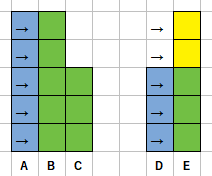
For the first skyscraper, we always need as many brushstrokes as there are floors in it.
Turning this into maths:
$$S=h_0+\sum_{i=1}^n \max(h_i-h_{i-1},0)$$
If we prepend \$0\$ to the list, this can be simplified to:
$$S=\sum_{i=1}^n \max(h_i-h_{i-1},0)$$
Commented
0š¥þO     # expects a list of non-negative integers  e.g. [10, 9, 8, 9]
0š        # prepend 0 to the list                    -->  [0, 10, 9, 8, 9]
  ¥       # compute deltas                           -->  [10, -1, -1, 1]
   þ      # keep only values made of decimal digits
          # (i.e. without a minus sign)              -->  ["10", "1"]
    O     # sum                                      -->  11
JavaScript (Node.js), 38 bytes
a=>a.map(v=>(n+=v>p&&v-p,p=v),p=n=0)|n
Simply a greedy algorithm which scan from left to right, only draw lines if needed, and draw it as long as possible.
Thanks Arnauld, save 2 3 bytes
Python 3, 37 bytes
lambda a:sum(a)-sum(map(min,a[1:],a))
-5 bytes by switching to Python 3, thanks to Sarien
Python 2, 47 43 42 bytes
lambda a:sum(a)-sum(map(min,a[1:],a[:-1]))
Alt:
lambda a:sum(a)-sum(map(min,zip(a[1:],a)))
Jelly, 5 bytes
A port of my 05AB1E answer, which itself is similar to @tsh JS answer.
ŻI0»S
Commented
ŻI0»S    - main link, expecting a list of non-negative integers  e.g. [10, 9, 8, 9]
Ż        - prepend 0                                             -->  [0, 10, 9, 8, 9]
 I       - compute the deltas                                    -->  [10, -1, -1, 1]
  0»     - compute max(0, v) for each term v                     -->  [10, 0, 0, 1]
    S    - sum                                                   -->  11
Retina 0.8.2, 21 bytes
\d+
$*
(1+)(?=,\1)

1
Try it online! Link includes test cases. Explanation:
\d+
$*
Convert to unary.
(1+)(?=,\1)
Delete all overlaps with the next tower, which don't need a new stroke.
1
Count the remaining strokes.
MATL, 8 bytes
0whd3Y%s
Pretty much @Arnauld's algorithm. Saved one byte (thanks @LuisMendo) by casting to uint64 rather than selecting ) positive entries.
Japt, 8 bytes
-2 bytes from @Shaggy
mîT Õ¸¸è
Explanation
mîT Õ¸¸è      Full program. Implicit input U
                e.g. U = [2,0,2]
mîT             Map each item X and repeat T(0) X times
                     U = ["00","","00"]
    Õ           Transpose rows with columns
                     U = ["0 0","0 0"]
     ¸¸         Join using space and then split in space
                     U = ["0","0","0","0"]
        è       Return the count of the truthy values
05AB1E, 13 10 bytes
Z>Lε@γPO}O
Try it online or verify all test cases.
Explanation:
Z            # Get the maximum of the (implicit) input-list
 >           # Increase it by 1 (if the list only contains 0s)
  L          # Create a list in the range [1, max]
   ε         # Map each value to:
    @        #  Check if this value is >= for each value in the (implicit) input
     γ       #  Split into chunks of adjacent equal digits
      P      #  Take the product of each inner list
       O     #  Take the sum
        }O   # And after the map: take the sum (which is output implicitly)
MATL, 15 14 13 bytes
ts:<~"@Y'x]vs
Input is a column vector, using ; as separator.
Try it online! Or verify all test cases.
Explanation
t       % Implicit input: column vector. Duplicate
s       % Sum
:       % Range from 1 to that. Gives a row vector
<~      % Greater or equal? Element-wise with broadcast
"       % For each column
  @     %   Push current columnn
  Y'    %   Run-length encoding. Gives vector of values (0, 1) and vector of lengths
  x     %   Delete vector of lengths
]       % End
v       % Vertically concatenate. May give an empty array
s       % Sum. Implicit display