| Bytes | Lang | Time | Link |
|---|---|---|---|
| 048 | Julia | 241117T222551Z | MarcMush |
| 190 | Mascarpone | 241116T111854Z | jan |
| 032 | Uiua | 240303T004340Z | jan |
| 084 | Python 3.8 prerelease | 240303T084409Z | movatica |
| 036 | Ruby p | 240301T185420Z | Jordan |
| 031 | Perl 5 + pl | 240301T171451Z | Dom Hast |
| 145 | TypeScript’s type system | 240301T183232Z | noodle p |
| 009 | Japt | 230619T085325Z | Shaggy |
| 7625 | Vyxal r | 230618T132023Z | lyxal |
| 125 | C# .NET Core | 181101T153316Z | Meerkat |
| 064 | PHP | 180728T164209Z | Titus |
| 082 | Powershell | 181031T135716Z | mazzy |
| 050 | C | 180728T130218Z | O.O.Bala |
| 024 | Apl Dyalog Unicode | 180728T185250Z | jslip |
| 325 | Starry | 180802T233750Z | Sasha |
| 036 | Zsh | 180801T020029Z | Noskcaj |
| 094 | sed | 180801T004122Z | Geoff Re |
| 030 | Perl 6 | 180728T033015Z | Jo King |
| 109 | brainfuck | 180730T185653Z | Nitrodon |
| 047 | Perl 5 F | 180730T172651Z | Xcali |
| 045 | JavaScript ES6 | 180728T132733Z | Arnauld |
| 123 | R | 180730T144622Z | ngm |
| 070 | Elixir | 180730T144937Z | Okx |
| 040 | Ruby | 180729T074405Z | Asone Tu |
| 026 | 6502 NMOS* machine code routine | 180730T094150Z | Felix Pa |
| 011 | Pyke | 180730T093926Z | Blue |
| 062 | Python 3.6+ and gmpy2 | 180730T070135Z | trolley8 |
| 048 | C gcc | 180728T180332Z | ErikF |
| 058 | Haskell | 180729T205703Z | xnor |
| 084 | Clean | 180729T015842Z | Οurous |
| 039 | Wolfram Language Mathematica | 180729T144216Z | alephalp |
| 063 | Haskell | 180729T121837Z | Laikoni |
| 089 | JavaScript ES6 | 180729T014232Z | Nebula |
| 056 | Java 8 | 180728T133435Z | O.O.Bala |
| 012 | Retina 0.8.2 | 180728T202929Z | Neil |
| 014 | Charcoal | 180728T202339Z | Neil |
| 088 | Python 2 | 180728T183649Z | Chas Bro |
| 745 | Online Turing Machine Simulator | 180728T171947Z | Erik the |
| 021 | Jelly | 180728T165425Z | Erik the |
| 007 | Stax | 180728T160112Z | wastl |
| 012 | MATL | 180728T143826Z | Sundar R |
| 013 | Japt | 180728T132648Z | crashoz |
| 010 | 05AB1E | 180728T130101Z | Adnan |
Julia, 48 bytes
!x=string(parse(Int,x;base=36)+1;base=36,pad=10)
a straight-forward solution by parsing and printing in base 36. I tried with regexes and character manipulations but couldn't get it shorter than this one
Mascarpone, 190 bytes
-13: followed DRY
['[/''/']v*v{/'a<v}^]v*v/'A<^[Av{*v{/a<v}^]v*v/'D<^[v'/>[]v*]'nD[A1/a</>v{{'r>/:!v{/'r<v}^$]'CD[[An/aCar]'rDA[0zyxwvutsrqponmlkjihgfedcba9876543210]$ar$A[]/$v*$a]'+D[[A'znaCra+]'rD$r[]/$]'fD
My editing version was formatted like this:
['[/''/']v*v{/'a<v}^]v*v/'A<^
[Av{*v{/a<v}^]v*v/'D<^
[v'/>[]v*]'nD
[A1/a</>v{{'r>/:!v{/'r<v}^$]'CD
[
[An/aCar]'rD
A[0zyxwvutsrqponmlkjihgfedcba9876543210]$ar$A[]/$v*$a
]'+D
[
[A'znaCra+]'rD
$r[]/$
]'fD
[squid09fzz]
f
Try it here! (doesn't support Link-embedded code)
I like Mascarpone, because it is so extensible and self-modifying that it could in theory become a terse language given enough setup, but also isn't actually terse at all. This feels like it makes golfing interesting. I define these operations:
Apops a symbol and installs an operation that pushes it ata.Dpops a symbol and a string, turns the string into an operation and installs it at the symbol.npushes the swap and then no-op operations.Cpops a symbol, two operations, and another symbol. It expects the operations to be swap and no-op. If the symbols are equal, it keeps the bottom operation, otherwise, the top one. It installs a no-op atrif it is no-op or it installs the parent interpretersroperation atrif it is swap. This mess is because I fused the equality testing with the recursion orchestration code, which used to be two operations.+pops a symbol and increments it in base 36.ftakes a string, accomplishes the task, and returns a string.
Uiua, 74 44 37 34 32 characters
-2 thanks to noodle man
i←|1⊂⟨++1×39=@9.|@0i◌⟩=@z.°⊂
⍜⇌i
Give input by putting it after the code. The part ⍜⇌i is basically indiscernible from a function in Uiua so I think this counts.
Uiua, 74 characters
a←"0123456789abcdefghijklmnopqrstuvwxyz0"
i←|1⊂⟨∘|⊙i⟩=@0.⊡:a+1⊗:a⊢:↘1.
⍜⇌i
For this one, i didn't know you could add 1 to characters yet.
Other changes were the discovery of un join, and using one switch and some math instead of three switches.
Python 3.8 (pre-release), 96 93 84 bytes
-9 bytes thanx to xnor
lambda a:''.join(chr((n:=-~int(a,36)//36**i%36)+48+39*(n>9))for i in range(9,-1,-1))
Ruby -p, 39 36 bytes
Port of Dom Hastings’ Perl 5 answer; give them an upvote.
-3 bytes thanks to DLosc
sub(/.z*$/){$&.tr"0-9a-z","1-9a-z0"}
Perl 5 + -pl, 31 bytes
Thanks to @DLosc for saving 3 bytes in the regex!
A different approach to @Xcali in their answer.
s/.z*$/$&=~y!0-9a-z!1-9a-z0!r/eExplanation
Replaces any character, followed by 0 or more zs, with the result of transliterating 0-9a-z to 1-9a-z0.
TypeScript’s type system, 145 bytes
type F<N>=N extends[...infer S,infer D]?"0123456789abcdedghijklmnopqrstuvwxyz"extends`${any}${D&string}${infer I}${any}`?[...S,I]:[...F<S>,"0"]:S
This is a generic type F<N> which takes a tuple type of characters and returns a type in the same format.
Explanation:
In the input tuple type N, match the last digit D and the rest S.
N extends[...infer S,infer D]
Match 0-9a-z against: anything + D + match the next character as I + anything.
"0123456789abcdedghijklmnopqrstuvwxyz"extends`${any}${D&string}${infer I}${any}`
If the match succeeded, return S + I.
?[...S,I]
Otherwise, recurse with S as the input, and append 0.
:[...F<S>,"0"]
This isn’t tail recursive, but that’s okay because the input is guaranteed to be 10 digits and the recursion limit for non tail-recursive TS types is 50.
Japt, 9 bytes
n36ÈÄÃùUA
Try it (includes all test cases)
n36ÈÄÃùTA :Implicit input of string U
n36 :Convert from base 36
È :Pass through the following function and convert back
Ä : Add 1
à :End function
ùU :Left pad with original U
A : To length 10
Vyxal r, 61 bitsv1, 7.625 bytes
36~β›R↳›
TIL a) 36β uses the alphabet 0-9a-z, b) β is type aware and c) ↳ pads one string to the length of another.
Explained
36~β›R↳›
36~β      # Convert input from base 36, leaving the 36 on the stack
    ›     # Increment
     R    # and convert to base 36 using the alphabet `0-9A-Z`
      ↳   # pad left to length of input string
       ›  # and replace spaces with 0s
C# (.NET Core), 125 bytes
a=>{var x="";for(int i=9;;i--){var y=a[i]==90?'0':a[i]==57?'A':(char)(a[i]+1);x=y+x;a=a.Remove(i);if(y>48)break;}return a+x;}
Ungolfed:
a => {
    var x = "";                 // initialize x
    for (int i = 9; ; i--)      // starting at 9 (length of string minus one) and decrementing i indefinitely
    {
        var y = a[i] == 90 ?        // if the last character of a is 'Z'
            '0' :                       // y = '0'
            a[i] == 57 ?                // if the last character of a is '9'
                'A':                        // y = 'A'
                (char)(a[i] + 1);           // y = the ascii value of last character plus 1
        x = y + x;                  // prepend y to x
        a = a.Remove(i);            // remove the last character of a
        if (y > 48)                 // if y is a character other than '0',
            break;                      // break from the loop
    }
    return a + x;               // return the remainder of a, with x appended
}
PHP, 69 64 bytes
lame version:
printf("%010s",base_convert(1+base_convert($argn,36,10),10,36));
Run as pipe with -R. Input case insensitive, output lowercase.
first approach, 69 bytes:
<?=str_pad(base_convert(1+base_convert($argn,36,10),10,36),10,'0',0);
Run as pipe with -F
looping version, also 69 bytes:
for($n=$argn;~$c=$n[$i-=1];)$f||$f=$n[$i]=$c!=9?$c>Y?0:++$c:A;echo$n;
- PHP 7.1 only: older PHP does not understand negative string indexes,
younger PHP will yield warnings for undefined constants. - requires uppercase input. Replace
YandAwith lowercase letters for lowercase input.
Run as pipe with -nR
... or try them online.
Powershell, 79 78 82 bytes
+4 bytes: z and 9 inside an argument string fixed
$i=1
"$args"[9..0]|%{$r=([char]($i+$_)+'0a')[2*($i*$_-eq57)+($i*=$_-eq'z')]+$r};$r
Less golfed test script:
$f = {

$i=1                    # increment = 1
"$args"[9..0]|%{        # for chars in positions 0..9 in the argument string (in reverse order)
    $c=[char]($i+$_)    # Important! A Powershell calculates from left to right
                        # Therefore the subexpression ($i+$_) gets a value before the subexpression ($i=$_-eq122)
    $j=2*($i*$_-eq57)+  # j = 2 if the current char is '9' and previous i is 1
        ($i*=$_-eq122)  # j = 1 if the current char is 'z' and previous i is 1
                        # j = 0 othewise
                        # side effect is: i = 1 if the current char is 'z' and previous i is 1, i = 0 othewise
    $c=($c+'0a')[$j]    # get element with index j from the array
    $r=$c+$r            # accumulate the result string
}
$r                      # push the result to a pipe

}

@(
    ,("09fizzbuzz" , "09fizzbv00")
    ,("0000000000" , "0000000001")
    ,("0000000009" , "000000000a")
    ,("000000000z" , "0000000010")
    ,("123456zzzz" , "1234570000")
    ,("00codegolf" , "00codegolg")
) | % {
    $s,$expected = $_
    $result = &$f $s
    "$($result-eq$expected): $result"
}
Output:
True: 09fizzBv00
True: 0000000001
True: 000000000a
True: 0000000010
True: 1234570000
True: 00codegolg
C, 82 81 53 50 bytes
f(char*s){for(s+=10;*--s>89;)*s=48;*s+=*s-57?1:8;}
Directly modifies the input string; input and output is in upper case. Try it online here. Thanks to Arnauld for golfing 24 bytes and to ceilingcat for golfing 3 more bytes.
Ungolfed:
f(char *s) { // function taking a string argument
     for(s += 10; *--s > 89; ) // skip to the least significant digit, and step through the string until you hit something other than a 'Z' (90 is the ASCII code for 'Z') ...
         *s = 48; // ... replacing each digit with a zero (48 is the ASCII code for '0')
         *s += // the next digit has to be incremented:
         *s - 57 // if it's not a '9' (ASCII code 57) ...
         ? 1 // ... that is straightforward ...
         : 8; // ... otherwise it has to be replaced with an 'A' (ASCII code 65 = 57 + 8)
 }
Apl (Dyalog Unicode), 30 28 24 bytes
Thanks to ngn for the hint to save some bytes.
(f⍣¯1)1+f←36⊥1,(⎕D,⎕A)⍳⊢
Requires ⎕IO of 0
Uses upper case
Starry, 325 bytes
+ , , , , , , , , , , + + + +`* + + +* + +** + * +* * ' + + +* +* +* +* +* ` + + + + + * +* * ' + +* + +* +* +* ` + + + +* + * ** + + +' + + ` + + +* + * * . + +* + * * + '
Explanation:
Put-a-zero-at-the-base-of-the-stack
|     +
Read-10-digits
| , , , , , , , , , ,
Initialise-next-stack
|     +
Initialise-carry-bit
|      +
|   +   +
Do
|`
    Top-of-stack:-[output-stack]-[carry-bit]-[next-value]
    Add-Carry-bit-to-digit
    |*

    Compare-with-58-("9"=57)
    | +
    5-double-triple-sub1-double
    |          + +* + +**      + * +*
    Take-difference
    | *
    If-one-above-"9"
    | '
        set-to-"a"=97=6-double-double-double-double-add1
        |    +
        |           + +* +* +* +*      +*
    | `

    Initialise-next-carry-bit
    |     +
    |  +

    Compare-with-123-("z"=122)
    | +
    11-squared-add2
    |                + +  *       +*
    Take-difference
    | *
    If-one-above-"z"
    |  '
        Delete-current-value
        |    +
        set-carry-bit
        |      +*
        Set-to-"0"=48
        |           + +* +* +*
    |  `

    Push-value-to-stack
    |   +   +
    |           + +* +  *
    |  **

    |   +  +
While-next-value-is-not-null
| +'

Pop-carry-bit-and-null-string-terminator
|    +    +
Do
|   `
    Get-top-value
    | +
    |           + +* +  *
    |    *

    Print-it
    | .

    Pop-the-value-off-the-stack
    |           + +* +  *
    |   *
While-stack-is-not-null
| +   '
sed, 94 bytes
s/$/#:0123456789abcdefghijklmnopqrstuvwxyz#0/
:l
s/\(.\)#\(.*:.*\1\)\(#*.\)/\3\2\3/
tl
s/:.*//
Sed suffers a lot for having to change the characters by lookup.
Perl 6, 34 32 30 bytes
Thanks to nwellnhof for -2 bytes through the use of the o operator to combine functions
{S/.//}o{base :36(1~$_)+1: 36}
Function that converts the argument to base 36, adds 1, converts back and then formats it. Now uses the same tactic as Adnan's answer to preserve the leading zeroes.
brainfuck, 109 bytes
,[>>,]<+[++++<[<--->>-<-]-[<->>+<---]<[[-]>-------<]+>>[[+<+>]<<+[>+<------]>>]-[<+>-----]<++++<]<[<<]>>[.>>]
JavaScript (ES6), 45 bytes
Saved 4 bytes thanks to @O.O.Balance
s=>(parseInt(1+s,36)+1).toString(36).slice(1)
R, 152 123 bytes
function(x)f(utf8ToInt(x),10)
f=function(x,n,y=x[n]){x[n]=y+(y==57)*39+(y==122)*(-75)+1
"if"(y==122,f(x,n-1),intToUtf8(x))}
A completely different approach. Get the ASCII code points and recursively "increment" the right-most code point (making 0 (57) jump to to a (97) and z (122) go back to 0 (48)) until you run out of zs. Convert back to string.
Old version
function(s,w=gsub("(z)(?=\\1*$)","0",s,,T),x=regexpr(".0*$",w)[1],y=substr(w,x,x),z=chartr("0-9a-z","1-9a-z0",y))sub(p(y,"(0*$)"),p(z,"\\1"),w)
p=paste0
This is all text manipulation, which is does not go hand-in-hand with R code golfing.
Replace all z at end of strings with 0. Find location of last element before the newly minted trailing 0s. Find the next base 36 digit. Make the change. Be glad to have barely beaten the Online Turing Machine Simulator solution.
Elixir, 70 bytes
fn x->"1"<>x=Integer.to_string 1+String.to_integer("1"<>x,36),36;x end
Explanation:
Prepends 1 to the input, converts it to an integer in base 36, increments it, converts it to a string in base 36, and matches it to "1" <> x (reverse concatenation), then returns x.
Ruby, 40 bytes
->s{(s.to_i(36)+1).to_s(36).rjust 10,?0}
- Convert the string to an integer interpreting it as base 36
- Add 1
- Convert back to base 36 string
- Left pad with
0s
"zzzzzzzzzz" returns an 11-long string
6502 (NMOS*) machine code routine, 26 bytes
A0 09 F3 FB B1 FB C9 5B 90 07 A9 30 91 FB 88 10 F1 C9 3A D0 04 A9 41 91 FB 60
*) uses an "illegal" opcode ISB/0xF3, works on all original NMOS 6502 chips, not on later CMOS variants.
Expects a pointer to a 10-character string in $fb/$fc which is expected to be a base-36 number. Increments this number in-place.
Doesn't do anything sensible on invalid input (like e.g. a shorter string) -- handles ZZZZZZZZZZ "correctly" by accident ;)
Commented disassembly
; function to increment base 36 number as 10 character string
;
; input:
;   $fb/$fc: address of string to increment
; clobbers:
;   A, Y
 .inc36:
A0 09       LDY #$09            ; start at last character
 .loop:
F3 FB       ISB ($FB),Y         ; increment character ("illegal" opcode)
B1 FB       LDA ($FB),Y         ; load incremented character
C9 5B       CMP #$5B            ; > 'z' ?
90 07       BCC .checkgap       ; no, check for gap between numbers and letters
A9 30       LDA #$30            ; load '0'
91 FB       STA ($FB),Y         ; and store in string
88          DEY                 ; previous position
10 F1       BPL .loop           ; and loop
 .checkgap:
C9 3A       CMP #$3A            ; == '9' + 1 ?
D0 04       BNE .done           ; done if not
A9 41       LDA #$41            ; load 'a'
91 FB       STA ($FB),Y         ; and store in string
 .done:
60          RTS
Example C64 assembler program using the routine:
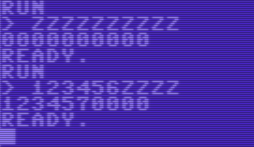
Code in ca65 syntax:
.import inc36   ; link with routine above

.segment "BHDR" ; BASIC header
                .word   $0801           ; load address
                .word   $080b           ; pointer next BASIC line
                .word   2018            ; line number
                .byte   $9e             ; BASIC token "SYS"
                .byte   "2061",$0,$0,$0 ; 2061 ($080d) and terminating 0 bytes

.bss
b36str:         .res    11

.data
prompt:         .byte   "> ", $0

.code
                lda     #<prompt        ; display prompt
                ldy     #>prompt
                jsr     $ab1e

                lda     #<b36str        ; read string into buffer
                ldy     #>b36str
                ldx     #$b
                jsr     readline

                lda     #<b36str        ; address of array to $fb/fc
                sta     $fb
                lda     #>b36str
                sta     $fc
                jsr     inc36           ; call incrementing function

                lda     #<b36str        ; output result
                ldy     #>b36str
                jmp     $ab1e

; read a line of input from keyboard, terminate it with 0
; expects pointer to input buffer in A/Y, buffer length in X
.proc readline
                dex
                stx     $fb
                sta     $fc
                sty     $fd
                ldy     #$0
                sty     $cc             ; enable cursor blinking
                sty     $fe             ; temporary for loop variable
getkey:         jsr     $f142           ; get character from keyboard
                beq     getkey
                sta     $2              ; save to temporary
                and     #$7f
                cmp     #$20            ; check for control character
                bcs     checkout        ; no -> check buffer size
                cmp     #$d             ; was it enter/return?
                beq     prepout         ; -> normal flow
                cmp     #$14            ; was it backspace/delete?
                bne     getkey          ; if not, get next char
                lda     $fe             ; check current index
                beq     getkey          ; zero -> backspace not possible
                bne     prepout         ; skip checking buffer size for bs
checkout:       lda     $fe             ; buffer index
                cmp     $fb             ; check against buffer size
                beq     getkey          ; if it would overflow, loop again
prepout:        sei                     ; no interrupts
                ldy     $d3             ; get current screen column
                lda     ($d1),y         ; and clear
                and     #$7f            ;   cursor in
                sta     ($d1),y         ;   current row
output:         lda     $2              ; load character
                jsr     $e716           ;   and output
                ldx     $cf             ; check cursor phase
                beq     store           ; invisible -> to store
                ldy     $d3             ; get current screen column
                lda     ($d1),y         ; and show
                ora     #$80            ;   cursor in
                sta     ($d1),y         ;   current row
                lda     $2              ; load character
store:          cli                     ; enable interrupts
                cmp     #$14            ; was it backspace/delete?
                beq     backspace       ; to backspace handling code
                cmp     #$d             ; was it enter/return?
                beq     done            ; then we're done.
                ldy     $fe             ; load buffer index
                sta     ($fc),y         ; store character in buffer
                iny                     ; advance buffer index
                sty     $fe
                bne     getkey          ; not zero -> ok
done:           lda     #$0             ; terminate string in buffer with zero
                ldy     $fe             ; get buffer index
                sta     ($fc),y         ; store terminator in buffer
                sei                     ; no interrupts
                ldy     $d3             ; get current screen column
                lda     ($d1),y         ; and clear
                and     #$7f            ;   cursor in
                sta     ($d1),y         ;   current row
                inc     $cc             ; disable cursor blinking
                cli                     ; enable interrupts
                rts                     ; return
backspace:      dec     $fe             ; decrement buffer index
                bcs     getkey          ; and get next key
.endproc
Pyke, 11 bytes
? b!!R+bhbt
? b         - Change default base of `base` command to 36
            -  This is kind of clever because it modifies the list of characters
            -  the command uses to exactly the same as it was originally, whilst
            -  forcing an overwrite from the default settings of 10.
            -  The default setup works for base 36, you just have to specify it
            -  time when using the command.
            -  Literally `b.contents = modify(b.contents, func=lambda: noop)`
   !!       - The previous command returns `0123456789abcdefghijklmnopqrstuvwxyz`
            -  So we convert it into a 1 with (not not ^) for the following command:
     R+     -     "1"+input
       b    -    base(^, 36)
        h   -   ^ + 1
         b  -  base(^, 36)
          t - ^[1:]
Could be 2 bytes shorter with the following language change: If hex mode is used, change all base_36 and base_10 usages to base_92 (which isn't really base 92 in that context anyway)
Python 3.6+ and gmpy2, 62 bytes
from gmpy2 import*;f=lambda s:f'{digits(mpz(s,36)+1,36):0>10}'
(Note that gmpy2 isn't part of Python standard library and requires separated installation)
C (gcc), 50 48 bytes
An explicit carry flag wasn't necessary after restructuring the loop to end as soon as no carry would happen. The 9->A adjustment is performed during the loop check.
Thanks to ceilingcat for the suggestion.
f(char*s){for(s+=9;(*s+=*s-57?1:8)>90;*s--=48);}
Original version: 71 57 bytes
This version uses a carry flag to propagate updates: I set it to truthy to begin the increment. The string is modified in-place and only accepts 0-9, A-Z. The tricky part was making sure that 9->A got handled correctly on carries.
Edit: I repurposed the input pointer as the carry flag.
f(s){for(char*t=s+9;s;)*t--+=(s=++*t>90)?-43:7*!(*t-58);}
Haskell, 58 bytes
d=['0'..'9']
f s=snd(span(<s)$mapM(\_->d++['a'..'z'])d)!!1
A very brute-force strategy: generate all the length-10 base-36 strings in order, and find the one that comes after the input in the list. Take an enormous amount of time on strings far from the start of the list.
Haskell, 60 bytes
q '9'='a'
q c=succ c
f(h:t)|any(<'z')t=h:f t|r<-'0'<$t=q h:r
Reads the string left to right until it reaches a character followed by a suffix of all z's, which may be empty. Increments that character, and replaces the z's with 0's.
Clean, 89 84 bytes
import StdEnv
@['9':t]=['a':t]
@['z':t]=['0': @t]
@[c:t]=[inc c:t]
r=reverse
r o@o r
A shorter solution thanks to Laikoni.
Clean, 115 bytes
I love it when I get to use limit(iterate...
import StdEnv
@'9'='a'
@c=inc c
?[h,'{':t]=[@h,'0': ?t]
?[h:t]=[h: ?t]
?e=e
$l=limit(iterate?(init l++[@(last l)]))
Produces the answer without converting bases using list matching.
? :: [Char] -> [Char]performs forward carrying.@ :: Char -> Charincrements by one, accounting for the gap between'9'and'z'.$ :: [Char] -> [Char]increments the last character and applies?until the value stabilizes.
Haskell, 63 bytes
r.f.r
f('9':r)='a':r
f('z':r)='0':f r
f(c:r)=succ c:r
r=reverse
Try it online! Reverses the string and checks the first character:
- A
9is replaced by ana. - A
zis replaced by a0and recursively the next character is checked. - All other characters are incremented using
succ, the successor function which can be used on Chars because they are an instance of the Enum class.
Finally the resulting string is reversed again.
JavaScript (ES6), 89 bytes
This one is not nearly as byte-efficient as the other JavaScript entry, but I made this without noticing this rule:
Given a string of length 10
So this isn't a serious entry - just for fun! It works with strings of general length, such as 0abc, and prepends a 1 when the first digit is z, e.g. zzz -> 1000. Input must be lowercase.
s=>(l=s[s.length-1],r=s.slice(0,-1),l=='z'?f(r||'0')+0:r+(parseInt(l,36)+1).toString(36))
Explanation
The expression (A, B, C) actually means "do A, then do B, then return C", which I make use of to declare some variables I reuse in the code. s stands for "string", l means "last", r means "rest".
/*1*/ s=>(
/*2*/   l=s[s.length-1],
/*3*/   r=s.slice(0,-1),
/*4*/   l=='z'
/*5*/     ? f(r||'0')+0
/*6*/     : r+(parseInt(l,36)+1).toString(36))
This is a recursive function. For a typical string like aza, it will just increment the last character (see line 6) - azb. But for a string that ends with z, like h0gz, it will run itself on everything up to the last character (the z) and substitute a 0 in place of it (see line 5) - f(h0gz) = f(h0g) + 0 = h0h0.
The ||'0' in line 5 is so that the function works when it's called on a 1-length string (i.e. the string 'z'). Without it, f('') is called (since 'z'.slice(0, -1) is ''), which has undefined behavior (literally - try it yourself), and that's no good. The expected result of f('z') is '10', which is what we get from f('0') + 0, so we use ||'0'. (||'0' is particularly useful because it doesn't get in the way of the usual case - r being at least 1-length (s at least 2-length) - because strings are falsey only when they are 0-length.)
The method for incrementing a string is the same as used in the other JS entry: convert the base-36 "number" into an actual number, add 1, then convert it back to base-36. We don't need to worry about the 1 from incrementing 'z' ('z' -> '10'), since we never actually increment 'z' (see line 4 and 6: the last character is only incremented if it is not 'z').
Also, we never risk discarding leading zeroes, because we don't ever actually manipulate more than a single character at a time - only ever the last character in the string. The rest of the characters are cleanly sliced off as you slice any string and prepended afterwords.
Java 8, 90 76 56 bytes
s->Long.toString(Long.valueOf(1+s,36)+1,36).substring(1)
Accepts both upper-case and lower-case letters for input. Output is always in lower case.
Thanks to Okx for golfing 18 bytes.
Try it online here.
Ungolfed:
s -> // lambda taking a String argument and returning a String
    Long.toString(Long.valueOf(1+s,36)+1,36) // prefix input with '1' to ensure leading zeros, convert to Long using base 36, increment, then convert back to String in base 36
    .substring(1) // remove the leading '1'
Retina 0.8.2, 12 bytes
T`zo`dl`.z*$
Try it online! Explanation: The dl part of the substitution destination expands to 0-9a-z while the o copies that to the source, resulting in z0-9a-z (although the second z gets ignored as it can never match). This increments the matched digits. The .z*$ part of the pattern matches the last non-z digit plus all trailing zs, thus handling the carry from their increment to 0.
Charcoal, 14 bytes
×0⁹←⮌⍘⊕⍘S³⁶¦³⁶
Try it online! Link is to verbose version of code. Explanation:
×0⁹
Print 9 0s. This serves to pad the result.
←⮌⍘⊕⍘S³⁶¦³⁶
Convert the input from base 36, incremented it, then convert back to base 36. Then, reverse the result and print it leftwards.
Python 2, 88 bytes
def f(s):L,R=s[:-1],s[-1:];return s and[[L+chr(ord(R)+1),f(L)+'0'][R>'y'],L+'a'][R=='9']
Increments the string "by hand".
Online Turing Machine Simulator, 745 bytes
init:0
accept:2
0,0
0,0,>
0,1
0,1,>
0,2
0,2,>
0,3
0,3,>
0,4
0,4,>
0,5
0,5,>
0,6
0,6,>
0,7
0,7,>
0,8
0,8,>
0,9
0,9,>
0,a
0,a,>
0,b
0,b,>
0,c
0,c,>
0,d
0,d,>
0,e
0,e,>
0,f
0,f,>
0,g
0,g,>
0,h
0,h,>
0,i
0,i,>
0,j
0,j,>
0,k
0,k,>
0,l
0,l,>
0,m
0,m,>
0,n
0,n,>
0,o
0,o,>
0,p
0,p,>
0,q
0,q,>
0,r
0,r,>
0,s
0,s,>
0,t
0,t,>
0,u
0,u,>
0,v
0,v,>
0,w
0,w,>
0,x
0,x,>
0,y
0,y,>
0,z
0,z,>
0,_
1,_,<
1,0
2,1,-
1,1
2,2,-
1,2
2,3,-
1,3
2,4,-
1,4
2,5,-
1,5
2,6,-
1,6
2,7,-
1,7
2,8,-
1,8
2,9,-
1,9
2,a,-
1,a
2,b,-
1,b
2,c,-
1,c
2,d,-
1,d
2,e,-
1,e
2,f,-
1,f
2,g,-
1,g
2,h,-
1,h
2,i,-
1,i
2,j,-
1,j
2,k,-
1,k
2,l,-
1,l
2,m,-
1,m
2,n,-
1,n
2,o,-
1,o
2,p,-
1,p
2,q,-
1,q
2,r,-
1,r
2,s,-
1,s
2,t,-
1,t
2,u,-
1,u
2,v,-
1,v
2,w,-
1,w
2,x,-
1,x
2,y,-
1,y
2,z,-
1,z
1,0,<
Stax, 7 bytes
ûæ≥╡►N▀
Explanation:
|3^|3A|z Full program, implicit input
|3       Convert from base 36
  ^      Increment
   |3    Convert to base 36
     A|z Fill with "0" to length 10
         Implicit output
MATL, 12 bytes
36ZAQ5M10&YA
           % Implicit input
36ZA       % convert from base 36 to decimal
Q          % increment by 1
5M         % bring the 36 back on stack (done this way to avoid needing space separator after this)
10         % = minimum length of output string
&YA        % convert back to base 36 with those arguments
           % Implicit output
Japt, 13 bytes
n36 Ä s36 ù0A
Try it online! and Verify test cases
Takes input as a string
Explanation
n36            converts input to base 36
    Ä           +1
      s36       to base 36 string
          ù0A   left-pad with 0 to length 10
05AB1E, 10 bytes
Input is in uppercase.
Code
1ì36ö>36B¦
Explanation
1ì           # Prepend a 1 to the number
  36ö        # Convert from base 36 to decimal
     >       # Increment by 1
      36B    # Convert from decimal to base 36
         ¦   # Remove the first character
Uses the 05AB1E encoding. Try it online! or Verify all test cases.