| Bytes | Lang | Time | Link |
|---|---|---|---|
| 044 | Wolfram Language Mathematica | 190730T084058Z | att |
| 056 | AWK | 241129T181811Z | xrs |
| 019 | Japt R | 180910T140742Z | Shaggy |
| 053 | Python 3 | 241012T002304Z | aeh5040 |
| 026 | Uiua | 241010T235436Z | noodle p |
| 013 | Vyxal | 241010T222357Z | emanresu |
| 027 | Zsh | 240121T170526Z | pxeger |
| 015 | Vyxal j | 210607T110733Z | Wasif |
| 051 | Haskell | 171016T131605Z | Laikoni |
| 039 | ink | 190731T003638Z | Sara J |
| 058 | Underload | 190729T210554Z | EdgyNerd |
| 050 | Ruby | 171016T211634Z | anna328p |
| 057 | Wolfram Language Mathematica | 190729T185721Z | Roman |
| 015 | Stax | 190729T182108Z | recursiv |
| 054 | TSQL | 171016T191126Z | BradC |
| 061 | Dart | 181119T084104Z | Elcan |
| 018 | MathGolf | 181116T150014Z | maxb |
| 078 | JavaScript | 181119T022817Z | eeze |
| 052 | ed | 181116T034122Z | user3604 |
| 069 | Python 3 | 181116T155719Z | Henry T |
| 029 | Burlesque | 181116T112703Z | mroman |
| 024 | Pyth | 181116T083842Z | Sok |
| 050 | R | 171016T132415Z | Giuseppe |
| 028 | Pyth | 171016T181146Z | Mr. Xcod |
| 993 | Shakespeare Programming Language | 180909T192515Z | JosiahRy |
| 015 | Jelly | 171016T132823Z | Erik the |
| 044 | PowerShell | 171017T151719Z | AdmBorkB |
| 066 | C gcc | 171111T132041Z | gastropn |
| 064 | C | 171231T040903Z | l4m2 |
| 049 | Haskell | 171231T000741Z | totallyh |
| 028 | Vim | 171030T175343Z | BlackCap |
| 054 | Haskell | 171017T032113Z | addison |
| 033 | Perl 5 | 171016T140703Z | Dom Hast |
| 036 | bash | 171016T150525Z | Nahuel F |
| 041 | K oK | 171026T144219Z | mkst |
| 055 | Octave | 171016T143027Z | Stewie G |
| 048 | 6502 machine code C64 | 171019T095625Z | Felix Pa |
| 025 | Vim | 171016T193034Z | H.PWiz |
| 052 | Bash | 171018T074235Z | dessert |
| 047 | Jq 1.5 | 171018T082828Z | jq170727 |
| 050 | Javascript | 171016T150954Z | Brian H. |
| 076 | C gcc | 171016T132826Z | Steadybo |
| 032 | Retina | 171016T131546Z | Martin E |
| 055 | Java 8 | 171016T133400Z | Kevin Cr |
| 035 | /// | 171017T071722Z | steenber |
| 038 | ReRegex | 171017T033457Z | ATaco |
| 014 | Husk | 171017T024559Z | Leo |
| 035 | APL Dyalog | 171016T132600Z | Uriel |
| 039 | J | 171016T180442Z | FrownyFr |
| 071 | Haxe | 171016T192727Z | Aurel B& |
| 078 | IBM/Lotus Notes Formula | 171016T145431Z | ElPedro |
| 047 | PHP | 171016T184358Z | Titus |
| 052 | Python 2 | 171016T133455Z | Rod |
| 066 | Batch | 171016T173026Z | Neil |
| 025 | V | 171016T155714Z | DJMcMayh |
| 078 | Batch | 171016T154601Z | schnaade |
| 052 | Haskell | 171016T153558Z | nimi |
| 032 | Retina | 171016T142247Z | Neil |
| 054 | C# .NET Core | 171016T151152Z | the defa |
| nan | 171016T141445Z | Brad Gil | |
| 025 | CJam | 171016T140247Z | Peter Ta |
| 012 | 05AB1E | 171016T133055Z | Emigna |
Wolfram Language (Mathematica), 46 44 bytes
Outer[Print[#,a=nown," ",#2,a,s]&,b=k|unk,b]
AWK, 56 bytes
{$0="X Xs\nX unXs\nunX Xs\nunX unXs";gsub("X","known")}1
To test:
awk '{$0="X Xs\nX unXs\nunX Xs\nunX unXs";gsub("X","known")}1' <<< ""
Japt -R, 22 19 bytes
`kÍ5 unkÍ5`¸ï ˸+'s
`...`¸ï ˸+'s
`...`             :Compressed string "known unknown"
     ¸            :Split on spaces
      ï           :Cartesian product
        Ë         :Map
         ¸        :  Join with space
          +'s     :  Append "s"
                  :Implicit output joined with newlines
Uiua, 26 bytes
♭⊞⍚$"_ _s".{⤙⊂"un""known"}
Try it: Uiua pad
   {⤙⊂"un""known"}
{"known" "unknown"}

   ⊞⊟.{⤙⊂"un""known"}              # Here, using `⊟ couple` as the function
╭─                                 # to `⊞ table`, for demonstration purposes.
╷ ⌜known⌟   ⌜known⌟
╷ ⌜known⌟   ⌜unknown⌟

  ⌜unknown⌟ ⌜known⌟
  ⌜unknown⌟ ⌜unknown⌟
                      ╯

   ⊞⍚$"_ _s".{⤙⊂"un""known"}       # $"_ _s" is a format string. Each _ is
╭─                                 # replaced by the corresponding word.
╷ ⌜known knowns⌟   ⌜known unknowns⌟
  ⌜unknown knowns⌟ ⌜unknown unknowns⌟
                                      ╯

   ♭⊞⍚$"_ _s".{⤙⊂"un""known"}      # ♭ flattens the array of boxes.
{"known knowns" "known unknowns" "unknown knowns" "unknown unknowns"}
Vyxal, 13 bytes
‛»²‛¢λ":\s+Ẋ⁋
      "       # Pair
‛»²           # "known"
   ‛¢λ        # and "unknown"
           Ẋ  # Cartesian product with
       :      # A copy
        \s+   # with "s" appended to each
            ⁋ # Join by newlines, joining each row by spaces
Zsh, 27 bytes
>{,un}known\ {,un}knowns
ls
Or, a slightly cheaty version which
outputs to a file called known knowns:
Zsh, 26 bytes
ls>{,un}known\ {,un}knowns
Vyxal j, 15 bytes, (@lyxal)
`»² ¢λ`⌈:ẊvṄ\s+
Vyxal j, 18 bytes
`»²`:‛unp":\svpẊvṄ
Vyxal has really improved my productivity, I wrote this in just 2 minutes.
`»²`    Dictionary compressed string "known"
:         Duplicate ^
‛un     Two byte string `un`
p         Prepend un to known
"          Pair the two words as a list
:          Duplicate ^
\s       Single byte char "s"
vp       Vectorised append to the duplicated lost
Ẋ         Take cartesian product of two lists
vṄ      Vectorised join by space in each ordered pair of the ^
            (Implicit join with newlines, by j flag)
Haskell, 60 58 53 51 bytes
f<$>l<*>l
f x y=x++' ':y++"s"
l=["known","unknown"]
Yields a list of lines as was recently allowed. Thanks to @firefrorefiddle for pointing out.
-2 bytes thanks to cole.
58 byte version:
f=<<"? ?s\n? un?s\nun? ?s\nun? un?s"
f '?'="known"
f c=[c]
Try it online! Yields a single string.
Underload, 58 bytes
((:^)(s
)( )(known):(un)~*):^!:S~SSS^~S~SSS^S~SSS^~!:S~SSS
Uses a simple lookup table with a lot of Ss.
Ruby, 53 50 bytes
$><<"a as
a unas
una as
una unas".gsub(?a,"known")
Wolfram Language (Mathematica), 57 bytes
StringReplace["K Ks
K unKs
unK Ks
unK unKs","K"->"known"]
Stax, 15 bytes
┬τj%7↕▬α0▄╘δ₧▲\
- Split compressed string "known unknown"
- Self Cross-product to produce all pairs
- For each, join with space, and append "s".
T-SQL, 56 54 bytes
PRINT REPLACE('1 1s
1 un1s
un1 1s
un1 un1s',1,'known')
SQL supports line breaks inside string literals, so similar to some other languages already posted.
EDIT: Slightly longer (82 bytes), but a bit more clever:
SELECT k+s+k+p+k+s+u+p+u+s+k+p+u+s+u+p
FROM(SELECT'known'k,' 's,'unknown'u,'s
'p)t
EDIT 2: My favorite so far, using a cross-self-join from a derived table (79 bytes):
WITH t AS(SELECT'known'a UNION SELECT'unknown')
SELECT z.a+' '+t.a+'s'FROM t,t z
EDIT 3: Changed the replacement character from 'x' to 1, which lets me remove the quotes around it and save 2 bytes, since REPLACE does an implicit conversion to string.
MathGolf, 23 19 18 bytes
4♀*(╦_╢Ñ▌]■{ u's+p
Explanation
I really need some base-250 integers
4♀*(                 Push 4, push 100, multiply, decrement (resulting in 399)
    ╦                Fetch dictionary word with index 399
     _               Duplicate
      ╢Ñ             Push "un"
        ▌            Prepend to TOS
         ]           Wrap stack in array
          ■          Cartesian product with itself
           {         For-each
             u       Join with space (space character is before the "u")
              's+    Add "s"
                 p   Print
JavaScript, 78 bytes
This is my first-ever attempt at solving a code golf, so all suggestions welcome!
console.log(k=(u="unknown").substr(2),k+(s="s")+(n="\n")+k,u+s+n+u,k+s+n+u,u+s)Explanation
Step 1: k=(u="unknown").substr(2). The u="unknown" evaluates to "unknown". A substring of this, from char #2 until the end of the string, is then assigned to variable k. This whole thing evaulutes to the outermost assignment, "known", which is the first parameter to console.log.
Step 2: Next is a ,. Each parameter to console.log is printed with a space in between, so a , represents a space in the output. The current output is "known ".
Step 3: k+(s="s") evalutates to "knowns", and at the same time assigns "s" to the variable s, to be used as a shorthand for later. The current output is "known knowns"
Step 4: +(n="\n")+k. We append a newline to this, and store the newline character as a shorthand for later. We also append k. The current output is "known knowns{newline}known".
Step 5: ,u+s+n+u,k+s+n+u,u+s) the rest is very simple: just appending k, s, and u, using ,s for spaces, to spell out the rest of the output.
Like I said, this is my first-ever code golf, so I would appreciate any tips/tricks.
Python 3, 69 bytes
k=['known','unknown']
for i in range(4):print(k[i//2]+' '+k[i%2]+'s')
Burlesque - 29 bytes
"unknown"J2.-CLJcp{wd's_+}muQ

"unknown"J                     duplicate
          2.-                  drop 2
             CL                collect stack
               J               duplicate
                cp             cross product
                  {            begin block
                   wd          words
                     's_+      append `s`
                         }     end block
                          mu   map unlines
                            Q  pretty print
Alternate versions:
"known unknown"wdJcp{wd's_+}muQ
Pyth, 24 bytes
jm+j;d\s^_>B"unknown"2 2
Try it online here.
jm+j;d\s^_>B"unknown"2 2
            "unknown"      String literal
          >          2     Remove the first two letters
           B               Pair the above with the original string - ["unknown", "known"]
         _                 Reverse
        ^              2   Cartesian product with itself
 m                         Map each pair, as d, using:
   j;d                       Join on spaces
  +   \s                     Append "s"
j                          Join on newlines, implicit print
R, 52 51 50 bytes
cat(gsub(1,"known","1 1s
1 un1s
un1 1s
un1 un1s"))
Surprisingly short substitution and print commands make this an actually competitive R answer in a string challenge!
Even if it's super boring. Mildly more interesting now, and with a byte saved thanks to J.Doe!
Saved another byte thanks to this answer, also by J.Doe!
Shakespeare Programming Language, 1021 1012 993 bytes
-19 bytes thanks to Joe King!
,.Ajax,.Ford,.Page,.Act I:.Scene I:.[Exeunt][Enter Ajax and Ford]Ajax:Am I nicer a big cat?If sois the remainder of the quotient betweenI the sum ofa cat a big cat worse a big cat?If notlet usScene V.You be the sum ofa fat fat fat pig the cube ofthe sum ofa cat a big big cat.Speak thy.You be the sum ofyou the sum ofa cat a fat fat fat pig.Speak thy.Scene V:.[Exit Ajax][Enter Page]Page:You be the product ofthe sum ofa cat a big big cat the sum ofa pig a big big big big cat.Speak thy.You be the sum ofyou the sum ofa cat a big cat.Speak thy.Ford:You be the sum ofI a cat.Speak thy.You be the sum ofyou a big big big cat.Speak thy.Page:Speak thy.You be the sum ofyou the sum ofa cat a big big cat.Is the remainder of the quotient betweenAjax a big cat worse a cat?If soyou big big big big big cat.Speak thy.If solet usScene X.You be twice the sum ofa cat a big big cat.Speak thy.Scene X:.[Exit Page][Enter Ajax]Ford:You be the sum ofyou a cat.Be you worse a big big big cat?If solet usAct I.
PowerShell, 46 44 bytes
' s
 uns
un s
un uns'-replace' |s','known$&'
(Almost) simple string replacement. Uses Neil's approach to trim two bytes. Thanks to Martin for pointing that out.
Sadly, it's shorter than the more interesting cross-product method by three five three bytes:
PowerShell, 49 47 bytes
($a='known','unknown')|%{$i=$_;$a|%{"$i $_`s"}}
C (gcc), 70 66 bytes
Thanks to @l4m2 for -4 bytes!
f(i){for(i=8;i--;)printf("unknown%s"+(i>4|i==2)*2,i%2?" ":"s\n");}
C, gcc, 64 bytes
c="unknown";f(i){for(i=4;i--;)printf("%s %ss\n",i&2|c,i%2*2+c);}
Seems doesn't work on TIO, but works fine on my coputer
Vim, 28 keystrokes
iknown <C-n>s<CR><C-X><C-l><S-Left>un<Esc>o<C-p><Left> <C-n><Esc>o<C-p><C-p> <C-p>s
Also 28:
iknown <C-n>s<Esc>qqo<C-X><C-l><S-Left>un<Esc>qo<C-p><Left> <C-n><Esc>@q
Haskell, 71 66 56 54 bytes
(<*>).map((++).init)<*>map(' ':)$["knowns","unknowns"]
Thanks to @Leo for -3 bytes!
Note: In the question's comments, the o.p. said that returning a list of strings is okay
Perl 5, 33 bytes
Disclaimer: I didn't realise that brace expansion was possible within the <...> operator (learned thanks to @Grimy's answer!) and the using the clever expansion trick from @NahuelFouilleul's amazing bash answer, I was able to build this solution. I will happily remove this at either of their request.
print<"{,un}known {,un}knowns$/">
Perl 5, 42 bytes
41 bytes code + 1 for -p.
s//K Ks
K unKs/;s/K/known/g;$\=s/^/un/gmr
Perl 5, 45 bytes
Tried to come up with an alternative, but couldn't make it shorter... Thought it was different enough to warrant adding anyway.
print"un"x/[3467]/,known,$_%2?"s
":$"for 0..7
bash, 36 bytes
printf %s\\n {,un}known\ {,un}knowns
other solutions
36
eval echo\ {,un}known\ {,un}knowns\;
37
eval printf '%s\\n' \{,un}known{\\,s}
38
eval eval echo\\ \{,un}known{\\,'s\;'}
41
x=\\\ {,un}known;eval "eval echo$x$x\s\;"
45
x='\ {,un}known' e=eval;$e "$e echo$x$x\s\;"
x='\ {,un}known' e=eval\ ;$e"$e\echo$x$x\s\;"
if leading newline and extra space were accepted 31 bytes :
echo '
'{,un}known\ {,un}knowns
K (oK), 41 bytes
Solution:
(1_',/x,/:\:x:(" known";" unknown")),'"s"
Explanation:
This still feels clunky, but this is the shortest version yet:
(1_',/x,/:\:x:(" known";" unknown")),'"s" / the solution
(                                  ),'"s" / append "s" to each left
              (" known";" unknown")       / 2-item list of " known" and " unknown"
            x:                            / save as variable x
      x,/:\:                              / x concatenate each right (/:) with each left (\:)
    ,/                                    / flatten lists
 1_'                                      / drop first item from each list (ie drop the leading whitespace)
Notes:
Other versions:
/ 49 bytes, just join each right/each left and flatten
,/("known";"unknown"),/:\:(" knowns";" unknowns")

/ 43 bytes, try to be smarter building the known/knowns
,/2 0_/:\:"unknown ",/:("";"un"),\:"knowns"
Octave, 55 bytes
[{'un','known',[115,10],32}{'bdbcbdabcabdbcabdabc'-96}]
Explanation:
First, we create a cell array with four strings: un, known, s\n and . Then we create a string bdbcbdabcabdbcabdabc that becomes the appropriate indices when we subtract 96: a=1, b=2, c=3, d=4. We index the cell array using cell indexing {}, and concatenate the result using brackets [].
The following is one byte longer than the output itself.
printf(strrep(', ,s\n, un,s\nun, ,s\nun, un,s',',','known'))
6502 machine code (C64), 48 bytes
00 C0 A9 37 85 FB A9 73 4D 2B C0 8D 2B C0 A9 0D 4D 2C C0 8D 2C C0 A9 26 90 02
E9 02 A0 C0 20 1E AB 06 FB D0 E1 60 55 4E 4B 4E 4F 57 4E 53 0D 00
Usage: sys49152
How it works
The trick here is to use a "loop counter" for 8 iterations where bits 7 to 1 of the initial value are 1 for unknown(s) and 0 for known(s) in one iteration. This counter is shifted to the left after each iteration (shifting the leftmost bit into the carry flag) and bit 0 is initially 1 so we know we're finished once the last bit was shifted out. In the first iteration, known is printed because when calling the program, the carry flag is clear.
In each iteration, the end of the string is toggled between <space> and s<newline>.
Here's the commented disassembly listing:
         00 C0            .WORD $C000    ; load address
.C:c000  A9 37            LDA #$37       ; initialize loop counter ...
.C:c002  85 FB            STA $FB        ; ... as 0011 0111, see description
.C:c004   .loop:
.C:c004  A9 73            LDA #('s'^' ') ; toggle between 's' and space
.C:c006  4D 2B C0         EOR .plural
.C:c009  8D 2B C0         STA .plural
.C:c00c  A9 0D            LDA #$0D       ; toggle between newline and 0
.C:c00e  4D 2C C0         EOR .newline
.C:c011  8D 2C C0         STA .newline
.C:c014  A9 26            LDA #<.knowns  ; start at "known" except
.C:c016  90 02            BCC .noprefix  ; when carry set from shifting $fb:
.C:c018  E9 02            SBC #$02       ; than start at "un"
.C:c01a   .noprefix:
.C:c01a  A0 C0            LDY #>.knowns  ; high-byte of string start
.C:c01c  20 1E AB         JSR $AB1E      ; output 0-terminated string
.C:c01f  06 FB            ASL $FB        ; shift loop counter
.C:c021  D0 E1            BNE .loop      ; repeat if not 0 yet
.C:c023  60               RTS            ; done
.C:c024   .unknowns:
.C:c024  55 4E           .BYTE "un"
.C:c026   .knowns:
.C:c026  4B 4E 4F 57 4E  .BYTE "known"
.C:c02b   .plural:
.C:c02b  53              .BYTE "s"
.C:c02c   .newline
.C:c02c  0D 00           .BYTE $0d, $00
Vim 28 25 bytes
This is my first Vim answer, any golfing tips are welcome.
2iunknown ␛rsY3P2xw.+.jw.
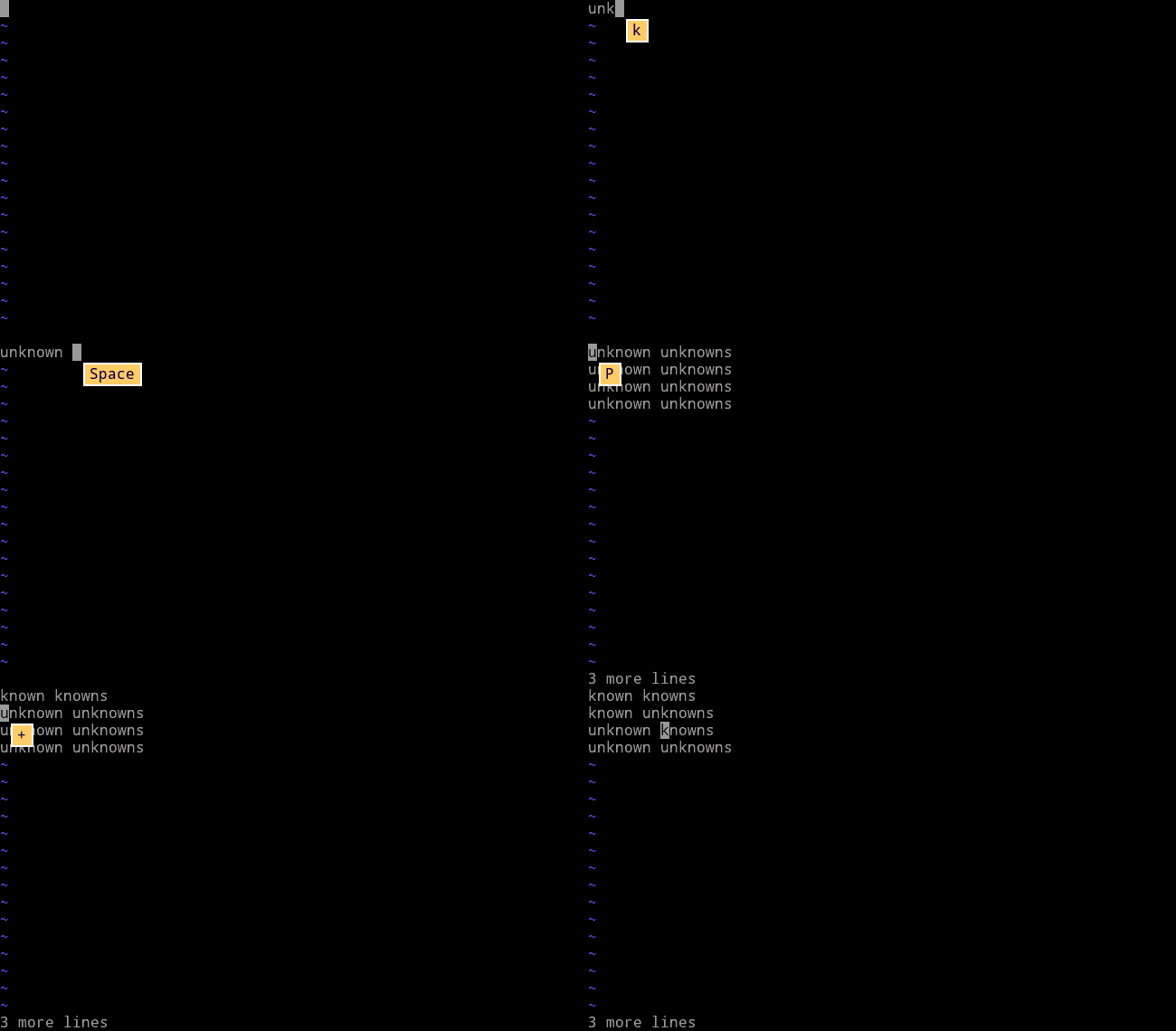
Thank you Lynn for writing the python script to make that fantastic animation.
This can also be run by V Try it Online!
Also 25:
2iknown ␛rsY3pwiun␛+.+.w.
Bash, 60 57 54 52 bytes
b=${a=known}s;echo "$a $b
$a un$b
un$a $b
un$a un$b"
- L3viathan: -3
- Dom Hastings: -3
- manatwork: -2
Thank you guys!
Javascript 66 54 53 50 bytes
_=>` s
 uns
un s
un uns`.replace(/ |s/g,'known$&')
History
- saved 12 bytes thanks to @someone (explicit usage of "un" in the main string)
- saved 1 byte thanks to @ThePirateBay (split..join instead of replace)
- saved 3 bytes thanks to @Neil (better replace())
C (gcc), 79 78 76 bytes
Thanks to @Justin Mariner for golfing one byte!
f(){printf("%s %1$ss\n%1$s un%1$ss\nun%1$s %1$ss\nun%1$s un%1$ss","known");}
Retina, 33 32 bytes
Saved 1 byte using an intermediate printing approach from Leo.
 ¶u

knowns
u
 un
:`s

m`^
un
Explanation
¶u
Turns the non-existent (i.e. empty) input into the string on the second line. That one seems pretty weird, but these characters are codes for the stuff that goes between two instances of known[s] on the first two lines of the result. Space and linefeed are just themselves and u is un.
knowns
Now we insert knowns at every position (i.e. at the beginning, end, and between every pair of characters).
u
 un
We decode the u.
:s
Then we get rid of the ss in front of spaces, i.e. those in the first half of each line, and print the result.
m`^
un
And finally we prepend un to both lines and print the result again.
This beats the trivial approach of just using a placeholder for known by 4 bytes, but not Neil's more efficient implementation of that approach.
Java 8, 56 55 bytes
v->" s\n uns\nun s\nun uns".replaceAll(" |s","known$0")
-1 byte thanks to @SuperChafouin.
Explanation:
v->                         // Method with empty unused parameter
  " s\n uns\nun s\nun uns"  //  Literal String
   .replaceAll(" |s",       //  Replace all spaces and "s" with:
     "known                 //   Literal "known"
           $0")             //   + the match (the space or "s")
                            // End of method (implicit / single-line return-statement)
Husk, 14 bytes
OΠṠemhw¨ṅW∫ḟωμ
Explanation
OΠṠemhw¨ṅW∫ḟωμ
       ¨ṅW∫ḟωμ    The compressed string "knowns unknowns"
      w           Split on spaces ["knowns","unknowns"]
   e              Make a list with:
    mh             this list with the last letter dropped from each word
  Ṡ                and this same list
                  [["known","unknown"],["knowns","unknowns"]]
 Π                Cartesian product [["known","knowns"],["unknown","knowns"],["known","unknowns"],["unknown","unknowns"]]
O                 Sort the list [["known","knowns"],["known","unknowns"],["unknown","knowns"],["unknown","unknowns"]]
                  Implicitely print joining with spaces and newlines
APL (Dyalog), 64 47 35 bytes
⍪,∘.{⍺,' ',⍵,'s'}⍨k('un',k←'known')
How?
k←'known' - k is "known"
k('un',k←'known') - "known" "unknown"
∘....⍨ - outer product with itself
{⍺,' ',⍵,'s'} - with the function that formats the args as {⍺} {⍵}s
, - smash the product table into vector
⍪ - separate to columns
J, 39 bytes
echo@;@,"1//' s'|.@;"0/(;'un',])'known'
Here's another one, that I'll explain instead (53 chars):
;"1((<<<2)&{,],48&A.,:n)({.,' ';n=.'un';])'known';'s'
|
({.,' ';n=.'un';])'known';'s'
Yields ["known", " ", "un", "known", "s"] and defines n that adds "un" in front. Then for each of the 4 lines respectively we
    (<<<2)&{                     Remove "un", the 2nd string
             ]                   Do nothing
               48&A.             Move "un" to the front
                      n          Add "un"
;"1                              Smash the lines.
2,0,1,3,4 is #48 in the alphabetically sorted list of permutations of 0,1,2,3,4. I've no idea how it's implemented.
Haxe, 71 bytes
(?x)->[for(a in x=["","un"])for(b in x)a+'known ${b}knowns'].join("\n")
IBM/Lotus Notes Formula, 78 bytes
@ReplaceSubstring("a as,a bas,ba as,ba bas";"a":"b":",";"known":"un":@Newline)
Not the shortest but actually shorter than just hard coding the strings in @Formula.
Formula language allows lists as the from and to parameters to @ReplaceSubstring. Just a shame that @ReplaceSubstring itself costs 17 bytes and @Newline costs 4 more than "\n".
Python 2, 54 52 bytes
-2 bytes thanks to xnor
k='unknowns'
for i in 8,6,2,0:print k[i/3:7],k[i%3:]
The results from the / and % will be [[2, 2], [2, 0], [0, 2], [0, 0]] that will be the starting indexes, removing the un when 2, keeping the string unaltered when 0
Batch, 66 bytes
@set s= in (known unknown)do @
@for %%a%s%for %%b%s%echo %%a %%bs
Alternative answer, also 66 bytes:
@for %%a in (k unk)do @for %%b in (k unk) do @echo %%anown %%bnowns
V, 25 bytes
Two solutions, both 25 bytes
2iunknowns |exÄwxxäj2xj.
Hexdump:
00000000: 3269 756e 6b6e 6f77 6e73 201b 7c65 78c4  2iunknowns .|ex.
00000010: 7778 78e4 6a32 786a 2e                   wxx.j2xj.
And
2iunknown Äwxxäj2xj.Î$rs
Hexdump:
00000000: 3269 756e 6b6e 6f77 6e20 1bc4 7778 78e4  2iunknown ..wxx.
00000010: 6a32 786a 2ece 2472 73                   j2xj..$rs
Batch, 78 bytes
@set a=known
@echo %a% %a%s&echo %a% un%a%s&echo un%a% %a%s&echo un%a% un%a%s
Quite hard to golf, everything non-trivial I tried so far just makes it longer.
Retina, 33 32 bytes
 s¶ uns¶un s¶un uns
 |s
known$&
Try it online! Edit: Saved 1 byte thanks to @ovs. Explanation: This is almost the trivial approach of using a placeholder for known, except here I simply insert it before each space or s, which saves 3 4 bytes.
Perl 6, 45 bytes
$_='known';.say for [X](($_,"un$_")xx 2)X~'s'
Expanded
$_ = 'known';

.say                # print with trailing newline the value in topic variable 「$_」

  for               # do that for each of the following

    [X](
      ($_, "un$_")  # ('known','unknown')
        xx 2        # list repeated twice
    ) X~ 's'        # cross using &infix:«~» with 's' (adds 「s」 to the end)
The [X](…) part generates
(("known","known"),("known","unknown"),("unknown","known"),("unknown","unknown")).Seq
Then using X~ on it coerces the inner lists into a Str (because of the &infix:«~» operator), which doing so adds a space between values.
("known known", "known unknown", "unknown known", "unknown unknown").Seq
Then each is joined with an s
("known knowns", "known unknowns", "unknown knowns", "unknown unknowns").Seq
CJam (26 25 bytes)
"unknown"_2>\]2m*{S*'sN}%
Cartesian product of ["known" "unknown"] with itself, then each element joined with space and suffixed with s and a newline.
Thanks to Erik for a one-byte saving.
05AB1E, 13 12 bytes
Saved 1 byte thanks to Erik the Outgolfer (avoid closing string)
„Š¢—‚#D's«â»
Explanation
„Š¢—‚           # push the string "known unknown"
     #          # split on spaces
      D         # duplicate
       's«      # append "s" to each
          â     # cartesian product
           »    # join on newline