| Bytes | Lang | Time | Link |
|---|---|---|---|
| 182 | Python3 | 240717T011303Z | Ajax1234 |
| 123 | Haskell | 171001T220213Z | Zgarb |
| 114 | Mathematica | 171003T154731Z | DavidC |
| 207 | Haskell | 170930T204511Z | flawr |
| 024 | Husk | 170930T213242Z | Zgarb |
| 108 | Mathematica | 171001T042355Z | Ben |
| 027 | Jelly | 170930T230803Z | Jonathan |
| 175 | Mathematica | 170930T184733Z | ZaMoC |
Python3, 182 bytes
def f(a,b):
 q,s=[(a,[a])],[]
 for a,c in q:
  if a==b:s+=[c];continue
  q+=[(u,c+[u])for i,j in enumerate(a)if(u:=a[:i]+str(int(not int(j)))+a[i+1:])not in c]
 return max(s,key=len)
Haskell, 141 123 bytes
c(a:b)=(1-a:b):map(a:)(c b)
c _=[]
q#z=[z]:[z:s|w<-c z,notElem w q,s<-(w:q)#w]
x!y=snd$maximum[(p*>x,p)|p<-[x]#x,last p==y]
Uses lists of integers. Try it online!
Explanation
The main function is !, and the auxiliary functions are # and c.
Given a list of bits, c gives all possible ways of flipping one of them, e.g. [0,1,1] -> [[1,1,1],[0,0,1],[0,1,0]].
c(a:b)=        -- c on nonempty list with head a and tail b is
 (1-a:b):      -- the list with negated a tacked to b, then
 map(a:)(c b)  -- c applied recursively to b, with a tacked to each of the results.
c _=[]         -- c on empty list gives an empty list.
The function # takes a list of lists (the "memory") and a list (the "initial bitstring").
It constructs all hypercube paths that begin with the initial element, contain only distinct bitstrings, and do not step on the strings in the memory.
q#z=            -- # on memory q and initial string z is
 [z]:           -- the singleton path [z], and
 [z:s|          -- z tacked to each path s, where
  w<-c z,       -- w is obtained by flipping a bit of z,
  notElem w q,  -- w is not in the memory, and
  s<-(w:q)#w]   -- s is a path starting from w that avoids w and all elements of q.
The main function ! ties it all together.
A trick I use here is p*>x (x repeated length p times) instead of length p.
Since longer repetitions of x come later in the natural ordering of lists, maximum chooses the longest path in either case, since the first coordinates of pairs are compared before the second ones.
x!y=          -- ! on inputs x and y is
 snd$maximum  -- the second element of the maximal pair in
 [(p*>x,p)|   -- the list of pairs (p*>x,p), where
  p<-[x]#x,   -- p is a path starting from x that avoids stepping on x, and
  last p==y]  -- p ends in y.
Mathematica 116 114 bytes
With several bytes saved thanks to Misha Lavrov.
Last@FindPath[Graph[Rule@@@Cases[Tuples[Tuples[{0,1},{l=Length@#}],{2}],x_/;Count[Plus@@x,1]==1]],##,{1,2^l},Alll]&
Input (8 dimensions)
[{1,0,0,1,0,0,0,1},{1,1,0,0,0,0,1,1}]//AbsoluteTiming
Output (length = 254, after 1.82 seconds)
{1.82393, {{1, 0, 0, 1, 0, 0, 0, 1}, {0, 0, 0, 1, 0, 0, 0, 1}, {0, 0, 0, 0, 0, 0, 0, 1}, {0, 0, 0, 0, 0, 0, 0, 0}, {0, 0, 0, 0, 0, 0, 1, 0}, {0, 0,0, 0, 0, 0, 1, 1}, {0, 0, 0, 0, 0, 1, 1, 1}, {0, 0, 0, 0, 0, 1, 0, 1}, {0, 0, 0, 0, 0, 1, 0, 0}, {0, 0, 0, 0, 0, 1, 1, 0}, {0, 0, 0, 0,1, 1, 1,0}, {0, 0, 0, 0, 1, 0, 1, 0}, {0, 0, 0, 0, 1, 0, 0, 0}, {0, 0, 0, 0, 1, 0, 0, 1}, {0, 0, 0, 0, 1, 0, 1, 1}, {0, 0, 0, 0,1, 1, 1, 1}, {0, 0, 0, 0, 1, 1, 0, 1}, {0, 0, 0, 0, 1, 1, 0, 0}, {0, 0, 0, 1, 1, 1, 0, 0}, {0, 0, 0, 1, 0, 1, 0, 0}, {0, 0, 0, 1,0, 0, 0, 0}, {0, 0, 0, 1, 0, 0, 1, 0}, {0, 0, 0, 1, 0, 0, 1, 1}, {0, 0, 0, 1, 0, 1, 1, 1}, {0, 0, 0, 1, 0, 1, 0, 1}, {0, 0, 0, 1, 1, 1, 0, 1}, {0, 0, 0, 1, 1, 0, 0, 1}, {0, 0, 0, 1, 1, 0, 0, 0}, {0, 0, 0, 1, 1, 0, 1, 0}, {0, 0, 0, 1, 1, 0, 1, 1}, {0, 0, 0, 1,1, 1, 1, 1}, {0, 0, 0, 1, 1, 1, 1, 0}, {0, 0, 0, 1, 0, 1, 1, 0}, {0, 0, 1, 1, 0, 1, 1, 0}, {0, 0, 1, 0, 0, 1, 1, 0}, {0, 0, 1, 0,0, 0, 1, 0}, {0, 0, 1, 0, 0, 0, 0, 0}, {0, 0, 1, 0, 0, 0, 0, 1}, {0, 0, 1, 0, 0, 0, 1, 1}, {0, 0, 1, 0, 0, 1, 1, 1}, {0, 0, 1, 0,0, 1, 0, 1}, {0, 0, 1, 0, 0, 1, 0, 0}, {0, 0, 1, 0, 1, 1, 0, 0}, {0, 0, 1, 0, 1, 0, 0, 0}, {0, 0, 1, 0, 1, 0, 0, 1}, {0, 0, 1, 0,1, 0, 1, 1}, {0, 0, 1, 0, 1, 0, 1, 0}, {0, 0, 1, 0, 1, 1, 1, 0}, {0, 0, 1, 0, 1, 1, 1, 1}, {0, 0, 1, 0, 1, 1, 0, 1}, {0, 0, 1, 1,1, 1, 0, 1}, {0, 0, 1, 1, 0, 1, 0, 1}, {0, 0, 1, 1, 0, 0, 0, 1}, {0, 0, 1, 1, 0, 0, 0, 0}, {0, 0, 1, 1, 0, 0, 1, 0}, {0, 0, 1, 1,0, 0, 1, 1}, {0, 0, 1, 1, 0, 1, 1,1}, {0, 0, 1, 1, 1, 1, 1, 1}, {0, 0, 1, 1, 1, 0, 1, 1}, {0, 0, 1, 1, 1, 0, 0, 1}, {0, 0, 1, 1,1, 0, 0, 0}, {0, 0, 1, 1, 1, 0, 1, 0}, {0, 0, 1, 1, 1, 1, 1, 0}, {0, 0, 1, 1, 1, 1, 0, 0}, {0, 0, 1, 1, 0, 1, 0, 0}, {0, 1, 1, 1,0, 1, 0, 0}, {0, 1, 0, 1, 0, 1, 0, 0}, {0, 1, 0, 0, 0, 1, 0, 0}, {0, 1, 0, 0, 0, 0, 0, 0}, {0, 1, 0, 0, 0, 0, 0, 1}, {0, 1, 0, 0,0, 0, 1, 1}, {0, 1, 0, 0, 0, 0, 1, 0}, {0, 1, 0, 0, 0, 1, 1, 0}, {0, 1, 0, 0, 0, 1, 1, 1}, {0, 1, 0, 0, 0, 1, 0, 1}, {0, 1, 0, 0,1, 1, 0, 1}, {0, 1, 0, 0, 1, 0, 0, 1}, {0, 1, 0, 0, 1, 0, 0, 0}, {0, 1, 0, 0, 1, 0, 1, 0}, {0, 1, 0, 0, 1, 0, 1, 1}, {0, 1, 0, 0,1, 1, 1, 1}, {0, 1, 0, 0, 1, 1, 1, 0}, {0, 1, 0, 0, 1, 1, 0,0}, {0, 1, 0, 1, 1, 1, 0, 0}, {0, 1, 0, 1, 1, 0, 0, 0}, {0, 1, 0, 1,0, 0, 0, 0}, {0, 1, 0, 1, 0, 0, 0, 1}, {0, 1, 0, 1, 0, 0, 1, 1}, {0, 1, 0, 1, 0, 0, 1, 0}, {0, 1, 0, 1, 0, 1, 1, 0}, {0, 1, 0, 1,0, 1, 1, 1}, {0, 1, 0, 1, 0, 1, 0, 1}, {0, 1, 0, 1, 1, 1, 0, 1}, {0, 1, 0, 1, 1, 0, 0, 1}, {0, 1, 0, 1, 1, 0, 1, 1}, {0, 1, 0, 1,1, 0, 1, 0}, {0, 1, 0, 1, 1, 1, 1, 0}, {0, 1, 0, 1, 1, 1, 1, 1}, {0, 1, 1, 1, 1, 1, 1, 1}, {0, 1, 1, 0, 1, 1, 1, 1}, {0, 1, 1, 0,0, 1, 1, 1}, {0, 1, 1, 0, 0, 0, 1, 1}, {0, 1, 1, 0, 0, 0, 0, 1}, {0, 1, 1, 0, 0, 0, 0, 0}, {0, 1, 1, 0, 0, 0, 1, 0}, {0, 1, 1, 0,0, 1, 1, 0}, {0, 1, 1, 0, 0, 1, 0, 0}, {0, 1, 1, 0, 0, 1, 0, 1}, {0, 1, 1, 0, 1, 1, 0, 1}, {0, 1, 1, 0, 1, 0, 0, 1}, {0, 1, 1, 0,1, 0, 0, 0}, {0, 1, 1, 0, 1, 0, 1, 0}, {0, 1, 1, 0, 1, 0, 1, 1}, {0, 1, 1, 1, 1, 0, 1, 1}, {0, 1, 1, 1, 0, 0, 1, 1}, {0, 1, 1, 1,0, 0, 0, 1}, {0, 1, 1, 1, 0, 0, 0, 0}, {0, 1, 1, 1, 0, 0, 1, 0}, {0, 1, 1, 1, 0, 1, 1, 0}, {0, 1, 1, 1, 0, 1, 1, 1}, {0, 1, 1, 1,0, 1, 0, 1}, {0, 1, 1, 1, 1, 1, 0, 1}, {0, 1, 1, 1, 1, 0, 0, 1}, {0, 1, 1, 1, 1, 0, 0, 0}, {0, 1, 1, 1, 1, 0, 1, 0}, {0, 1, 1, 1,1, 1, 1, 0}, {0, 1, 1, 0, 1, 1, 1, 0}, {0, 1, 1, 0, 1, 1, 0, 0}, {0, 1, 1, 1, 1, 1, 0, 0}, {1, 1, 1, 1, 1, 1, 0, 0}, {1, 0, 1, 1,1, 1, 0, 0}, {1, 0, 0, 1, 1, 1, 0, 0}, {1, 0, 0, 0, 1, 1, 0, 0}, {1, 0, 0, 0, 0, 1, 0, 0}, {1, 0, 0, 0, 0, 0, 0, 0}, {1, 0, 0, 0,0, 0, 0, 1}, {1, 0, 0, 0, 0, 0, 1, 1}, {1, 0, 0, 0, 0, 0, 1, 0}, {1, 0, 0, 0, 0, 1, 1, 0}, {1, 0, 0, 0, 0, 1, 1, 1}, {1, 0, 0, 0,0, 1, 0, 1}, {1, 0, 0, 0, 1, 1, 0, 1}, {1, 0, 0, 0, 1, 0, 0, 1}, {1, 0, 0, 0, 1, 0, 0, 0}, {1, 0, 0, 0, 1, 0, 1, 0}, {1, 0, 0, 0,1, 0, 1, 1}, {1, 0, 0, 0, 1, 1, 1, 1}, {1, 0, 0, 0, 1, 1, 1, 0}, {1, 0, 0, 1, 1, 1, 1, 0}, {1, 0, 0, 1, 0, 1, 1, 0}, {1, 0, 0, 1,0, 0, 1, 0}, {1, 0, 0, 1, 0, 0, 0, 0}, {1, 0, 0, 1, 0, 1, 0, 0}, {1, 0, 0, 1, 0, 1, 0, 1}, {1, 0, 0, 1, 0, 1, 1, 1}, {1, 0, 0, 1,0, 0, 1, 1}, {1, 0, 0, 1, 1, 0, 1, 1}, {1, 0, 0, 1, 1, 0, 0, 1}, {1, 0, 0, 1, 1, 0, 0, 0}, {1, 0, 0, 1, 1, 0, 1, 0}, {1, 0, 1, 1,1, 0, 1, 0}, {1, 0, 1, 0, 1, 0, 1, 0}, {1, 0, 1, 0, 0, 0, 1, 0}, {1, 0, 1, 0, 0, 0, 0, 0}, {1, 0, 1, 0, 0, 0, 0, 1}, {1, 0, 1, 0,0, 0, 1, 1}, {1, 0, 1, 0, 0, 1, 1, 1}, {1, 0, 1, 0, 0, 1, 0, 1}, {1, 0, 1, 0, 0, 1, 0, 0}, {1, 0, 1, 0, 0, 1, 1, 0}, {1, 0, 1, 0,1, 1, 1, 0}, {1, 0, 1, 0, 1, 1, 0, 0}, {1, 0, 1, 0, 1, 0, 0, 0}, {1, 0, 1, 0, 1, 0, 0, 1}, {1, 0, 1, 0, 1, 0, 1, 1}, {1, 0, 1, 0,1, 1, 1, 1}, {1, 0, 1, 0, 1, 1, 0, 1}, {1, 0, 1, 1, 1, 1, 0, 1}, {1, 0, 0, 1, 1, 1, 0, 1}, {1, 0, 0, 1, 1, 1, 1, 1}, {1, 0, 1, 1,1, 1, 1, 1}, {1, 0, 1, 1, 0, 1, 1, 1}, {1, 0, 1, 1, 0, 0, 1, 1}, {1, 0, 1, 1, 0, 0, 0, 1}, {1, 0, 1, 1, 0, 0, 0, 0}, {1, 0, 1, 1,0, 0, 1, 0}, {1, 0, 1, 1, 0, 1, 1, 0}, {1, 0, 1, 1, 0, 1, 0, 0}, {1, 0, 1, 1, 0, 1, 0, 1}, {1, 1, 1, 1, 0, 1, 0, 1}, {1, 1, 0, 1,0, 1, 0, 1}, {1, 1, 0, 0, 0, 1, 0,1}, {1, 1, 0, 0, 0, 0, 0, 1}, {1, 1, 0, 0, 0, 0, 0, 0}, {1, 1, 0, 0, 0, 0, 1, 0}, {1, 1, 0, 0,0, 1, 1, 0}, {1, 1, 0, 0, 0, 1, 0, 0}, {1, 1, 0, 0, 1, 1, 0, 0}, {1, 1, 0, 0, 1, 0, 0, 0}, {1, 1, 0, 0, 1, 0, 0, 1}, {1, 1, 0, 0,1, 0, 1, 1}, {1, 1, 0, 0, 1, 0, 1, 0}, {1, 1, 0, 0, 1, 1, 1, 0}, {1, 1, 0, 0, 1, 1, 1, 1}, {1, 1, 0, 0, 0, 1, 1, 1}, {1, 1, 0, 1,0, 1, 1, 1}, {1, 1, 0, 1, 0, 0, 1, 1}, {1, 1, 0, 1, 0, 0, 0, 1}, {1, 1, 0, 1, 0, 0, 0, 0}, {1, 1, 0, 1, 0, 0, 1, 0}, {1, 1, 0, 1,0, 1, 1, 0}, {1, 1, 0, 1, 0, 1, 0, 0}, {1, 1, 0, 1, 1, 1, 0, 0}, {1, 1, 0, 1, 1, 0, 0, 0}, {1, 1, 0, 1, 1, 0, 0, 1}, {1, 1, 0, 1,1, 0, 1, 1}, {1, 1, 0, 1, 1, 0, 1, 0}, {1, 1, 0, 1, 1, 1, 1, 0}, {1, 1, 0, 1, 1, 1, 1, 1}, {1, 1, 0, 1, 1, 1, 0, 1}, {1, 1, 0, 0,1, 1, 0, 1}, {1, 1, 1, 0, 1, 1, 0, 1}, {1, 1, 1, 0, 0, 1, 0, 1}, {1, 1, 1, 0, 0, 0, 0, 1}, {1, 1, 1, 0, 0, 0, 0, 0}, {1, 1, 1, 0,0, 0, 1, 0}, {1, 1, 1, 0, 0, 1, 1, 0}, {1, 1, 1, 0, 0, 1, 0, 0}, {1, 1, 1, 0, 1, 1, 0, 0}, {1, 1, 1, 0, 1, 0, 0, 0}, {1, 1, 1, 0,1, 0, 0, 1}, {1, 1, 1, 0, 1, 0, 1, 1}, {1, 1, 1, 0, 1, 0, 1, 0}, {1, 1, 1, 0, 1, 1, 1, 0}, {1, 1, 1, 0, 1, 1, 1, 1}, {1, 1, 1, 0,0, 1, 1, 1}, {1, 1, 1, 1, 0, 1, 1, 1}, {1, 1, 1, 1, 0, 1, 1, 0}, {1, 1, 1, 1, 0, 0, 1, 0}, {1, 1, 1, 1, 0, 0, 0, 0}, {1, 1, 1, 1,0, 0, 0, 1}, {1, 1, 1, 1, 1, 0, 0, 1}, {1, 1, 1, 1, 1, 1, 0, 1}, {1, 1, 1, 1, 1, 1, 1, 1}, {1, 1, 1, 1, 1, 1, 1, 0}, {1, 1, 1, 1,1, 0, 1, 0}, {1, 1, 1, 1, 1, 0, 0, 0}, {1, 0, 1, 1, 1, 0, 0, 0}, {1, 0, 1, 1, 1, 0, 0, 1}, {1, 0, 1, 1, 1, 0, 1, 1}, {1, 1, 1, 1,1, 0, 1, 1}, {1, 1, 1, 1, 0, 0, 1, 1}, {1, 1, 1, 0, 0, 0, 1, 1}, {1, 1, 0, 0, 0, 0, 1, 1}}}
Tuples[{0,1},{l=Length@#}],{2}]& generates the numbers 0...8 as binary lists.
The outer Tuples...{2} produces all ordered pairs of those binary numbers.
Plus@@x sums each of the pairs, generating triplets of 0, 1.
Cases....Count[Plus@@x, 1]==1 returns all of the sums that contain a single 1. These arise when the two original binary numbers are connected by an edge.
Rules connects the vertices of the graph, each vertex being a binary number.
Graph creates a graph corresponding to said vertices and edges.
FindPath finds up to 2^n paths connecting vertex a to vertex b, the given numbers.
Last takes the longest of these paths.
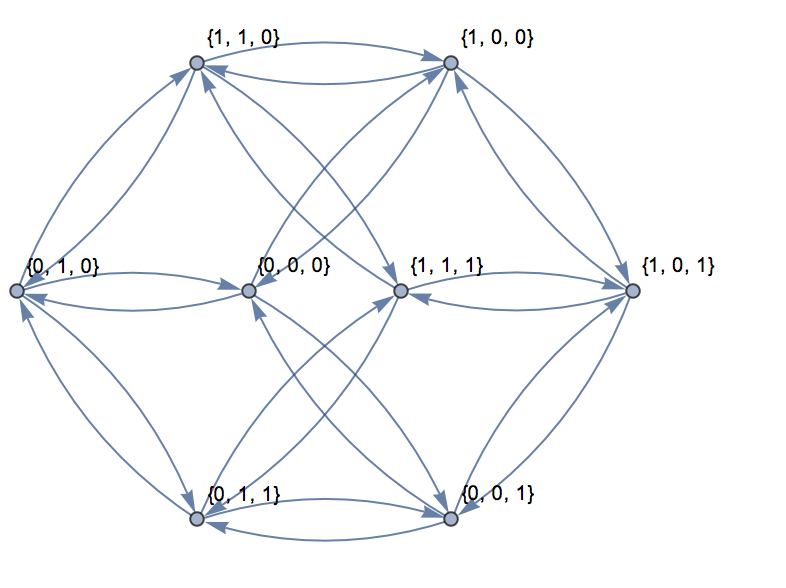
For three dimensions, the graph can be represented in a plane as shown here:
For the input, {0,0,0}, {1,1,1}, the following is output:
{{{0, 0, 0}, {0, 0, 1}, {0, 1, 1}, {0, 1, 0}, {1, 1, 0}, {1, 0,
   0}, {1, 0, 1}, {1, 1, 1}}}
This path can be found in the above graph.
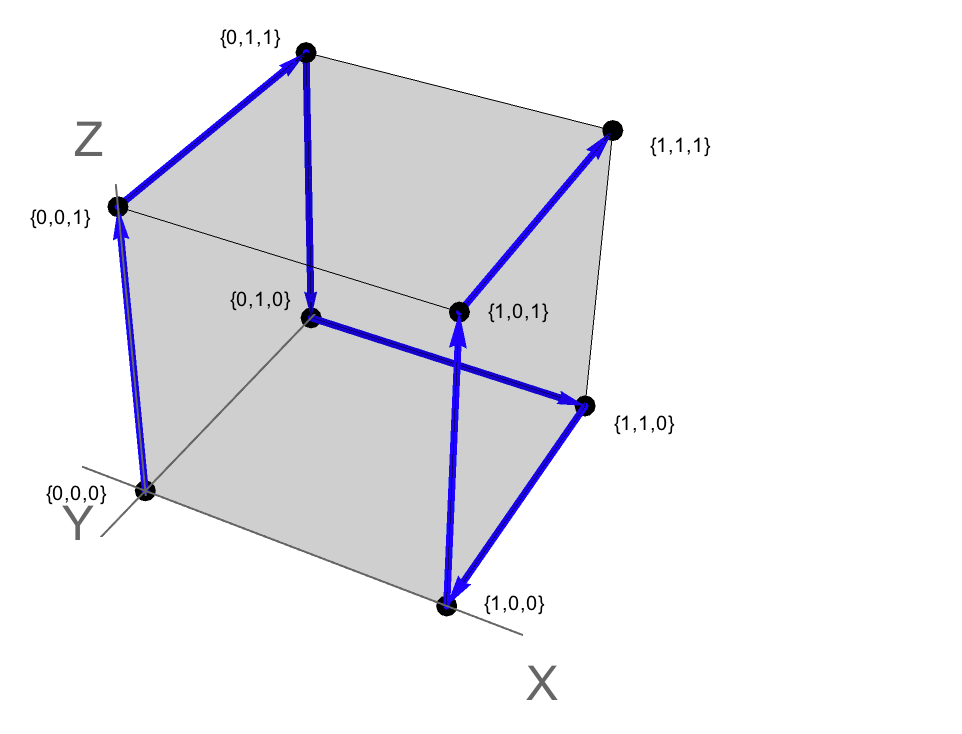
It can also be conceived as the following path in 3-space,
where each vertex corresponds to a point {x,y,z}. {0,0,0} represents the origin and {1,1,1} represents the "opposite" point in a unit cube.
So the solution path corresponds to a traversal of edges along the unit cube. In this case, the path is Hamiltonian: it visits each vertex one time (i.e. with no crossings and no vertices omitted).
Haskell, 212 207 bytes
This is probably way too long, but it finally works now. (Thanks to @Lynn for the cartesian product trick!) Thansk @nimi for -5 bytes!
import Data.List
b%l=[l++[x|b/=last l,x`notElem`l,1==sum[1|(u,v)<-x`zip`last l,u/=v]]|x<-mapM id$[0>1..]<$b]
b!a|f<-nub.concat.((b%)<$>)=snd$maximum$map(length>>=(,))$filter((==b).last)$until(f>>=(==))f[[a]]
Explanation:
b%l -- helper function:
    -- given a path l (that should end in b) this generates all possible extensions
    -- of l (if not possible also l itself)
            x<-mapM id$[0>1..]<$b -- generate all possible vertices of the hypercube
             -- and check the criteria
           b/=last l,x`notElem`l,1==sum[1|(u,v)<-x`zip`last l,u/=v]
             -- extend if possible
    [l++[x|  ...                                                   ]| ... ]
b!a| -- actual function:
     -- first define a helper function:
    f<-nub.concat.((b%)<$>)
     -- begin with the vertex a and apply the function from above repeatedly
     -- until you cannot make the path any longer without violating the
     -- criteria
                                                                             until(f>>=(==))f[[a]]
     -- only take the paths that actually end in b
                                                          filter((==b).last)$
     -- and find the one with the maximum length
                           =snd$maximum$map(length>>=(,))$
Husk, 27 26 24 bytes
→foΛεẊδṁ≠ÖLm↓≠⁰←ġ→PΠmṠe¬
Brute force, so very slow. Try it online!
Explanation
Husk reads naturally from right to left.
←ġ→PΠmṠe¬  Hypercube sequences ending in second input, say y=[1,1,0]
     mṠe¬  Pair each element with its negation: [[0,1],[0,1],[1,0]]
    Π      Cartesian product: [[0,0,1],[1,0,1],..,[1,1,0]]
   P       Permutations.
 ġ→        Group by last element
←          and take first group.
           The permutations are ordered so that those with last element y come first,
           so they are grouped together and returned here.

ÖLm↓≠⁰  Find first input.
  m     For each permutation,
   ↓≠⁰  drop all elements before the first input.
ÖL      Sort by length.

foΛεẊδṁ≠  Check path condition.
fo        Keep those lists that satisfy:
    Ẋ      For each adjacent pair (e.g. [0,1,0] and [1,1,0]),
      ṁ    take sum of
       ≠   absolute differences
     δ     of corresponding elements: 1+0+0 gives 1.
  Λε       Each value is at most 1.

→  Finally, return last element (which has greatest length).
Mathematica, 108 bytes
a=#~FromDigits~2+1&;Last@PadLeft[IntegerDigits[#-1,2]&/@FindPath[HypercubeGraph@Length@#,a@#,a@#2,∞,All]]&
Input:
[{0, 0, 0, 0}, {1, 1, 1, 1}]
Output:
{{0, 0, 0, 0}, {0, 0, 0, 1}, {0, 0, 1, 1}, {0, 0, 1, 0}, {0, 1, 1, 0},
 {0, 1, 0, 0}, {0, 1, 0, 1}, {1, 1, 0, 1}, {1, 0, 0, 1}, {1, 0, 0, 0},
 {1, 1, 0, 0}, {1, 1, 1, 0}, {1, 0, 1, 0}, {1, 0, 1, 1}, {1, 1, 1, 1}}
Jelly, 25 27 bytes
+2 bytes to fix a bug with my golfing :( hopefully I'll find a shorter way though.
ṫi¥³ḣi
L2ṗŒ!瀵ạ2\S€ỊẠ×LµÞṪ
A full program taking the bit-strings using 1 and 2* as lists. The arguments are from and to. The program prints a list of lists of the same.
* 0 and 1 may be used instead at the cost of a byte (add ’ between L2ṗ and Œ!ç€... to decrement).
How?
updating...
ṫi¥³ḣi - Link 1, getSlice: list of lists, bitstrings; list, toBitstring
   ³   - get 3rd command line argument (fromBitstring)
  ¥    - last two links as a dyad:
 i     -   index (of fromBitstring in bitstrings)
ṫ      -   tail (bitstrings) from (that) index
     i - index (of toBitstring in that result)
    ḣ  - head to (that) index

L2ṗŒ!瀵ạ2\S€ỊẠ×LµÞṪ - Main link: list, fromBitstring; list, toBitstring
L                    - length (of fromBitstring)
 2                   - literal two
  ṗ                  - Cartesian power (of implicit range(2)=[1,2] with L(fromBitstring))
                     - ...i.e. all unique bitstrings of the required length (using [1,2])
   Œ!                - all permutations (of that list)
     ç€              - call the last link (1) as a dyad (i.e. f(that, toBitstring))
       µ         µÞ  - sort by the monadic function:
         2\          -   2-wise reduce with:
        ạ            -     absolute difference
           S€        -   sum €ach
             Ị       -   insignificant (vectorises) (abs(z)<=1 - for our purposes it's really just used for z==1 since only positive integers are possible)
              Ạ      -   all truthy? (1 if so 0 otherwise)
                L    -   length
               ×     -   multiply
                   Ṫ - tail (the last one is one of the maximal results)
                     - implicit print
Mathematica, 175 bytes
Nice first question!
(m=#;n=#2;Last@SortBy[(S=Select)[S[Rest@Flatten[Permutations/@Subsets[Tuples[{0,1},(L=Length)@m]],1],First@#==m&&Last@#==n&],Union[EditDistance@@@Partition[#,2,1]]=={1}&],L])&
Input
[{0, 0, 0}, {1, 1, 1}]