| Bytes | Lang | Time | Link |
|---|---|---|---|
| 021 | Dyalog APL | 250903T160538Z | Aaron |
| 055 | R | 250903T133123Z | Giuseppe |
| 036 | Regenerate | 210703T214525Z | DLosc |
| 090 | sed 4.2.2 | 240414T174225Z | guest430 |
| 094 | ><> Fish | 221105T104552Z | mousetai |
| 005 | 05AB1E | 170814T172913Z | Erik the |
| 038 | Regenerate a | 210703T222136Z | DLosc |
| 036 | Vim | 210430T032349Z | DLosc |
| 012 | Vyxal C | 210604T013458Z | emanresu |
| 007 | Canvas | 210429T112133Z | Razetime |
| 097 | Batch | 210429T205635Z | T3RR0R |
| 025 | APL NARS2000 | 200908T175441Z | jimfan |
| 012 | Japt R | 200908T150009Z | Shaggy |
| 047 | PowerShell | 191218T202809Z | mazzy |
| 625 | Shakespeare Programming Language | 170414T134448Z | Maya |
| 027 | GolfScript | 191217T132534Z | Pseudo N |
| 067 | Wren | 191217T065859Z | user8505 |
| 037 | Keg | 191216T234629Z | lyxal |
| 023 | CJam | 170411T160432Z | Martin E |
| 017 | J | 191216T185638Z | Adá |
| 059 | JavaScript ES6 | 170411T155029Z | Shaggy |
| 086 | Excel | 170818T142021Z | Wernisch |
| nan | Perl 5 | 170815T034405Z | Xcali |
| 024 | Pyth | 170814T172106Z | chromati |
| 089 | Rust | 170527T132227Z | bearbear |
| 069 | Common Lisp | 170513T104443Z | user6516 |
| 057 | 8086 machine code | 170421T042622Z | user5434 |
| 024 | Japt | 170420T173612Z | Oliver |
| nan | BrainFlak | 170419T042130Z | 0 |
| 056 | Python 2 | 170411T160455Z | Keerthan |
| 021 | J | 170413T230845Z | ephemien |
| 048 | MUMPS | 170411T213448Z | mumpsimu |
| 005 | Charcoal | 170411T172423Z | fergusq |
| 054 | R | 170412T130418Z | count |
| 014 | Pyke | 170412T172402Z | Blue |
| 099 | GNU sed | 170411T165832Z | Riley |
| 068 | PHP | 170411T165210Z | Jör |
| 081 | REXX | 170412T113559Z | idrougge |
| 015 | V | 170411T152827Z | user4180 |
| 012 | 05AB1E | 170411T171505Z | Magic Oc |
| 048 | PowerShell | 170412T063120Z | Joey |
| 031 | Octave | 170412T044531Z | rahnema1 |
| 052 | Python 2 | 170411T203146Z | xnor |
| 017 | CJam | 170411T203458Z | aditsu q |
| 108 | Batch | 170411T194435Z | Neil |
| 060 | JavaScript ES6 | 170411T194106Z | Neil |
| 4140 | Ruby | 170411T175428Z | Ventero |
| 090 | Lua | 170411T175849Z | Blab |
| 069 | C | 170411T164710Z | Quentin |
| 053 | Python 2 | 170411T164111Z | Dennis |
| 045 | Perl 5 | 170411T161254Z | Dada |
| 073 | JS ES6 | 170411T154225Z | user5882 |
| 013 | Charcoal | 170411T154013Z | user4180 |
| 011 | Jelly | 170411T154726Z | Dennis |
| 011 | MATL | 170411T151755Z | Luis Men |
| 025 | Charcoal | 170411T152221Z | Steadybo |
| 039 | Mathematica | 170411T153553Z | Martin E |
| 065 | Python 2 | 170411T153500Z | math jun |
| 048 | PowerShell | 170411T152723Z | AdmBorkB |
Dyalog APL, 21 bytes
{' +'[1+⍵∊¨⍳,⍨⍵+⍵-1]}
' +'[ ] # Index into this string
⍵+⍵-1 # 2x-1 the input
,⍨ # Make a duplicate of that number
⍳ # Generate indices for that. This makes a matrix of coordinates from [1..x,1..x]
⍵∊¨ # Find where the input number is an element of those coordinate pairs. That will be the middle row and middle column
1+ # Add 1 for indexing's sake
💎
Created with the help of Luminespire.
R, 55 bytes
\(n,y=2*n-1,z=1:y-n)write(c(" ","+")[1+!z%o%z],1,y,,"")
The older R answer doesn't print the output; even if using the newer \ syntax for function, it would be longer than this, something like this
Regenerate, 38 36 bytes
(( {$~1-1}\+
){$~1-1})\+{$~1*2-1}
$1
Explanation
Space is represented by underscore and newline by ¶ for better visibility.
(( {$~1-1}\+¶){$~1-1})\+{$~1*2-1}¶$1
(                    )                Group 1: the section above the center line
 (           )                         Group 2: one line of that section
  _{$~1-1}                              n-1 spaces
          \+¶                           followed by + and newline
              {$~1-1}                  Repeat n-1 times
                      \+{$~1*2-1}     n*2-1 + characters
                                 ¶    followed by newline
                                  $1  Contents of group 1 again
sed 4.2.2, 90 bytes
s/ //
h
H
s/.*/&+&/
tb
:a
p
:b
x
s/\n /\n/
x
ta
y/ /+/
p
x
h
s/\n/+/
t
:c
p
:
x
s/ //
x
tc
almost a quarter of the bytes are just correcting off-by-one errors, but at least it beat the other answer. this problem would be a lot easier if 2, or better yet, 3, was the first required bit.
while their answer builds the solution up inside the pattern space, this one just prints it out line by line while decrementing a unary counter. takes input as unary spaces. accepting decimal gets me 114 bytes.
explanation:
s/ //;h;H                    # delete 1 space, stick in hold space twice
s/.*/&+&/                    # & is the full match, so it becomes 'MATCH+MATCH'
tb;:a;p;:b;x;s/\n /\n/;x;ta  # loop that first decrements the second hold space and then prints that line
y/ /+/;p                     # swap spaces to +s and prints
x;h;s/\n/+/                  # bring in that second hold space and pattern becomes 'MATCH+'
t;:c;p;:;x;s/ //;x;tc        # loop that first decrements the hold space and then prints that line
><> (Fish), 94 bytes
1-:?!/:::?v"+"o~ \
 84*o1-70.\
>.!07$&:&v!?:-1oa/
/+1 *2:~ /
 /ao~";"93p10.
<\!?:-1o"+"
 ;"+"\
Try it online! Animated Version
Explanation
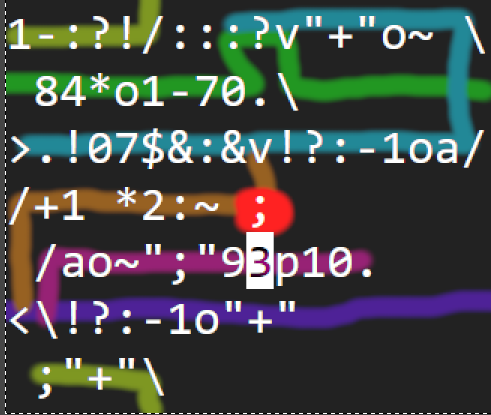
The yellow loop special cases the 1 cross variant to print a + and exit.
The blue loop is the loops over each line. The green loop prints N spaces and the blue loop then prints a "+" at the end of each line.
The orange bypass calculates the length of the row which will have only + signs (2n + 1). Then it will enter the blue-purple loop.
The blue-purple loop prints the plus signs in the middle row. Once the count reaches 0 the mirror isn't skipped anymore so the pink segment is entered.
The pink segment replaces the mirror at 9,3 with a ;. This is the red highlighted semicolon in the picture. Then jumps back to the blue loop. However, this time instead of printing the row of + signs it will exit. (; means exit program in fish)
Regenerate -a, 38 bytes
(({2,$~1} |\+|{2,$~1} )$2{$~1-2}!)\+$1
Takes input as a command-line argument. Try it here!
Explanation
Here, we're going to (ab)use Regenerate's backtracking algorithm. The regex describes several possibilities for a single line, and the -a flag instructs Regenerate to output all possible matches. I'm going to start with a slightly different version that doesn't work for input \$n=1\$, and then discuss how to deal with that corner case afterwards.
Space is represented by underscore for better visibility.
(({2,$~1} |\+|{2,$~1} )$2{$~1-2})\+$1
(                               )      Group 1: the part before the central + character:
                                       either n-1 spaces or n-1 + characters
 (                    )                 Group 2: which character to use
                                         Option 1:
  {2,$~1}                                 Repeat empty string between 2 and n times
                                          (this causes the backtracker to try n-1 different
                                          options, all of them equal to empty string)
         _                                followed by space
          |                              Option 2:
           \+                             + character
             |                           Option 3:
              {2,$~1}_                    Same deal as option 1
                       $2               Group 2 again...
                         {$~1-2}        ... repeated n-2 times, for a total of n-1
                                 \+    The central + character
                                   $1  followed by group 1 again
When backtracking over group 2, Regenerate will try space \$n-1\$ times, then +, then space another \$n-1\$ times. So the list of all possible matches will be \$n-1\$ lines of spaces with a + in the middle, one line of + characters with a + in the middle, and \$n-1\$ more lines of spaces with a + in the middle--exactly the output we want.
There is a problem with \$n=1\$, however. We want group 1 to match the empty string, so that the only possible match for the full regex is +. However, with input of \$1\$, group 1 fails to match. The culprit is $2{$~1-2}, "repeat group 2's contents \$n-2\$ times." It's not possible to repeat something \$-1\$ times, so the whole group fails.
We can get around this failure by providing empty string as another alternative inside group 1. However, using | here raises another issue: we don't want the empty string to be tried if the first alternative succeeded, only if it failed. (Since we're asking for all possible matches, we would get a stray + at the end of the output for \$n>1\$.)
The solution is to use !, a greedy version of |. If its left side matches at all, it takes the left side's match(es) and never tries the right side. It only tries the right side if its left side fails entirely. Thus, our final solution is:
((...)$2{$~1-2}!)\+$1
(               )      Group 1: the part before the central + character
 (...)                  Group 2: same options as before
      $2{$~1-2}         Repeat group 2 again n-2 times
               !        Or, iff that fails because n-2 < 0...
                        Empty string
                 \+    The central + character
                   $1  followed by group 1 again
Vim, 36 bytes
<C-x>D@-i <esc>Y@-pVGy:1s/ /+/g
P:%s/.*/&+&
The byte-count includes a trailing newline. Try it online!
Explanation
<C-x>D
Decrement the input number n and delete it. The deleted text is stored in the "small deletion" register "-.
@-i <esc>
Insert a space "- times.
Y@-p
Yank that line, and then paste it "- times. We now have n lines of n-1 spaces each, with the cursor at the beginning of line 2.
VGy
Select all lines till the end of the file (i.e. n-1 lines, all but the first one) and yank them.
:1s/ /+/g
On line 1, replace each space with a plus sign. This command leaves the cursor on line 1.
P
Paste the previously yanked lines above the current line. We now have n-1 lines of spaces, one line of plus signs, and n-1 more lines of spaces.
:%s/.*/&+&
Replace each line with itself followed by a plus sign followed by itself again.
Batch 97 bytes
requires windows 10 with virtual terminal support
Set x=%~1&cls&@Set/a c=x*2-1
@For /L %%i in (1 1 %c%)Do @Echo(ESC[%%i;%x%H+ESC[%x%;%%iH+ESC[%x%BESC[1G
ESC is the ANSI escape character, which doesn't paste well but can be copied from the raw paste data here.
Or it can be generated by opening the command prompt and typing >"%TEMP%\escape.chr" Echo(ALT+027 then pressing ENTER, or output using a for loop with Echo off:
(For /F "skip=4 DELIMS=" %a in ('Echo(prompt $E^|cmd')Do Echo(%a) >"%TEMP%\escape.chr"
How:
Iterates over the width of the string c and outputs c+ along the the x (y and x) intersection using virtual terminal sequences to move the cursor to the relevant coordinates.
APL (NARS2000), 25 characters:
{' +'[1+∨/¨⍵=∘.,⍨⍳⍵+⍵-1]}
APL (NARS2000), 26 characters:
{' +'[1+∨/¨⍵=∘.,⍨⍳¯1+2×⍵]}
Examples:
      {' +'[1+∨/¨⍵=∘.,⍨⍳⍵+⍵-1]} 1
+
      {' +'[1+∨/¨⍵=∘.,⍨⍳⍵+⍵-1]} 2
 +
+++
 +
      {' +'[1+∨/¨⍵=∘.,⍨⍳⍵+⍵-1]} 3
  +
  +
+++++
  +
  +
      {' +'[1+∨/¨⍵=∘.,⍨⍳⍵+⍵-1]} 4
   +
   +
   +
+++++++
   +
   +
   +
Rationale:
Take n = 4 as example. Objective is to generate an integer matrix as below:
1 1 1 2 1 1 1
1 1 1 2 1 1 1
1 1 1 2 1 1 1
2 2 2 2 2 2 2
1 1 1 2 1 1 1
1 1 1 2 1 1 1
1 1 1 2 1 1 1
Expression ⍵=∘.,⍨⍳⍵+⍵-1, when given ⍵ = 4, generates matrix of 2-tuple from integer vector 1..7:
 0 0  0 0  0 0  0 1  0 0  0 0  0 0
 0 0  0 0  0 0  0 1  0 0  0 0  0 0
 0 0  0 0  0 0  0 1  0 0  0 0  0 0
 1 0  1 0  1 0  1 1  1 0  1 0  1 0
 0 0  0 0  0 0  0 1  0 0  0 0  0 0
 0 0  0 0  0 0  0 1  0 0  0 0  0 0
 0 0  0 0  0 0  0 1  0 0  0 0  0 0
Each cell is reduced by logical-or ∨/¨ to give boolean matrix:
0 0 0 1 0 0 0
0 0 0 1 0 0 0
0 0 0 1 0 0 0
1 1 1 1 1 1 1
0 0 0 1 0 0 0
0 0 0 1 0 0 0
0 0 0 1 0 0 0
Add 1 to this matrix and we have the desired array-indexing matrix.
PowerShell, 47 bytes
param($n)($x=,(' '*--$n+'+')*$n)
'+'+'++'*$n
$x
Shakespeare Programming Language, 749 743 666 625 bytes
N.Puck,.Page,.Ford,.Ajax,.Act I:.Scene I:.[Enter Puck and Ford]Puck:Listen tothy!Ford:You is the difference betweena cat I.Scene V:.[Exeunt][Enter Page and Ajax]Ajax:You is the difference betweena cat Ford.Scene X:.Page:You is the product ofPuck I.Is you as big as zero?If soyou is the sum oftwice the sum oftwice twice the sum ofa big big cat a cat a cat a cat.If notyou big big big big big cat.Speak thy!Ajax:You is the sum ofyou a cat.Is you worse Ford?If soLet usScene X.Page:You is twice the sum ofa big big cat a cat.Speak thy![Exit Page][Enter Puck]Ajax:You is the sum ofyou a cat.Is you worse Ford?If soLet usScene V.
With added newlines:
N.
Puck,.
Page,.
Ford,.
Ajax,.
Act I:.
Scene I:.
[Enter Puck and Ford]
Puck:Listen tothy!
Ford:You is the difference betweena cat I.
Scene V:.
[Exeunt]
[Enter Page and Ajax]
Ajax:You is the difference betweena cat Ford.
Scene X:.
Page:You is the product ofPuck I.Is you as big as zero?
If soYou is the sum ofTwice the sum ofTwice twice the sum ofA big big cat a cat a cat a cat.
If notyou big big big big big cat.Speak thy!
Ajax:You is the sum ofyou a cat.Is you worse Ford?If soLet usScene X.
Page:You is twice the sum ofa big big cat a cat.Speak thy!
[Exit Page]
[Enter Puck]
Ajax:You is the sum ofyou a cat.Is you worse Ford?If soLet usScene V.
Golfed 6 bytes because scene numbers don't have to be consecutive. Golfed some more bytes by applying the tips in the new answers to the Shakespeare tips question, though these golfs aren't reflected in the explanation.
(Slightly outdated) explaination
SPL is an esolang designed to look like Shakespeare plays. Positive nouns have the value of 1 (here cat is used) and negative nouns have the value of -1 (none were used but pig is one of them). Adjectives modify a constant by multiplying it by 2.
N.
Everything until the first dot is the title and doesn't matter.
Puck,.                           row counter
Page,.                           column counter
Ford,.                           input
Ajax,.                           temp
The characters are integer variables, each of them also has a stack but I did not need to use that feature.
Act I:.
Scene I:.
Acts and scenes are used as goto labels
[Enter Puck and Ford]
It's only useful if exactly two characters are on the stage at the same time.
Puck:Listen to thy heart!
Reads a number and makes Ford remember it.
Ford:You is the difference between a cat and I.
As you can see Engrish is valid in SPL. This makes Puck's value "the different between a cat and I". But what does it mean? cat is a positive noun, so it's Puck = 1 - Ford.
Scene II:.
[Exeunt]
Exeunt is just a plural of "exit", and without arguments means that everyone on the stage exits.
[Enter Page and Ajax]
Ajax:You is the difference between a cat and Ford.
It's also Page = 1 - Ford but it's spoken by a different actor so I would be wrong. Since it's a loop, I can't just copy the value of Puck.
Scene III:.
Page:You is the product of Puck and I.
Pretty straightforward by now. Ajax = Puck * Page.
Is you as big as zero?
"as [adj] as" is the == operator.
If so,you is the sum of the sum of the sum of a big big big big big cat and a big big big cat and a big cat and a cat.
If Ajax == 0... "cat" is 1, "big cat" is 2, "big big cat" is 4 and so on. After substituting the simple constants we get "the sum of the sum of the sum of 32 and 8 and 2 and 1" -> "the sum of the sum of 40 and 2 and 1" -> "the sum of 42 and 1" -> "43", which is the ASCII for +.
If not,you fat fat fat fat fat cat.
else it's just "fat fat fat fat fat cat", so Ajax gets the value of 32, the ASCII for a space.
Speak thy mind!
This is the command for outputting a character.
Ajax:
You sum you and cat.Is you as big as Ford?If not,let us return to Scene III.
This is a loop construct. "You sum you and cat" increments Page, and if(Page != Ford) goto Scene III. The rest of the program uses the same components, so here is a more readable pseudocode version:
Scene1:
    input = [input number];
    row = 0 - input + 1;
Scene2:
    col = 0 - input + 1;
Scene3:
    temp = row * col;
    if(temp == 0){
        temp = '+';
    }else{
        temp = ' ';
    }

    putchar(temp);
    Page = Page + 1;
    if(Page != Ford) goto Scene3;
    Ajax = 10;
    putchar(Ajax);
    Puck = Puck + 1;
    if(Puck != Ford) goto Scene2;
GolfScript, 27 bytes
~.(." "*"+"n++*.@2*("+"*n+\
Explanation and Example Execution:
                              # Input: 3
~.(.                          # Eval input, duplicate twice, decrement duplicates
                              # Stack: 3 2 2
    " "*                      # That many spaces
                              # Stack: 3 2 "  "
        "+"n++                # Followed by a + and a newline
                              # Stack: 3 2 "  +\n"
              *.              # Create n of those strings and duplicate it
                              # Stack: 3 "  +\n  +\n" "  +\n  +\n"
                @2*(          # Pull bottom to top, double it, decrement
                              # Stack: "  +\n  +\n" "  +\n  +\n" 5
                    "+"*n+    # That many +s followed by a newline
                              # Stack: "  +\n  +\n" "  +\n  +\n" "+++++\n"
                          \   # Swap last 2 items and implicityly print
                              # Stack: "  +\n  +\n" "+++++\n" "  +\n  +\n"
Wren, 67 bytes
Fn.new{|n|(1...2*n).map{|i|i==n?"+"*(n+~-n):" "*~-n+"+"}.join("
")}
Explanation
Fn.new{|n|                                                      // New anonymous function with parameter n
          (1...2*n).map{|i|                                     // Foreach 1 -> 2n-1:
                           i==n?                                // If i equals n:
                                "+"*(n+~-n)                     // Return "+" 2n-1 times
                                           :" "*~-n             // Otherwise return space n-1 times
                                                   +"+"         // Add a trailing "+"
                                                       }.join("
")}                                                             // Join with newline
Keg, 39 37 bytes
;(:|:⑬*,\+,
,):⑨⑵;`+`*,
,(:|:⑬*,\+,
,
-2 bytes using built-ins
This attempt prints the isolated +s first, then the big row of +s then the final isolated +s.
CJam, 23 bytes
ri_(S*'++a\2*(*_z..e>N*
Explanation
This feels a bit suboptimal, but the idea is to superimpose the following two grids:
  +
  +
  +
  +
  +
+++++
Which gives the desired result.
ri    e# Read input and convert to integer N.
_(    e# Duplicate and decrement.
S*    e# Get a string of N-1 spaces (indentation of the vertical bar).
'++   e# Append a + (the vertical bar).
a     e# Wrap the line in an array.
\2*(  e# Swap with the other copy of N and compute 2N-1.
*     e# Repeat the line that many times.
_z    e# Duplicate the grid and transpose it.
..e>  e# Pairwise maximum between the two grids. This superimposes them.
N*    e# Join with linefeeds.
J, 17 bytes
Anonymous tacit prefix function
' +'{~0=*/~@i:@<:
For example for 3:
<: decrement; 2
i: steps; [-2,-1,0,1,2]
*/~ times table; [[4,2,0,-2,-4],[2,1,0,-1,-2],[0,0,0,0,0],[-2,-1,0,1,2],[-4,-2,0,2,4]]
0= indicate where zero; [[0,0,1,0,0],[0,0,1,0,0],[1,1,1,1,1],[0,0,1,0,0],[0,0,1,0,0]]
" +"{~ use that to index into " +"; [" + "," + ","+++++"," + "," + "]
JavaScript (ES6), 67 65 63 60 59 bytes
x=>(v=(` `[r=`repeat`](--x)+`+
`)[r](x))+`+`[r](x*2)+`+
`+v;
- 2 bytes saved by replacing two occurrences of
x-1, the first with--xand the second withx. - 2 bytes saved thanks to Kritixi Lithos, replacing
"\n"with`[newline]`. - 3 bytes saved thanks to user2428118, finally helping me to figure out a way to alias the
repeatin a way that reduced the size. (With honourable mention to Marie for her efforts, too) - 1 byte saved indirectly thanks to Herman.
Try It
f=
x=>(v=(` `[r=`repeat`](--x)+`+
`)[r](x))+`+`[r](x*2)+`+
`+v;
oninput=_=>o.innerText=f(+i.value)
o.innerText=f(i.value=3)
<input id=i min=1 type=number><pre id=o>Excel, 86 bytes
=REPT(REPT(" ",A1-1)&"+
",A1-1)&REPT("+",2*A1-1)&"
"&REPT(REPT(" ",A1-1)&"+
",A1-1)
Perl 5, 43 + 1 (-n) = 44 bytes
$,="+
";say@q=($"x--$_)x$_,'+'x(2*$_),@q,''
Independently came up with pretty much the same method as @Dada, but got it down by 1 byte.
Rust, 89 bytes
|n|{for i in 1..2*n{if i==n{println!("{:+^1$}","",2*n-1)}else{println!("{:>1$}","+",n)}}}
Common Lisp, SBCL, 69 bytes
(format t"~@?~@?~@?+
~@*~@?""~v@{~:*~v@t+
~}"(1-(read))"~1@*~v@{+~}")
Explanation
format        ;printing function
~@?           ;execute current argument as format string
~@*           ;go to first argument in list, to reuse "~v@{~:*~v@t+
              ;~}"
~v@{~}        ;loop n times, where n is current argument
~:*           ;go back one argument - to reuse (1-(read))
~v@t          ;add n spaces where n is current argument
              ;if we were sure that we start on new line we could
              ;use ~vt, which moves to nth column
(1-(read))    ;take input and subtract 1 from it
~1@*          ;move to second argument, to reuse (1-(read))

"~@?~@?~@?+   ;main format string - calls others
~@*~@?"       ;prints one "+" and one newline
"~v@{~:*~v@t+ ;outputting input-1 lines of "+"s
~}"           ;preceded by correct amount of spaces
"~1@*~v@{+~}" ;outputting input-1 pluses. We do it two times
              ;and then add one + at the end. This way there
              ;is no need for argument like: (1-(* 2 INPUT))
              ;which would make me need a variable keeping INPUT
Ideas for improvement are welcomed.
8086 machine code, 57 bytes
00000000  a0 82 00 24 cf 98 48 89  c1 b4 4c e3 20 bf 39 01  |...$..H...L. .9.|
00000010  57 51 5a 52 51 b0 20 89  d1 f3 aa b8 2b 0a ab 59  |WQZRQ. .....+..Y|
00000020  e2 f2 c6 05 24 59 01 c9  b4 09 5a cd 21 41 b0 2b  |....$Y....Z.!A.+|
00000030  cd 29 e2 fa 4a cd 21 c3  0a                       |.)..J.!..|
00000039
Takes a number (one digit...) as command line argument.
How it works:
            |   use16
a0 82 00    |       mov al, byte [0x82]
24 cf       |       and al, not 0x30
98          |       cbw
48          |       dec ax
89 c1       |       mov cx, ax
b4 4c       |       mov ah, 0x4c
e3 20       |       jcxz a
bf 39 01    |       mov di, s+1
57          |       push di
51          |       push cx
5a          |       pop dx
52          |       push dx
51          |   @@: push cx
b0 20       |       mov al, ' '
89 d1       |       mov cx, dx
f3 aa       |       rep stosb
b8 2b 0a    |       mov ax, 0x0a2b
ab          |       stosw
59          |       pop cx
e2 f2       |       loop @b
c6 05 24    |       mov byte [di], 0x24
59          |       pop cx
01 c9       |       add cx, cx
b4 09       |       mov ah, 0x09
5a          |       pop dx
cd 21       |       int 0x21
41          |   a:  inc cx
b0 2b       |   @@: mov al, '+'
cd 29       |       int 0x29
e2 fa       |       loop @b
4a          |       dec dx
cd 21       |       int 0x21
c3          |       ret
0a          |   s db 0x0a
Japt, 30 26 24 bytes
23 bytes of code, +1 for the -R flag.
Saved 4 bytes thanks to @ETHproductions!
V=U+´UVǦU?SpU +'+:'+pV
Brain-Flak, 216 + 1 = 217 bytes
+1 bytes from the -A flag
([{}]())(()()){<>(((((()()()()()){})){}()){}())<>(({}[()])<({}<(({})){({}()<(({}<<>(({}<(({})<>)>)<>)<>>)<{({}()<(((((()()){}){}){}){})>)}{}>)>)}{}>){(<{}(({}<<>({}<({}<>)>)>)<(({}){}){({}()<(({}))>)}{}>)>)}{}>)}{}{}
Explanation to come
Python 2, 60,56 bytes
n=input()-1
z=(' '*n+'+\n')*n
print z+'+'*(2*n+1)+'\n'+z
- -4 bytes - thanks to math junkie!
J, 21 bytes
' +'{~+./~(0=}.,])i.n
MUMPS, 48 50 53 bytes
F i=1-n:1:n-1 W ! F j=1-n:1:n-1 W $C(i&j*-11+43)
R, 54 bytes
Shaving off 7 bytes thanks to @Jarko Dubbeldam:
function(n){a=matrix("",y<-n*2-1,y);a[n,]=a[,n]="x";a}
previous answer:
f=function(n){a=matrix("",n*2-1,n*2-1);a[n,]="x";a[,n]="x";a}
GNU sed, 104 99 bytes
-5 thanks to seshoumara
Includes +1 for -r
s/1//;h;:;s/(.*)1/ \12/;t;s/( *2)2(2*)/\1\n\1\2/
t;G;s/1+/&&1/;s/(.*)(\n1*)/&\n\1/;/1/!c+
y/12/++/
Takes input in unary.
s/1//                    # Subtract 1 from input
h                        # Hold onto input
:                        # Start loop
s/(.*)1/ \12/            #   Remove a 1, prepend a space, and append a 2
t                        # Loop until all 1s are 2s
                         # Start Loop (uses the previous label)
s/( *2)2(2*)/\1\n\1\2/   #   Shift all but the first 2 from the last line to a new line
                         #   E.g.  "  2"      "  2"
                         #         "  222" -> "  2"
                         #                    "  22"
t                        # Loop until all 2s are on their own line
G                        # Append a newline and input
s/1+/&&1/                # Double the number of 1s and append an extra
s/(.*)(\n1*)/&\n\1/      # Copy all of the lines with 2s to the end
/1/!c+                   # If there aren't any 1s print a '+'
y/12/++/                 # Convert all 1s and 2s to +s
PHP, 68 Bytes
for(;$i<$c=-1+2*$m=$argn;)echo"\n".str_pad("+",$c," +"[$m==++$i],2);
83 Bytes
for(;$i<($c=($n=$argn)*2-1)**2;)echo$i%$c?"":"\n".!++$k," +"[$k==$n|$i++%$c==$n-1];
REXX, 81 bytes
arg a
b=a*2-1
do i=1 to b
  if i=a then say copies('+',b)
  else say right('+',a)
  end
PowerShell, 48
Doesn't seem to get shorter than that (and pretty much the same approach as the other solution):
($a=,(' '*($n="$args"-1)+'+')*$n)
'+'+'++'*$n
$a
or
($a=(' '*($n="$args"-1)+'+
')*$n)+'++'*$n+"+
$a"
Octave, 36 31 bytes
Inspired by @LuisMendo 's MATL answer.
@(n)' +'(((a=1:n*2-1==n)|a')+1)
Previous answer:
@(n)' +'(1+((a=padarray(1,n-1))|a'))
Python 2, 52 bytes
n=input()-1
p=(' '*n+'+\n')*n
print p+'++'*n+'+\n'+p
A 53-byte alternative (TIO):
n=input()-1
for c in' '*n+'+'+' '*n:print c*n+'+'+c*n
CJam, 17
ri(S*_]'+*_ffe>N*
Explanation:
ri(      read n, convert to int and decrement
S*       make a string of n-1 spaces
_]       duplicate it and put the 2 strings in an array
'+*_     join the strings with a '+' and duplicate the result
ffe>     for each pair of characters from the 2 (identical) strings,
          get the larger character (results in a matrix)
N*       join the rows with newlines
Batch, 108 bytes
@set p=+
@set l=@for /l %%i in (2,1,%1)do @
%l%call set p= %%p%%
%l%echo %p%
@echo %p: =+%
%l%echo %p%
Note: Line 3 ends in a space.
JavaScript (ES6), 60 bytes
f=
n=>(r=([s,t])=>(s=s.repeat(n-1))+t+s+`
`)([r(` +`),r(`++`)])
<input type=number min=1 oninput=o.textContent=f(this.value)><pre id=o>Outputs two trailing newlines. Alternative formulation, also 60 bytes:
n=>(r=a=>(s=a[0].repeat(n-1))+a[1]+s+`
`)([r(` +`),r(`++`)])
Lua 113, 90 bytes
r,w,p=string.rep,io.read(),io.write;s=r(' ',w-1)p(r(s..'+'..'\n',w-1))p(r('+',w*2-1)..'\n')p(r(s..'+'..'\n',w-1))
r,w=string.rep,io.read()d=w*2-1;for a=1,d do print(a~=w and r(' ',w-1)..'+'or r('+',d))end
C, 69 bytes
Not very interesting... Loops over the square, printing out the appropriate character.
r,c;f(n){for(r=-n;++r<n;puts(""))for(c=-n;++c<n;putchar(r*c?32:43));}
Perl 5, 45 bytes
44 bytes of code + -p flag.
$_=join"+
",@%=($"x--$_)x$_,"+"x($_*2),@%,""
Some similar (but still different) approaches:
48 bytes (47+-p):
$_=join"+"x($_*2-1).$/,(~~($"x--$_."+\n")x$_)x2
50 bytes (49+-n):
$,="+"x($_*2-1).$/;print+(~~($"x--$_."+\n")x$_)x2
JS (ES6), 88 74 73 bytes
x=>(x--,y=y=>(" ".repeat(x)+`+
`).repeat(x),y``+"+".repeat(x+x+1)+"\n"+y``)
Probably can be golfed more.
Snippetify(x=>(x--,y=y=>(" ".repeat(x)+`+
`).repeat(x),y``+"+".repeat(x+x+1)+"\n"+y``))
<script src="https://programmer5000.com/snippetify.min.js"></script>
<input type = "number">
<pre data-output></pre>Charcoal, 16 13 bytes
Nα×+α←↑×+α‖O↘
Uses a different approach from the other Charcoal answer.
Explanation
Nα                       # Take input and store it in variable α
×+α                       # α times write a +
←                         # Go left
↑×+α                      # α times write a + upwards
Now the top left corner is complete, it will look something like this:
  +
  +
+++

‖O↘                      # Reflect-overlap it in a SE direction
The last step is the key to this program, it uses the top-left part of the plus to generate the rest of the plus by reflecting it in the southeast direction (rightwards and downwards).
MATL, 11 bytes
tZv=&+g43*c
Explanation with example
Consider n = 3.
t     % Implicitly input n. Duplicate
      % STACK: 3, 3
Zv    % Symmetric range
      % STACK: 3, [1 2 3 2 1]
=     % Equal, element-wise
      % STACK: [0 0 1 0 0]
&+    % All pair-wise additions. Gives a 2D array
      % STACK: [0 0 1 0 0;
                0 0 1 0 0;
                1 1 2 1 1;
                0 0 1 0 0;
                0 0 1 0 0]
g     % Logical: convert non-zero to one
      % STACK: [0 0 1 0 0;
                0 0 1 0 0;
                1 1 1 1 1;
                0 0 1 0 0;
                0 0 1 0 0]
43*   % Multiply by 43 (ASCII for '+'), element-wise
      % STACK: [ 0  0 43  0  0;
                 0  0 43  0  0;
                43 43 43 43 43;
                 0  0 43  0  0;
                 0  0 43  0  0]
c     % Convert to char. Char 0 is displayed as space. Implicitly display.
      % STACK: ['  +  ';
                '  +  ';
                '+++++';
                '  +  ';
                '  +  ']
Charcoal, 26 25 bytes
NηA⁻η¹η××η²+P+Mη↙G↑⁺¹×η²+
Explanation:
Nη                   // Take the size as input.
A⁻η¹η                // Set η to η-1.
××η²+                // Print '+' η*2 times.
P+                   // Print '+'
Mη↙                 // Move η steps down to the left.
G↑⁺¹×η²+            // Print '+' η*2+1 times upwards from current position.
Mathematica, 39 bytes
Print@@@(CrossMatrix[#-1]"+"/. 0->" ")&
CrossMatrix is a built-in that generates a matrix of the required shape with 1s instead of +s and 0s instead of spaces. If we multiply that matrix by "+", that replaces the 1s with +s while leaving the 0s unchanged (obviously... 0*x = 0 and 1*x = x, right?). Then we replace the zeros manually with spaces using /. 0->" ". Finally, we print each line of the matrix with Print@@@(...).
PowerShell, 48 bytes
param($n)($x=,(" "*--$n+"+")*$n);'+'*(1+2*$n);$x
Takes input $n. Starts by constructing a string of --$n spaces, concatenated with +. That's converted into an array using the comma operator, (newly-decremented) $n times. That array is stored in $x and encapsulated in parens to place a copy on the pipeline.
We then do the middle section, which is + string multiplied out the appropriate number of times. That's left on the pipeline. Finally, we put $x on the pipeline again.
Those are all left on the pipeline at program completion, and the implicit Write-Output inserts a newline between elements.