| Bytes | Lang | Time | Link |
|---|---|---|---|
| 106 | Pure bash | 250622T063810Z | F. Hauri |
| 007 | Perl 5 p | 250622T053648Z | Xcali |
| 005 | Juby | 250621T163003Z | Jordan |
| nan | 250621T001455Z | RARE Kpo | |
| 001 | Thunno 2 | 230607T075315Z | The Thon |
| nan | 230219T153625Z | The Thon | |
| 040 | Pascal | 230219T001743Z | Kai Burg |
| 001 | Pyt | 230218T224010Z | Kip the |
| 005 | Factor | 221003T210722Z | chunes |
| 006 | Kotlin | 221003T161754Z | Seggan |
| nan | 221003T152305Z | bigyihsu | |
| 001 | Vyxal | 221003T132604Z | pacman25 |
| 100 | HODOR | 170403T213309Z | caird co |
| 031 | NO! | 170402T004055Z | caird co |
| 003 | MATL | 170330T175658Z | Suever |
| 015 | Rogex | 200121T045706Z | lyxal |
| 003 | W | 200120T230405Z | user8505 |
| 001 | Keg | 190915T051822Z | user8505 |
| 016 | SenseTalk | 180322T020429Z | Allen Fi |
| 007 | AWK | 170405T141908Z | Robert B |
| 048 | KoopaScript | 180318T153127Z | Jhynjhir |
| 015 | Bash | 170423T033107Z | Graviton |
| 003 | Julia | 170330T180751Z | Uriel |
| 004 | Attache | 180201T181009Z | Conor O& |
| 1420 | OIL | 170331T192215Z | L3viatha |
| 003 | Aceto 1.0 | 170410T102958Z | L3viatha |
| 003 | ARBLE | 171019T044922Z | ATaco |
| 001 | Common Lisp | 171019T042214Z | ceilingc |
| 009 | Groovy | 170525T200633Z | Magic Oc |
| 001 | APL | 170330T182137Z | Uriel |
| 005 | Cheddar | 170330T185543Z | Conor O& |
| 004 | 8087 machine code | 170420T042319Z | user5434 |
| 007 | Perl 5 | 170419T060713Z | msh210 |
| nan | Batch | 170409T080538Z | stevefes |
| 011 | Jelly | 170418T175047Z | fireflam |
| 001 | Convex | 170418T025157Z | GamrCorp |
| 079 | Fourier NonCompeting | 170417T182002Z | Beta Dec |
| 024 | PHP | 170417T221438Z | dv02 |
| 057 | Axiom | 170417T135503Z | user5898 |
| 004 | Haskell | 170417T133618Z | Enderper |
| 006 | CGL CGL Golfing Language | 170414T202646Z | user5882 |
| nan | BrainFlak | 170331T002852Z | Wheat Wi |
| nan | sed | 170401T183558Z | user4180 |
| 025 | Python 2.7 | 170409T071437Z | Koishore |
| 002 | Pyth | 170330T180429Z | NoOneIsH |
| nan | GNU sed | 170406T123649Z | seshouma |
| 008 | JavaScriptES7 | 170402T045841Z | Matthew |
| 012 | REXX | 170405T121133Z | idrougge |
| 006 | Javascript ES6 | 170330T175702Z | fəˈnɛtɪk |
| 012 | C | 170330T180615Z | Steadybo |
| 007 | Racket | 170402T044323Z | rnso |
| 012 | Bash + bc | 170402T043147Z | Christop |
| 011 | Emacs Lisp | 170402T042815Z | Christop |
| 002 | TIBasic TI84 Plus CE | 170331T021256Z | pizzapan |
| 091 | Retina | 170331T070455Z | Martin E |
| 056 | LOLCODE | 170330T203151Z | DJMcMayh |
| 007 | Elixir | 170331T194549Z | adrianmp |
| 006 | C# | 170331T055701Z | adrianmp |
| 010 | bc | 170331T124347Z | Max Mikh |
| 015 | Scala | 170331T083650Z | Stefan A |
| 012 | OCaml | 170331T154420Z | Redouane |
| 001 | Noodel | 170331T151632Z | tkellehe |
| 024 | C++ lambda function | 170331T124644Z | jdt |
| 002 | TIBasic | 170331T123241Z | Timtech |
| 008 | Vim | 170330T182106Z | DJMcMayh |
| 029 | Java 7 | 170331T083429Z | peech |
| 008 | R | 170331T075520Z | Rudier |
| 006 | dc | 170330T183810Z | seshouma |
| 007 | Excel VBA | 170331T015619Z | Taylor R |
| 467 | Taxi | 170330T193137Z | Erik the |
| 002 | Brachylog | 170331T070400Z | Fatalize |
| 011 | PHP | 170331T063108Z | Christop |
| 005 | Dyvil | 170331T052027Z | Clashsof |
| 011 | Racket | 170331T042509Z | assefama |
| nan | 170331T034509Z | Brad Gil | |
| 003 | Scala | 170331T011440Z | Brian Mc |
| 001 | Actually | 170330T180140Z | quintopi |
| 005 | x86_64 Linux machine language | 170330T202529Z | ceilingc |
| 004 | Haskell | 170330T202957Z | flawr |
| 001 | J | 170330T181227Z | xenia |
| 003 | Forth | 170330T201836Z | mbomb007 |
| 013 | ZX Spectrum BASIC | 170330T201358Z | Neil |
| 3320 | JSFuck | 170330T185152Z | powelles |
| 005 | yup | 170330T194534Z | Conor O& |
| 005 | QBIC | 170330T194354Z | steenber |
| 004 | Gol><> | 170330T193643Z | Erik the |
| 030 | C | 170330T180725Z | anna328p |
| 006 | Bean | 170330T181432Z | Patrick |
| 002 | Japt | 170330T184240Z | ETHprodu |
| 010 | Python 2 | 170330T183212Z | Dennis |
| 001 | Jelly | 170330T182825Z | Dennis |
| 004 | Mathematica | 170330T175937Z | Martin E |
| 004 | Mathics | 170330T181908Z | Pavel |
| 023 | Fortran 95 | 170330T180932Z | Steadybo |
| 003 | Jellyfish | 170330T180926Z | Martin E |
| 012 | Python | 170330T175538Z | xenia |
| 003 | Quetzalcoatl | 170330T180106Z | NoOneIsH |
| 004 | MATLAB / Octave | 170330T180036Z | Suever |
| 006 | Java 8 | 170330T175907Z | xenia |
| 004 | CJam | 170330T175905Z | Business |
| 001 | 05AB1E | 170330T175839Z | Riley |
| 010 | Ruby | 170330T175705Z | anna328p |
Pure bash: 106
Without any fork!!
printf -vv %.6f ${1#-}
v=00000$((1000000000000/10#${v/.}))
printf %s%.5f\\n "${1//[^-]}" ${v::-6}.${v: -6}
Take a try:
Showing bc's results side by side, with my function's results.
#!/bin/bash

reciprocal() {
    printf -vv %.6f ${1#-}
    v=00000$((1000000000000/10#${v/.}))
    printf %s%.5f\\n "${1//[^-]}" ${v::-6}.${v: -6}
}

tests=( 0.5134  0.5  2  2.0  0.2  51.2  113.7  1.337
        -2.533  -244.1  -0.1  -5 )

for i in ${tests[@]};do
    reciprocVal=$(reciprocal $i)
    verifByBc=$(bc -l <<<"1/$i")
    printf '%12.4f -> %9.4f  (%9.4f)\n' $i \
         "$reciprocVal" "$verifByBc"
done
      0.5134 ->    1.9478  (   1.9478)
      0.5000 ->    2.0000  (   2.0000)
      2.0000 ->    0.5000  (   0.5000)
      2.0000 ->    0.5000  (   0.5000)
      0.2000 ->    5.0000  (   5.0000)
     51.2000 ->    0.0195  (   0.0195)
    113.7000 ->    0.0088  (   0.0088)
      1.3370 ->    0.7479  (   0.7479)
     -2.5330 ->   -0.3948  (  -0.3948)
   -244.1000 ->   -0.0041  (  -0.0041)
     -0.1000 ->  -10.0000  ( -10.0000)
     -5.0000 ->   -0.2000  (  -0.2000)
For fun: Over an array, but without loop: 293
Still pure bash, without any fork.
local a t p=printf\ -vt
$p '%.6f ' ${@#-}
a=($t)
a=(${a[@]/.})
local -ai i=("${a[@]/#/1000000000000/10#}")
$p '%020.0f ' ${i[@]}
a=($t)
$p '%%s.%s ' ${a[@]/#??????????????}
$p "$t" ${a[@]/%??????}
$p '%%s%.4f\n' ${t}
$p "$t" "${@//[^-]}"
a=($t)
$p '%%20.4f %9.4f\n' ${a[@]}
printf "$t" "${@}"
Take a try:
#!/bin/bash

reciprocal() {
    local a t p=printf\ -vt
    $p '%.6f ' ${@#-}
    a=($t)
    a=(${a[@]/.})
    local -ai i=("${a[@]/#/1000000000000/10#}")
    $p '%020.0f ' ${i[@]}
    a=($t)
    $p '%%s.%s ' ${a[@]/#??????????????}
    $p "$t" ${a[@]/%??????}
    $p '%%s%.4f\n' ${t}
    $p "$t" "${@//[^-]}"
    a=($t)
    $p '%%20.4f %9.4f\n' ${a[@]}
    printf "$t" "${@}"
}

reciprocal 0.5134 0.5 2 2.0 0.2 51.2 113.7 1.337 \
           -2.533 -244.1 -0.1 -5
              0.5134    1.9478
              0.5000    2.0000
              2.0000    0.5000
              2.0000    0.5000
              0.2000    5.0000
             51.2000    0.0195
            113.7000    0.0088
              1.3370    0.7479
             -2.5330   -0.3948
           -244.1000   -0.0041
             -0.1000  -10.0000
             -5.0000   -0.2000
Without format printing: 227
Showing results only, we just have to skip last step.
p=printf\ -vt;$p %.6f\  ${@#-};a=($t);a=(${a[@]/.})
declare -ai i=(${a[@]/#/1000000000000/10#});$p %020.0f\  ${i[@]};a=($t)
$p %%s.%s\  ${a[@]/#??????????????};$p "$t" ${a[@]/%??????};$p %%s%.4f\\n ${t}
printf "$t" "${@//[^-]}"
Into a function 235
local a t p=printf\ -vt;$p %.6f\  ${@#-};a=($t);a=(${a[@]/.})
local -ai i=(${a[@]/#/1000000000000/10#});$p %020.0f\ ${i[@]};a=($t)
$p %%s.%s\  ${a[@]/#??????????????};$p "$t" ${a[@]/%??????};$p %%s%.4f\\n ${t}
printf "$t" "${@//[^-]}"
Take a try:
#!/bin/bash

reciprocal() {
    local a t p=printf\ -vt;$p %.6f\  ${@#-};a=($t);a=(${a[@]/.})
    local -ai i=(${a[@]/#/1000000000000/10#});$p %020.0f\ ${i[@]};a=($t)
    $p %%s.%s\  ${a[@]/#??????????????};$p "$t" ${a[@]/%??????}
    $p %%s%.4f\\n ${t};printf "$t" "${@//[^-]}"
}

reciprocal 0.5134  0.5  2  2.0  0.2  51.2  113.7 \
           1.337  -2.533  -244.1  -0.1  -5
1.9478
2.0000
0.5000
0.5000
5.0000
0.0195
0.0088
0.7479
-0.3948
-0.0041
-10.0000
-0.2000
awk
Taking negative-one power is much safer than 1 / n because a zero input would safely return inf instead of crashing with division-by-zero error.
echo '0.5134
0.5
2
2.0
0.2
51.2
113.7
1.337
-2.533
-244.1
-0.1
-5' |
awk 'function __(_) { return _^-1 }'
0.5134  1.9478
0.5     2
2       0.5
2.0     0.5
0.2     5
51.2    0.0195312
113.7   0.00879507
1.337   0.747943
-2.533  -0.394789
-244.1  -0.00409668
-0.1    -10
-5      -0.2
Without wrapping it in a function, it's actually ultra short in awk :
awk '$1^=-1'
6 ASCII bytes.
Thunno 2, 1 byte
Ị
Built-in.
Thunno 2, 8 bytes
ÆtÆCÆsÆT
Uses the fact that: $$\tan(\arcsin(\cos(\arctan(x)))) \equiv {{1} \over {x}}$$
Pascal, 40 bytes
The built-in data type real provides an implementation-defined approximation.
function f(x:real):real;begin f:=1/x end
HODOR, 100 bytes
Walder
Hodor?!
Hodor, Hodor Hodor Hodor Hodor Hodor Hodor Hodor Hodor Hodor, Hodor,
HODOR!!
HODOR!!!
If you must know how it works, I'll tell you.
Explanation
Walder                                                                       Hodor hodor
Hodor?!                                                                     Hodor hodor hodor HODOR
Hodor, Hodor Hodor Hodor Hodor Hodor Hodor Hodor Hodor Hodor, Hodor,        Hodor hodor hodor hodor hodor hodor
HODOR!!                                                                     Hodor hodor hodor hodor hodor
HODOR!!!                                                                    Hodor hodor (Hodor hodor hodor)
Walder - Start program
Hodor?! - Take input from STDIN
Hodor, Hodor Hodor Hodor Hodor Hodor Hodor Hodor Hodor Hodor, Hodor, - Change accumulator value to it's reciprocal
HODOR!! - Output accumulator value as number
HODOR!!! - Kill Hodor (End the program)
NO!, 31 bytes
NO! has 6 valid tokens: NOno!? and commands are made up of NO with the number of O determining the command.
NOOOOO?no!NOOOOOOOOOOO
NOOOOOOOO?no
###More readable
NOOOOO?                 NOOOOO is the divide command and ? starts the arguments
       no!              no is 1 and ! separates the arguments
          NOOOOOOOOOOO  This takes input from STDIN.

NOOOOOOOO?              This outputs the result of the       line
          no                                           first

The equivalent pseudocode:

output divide 1, input
MATL, 3 bytes
l_^
Try it at MATL Online
Explanation
    % Implictily grab input
l_  % Push -1 to the stack
^   % Raise the input to the -1 power
    % Implicitly display the result
Rogex, 15 bytes
701300001600200
The actual language isn't on TIO yet, so a python 3.8 interpreter with the program in the code section and the python interpreter split in the header and footer is provided
Rogex is a newly developed language that I've recently discovered, so I though I'd give it a crack and write an answer.
Explained
701 300 # Set the buffer to 1 and place it in cell 0
001     # Get numeric input and place it into the buffer
600 200 # Divide cell 0 (1) by the buffer (input) and print
(╭☞´• ᗜ •`)╭☞ 100 answers! Woot! (⌐■◡■)
W, 3 bytes
You know, we can't beat the built-ins.
1S/
Explanation
a1S  % Stack : 1 a
   / % Divide.(1/a)
     % Output.
SenseTalk, 16 bytes
params r
put 1/r
Explanation
params r # accept input
put 1/r  # get the reciprocal
AWK, 10 7 bytes
$0=1/$0
Usage:
awk '$0=1/$1' <<< "some number here"
or use the TIO link : Try it online!
Explanation:
Replace the input line with its reciprocal. This is then evaluated and the entire line is printed if the evaluation in non-zero. Since the result can't be 0 we don't need to worry about not receiving output.
KoopaScript, 48 bytes
def a i inp;setath o 1 / \%vuserInput;print \%vo
And how it works (KS isn't really golfable yet but it's fun nonetheless):
def a i                                          - define a function and call it a lot
        inp;                                     - pause execution until input
            setath o 1 / \%vuserInput;           - set 'o' to 1 / the input
                                      print \%vo - output 'o'
Try it online (paste the code into the left-hand box, press enter, then type a number, press enter, etc)
Now that KS has input, I can finally start using it for stuff that involves interaction :D (Tell me if this should be non-competing :P)
Bash, 15 bytes
dc -e"Fk$1_1^p"
dc               ::Use dc calculation
   -e            ::Evaluate argument as dc code
     "         " ::Quote
      Fk         ::F sig-figs (F is hex for 15)
        $1       ::$1 is initial value (the first argument)
           _1^   ::Raise $1 to power of -1
              p  ::Print result
OIL, 1428 1420 bytes
Oh well. I thought I might as well try it, and I did in the end succeed. There's just one downside: It takes almost as long to run as it took to write.
The program is separated into multiple files, which have all 1-byte-filenames (and count for one additional byte in my byte calculation). Some of the files are part of the example files of the OIL language, but there's no real way to consistently call them (there's no search path or anything like that in OIL yet, so I don't consider them a standard library), but that also means that (at the time of posting) some of the files are more verbose than neccessary, but usually only by a few bytes.
The computations are accurate to 4 digits of precision, but calculating even a simple reciprocal (such as the input 3) takes a really long time (over 5 minutes) to complete. For testing purposes, I've also made a minor variant that's accurate to 2 digits, which takes only a few seconds to run, in order to prove that it does work.
I'm sorry for the huge answer, I wish I could use some kind of spoiler tag. I could also put the bulk of it on gist.github.com or something similar, if desired.
Here we go: main, 217 bytes (file name doesn't count for bytes):
5
1
1
4
-
14
a
5
Y
10
5
8
14
29
12
1
97
1
97
24
9
24
13
99

1
1
4
31
1
35

14
a
32
.
10
32
8
50
41
1
53
2
14
b
1
1
6
72
14
c
5
0000
14
d
6
6
10
74
5
63
68
1
6
1
6
72
14
b
1
5
1
77
0
14
e
1
0
14
f
1
1
1
31
0
14
b
0
0
4
a (checks if a given string is in a given other string), 74+1 = 75 bytes:
5
0
5
1
14
g
2
0
10
2
30
24
13
10
1
31
27
18
14
h
1
1
6
4
4
30
3
4
29
N
Y
b (joins two given strings), 20+1=21 bytes:
5
0
5
1
13
0
2
0
4
0
c (given a symbol, splits the given string at its first occurrence), 143+1=144 bytes (this one is obviously still golfable):
5
0
5
83
12
83
83


10
84
0
21
17
8
13
6
12
1
13
1
1
5
2
14
i
45
1
1
83
1
1
45
2
14
i
57
1
9
45
13
84

1


8
13
1
13
56
13
13

2
4
1
11
4
2
d (given a string, gets the first 4 characters), 22+1=23 bytes:
5
0
12
0
20
13
21
4

4
e (high-level division (but with zero division danger)), 138+1=139 bytes:
5
0
5
1
.
.
1
1
6
14
j
0
0
1
0
4
10
11
1
58
21
14
b
4
4
1
1
15
14
k
0
15
1
6
1
14
j
0
0
1
0
5
14
b
4
4
9
8
10
8
11
58
53
10
11
1
58
25
4
4
f (moves a dot 4 positions to the right; "divides" by 10000), 146+1=147 bytes:
5
.
12
0
100
10
101
1
14
10
8
6
6
5
1
6
34
1
6
33
8
33
1
6
37
8
37
10
55
3
48
32
1
102
101
1
1
102
9
55
8
34
8
33
8
37
6
27
1
100
53
13
101


4

4
g (checks if a string starts with a given character), 113+1=114 bytes:
5
0
5
1
12
0
100
12
1
200
1
6
2
1
9
3
8
2
8
3
9
100
9
200
1
2
31
1
3
32
10


39
35
4
38
3
N
10
100
5
44
16
4
46
Y
h (returns everything but the first character of a given string), 41+1=42 bytes:
5
0
12
0
100
9
100
1
100
12
13
102

0
4
0
i (subtracts two numbers), 34+1=35 bytes:
5
0
5
1
10
16
1
14
9
9
0
9
1
6
4
0
j (low-level division that doesn't work in all cases), 134+1=135 bytes:
5
0
5
2
10
2
19
52
9
1
2
3
10
23
2
28
17
10
23
0
35
22
9
0
9
2
6
12
8
1
1
3
2
6
17
10
23
2
46
40
9
2
9
3
6
35
4
1
11
4
3
3
4
19
11
4
0
k (multiplication), 158+1=159 bytes:
5
0
5
1
8
0
9
0
8
1
9
1
1
5
2
12
0
68
10
69
66
23
29
8
7
14
l
0
0
12
1
68
10
69
66
37
43
8
7
14
l
1
1
10
0
5
56
48
9
0
14
m
2
1
6
43
10
7
3
61
63
4
66
4
2
3
-
l (return absolute value), 58+1=59 bytes:
5
-
12
0
24
10
25
1
13
10
4
0
3
9
24
1
24
20
13
26

0
6
10
m (addition), 109+1=110 bytes:
5
0
5
1
8
0
9
0
8
1
9
1
12
1
46
10
47
45
31
20
10
1
43
42
25
9
1
8
0
6
20
10
1
43
42
36
8
1
9
0
6
31
4
0
3
-
Aceto 1.0, 4 3 bytes non-competing
Non-competing because the challenge predates Aceto. Assumes input number is on the stack, and leaves it on the stack.
1s:
1 pushes 1 on the stack, s swaps the top two values, and : does floating point division.
Also, this is the first Aceto answer!
edit: Saved 1 byte
Groovy, 9 bytes
{1.0g/it}
Needs the .0g to denote big decimal notation on the 1, making the it unbox itself as a BigDecimal.
Input of 7.29349129124513204632593467635245678734521456789
Results in 0.13710854789123656486815482305643737234188188122
If you use an input of 214700000000000, however, without the .0g...
You get an error or nothing.
APL, 1 byte
÷
÷ Computes reciprocal when used as monadic function. Try it online!
Uses the Dyalog Classic character set.
Cheddar, 5 bytes
1&(/)
This uses &, which bonds an argument to a function . In this case, 1 is bound to the left hand side of /, which gives us 1/x, for an argument x. This is shorter than the canonical x->1/x by 1 byte.
Alternatively, in the newer versions:
(1:/)
8087 machine code, 4 bytes
d9 e8   |   fld1
d8 f1   |   fdiv st0, st1
The obvious/trivial solution. Expects input in register st0.
Perl 5, 7 bytes
The obvious subroutine.
{1/pop}
Batch, 69 67 + 39 (vbs section) = 106 bytes
a.bat
@for /f "skip=1" %%n in ('cscript //nologo b.vbs 1/%1')do @echo %%n
Explanation:
- call VBScript to calculate 1/argument
- return the result
b.vbs
WScript.Echo Eval(WScript.Arguments(0))
Explanation:(my guess, I'm not good at VBS)
- return the result calculated by
Eval
Test cases
called from command line:
>a.bat 0.5134
1.94779898714453

>a.bat -0.5
-2
Batch can't handle floating point division....
Jelly , 11 Bytes
²Nṭ1,0ÆrḢ×Ṡ
This works without the built-in inverse function Ị. (Who uses that anyway?).
How it works
²Nṭ1,0ÆrḢ×Ṡ
   1,0      # Look at the list [1,0]
  ṭ         # Append (to the end)
²N          #  the negative of the square of the input
      Ær    # Find the roots to the polynomial with coefficients corresponding to the list as [greater root,lower root] pair
        Ḣ   # Head; get the first element of the roots (always positive)
         ×Ṡ # Multiply by the sign of the input (to accommodate negative input)
Fourier (Non-Competing), 79 bytes
1~RI~X<0{1}{0-1~R45a}X*R~XL*2+2/2~UX{1}{0~U}10P10/X~DL+U~p10Pp~TD/To*T~A46aD-Ao
This is non-competing for two reasons:
- Firstly, it does not fulfil the spec (it only works for inputs in the range
-10 <= x <= 10 - Secondly, it uses the functions
LandPwhich were added after the writing of this challenge
So, this answer poses a challenge: can you complete this challenge in Fourier in the range -9999 <= x <= 9999? There are two bounties up for grabs:
- 100 Rep Bounty for the first solution to complete this task without using the new functions
L(log 10) andP(power) - 50 Rep Bounty for the shortest solution to complete this task using the new functions
L(log 10) andP(power)
Note that on the Fourier github repo (https://github.com/beta-decay/Fourier/tree/master/fourIDE/editor) the FourIDE is up to date with L and P.
To-do list
- Add explanation of code
PHP, 24 bytes
echo(1/(float)$argv[1]);
This is my first answer, tell me if I can somehow shorten it! Try it online!
When trying it online, just change the argument to the desired number n of which you want to get 1/n
Very straightforward approach.
Axiom, 57 bytes
f(x)==(y:=abs(x);y>9999 or y<0.0001=>"ObjFloatErr ";1./x)
test code and results
(21) -> [[i,f(i)] for i in [-2,-1,-0.0001,-0.00001,9999,10000]]
   (21)
   [[- 2.0,- 0.5], [- 1.0,- 1.0], [- 0.0001,- 10000.0],
    [- 0.00001,"ObjError 1/x"], [9999.0,0.0001000100 0100010001],
    [10000.0,"ObjError 1/x"]]
Haskell, 4 bytes
(/)1
Currying FTW!
CGL (CGL Golfing Language), 6 bytes (non-competing)
This language postdates this challenge.
-÷Ⓧ
Explanation:
- decrements the current stack, so it is now -1, where input is placed
÷ Divides the first element of the stack by the second if it exists, otherwise (this case) it divides 1 by the first (reciprocal)
Ⓧ Output the last stack item (the result of ÷) and exit
Brain-Flak, 772 536 530 482 480 + 1 = 481 bytes
Since Brain-Flak does not support floating point numbers I had to use the -c flag in order input and output with strings, hence the +1.
(({})[((((()()()()())){}{})){}{}]){((<{}>))}{}({}<{({}[((((()()()){}())()){}{}){}]<>)<>}<>{({}<>[()()])<>}{}([]<{({}<>[()()])<>}>)<>([[]](())){({}()<((((((({}<(((({})({})){}{}){}{})>)({})){}{}){})({})){}{}){})>)}{}({}(<>))<>([()]{()<(({})){({}[()])<>}{}>}{}<><{}{}>){({}<((()()()()()){})>(<>))<>([()]{()<(({})){({}[()])<>}{}>}{}<><([{}()]{})>)}{}<>({}()<<>([]){{}({}<>)<>([])}{}<>>){({}[()]<({}<>((((()()()){}){}){}){})<>>)}{}([()()])([]){{}({}<>((((()()()){}){}){}){})<>([])}<>>)
Explanation
The first thing we need to take care of is the negative case. Since the reciprocal of a negative number is always negative we can simply hold on to the negative sign until the end. We start by making a copy of the top of the stack and subtracting 45 (the ASCII value of -) from it. If this is one we put a zero on the top of the stack, if not we do nothing. Then the we pick up the top of the stack to be put down at the end of the program. If the input started with a - this is still a - however if it is not we end up picking up that zero we placed.
(({})[((((()()()()())){}{})){}{}]){((<{}>))}{}
({}<
Now that that is out of the way we need to convert the ASCII realizations of each digit into there actual values (0-9). We also are going to remove the decimal point . to make computations easier. Since we need to know where the decimal point started when we reinsert it later we store a number to keep track of how many digits were in front of the . on the offstack.
Here is how the code does that:
We start by subtracting 46 (the ASCII value of .) from each element on the stack (simultaneously moving them all onto the offstack). This will make each digit two more than should be but will make the . exactly zero.
{({}[((((()()()){}())()){}{}){}]<>)<>}<>
Now we move everything onto the left stack until we hit a zero (subtracting two from each digit while we go):
{({}<>[()()])<>}{}
We record the stack height
([]<
Move everything else onto the left stack (once again subtracting the last two from every digit as we move them)
{({}<>[()()])<>}
And put the stack height we recorded down
>)
Now we want to combine the digits into a single base 10 number. We also want to make a power of 10 with twice the digits as that number for use in the calculation.
We start by setting up a 1 on top of the stack to make the power of 10 and pushing the stack height minus one to the on stack for the use of looping.
<>([][(())])
Now we loop the stack height minus 1 times,
{
 ({}[()]<
Each time we multiply the top element by 100 and underneath it multiply the next element by 10 and add that to the number below.
((((((({}<(((({})({})){}{}){}{})>)({})){}{}){})({})){}{}){})
We end our loop
 >)
}{}
Now we are finally done with the set up and can begin the actual calculation.
({}(<>))<>([()]{()<(({})){({}[()])<>}{}>}{}<><{}{}>)
That was it...
We divide the power of 10 by the modified version of the input using 0 ''s integer division algorithm as found on the wiki. This simulates the division of 1 by the input the only way Brain-Flak knows how.
Lastly we have to format our output into the appropriate ASCII.
Now that we have found ne we need to take out the e. The first step to this is converting it to a list of digits. This code is a modified version of 0 ''s divmod algorithm.
{({}<((()()()()()){})>(<>))<>([()]{()<(({})){({}[()])<>}{}>}{}<><([{}()]{})>)}{}
Now we take the number and add the decimal point back where it belongs. Just thinking about this part of the code brings back headaches so for now I will leave it as an exercise for the reader to figure out how and why it works.
<>({}()<<>([]){{}({}<>)<>([])}{}<>>){({}[()]<({}<>((((()()()){}){}){}){})<>>)}{}([()()])([]){{}({}<>((((()()()){}){}){}){})<>([])}<>
Put the negative sign down or a null character if there is no negative sign.
>)
sed, 575 + 1 (-r flag) = 723 718 594 588 576 bytes
s/$/\n0000000000/
tb
:b
s/^0+//
s/\.(.)(.*\n)/\1.\2/
tD
bF
:D
s/.*/&&&&&&&&&&/2m
tb
:F
s/\.//
h
s/\n.+//
s/-//
:
s/\b9/;8/
s/\b8/;7/
s/\b7/;6/
s/\b6/;5/
s/\b5/;4/
s/\b4/;3/
s/\b3/;2/
s/\b2/;1/
s/\b1/;0/
s/\b0//
/[^;]/s/;/&&&&&&&&&&/g
t
y/;/0/
x
G
s/[^-]+(\n0+)\n(0+)/\2\1/
s/\n0+/&&\n./
:a
s/^(-?)(0*)0\n0\2(.*)$/\10\2\n\30/
ta
s/.*/&&&&&&&&&&/2m
s/\n0(0*\n\..*)$/\n\1 x/
Td
s/x//
ta
:d
s/[^-]+\n//
s/-(.+)/\1-/
s/\n//
:x
s/^0{10}/0x/
s/(.)0{10}/0\1/
tx
s/00/2/g
s/22/4/g
y/0/1/
s/41/5/g
s/21/3/g
s/45/9/g
s/44/8/g
s/43/7/g
s/42/6/g
y/ /0/
s/([1-9])0/\1/g
y/x/0/
s/(.+)-/-\1/
Note: floats for which the absolute value is less than 1 will have to be written without a leading 0 like .5 instead of 0.5. Also the number of decimal places is equal to  , where
 n is the number of decimal places in the number (so giving 13.0 as input will give more decimal places than giving 13 as input)
This is my first sed submission on PPCG. Ideas for the decimal-to-unary conversion were taken from this amazing answer. Thanks to @seshoumara for guiding me through sed!
This code performs repeated long division to get the result. The division only takes ~150 bytes. The unary-decimal conversions take the most bytes, and a few other bytes go to supporting negative numbers and floating-point inputs
Explanation
#Append 10 0's. This is the dividend, I think
s/$/\n0000000000/
tb

#This branch moves the decimal point 1 to the right
:b
#Remove leading 0's (such as from numbers like .05 => 0.5)
s/^0+//
#Move the decimal point 1 to the right
s/\.(.)(.*\n)/\1.\2/
#If the above has resulted in a successful substitution, go to branch D
tD
#else go to branch F
bF

#Multiply the dividend by 10; also keeps the mood positive
:D
s/.*/&&&&&&&&&&/2m
#Then go back to branch b
tb

:F
#Remove decimal point since it is all the way to the right now
s/\.//
h
#Remove "unnecessary" things
s/\n.+//
s/-//

#Convert to unary
:
s/\b9/;8/
s/\b8/;7/
s/\b7/;6/
s/\b6/;5/
s/\b5/;4/
s/\b4/;3/
s/\b3/;2/
s/\b2/;1/
s/\b1/;0/
s/\b0//
/[^;]/s/;/&&&&&&&&&&/g
t
y/;/0/

#Append the unary number to the pattern space
x
G
s/[^-]+(\n0+)\n(0+)/\2\1/

### END Decimal-to-Unary conversion
### BEGIN Division

#Performs Long Division
#Format looks something like this (can't remember): divisor\ndividend\ncount\nresult
#Count controls how many decimal places the answer should have; dp => 10^numDigits(n)
#Removes divisor from dividend and then add a 0 to result
#Once the dividend becomes too small, append a space to result and remove a zero from count
#Rinse and repeat
s/\n0+/&&\n./
:a
s/^(-?)(0*)0\n0\2(.*)$/\10\2\n\30/
ta
s/.*/&&&&&&&&&&/2m
s/\n0(0*\n\..*)$/\n\1 x/
Td
s/x//
ta

### END DIVISION
### BEGIN Unary-to-Decimal conversion

:d
s/[^-]+\n//
s/-(.+)/\1-/
s/\n//

#"carry over"-ing; .0000000000 => 0.
:x
s/^0{10}/0x/
s/(.)0{10}/0\1/
tx

#Convert each pair of unary 0s to their decimal counterparts
s/00/2/g
s/22/4/g
y/0/1/
s/41/5/g
s/21/3/g
s/45/9/g
s/44/8/g
s/43/7/g
s/42/6/g
y/ /0/
s/([1-9])0/\1/g
y/x/0/
s/(.+)-/-\1/
Edits
s:s/(.)/(.)/g:y/\1/\2/g:gto save 1 byte at each substitution (5 in total)- Saved a ton of bytes by looking at a nice decimal-to-unary converter on "Tips for golfing in sed"
- I changed around some substitutions revolved around taking care of the minus sign to save 6 bytes.
- Used
\ninstead of;as the separator, then I was able to shorten the "multiply by 10" substitutions to save 12 bytes (thanks to @Riley and @seshoumara for showing me this)
Python 2.7, 17 25 bytes
Full program:
print'%.4f'%(1.0/input())
Pyth, 3 2 bytes
-1 byte thanks to Steven Hewitt
c1
c is float division, with 1 and implicit input.
GNU sed, 377 362 + 1(r flag) = 363 bytes
Warning: the program will eat all the system memory trying to run and require more time to finish than you'd be willing to wait! See below for an explanation and a fast, but less precise, version.
s:\.|$:,,,,,,,,:;:i;s:,(,+)(\w):\2\1:;ti
h;:;s:\w::2g;y:9876543210:87654321\t :;/ /!s:,:@,:;/\s/!t;x;s:-?.::;x;G;s:,.*::m;s:\s::g;/\w/{s:@+:&&&&&&&&&&:;t}
/@,-?@/!{s:^:10000000,:;h;t}
:l;s:(@+)(,-?\1):\2;:;tl;s:,::;s:@+;?@+::
s:-?:&0:;:c;s:\b9+:0&:;s:.9*;:/&:;h;s:.*/::;y:0123456789:1234567890:;x;s:/.*::;G;s:\n::;s:;::;/;/tc
:f;s:(\w)(,+),:\2\1:;tf;s:,:.:;y:,:0:
This is based on the Retina answer by Martin Ender. I count \t from line 2 as a literal tab (1 byte).
My main contribution is to the conversion method from decimal to plain unary (line 2), and vice versa (line 5). I managed to significantly reduce the size of code needed to do this (by ~40 bytes combined), compared to the methods shown in a previous tip. I created a separate tip answer with the details, where I provide ready to use snippets. Because 0 is not allowed as input, a few more bytes were saved.
Explanation: to better understand the division algorithm, read the Retina answer first
The program is theoretically correct, the reason why it consumes so much computational resources is that the division step is run hundred of thousands of times, more or less depending on the input, and the regex used gives rise to a backtracking nightmare. The fast version reduces the precision (hence the number of division steps), and changes the regex to reduce the backtracking.
Unfortunately, sed doesn't have a method to directly count how many times a backreference fits into a pattern, like in Retina.
s:\.|$:,,,,,,,,:             # replace decimal point or end of string with 8 commas
:i                           # loop to generate integer (useful for unary division)
  s:,(,+)(\w):\2\1:          # move 1 digit in front of commas, and delete 1 comma
ti                           # repeat (':i')
h;:                          # backup pattern and start decimal to unary conversion
  s:\w::2g                   # delete decimal digits, except the first (GNU magic)
  y:9876543210:87654321\t :; # transliterate characters
  / /!s:,:@,:                # if no space is present, append a unary digit ('@')
  /\s/!t                     # if no whitespace is present, go back to ':'
  x;s:-?.::;x                # delete first digit and the negative sign from backup
  G;s:,.*::m;s:\s::g         # append backup, delete whitespace and duplicate stuff
/\w/{s:@+:&&&&&&&&&&:        # if decimal digit left, multiply unary number by 10
t}                           # and repeat (':')
/@,-?@/!{                    # if only one unary number found (the input)
  s:^:10000000,:             # prepend decimal 10^7 separated by a comma
h;t}                         # backup pattern and convert new number to unary also
:l                           # start unary division loop (tons of RAM and time!!!)
  s:(@+)(,-?\1):\2;:         # delete as many '@'s from 10^7, as found in unary
                             #input, and add one ';' (new unary digit)
tl                           # repeat (':l')
s:,::;s:@+;?@+::             # delete leftover stuff
s:-?:&0:;:c                  # prepend zero and start unary to decimal conversion
  s:\b9+:0&:                 # if only 9s found, prepend zero to them
  s:.9*;:/&:                 # separate the digit(s) that would change on increment
  h;s:.*/::                  # backup, delete all (non-changing) digits (till '/')
  y:0123456789:1234567890:   # increment changing digit(s)
  x;s:/.*::                  # delete changing digits from backup
  G;s:\n::                   # append backup, delete newline
  s:;::                      # delete one unary digit (';')
/;/tc                        # if unary portion left, repeat (':c')
:f                           # loop to generate floating-point number
  s:(\w)(,+),:\2\1:          # move 1 digit after the commas, and delete 1 comma
tf                           # repeat (':f')
s:,:.:                       # turn first comma into a decimal point
y:,:0:                       # turn the rest of commas into zeroes (final result)
                             # implicit printing
For a fast and safe version of the program, but less precise, you can try this online.
JavaScript(ES7), 8 bytes
x=>x**-1
f=x=>x**-1;
console.log(f(0.5134));
REXX, 12 bytes
say 1/arg(1)
Divides 1 by first argument. Precision is decided by NUMERIC DIGITS but defaults to at least 9 decimals.
C, 15 12 bytes
#define f 1/
16 13 bytes, if it needs to handle integer input also:
#define f 1./
So you can call it with f(3) instead of f(3.0).
Thanks to @hvd for golfing 3 bytes!
Racket 7 bytes
(/ 1 x)
Full function:
(define (f x)
  (/ 1 x))
Testing:
(f 1.56)
Output:
0.641025641025641
Bash + bc, 12 bytes
bc -l<<<1/$1
bc defaults to integer division, which would be a problem, but running bc with the -l flag loads a math library that allows for floating point division. The $1 takes the first command line argument passed to the Bash script and the <<< passes the string with the expanded argument to bc.
Emacs Lisp, 11 bytes
(/ 1(read))
Elisp defaults to integer division, so the input will have to be given as floating point, e.g. 1.0 instead of 1. The engine evaluates the (read) statement to get the input and then evaluates the (/ ...) statement, and outputs the answer to stdout.
TI-Basic (TI-84 Plus CE), 6 5 2 bytes
Ans⁻¹
-1 byte thanks to Timtech.
-3 bytes with Ans thanks to Григорий Перельман.
Ans and ⁻¹ are one-byte tokens.
TI-Basic implicitly returns the last value evaluated (Ans⁻¹).
Retina, 99 91 bytes
1`\.|$
8$*;
+`;(;*)(\d)
$2$1
\d+
$*1,10000000$*
(1+),(\1)+1*
$#2
+`(\d)(;+);
$2$1
1`;
.
;
0
Woohoo, sub-100! This is surprisingly efficient, considering that it creates (and then matches against) a string with more than 107 characters at one point. I'm sure it's not optimal yet, but I'm quite happy with the score at the moment.
Results with absolute value less than 1 will be printed without the leading zero, e.g. .123 or -.456.
Explanation
The basic idea is to using integer division (because that's fairly easy with regex and unary arithmetic). To ensure that we get a sufficient number of significant digits, we divide the input into 107. That way, any input up to 9999 still results in a 4-digit number. Effectively, that means we're multiplying the result by 107 so we need to keep track of that when later reinsert the decimal point.
1`\.|$
8$*;
We start by replacing the decimal point, or the end of the string if there is no decimal point with 8 semicolons. The first one of them is essentially the decimal point itself (but I'm using semicolons because they don't need to be escaped), the other 7 indicate that value has been multiplied by 107 (this isn't the case yet, but we know we will do that later).
+`;(;*)(\d)
$2$1
We first turn the input into an integer. As long as there are still digits after the decimal point, we move one digit to the front and remove one of the semicolons. This is because moving the decimal point right multiplies the input by 10, and therefore divides the result by 10. Due to the input restrictions, we know this will happen at most four times, so there are always enough semicolons to be removed.
\d+
$*1,10000000$*
Now that the input is an integer, we convert it to unary and append 107 1s (separated by a ,).
(1+),(\1)+1*
$#2
We divide the integer into 107 by counting how many backreferences to it fit ($#2). This is standard unary integer division a,b --> b/a. Now we just need to correct the position of the decimal point.
+`(\d)(;+);
$2$1
This is basically the inverse of the second stage. If we still have more than one semicolon, that means we still need to divide the result by 10. We do this by moving the semicolons one position to the left and dropping one semicolon until we either reach the left end of the number, or we're left with only one semicolon (which is the decimal point itself).
1`;
.
Now is a good time to turn the first (and possibly only) ; back into ..
;
0
If there are still semicolons left, we've reached the left end of the number, so dividing by 10 again will insert zeros behind the decimal point. This is easily done by replacing each remaining ; with a 0, since they're immediately after the decimal point anyway.
LOLCODE, 63, 56 bytes
HOW DUZ I r YR n
VISIBLE QUOSHUNT OF 1 AN n
IF U SAY SO
7 bytes saved thanks to @devRicher!
This defines a function 'r', which can be called with:
r 5.0
or any other NUMBAR.
Elixir, 7 bytes
&(1/&1)
Anonymous function defined using the capture operator.
Full program:
f=
&(1/&1)

IO.inspect(f.(0.5134))  # 1.94779898714453
C#, 7 6 bytes
Saved a byte thanks to David Conrad.
x=>1/x;
Anonymous function which returns the inverse of a number.
Full program with test cases:
using System;

public class Program
{
    public static void Main()
    {
        Func<double, double> f =
        x=>1/x;

        // test cases:
        Console.WriteLine(f(0.5134));
        Console.WriteLine(f(0.5));
        Console.WriteLine(f(2));
        Console.WriteLine(f(2.0));
        Console.WriteLine(f(0.2));
        Console.WriteLine(f(51.2));
        Console.WriteLine(f(113.7));
        Console.WriteLine(f(1.337));
        Console.WriteLine(f(-2.533));
        Console.WriteLine(f(-244.1));
        Console.WriteLine(f(-0.1));
        Console.WriteLine(f(-5));
    }
}
bc + sh, 14 10 bytes
1/read()<NEWLINE>
Run bc with -l which sets the default scale to 20. That way both input and output have 20 digits after the decimal point.
Edit: Thanks DigitalTrauma for a tip on changing the answer from bc + sh to pure bc. Saved 4 bytes.
Scala, 15 Bytes
(x:Double)=>1/x
Don't think there's a shorter way to do this in Scala.
OCaml, 12
fun x->1./.x
The division of floats is done with the operator /..
Noodel, 1 byte
ẹ
A command that takes the first character of a string and places at the end, for numbers takes the reciprocal of the number. The interpreter for Noodel is written in JavaScript which has double precision floating point numbers.
How it works
  # Implicitly pushes the number onto the stack.
ẹ # Takes the reciprocal of the input.
  # Implicitly prints the top of the stack to the screen.
C++ lambda function, 24 bytes
[](float x){return 1/x;}
Full program
#include <iostream>

void main()
{
    auto y = [](float x){return 1/x;} ;
    std::cout << y(5) << std::endl;
}
TI-Basic, 2 bytes
Ansֿֿ ¹
You could also do 1/Ans (3) or Ans^~1 (4).
Java 7, 29 bytes
Golfed:
float i(float x){return 1/x;}
Ungolfed:
float i(float x)
{
    return 1 / x;
}
Pretty straight forward.
R, 8 bytes
1/scan()
Pretty straightforward. Directly outputs the inverse of the input.
Another, but 1 byte longer solution can be : scan()^-1, or even scan()**-1 for an additional byte. Both ^ and ** the power symbol.
dc, 7 6 bytes
Edit: saved 1 byte thanks to Digital Trauma
7k1?/p
Because dc treats the input as commands, negative numbers are recognized using _ as the negative sign, instead of -, which is interpreted as the subtraction command. This is allowed by this meta consensus.
Explanation:
7k           # set precision to 7 digits. This is needed to output at least 4
             #significant figures when the input is '6431' for example)
1?           # push 1, then push input number
/p           # divide and print result
Excel VBA, 7 Bytes
Anonymous VBE immediates window function that takes input from cell [A1] of type variantand expecting a (floating-point) number and outputs its inverse to the VBE immediates window. Does not handle improperly formatted input.
?1/[A1]
Taxi, 467 bytes
Go to Starchild Numerology:w 1 l 2 r 1 l 1 l 2 l.1 is waiting at Starchild Numerology.Pickup a passenger going to Divide and Conquer.Go to Post Office:w 1 r 2 r 1 r 1 l.Pickup a passenger going to The Babelfishery.Go to The Babelfishery:s 1 l 1 r.Pickup a passenger going to Divide and Conquer.Go to Divide and Conquer:e 4 l.Pickup a passenger going to The Babelfishery.Go to The Babelfishery:e 1 r.Pickup a passenger going to Post Office.Go to Post Office:e 1 l 1 r.
Ungolfed:
Go to Starchild Numerology:west 1 left, 2 right, 1 left, 1 left, 2 left.
1 is waiting at Starchild Numerology.
Pickup a passenger going to Divide and Conquer.
Go to Post Office:west 1 right, 2 right, 1 right, 1 left.
Pickup a passenger going to The Babelfishery.
Go to The Babelfishery:south 1 left, 1 right.
Pickup a passenger going to Divide and Conquer.
Go to Divide and Conquer:east 4 left.
Pickup a passenger going to The Babelfishery.
Go to The Babelfishery:east 1 right.
Pickup a passenger going to Post Office.
Go to Post Office:east 1 left, 1 right.
Brachylog, 2 bytes
/₁
For the sake of completeness…
Explanation
/, by default, takes a list of 2 numbers [A, B] as input and unify its output with A divided by B.
When / has a subscript, it takes a single number as input unify its output with that number divided by the subscript. For example, /₄₂ will divide the input number by 42.
The only exception is if the subscript is 1 (because dividing by 1 is kind of useless). In that case, it unifies its output with the inverse of its input.
PHP, 11
<?=1/$argn;
Run with echo <n> | php -nR '<code
Dyvil, 5 Bytes
1 / _
Unfortunately we need the extra white space because /_ would be a single operator, and 1/ _ would parse differently
Usage:
let f: double -> double = 1 / _
print(f(2)) // 0.5
Perl 6, 3 bytes
1/*
This also works, but is 5 or 6 bytes
You can use ⁻ (superscript minus) at 3 bytes, or ¯ (macron) which is 2 bytes
*⁻¹
Scala, 3 bytes
1/_
This defines a lambda equivalent to x => 1/x (_ is a placeholder for the argument). Use by assigning it to a variable, then calling it, like this:
val f: Double => Double = 1/_
f(5) // 0.2
Actually, 1 byte
ì
From the docs:
8D (ì): pop a: push 1/a
In Seriously, it would be two bytes:
,ì
x86_64 Linux machine language, 5 bytes
0:       f3 0f 53 c0             rcpss  %xmm0,%xmm0
4:       c3                      retq
To test this, you can compile and run the following C program
#include<stdio.h>
#include<math.h>
const char f[]="\xf3\xf\x53\xc0\xc3";
int main(){
  for( float i = .1; i < 2; i+= .1 ) {
    printf( "%f %f\n", i, ((float(*)(float))f)(i) );
  }
}
J, 1 byte
%
% is a function giving the reciprocal of its input. You can run it like this
   % 2
0.5
Forth, 3 bytes
1/f
Takes a floating point literal, which in Forth must be in scientific notation, like 5e-4 for 0.0005 or 2e3 for 2000.0. The result will be left on the floating point stack.
ZX Spectrum BASIC, 13 bytes
1 INPUT A: PRINT SGN PI/A
Notes:
- Each line costs 2 bytes for the line number, 2 bytes for the length of the line and 1 byte for the newline
- Numeric literals are converted into binary at parse time, costing an extra 6 bytes, thus the use of
SGN PIinstead of literal1. - Keywords take 1 byte each.
ZX81 version for 17 bytes:
1 INPUT A
2 PRINT SGN PI/A
JSFuck, 3320 bytes
JSFuck is an esoteric and educational programming style based on the atomic parts of JavaScript. It uses only six different characters ()[]+! to write and execute code.
[][(![]+[])[+[]]+([![]]+[][[]])[+!+[]+[+[]]]+(![]+[])[!+[]+!+[]]+(![]+[])[!+[]+!+[]]][([][(![]+[])[+[]]+([![]]+[][[]])[+!+[]+[+[]]]+(![]+[])[!+[]+!+[]]+(!![]+[])[+[]]+(!![]+[])[!+[]+!+[]+!+[]]+(!![]+[])[+!+[]]]+[])[!+[]+!+[]+!+[]]+(!![]+[][(![]+[])[+[]]+([![]]+[][[]])[+!+[]+[+[]]]+(![]+[])[!+[]+!+[]]+(!![]+[])[+[]]+(!![]+[])[!+[]+!+[]+!+[]]+(!![]+[])[+!+[]]])[+!+[]+[+[]]]+([][[]]+[])[+!+[]]+(![]+[])[!+[]+!+[]+!+[]]+(!![]+[])[+[]]+(!![]+[])[+!+[]]+([][[]]+[])[+[]]+([][(![]+[])[+[]]+([![]]+[][[]])[+!+[]+[+[]]]+(![]+[])[!+[]+!+[]]+(!![]+[])[+[]]+(!![]+[])[!+[]+!+[]+!+[]]+(!![]+[])[+!+[]]]+[])[!+[]+!+[]+!+[]]+(!![]+[])[+[]]+(!![]+[][(![]+[])[+[]]+([![]]+[][[]])[+!+[]+[+[]]]+(![]+[])[!+[]+!+[]]+(!![]+[])[+[]]+(!![]+[])[!+[]+!+[]+!+[]]+(!![]+[])[+!+[]]])[+!+[]+[+[]]]+(!![]+[])[+!+[]]]((!![]+[])[+!+[]]+(!![]+[])[!+[]+!+[]+!+[]]+(!![]+[])[+[]]+([][[]]+[])[+[]]+(!![]+[])[+!+[]]+([][[]]+[])[+!+[]]+(+(+!+[]+(!+[]+[])[!+[]+!+[]+!+[]]+[+!+[]]+[+[]]+[+[]])+[])[!+[]+!+[]]+[+!+[]]+(![]+[+![]])[([![]]+[][[]])[+!+[]+[+[]]]+(!![]+[])[+[]]+(![]+[])[+!+[]]+(![]+[])[!+[]+!+[]]+([![]]+[][[]])[+!+[]+[+[]]]+([][(![]+[])[+[]]+([![]]+[][[]])[+!+[]+[+[]]]+(![]+[])[!+[]+!+[]]+(!![]+[])[+[]]+(!![]+[])[!+[]+!+[]+!+[]]+(!![]+[])[+!+[]]]+[])[!+[]+!+[]+!+[]]+(![]+[])[!+[]+!+[]+!+[]]]()[+!+[]+[+[]]]+(!![]+[])[+[]]+(+(+!+[]+[+[]]+[+!+[]]))[(!![]+[])[+[]]+(!![]+[][(![]+[])[+[]]+([![]]+[][[]])[+!+[]+[+[]]]+(![]+[])[!+[]+!+[]]+(!![]+[])[+[]]+(!![]+[])[!+[]+!+[]+!+[]]+(!![]+[])[+!+[]]])[+!+[]+[+[]]]+(+![]+([]+[])[([][(![]+[])[+[]]+([![]]+[][[]])[+!+[]+[+[]]]+(![]+[])[!+[]+!+[]]+(!![]+[])[+[]]+(!![]+[])[!+[]+!+[]+!+[]]+(!![]+[])[+!+[]]]+[])[!+[]+!+[]+!+[]]+(!![]+[][(![]+[])[+[]]+([![]]+[][[]])[+!+[]+[+[]]]+(![]+[])[!+[]+!+[]]+(!![]+[])[+[]]+(!![]+[])[!+[]+!+[]+!+[]]+(!![]+[])[+!+[]]])[+!+[]+[+[]]]+([][[]]+[])[+!+[]]+(![]+[])[!+[]+!+[]+!+[]]+(!![]+[])[+[]]+(!![]+[])[+!+[]]+([][[]]+[])[+[]]+([][(![]+[])[+[]]+([![]]+[][[]])[+!+[]+[+[]]]+(![]+[])[!+[]+!+[]]+(!![]+[])[+[]]+(!![]+[])[!+[]+!+[]+!+[]]+(!![]+[])[+!+[]]]+[])[!+[]+!+[]+!+[]]+(!![]+[])[+[]]+(!![]+[][(![]+[])[+[]]+([![]]+[][[]])[+!+[]+[+[]]]+(![]+[])[!+[]+!+[]]+(!![]+[])[+[]]+(!![]+[])[!+[]+!+[]+!+[]]+(!![]+[])[+!+[]]])[+!+[]+[+[]]]+(!![]+[])[+!+[]]])[+!+[]+[+[]]]+(!![]+[])[+[]]+(!![]+[])[+!+[]]+([![]]+[][[]])[+!+[]+[+[]]]+([][[]]+[])[+!+[]]+(+![]+[![]]+([]+[])[([][(![]+[])[+[]]+([![]]+[][[]])[+!+[]+[+[]]]+(![]+[])[!+[]+!+[]]+(!![]+[])[+[]]+(!![]+[])[!+[]+!+[]+!+[]]+(!![]+[])[+!+[]]]+[])[!+[]+!+[]+!+[]]+(!![]+[][(![]+[])[+[]]+([![]]+[][[]])[+!+[]+[+[]]]+(![]+[])[!+[]+!+[]]+(!![]+[])[+[]]+(!![]+[])[!+[]+!+[]+!+[]]+(!![]+[])[+!+[]]])[+!+[]+[+[]]]+([][[]]+[])[+!+[]]+(![]+[])[!+[]+!+[]+!+[]]+(!![]+[])[+[]]+(!![]+[])[+!+[]]+([][[]]+[])[+[]]+([][(![]+[])[+[]]+([![]]+[][[]])[+!+[]+[+[]]]+(![]+[])[!+[]+!+[]]+(!![]+[])[+[]]+(!![]+[])[!+[]+!+[]+!+[]]+(!![]+[])[+!+[]]]+[])[!+[]+!+[]+!+[]]+(!![]+[])[+[]]+(!![]+[][(![]+[])[+[]]+([![]]+[][[]])[+!+[]+[+[]]]+(![]+[])[!+[]+!+[]]+(!![]+[])[+[]]+(!![]+[])[!+[]+!+[]+!+[]]+(!![]+[])[+!+[]]])[+!+[]+[+[]]]+(!![]+[])[+!+[]]])[!+[]+!+[]+[+[]]]](!+[]+!+[]+[+!+[]])[+!+[]]+([![]]+[][[]])[+!+[]+[+[]]]+(![]+[])[!+[]+!+[]+!+[]])[([][(![]+[])[+[]]+([![]]+[][[]])[+!+[]+[+[]]]+(![]+[])[!+[]+!+[]]+(!![]+[])[+[]]+(!![]+[])[!+[]+!+[]+!+[]]+(!![]+[])[+!+[]]]+[])[!+[]+!+[]+!+[]]+(![]+[])[+!+[]]+(![]+[])[!+[]+!+[]]+(![]+[])[!+[]+!+[]]]
Try it online!
alert(
  /* empty array       */ []
  /* ['fill']          */ [(![]+[])[+[]]+([![]]+[][[]])[+!+[]+[+[]]]+(![]+[])[!+[]+!+[]]+(![]+[])[!+[]+!+[]]]
  /* ['constructor']   */ [([][(![]+[])[+[]]+([![]]+[][[]])[+!+[]+[+[]]]+(![]+[])[!+[]+!+[]]+(!![]+[])[+[]]+(!![]+[])[!+[]+!+[]+!+[]]+(!![]+[])[+!+[]]]+[])[!+[]+!+[]+!+[]]+(!![]+[][(![]+[])[+[]]+([![]]+[][[]])[+!+[]+[+[]]]+(![]+[])[!+[]+!+[]]+(!![]+[])[+[]]+(!![]+[])[!+[]+!+[]+!+[]]+(!![]+[])[+!+[]]])[+!+[]+[+[]]]+([][[]]+[])[+!+[]]+(![]+[])[!+[]+!+[]+!+[]]+(!![]+[])[+[]]+(!![]+[])[+!+[]]+([][[]]+[])[+[]]+([][(![]+[])[+[]]+([![]]+[][[]])[+!+[]+[+[]]]+(![]+[])[!+[]+!+[]]+(!![]+[])[+[]]+(!![]+[])[!+[]+!+[]+!+[]]+(!![]+[])[+!+[]]]+[])[!+[]+!+[]+!+[]]+(!![]+[])[+[]]+(!![]+[][(![]+[])[+[]]+([![]]+[][[]])[+!+[]+[+[]]]+(![]+[])[!+[]+!+[]]+(!![]+[])[+[]]+(!![]+[])[!+[]+!+[]+!+[]]+(!![]+[])[+!+[]]])[+!+[]+[+[]]]+(!![]+[])[+!+[]]]
  /* ('return+1/this') */ ((!![]+[])[+!+[]]+(!![]+[])[!+[]+!+[]+!+[]]+(!![]+[])[+[]]+([][[]]+[])[+[]]+(!![]+[])[+!+[]]+([][[]]+[])[+!+[]]+(+(+!+[]+(!+[]+[])[!+[]+!+[]+!+[]]+[+!+[]]+[+[]]+[+[]])+[])[!+[]+!+[]]+[+!+[]]+(![]+[+![]])[([![]]+[][[]])[+!+[]+[+[]]]+(!![]+[])[+[]]+(![]+[])[+!+[]]+(![]+[])[!+[]+!+[]]+([![]]+[][[]])[+!+[]+[+[]]]+([][(![]+[])[+[]]+([![]]+[][[]])[+!+[]+[+[]]]+(![]+[])[!+[]+!+[]]+(!![]+[])[+[]]+(!![]+[])[!+[]+!+[]+!+[]]+(!![]+[])[+!+[]]]+[])[!+[]+!+[]+!+[]]+(![]+[])[!+[]+!+[]+!+[]]]()[+!+[]+[+[]]]+(!![]+[])[+[]]+(+(+!+[]+[+[]]+[+!+[]]))[(!![]+[])[+[]]+(!![]+[][(![]+[])[+[]]+([![]]+[][[]])[+!+[]+[+[]]]+(![]+[])[!+[]+!+[]]+(!![]+[])[+[]]+(!![]+[])[!+[]+!+[]+!+[]]+(!![]+[])[+!+[]]])[+!+[]+[+[]]]+(+![]+([]+[])[([][(![]+[])[+[]]+([![]]+[][[]])[+!+[]+[+[]]]+(![]+[])[!+[]+!+[]]+(!![]+[])[+[]]+(!![]+[])[!+[]+!+[]+!+[]]+(!![]+[])[+!+[]]]+[])[!+[]+!+[]+!+[]]+(!![]+[][(![]+[])[+[]]+([![]]+[][[]])[+!+[]+[+[]]]+(![]+[])[!+[]+!+[]]+(!![]+[])[+[]]+(!![]+[])[!+[]+!+[]+!+[]]+(!![]+[])[+!+[]]])[+!+[]+[+[]]]+([][[]]+[])[+!+[]]+(![]+[])[!+[]+!+[]+!+[]]+(!![]+[])[+[]]+(!![]+[])[+!+[]]+([][[]]+[])[+[]]+([][(![]+[])[+[]]+([![]]+[][[]])[+!+[]+[+[]]]+(![]+[])[!+[]+!+[]]+(!![]+[])[+[]]+(!![]+[])[!+[]+!+[]+!+[]]+(!![]+[])[+!+[]]]+[])[!+[]+!+[]+!+[]]+(!![]+[])[+[]]+(!![]+[][(![]+[])[+[]]+([![]]+[][[]])[+!+[]+[+[]]]+(![]+[])[!+[]+!+[]]+(!![]+[])[+[]]+(!![]+[])[!+[]+!+[]+!+[]]+(!![]+[])[+!+[]]])[+!+[]+[+[]]]+(!![]+[])[+!+[]]])[+!+[]+[+[]]]+(!![]+[])[+[]]+(!![]+[])[+!+[]]+([![]]+[][[]])[+!+[]+[+[]]]+([][[]]+[])[+!+[]]+(+![]+[![]]+([]+[])[([][(![]+[])[+[]]+([![]]+[][[]])[+!+[]+[+[]]]+(![]+[])[!+[]+!+[]]+(!![]+[])[+[]]+(!![]+[])[!+[]+!+[]+!+[]]+(!![]+[])[+!+[]]]+[])[!+[]+!+[]+!+[]]+(!![]+[][(![]+[])[+[]]+([![]]+[][[]])[+!+[]+[+[]]]+(![]+[])[!+[]+!+[]]+(!![]+[])[+[]]+(!![]+[])[!+[]+!+[]+!+[]]+(!![]+[])[+!+[]]])[+!+[]+[+[]]]+([][[]]+[])[+!+[]]+(![]+[])[!+[]+!+[]+!+[]]+(!![]+[])[+[]]+(!![]+[])[+!+[]]+([][[]]+[])[+[]]+([][(![]+[])[+[]]+([![]]+[][[]])[+!+[]+[+[]]]+(![]+[])[!+[]+!+[]]+(!![]+[])[+[]]+(!![]+[])[!+[]+!+[]+!+[]]+(!![]+[])[+!+[]]]+[])[!+[]+!+[]+!+[]]+(!![]+[])[+[]]+(!![]+[][(![]+[])[+[]]+([![]]+[][[]])[+!+[]+[+[]]]+(![]+[])[!+[]+!+[]]+(!![]+[])[+[]]+(!![]+[])[!+[]+!+[]+!+[]]+(!![]+[])[+!+[]]])[+!+[]+[+[]]]+(!![]+[])[+!+[]]])[!+[]+!+[]+[+[]]]](!+[]+!+[]+[+!+[]])[+!+[]]+([![]]+[][[]])[+!+[]+[+[]]]+(![]+[])[!+[]+!+[]+!+[]])
  /* ['call']          */ [([][(![]+[])[+[]]+([![]]+[][[]])[+!+[]+[+[]]]+(![]+[])[!+[]+!+[]]+(!![]+[])[+[]]+(!![]+[])[!+[]+!+[]+!+[]]+(!![]+[])[+!+[]]]+[])[!+[]+!+[]+!+[]]+(![]+[])[+!+[]]+(![]+[])[!+[]+!+[]]+(![]+[])[!+[]+!+[]]]
  (prompt())
)yup, 5 bytes
|0~-e
Try it online! This takes input from the top of the stack and leaves output on the top of the stack. The TIO link takes input from command line arguments, which is only capable of taking integer input.
Explanation
yup only has a few operators. The ones used in this answer are ln(x) (represented by |), 0() (constant, nilary function returning 0), − (subtraction), and exp(x) (represented by e). ~ switches the top two members on the stack.
|0~-e     top of the stack: n    stack: [n]
|         pop n, push ln(n)      stack: [ln(n)]
 0        push 0                 stack: [ln(n), 0]
  ~       swap                   stack: [0, ln(n)]
   -      subtract               stack: [-ln(n)]
    e     exp                    stack: [exp(-ln(n))]
This uses the identity
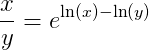
which implies that

C, 30 bytes
float f(float x){return 1./x;}
Bean, 7 6 bytes
Equivalent JavaScript:
(1/A)
Bean xxd-style hexdump:
00000000: 4ca5 3a8e 2043 L¥:. C
Explanation
A is auto-initialized with the 1st input line JSON-parsed. (e.g. 5 is interpreted as JSON and becomes a number), and the program implicitly outputs 1/A.
Edit The "hack" I just realized is that removing the first byte of the AST binary doesn't seem to affect the compilation of the program...
Japt, 2 bytes
The obvious solution would be
1/U
which is, quite literally, 1 / input. However, we can do one better:
pJ
This is equivalent to input ** J, and J is set to -1 by default.
Fun fact: as p is the power function, so q is the root function (p2 = **2, q2 = **(1/2)); this means that qJ will work as well, since -1 == 1/-1, and therefore x**(-1) == x**(1/-1).
Mathematica, 4 bytes
1/#&
Provides you with an exact rational if you give it an exact rational, and with a floating-point result if you give it a floating-point result.
Fortran 95, 23 bytes
function f(x)
f=1/x
end
Python, 12 bytes
lambda x:1/x
One for 13 bytes:
(-1).__rpow__
One for 14 bytes:
1 .__truediv__
Quetzalcoatl, 3 bytes
cfI
c takes input, f converts to a float, and I takes the inverse.
CJam, 4 bytes
1rd/
1     e# Push 1
 rd   e# Push input as a double
   /  e# Divide
Alternate solution:
rdW#

rd    e# Push input as a double
  W   e# Push -1
   #  e# Exponentiation
Ruby, 10 bytes
->x{1.0/x}
Very simple